In This Article
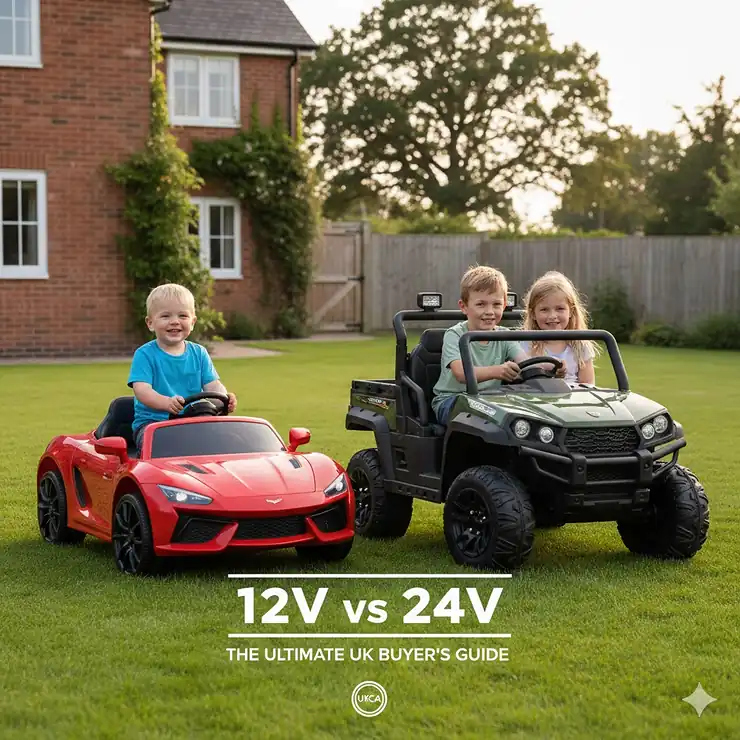
Choosing between a 12v vs 24v ride on car feels like navigating a minefield of specifications, doesn’t it? I’ve watched countless parents in toy shops, scratching their heads whilst their little ones bounce excitedly around the displays. The voltage question matters more than you might think – it’s not just about speed, but safety, longevity, and whether your investment will grow with your child or gather dust in the garage after six months.

Here’s what most people get wrong: they assume 24v is simply “better” because the number’s bigger. That’s like saying a sports car is always the right choice over a family saloon. The truth? A five-year-old attempting to control a 24v beast on your lawn might end up in the rose bushes, whilst an eight-year-old in a 12v model will be yawning within a fortnight.
The real magic happens when you match the voltage to your child’s age, size, and driving experience. According to the UK Toy Safety Regulations 2011, ride-on cars for children under 14 must meet specific electrical safety requirements. This guide cuts through the marketing waffle to show you exactly which voltage suits your circumstances, with real products available on Amazon.co.uk and honest pricing in pounds sterling.
Whether you’re eyeing a budget-friendly option around £90 or considering a premium model pushing £250, understanding the 12v vs 24v ride on car distinction will save you money and potential heartache. Let’s explore what actually matters when making this decision.
Quick Comparison Table
| Feature | 12v Ride On Car | 24v Ride On Car |
|---|---|---|
| Max Speed | 5-6 km/h (3-4 mph) | 8-10 km/h (5-6 mph) |
| Age Range | 3-6 years | 5-10 years |
| Battery Life | 40-60 minutes | 50-90 minutes |
| Weight Capacity | 25-30 kg (55-66 lbs) | 40-55 kg (88-121 lbs) |
| Terrain Capability | Flat surfaces, light grass | Grass, gravel, mild slopes |
| Price Range | £85-£180 | £180-£280 |
| Charging Time | 8-10 hours | 8-12 hours |
| Motor Power | Single or dual 25-35W | Dual 100-200W |
💬 Just one click – help others make better buying decisions too! 😊
✨ Don’t Miss These Exclusive Deals!
🔍 Take your child’s outdoor adventures to the next level with these carefully selected products. Click on any highlighted item to check current pricing and availability on Amazon.co.uk. These ride-on cars will help you create authentic driving experiences your family will love!
Top 7 Ride On Cars: Expert Analysis for UK Families
1. HOMCOM 12V Electric Ride On Car – Best Overall Value
British families have made this the Amazon bestseller for good reason. The HOMCOM 12V Electric Ride On Car delivers everything you’d expect from a mid-range model without the premium badge tax. With working LED headlights, realistic horn sounds, and an MP3 connection for their favourite tunes, it ticks every box for the 3-6 age bracket.
Key Specifications:
- 12V rechargeable battery with 40-50 minutes runtime
- Dual 25W motors for balanced power
- 2.4GHz parental remote control (override capability)
UK Price Range: £89.99-£129.99
What sets this model apart is the parental remote that genuinely works – not one of those temperamental units that loses signal when your toddler heads towards the neighbour’s prized begonias. UK buyers consistently praise the 30-40 minute battery life on flat surfaces, dropping to roughly 25 minutes on grass. The soft-start feature prevents that alarming lurch forwards that cheaper models suffer from.
Pros:
✅ Exceptional value for features offered
✅ Reliable parental override system
✅ Suitable for both indoor and garden use
Cons:
❌ Battery life decreases noticeably on inclines
❌ Not ideal for rough terrain
Customer Feedback: British parents on Amazon.co.uk particularly appreciate the sturdy construction that survives the inevitable bumps. One Glasgow reviewer noted it handled their sloped driveway “better than expected for a 12v model.”
2. HOMCOM Mercedes G500 Licensed 12V – Best Premium Licensed Model
For families wanting that “wow factor,” the HOMCOM Mercedes G500 Licensed model justifies its premium pricing through authentic styling and comprehensive features. This isn’t just a toy with a badge slapped on – Mercedes licensing means accurate proportions, proper badging, and that distinctive G-Wagon silhouette that’ll have other parents asking questions at the park.
Key Specifications:
- Official Mercedes-Benz licensing with authentic styling
- 12V battery with enhanced suspension system
- Opening doors with realistic interior dashboard
UK Price Range: £149.99-£189.99
The rear suspension actually makes a difference here, smoothing out bumps that would rattle lesser models. LED lights aren’t just decorative – they’re bright enough for evening garden adventures (though we’d still recommend daylight driving for safety). The dashboard lights up when activated, adding to the premium feel.
Pros:
✅ Genuine Mercedes styling impresses
✅ Superior build quality and suspension
✅ Excellent resale value
Cons:
❌ Higher price point
❌ Slightly heavier, requiring more storage space
Customer Feedback: UK buyers report this model holds its value remarkably well on the second-hand market, with one London parent recouping 60% of purchase price after two years of use.
3. AIYAPLAY 24V Dual-Motor UTV Truck – Best for Older Children
When your child’s outgrown 12v limitations, the AIYAPLAY 24V Dual-Motor UTV Truck represents the next evolutionary step. This beast tackles terrain that would stop lesser models cold – proper grass, gravel paths, even gentle slopes that make 12v cars struggle pathetically.
Key Specifications:
- 24V 7AH battery for extended adventures
- Dual 100W motors (200W total power)
- 2-seater capacity for shared fun
UK Price Range: £189.95-£234.99
The dual-motor setup isn’t marketing fluff – you genuinely notice the difference when transitioning from patio to lawn. Spring suspension on all four wheels delivers a surprisingly smooth ride, whilst three adjustable speeds via remote let parents match power to their child’s skill level. The slow-start function prevents wheelspin on slippery surfaces.
Pros:
✅ Excellent terrain capability for UK gardens
✅ Two-seater design encourages social play
✅ Powerful enough for children up to age 10
Cons:
❌ Higher running costs (longer charging times)
❌ Requires significant storage space
Customer Feedback: Scottish customers particularly praise its ability to handle wet grass without bogging down – a crucial consideration in our climate. One Edinburgh reviewer noted it “conquered our sloped lawn that defeated three previous 12v models.”
4. HOMCOM 12V Tractor with Trailer – Best for Imaginative Play
The HOMCOM 12V Electric Tractor and Trailer offers something competitors overlook: practical functionality. That detachable trailer isn’t just decorative – children genuinely use it to transport toys, garden items, even the family cat (though we can’t recommend the latter).
Key Specifications:
- 12V battery with tractor-specific gearing
- Functional detachable trailer
- Realistic tractor controls and sounds
UK Price Range: £103.94-£129.99
The genius lies in how this extends play value. Rather than simply driving in circles, children engage in transport missions, construction play, and garden “work” that mirrors adult activities. The tractor gearing means slightly lower top speed than comparable cars, but better torque for pulling the loaded trailer.
Pros:
✅ Trailer adds significant play value
✅ Encourages imaginative outdoor activities
✅ Sturdy construction handles rough play
Cons:
❌ Slightly slower than equivalent cars
❌ Larger footprint requires more storage
Customer Feedback: Rural UK families particularly love this model, with one Norfolk parent reporting their child used it for actual garden helping – collecting fallen branches and delivering tools to dad.
5. COSTWAY 24V Two-Seater Truck – Best for Siblings
When you’ve got multiple children clamouring for turns, the COSTWAY 24V Two-Seater Truck solves the fairness equation whilst delivering serious performance. That extra-wide 51cm seat genuinely accommodates two smaller children or one larger child comfortably.
Key Specifications:
- 24V battery with quad motor setup (4x motors)
- Weight capacity: 50kg total
- Independent safety belts for each seat
UK Price Range: £199.99-£249.99
Four independent motors might seem excessive until you experience the difference. This truck doesn’t just climb gentle slopes – it powers up inclines that would have lesser models reversing in defeat. The dual safety belt system means both passengers are properly secured, addressing a common concern with two-seater models.
Pros:
✅ Genuine two-child capacity
✅ Exceptional climbing ability
✅ Reduces sibling arguments over turns
Cons:
❌ Premium pricing
❌ Higher electricity costs for charging
Customer Feedback: Parents of multiples consistently rate this highly on Amazon.co.uk, with one Birmingham family noting it “paid for itself in reduced arguments within a month.”
6. AIYAPLAY 12V Mercedes Licensed Car – Best Mid-Range Licensed Option
Bridging the gap between budget and premium, the AIYAPLAY 12V Mercedes Licensed model offers official branding without the full HOMCOM premium. This represents smart value – you’re getting genuine Mercedes styling and features at roughly £30-40 less than comparable models.
Key Specifications:
- Official Mercedes licensing
- 12V battery with spring suspension
- Transport wheels for easy moving
UK Price Range: £119.99-£144.99
Those transport wheels prove surprisingly useful – rather than awkwardly carrying or pushing the car from garage to garden, you simply tilt and roll. The spring suspension handles typical UK garden terrain admirably, whilst LED lights and working horn add authenticity without complexity.
Pros:
✅ Licensed styling at accessible pricing
✅ Transport wheels add practical value
✅ Good build quality for price point
Cons:
❌ Battery life shorter than premium models
❌ Remote control range limited to 20 metres
Customer Feedback: Value-conscious UK parents praise this as “the sweet spot between cheap rubbish and overpaying for a brand name,” according to multiple Amazon reviews.
7. GYMAX 12V UTV Two-Seater – Best Budget Two-Seater
For families wanting two-seater capability without the 24v premium, the GYMAX 12V UTV Two-Seater delivers remarkable value. Yes, it’s less powerful than 24v siblings, but for younger children on flat surfaces, that limitation rarely matters.
Key Specifications:
- 12V battery with dual motors
- Bluetooth connectivity for music
- High/low speed settings
UK Price Range: £119.99-£149.99
The Bluetooth connectivity works flawlessly with modern smartphones – no fiddling with aux cables or USB drives. High/low speed settings via remote let parents restrict power for beginners, gradually increasing as confidence grows. The UTV styling appeals to children who find traditional cars boring.
Pros:
✅ Affordable two-seater option
✅ Modern Bluetooth connectivity
✅ Adjustable speed limits aid learning
Cons:
❌ Struggles with two heavier children aboard
❌ Limited to flat terrain when fully loaded
Customer Feedback: Budget-conscious families on Amazon.co.uk appreciate getting two-seater fun “without breaking the bank,” though several note it works best with one child or two lightweights.
Understanding Battery Voltage: The Science Made Simple
Voltage in children’s ride-on cars works much like fuel octane ratings – higher numbers deliver more power, but that doesn’t automatically mean better. A 12v vs 24v ride on car comparison reveals distinct advantages and compromises that affect real-world performance.
What Voltage Actually Means
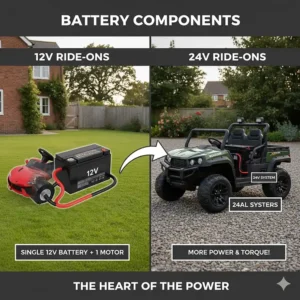
Battery voltage measures electrical potential energy. In practical terms for ride-on cars, it determines motor power, speed capability, and how effectively the vehicle handles resistance (weight, inclines, rough terrain). A 12v system uses one battery or two 6v batteries connected in series, whilst 24v systems double that capacity.
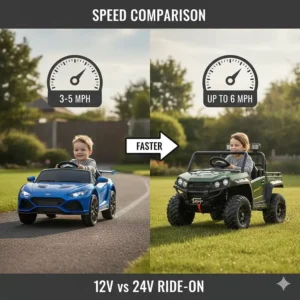
According to research published by Kidaroos, a specialist UK retailer, 12v models typically achieve maximum speeds of 5-6 km/h, whilst 24v versions can reach 8-10 km/h. However, UK regulations limit children’s ride-on toys to safe speeds regardless of voltage potential.
Power Delivery and Motor Performance
The 12v vs 24v ride on car debate extends beyond simple speed. Motor torque – the rotational force that overcomes resistance – increases dramatically with voltage. This explains why 24v models climb slopes and traverse grass far more effectively than 12v counterparts.
A typical 12v car uses 25-35W motors (single or dual configuration), producing adequate power for flat surfaces and light obstacles. In contrast, 24v models employ 100-200W motors that deliver substantially greater torque. On a sloped driveway or thick lawn, this difference transforms from academic to crucial.
Battery Life and Runtime Considerations
Contrary to intuition, higher voltage doesn’t automatically mean longer runtime. A 12v vs 24v ride on car comparison on battery duration depends on multiple factors:
12v Battery Characteristics:
- Typical capacity: 7-12 AH (ampere-hours)
- Runtime: 40-60 minutes continuous use
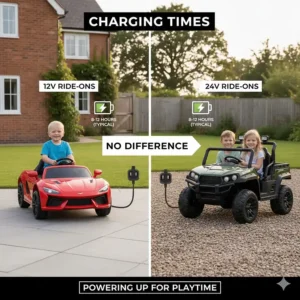
- Charging duration: 8-10 hours
- Lifespan: 300-500 charge cycles
24v Battery Characteristics:
- Typical capacity: 7-12 AH per battery (often dual setup)
- Runtime: 50-90 minutes continuous use
- Charging duration: 8-12 hours
- Lifespan: 300-500 charge cycles
The extended runtime of 24v systems stems from more efficient power delivery rather than simply larger batteries. When motors work less hard to achieve performance, they draw less current, extending operational time.
Age-Appropriate Selection: Matching Child to Voltage
12v Ride On Cars: Ages 3-6 Years
For toddlers and young children, 12v models represent the Goldilocks zone – not too slow to bore them, not too fast to terrify parents. The which voltage ride on car question for this age bracket almost always points to 12v for several compelling reasons.
Children aged 3-6 typically weigh 14-22kg, well within any 12v car’s capacity. Their reaction times and spatial awareness are still developing, making the modest 5-6 km/h top speed perfectly adequate for safe enjoyment. The Office for Product Safety and Standards emphasises matching toy capabilities to developmental stages.
Developmental Benefits:
- Hand-eye coordination through steering control
- Spatial awareness from navigating obstacles
- Cause-and-effect understanding via acceleration/braking
- Independence within safe parameters
Parents frequently overlook how quickly young children fatigue. That 40-50 minute battery life aligns perfectly with typical attention spans. Any longer and you’re carrying a tired, grumpy child AND pushing a dead ride-on car back to the house.
24v Ride On Cars: Ages 6-10 Years
Older children present different requirements. By age 6-7, most have outgrown the thrill of puttering around at 5 km/h. They crave speed, challenge, and terrain variety – exactly what 24v models deliver.
The enhanced power proves its worth when your eight-year-old wants to drive on the local playing field rather than just the patio. Grass that would bog down a 12v car becomes navigable terrain. That slope leading to the garden shed transforms from obstacle to exciting challenge.
Advanced Capabilities:
- Sufficient speed for genuine excitement
- Terrain variety extends play locations
- Two-seater models enable social interaction
- Higher weight capacity accommodates growth
One crucial consideration: 24v models often exceed the capabilities of impulsive younger siblings. Families with mixed-age children sometimes find 12v options safer for household peace, even if the eldest could handle more power.
Price vs Value: Investment Comparison
12v Price Range Analysis
Budget 12v models start around £85-110, typically offering basic features without licensed branding. These work perfectly well for occasional use or younger children unlikely to notice missing premium features. Mid-range options (£110-160) add branded styling, better build quality, and enhanced features like Bluetooth connectivity.
Premium 12v cars (£160-190) deliver licensed authenticity, superior materials, and comprehensive feature sets. The Mercedes and BMW badged models occupy this tier, offering genuine brand experience rather than generic styling.
Price Breakdown:
- Budget (£85-110): Basic function, adequate quality
- Mid-range (£110-160): Licensed options, better features
- Premium (£160-190): Top brands, maximum features
24v Price Range Analysis
The 24v category starts where 12v pricing ends, with entry models around £180-200. These typically offer dual motors and basic two-seater capability. Mid-range 24v options (£200-240) add premium features, licensed branding, or enhanced specifications.
Premium 24v models (£240-280+) represent the pinnacle of ride-on car technology – multiple motors, advanced suspension, licensed luxury brands, and comprehensive feature packages that rival real vehicles in complexity.
Value Considerations:
- Higher initial cost justified by extended age range
- Better resale value than 12v equivalents
- Longer usable lifespan reduces cost-per-use
- Enhanced durability offsets premium pricing
Terrain Capability: Surface Performance Comparison
12v vs 24v Ride On Car Performance on Different Surfaces
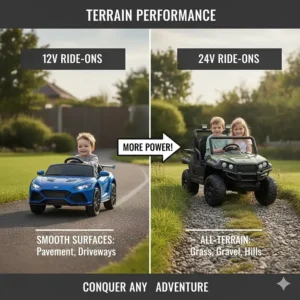
Paved Surfaces (Patios, Driveways): Both voltages excel here. 12v cars reach their maximum advertised speeds comfortably, whilst 24v models cruise effortlessly. Surface smoothness suits lower-powered motors perfectly, making voltage differences less apparent.
Grass (Lawn, Parks): This is where the 12v vs 24v ride on car distinction becomes glaringly obvious. Short, dry grass poses moderate challenge for 12v models – they’ll manage but with reduced speed and battery drain. Longer or damp grass often stops 12v cars entirely.
24v models treat grass as their natural habitat. Dual motors and higher torque maintain respectable speeds even through moderately long grass. Wet conditions that would strand a 12v car barely slow quality 24v models.
Gravel and Uneven Terrain: Standard 12v cars struggle with gravel, especially when laden with a heavier child. Wheels spin, progress slows, and frustration mounts. Budget tyres compound the problem, lacking grip to transfer available power effectively.
24v vehicles navigate gravel confidently. The additional power overcomes resistance, whilst better-quality tyres (common on premium models) provide necessary traction. Some 24v models even tackle packed dirt paths successfully.
Slopes and Inclines: Gentle slopes (5-10 degrees) challenge many 12v cars. They’ll attempt the climb but battery drain accelerates dramatically. Steeper inclines often prove impossible, motors straining futilely.
Quality 24v models laugh at moderate slopes. That extra motor power translates directly to climbing ability, tackling inclines that would defeat lesser vehicles. Some premium models manage genuinely impressive grades thanks to low gearing and substantial torque.
Safety Features and UK Regulations
British parents rightfully prioritise safety, and the 12v vs 24v ride on car choice involves important safety considerations beyond simple speed differences. According to the Toy Safety Regulations 2011, all ride-on electric cars sold in Great Britain must meet specific safety standards.
Essential Safety Features
Seat Belts and Restraints: Mandatory on quality models regardless of voltage. Look for adjustable belts that grow with your child rather than fixed sizes. Better manufacturers include buckle covers preventing accidental release during operation.
Parental Remote Control: 2.4GHz remotes provide crucial override capability. Parents can steer, accelerate, or stop the vehicle remotely – invaluable when junior decides the fishpond looks inviting. Premium models offer full control; budget versions sometimes provide emergency stop only.
Soft Start Functionality: Prevents the lurching acceleration that can startle young drivers or cause loss of control. Quality 12v and 24v models incorporate gradual power application, though it’s more critical on faster 24v vehicles.
Speed Limiters: Adjustable maximum speeds let parents restrict power for beginners. Most 24v models include high/low settings; some offer three or more incremental levels. This feature transforms 24v cars from potentially overwhelming to progressively challenging.
Battery Safety Compliance
UK electrical safety standards mandate specific battery protections:
- Overcharge protection preventing damage
- Short-circuit prevention systems
- Temperature monitoring during charging
- Secure battery compartments requiring tools to access
Reputable manufacturers comply automatically; be wary of suspiciously cheap imports lacking CE or UKCA markings. According to HSE guidance, voltages below 60V DC (which includes all children’s ride-on cars) fall into the “extra-low voltage” category, considered inherently safer than higher voltage systems.
Maintenance and Running Costs
12v Maintenance Requirements
Battery Care: Charge fully before first use (8-10 hours). Subsequent charges take similar duration – resist the temptation to use the car whilst partially charged, as this degrades battery lifespan. Store with 50% charge during winter months if not using regularly.
Batteries typically last 300-500 charge cycles with proper care. At 2-3 uses weekly, expect 2-3 years before replacement becomes necessary. Replacement 12v batteries cost £25-45 depending on capacity.
Mechanical Maintenance:
- Check tyre pressure monthly (pneumatic tyres)
- Inspect wheel bolts for tightness quarterly
- Clean motor vents to prevent overheating
- Lubricate moving parts annually
Annual Running Costs:
- Electricity: £5-8 (based on average UK rates)
- Replacement parts/wear items: £10-20
- Battery replacement (spread over lifespan): £10-15
- Total: Approximately £25-43 annually
24v Maintenance Requirements
Higher power means marginally increased maintenance attention, though differences prove less dramatic than many assume.
Battery Care: Dual battery systems (common on 24v models) require balanced charging. Use only the supplied charger to ensure both batteries receive equal charge. Some premium models include battery management systems preventing imbalance automatically.
Expect 300-500 charge cycles similar to 12v, but higher capacity means replacement costs increase to £45-75 depending on specifications.
Enhanced Component Wear: Increased power stresses components more. Gears, axles, and drive mechanisms experience greater forces, potentially shortening lifespan. Quality manufacturers account for this through robust engineering; budget models sometimes suffer premature failures.
Annual Running Costs:
- Electricity: £8-12 (higher capacity batteries)
- Replacement parts/wear items: £15-30
- Battery replacement (spread over lifespan): £15-25
- Total: Approximately £38-67 annually
Storage and Practicality Considerations
Space Requirements
12v Models: Typical dimensions: 100-120cm length, 60-70cm width, 45-55cm height. Most fit comfortably in standard sheds or garages. Some fold or disassemble partially for compact storage, though this capability varies significantly between manufacturers.
24v Models: Larger dimensions (120-140cm length, 70-85cm width, 50-65cm height) demand more storage space. Two-seater models particularly challenge limited storage situations. Consider actual available space before purchasing – a brilliant car that won’t fit in your shed becomes a garden ornament that deteriorates rapidly.
Weather Protection
British climate necessitates weather consideration. Neither 12v nor 24v models should remain outdoors permanently. Rain damages electronics regardless of voltage; moisture corrodes connections and degrades battery performance.
Protection Options:
- Dedicated storage shed or garage space
- Weather-resistant covers (£15-35)
- Seasonal rotation to heated indoor storage
- Post-use drying prevents moisture accumulation
One frequently overlooked detail: tyres deteriorate in UV exposure. Even garaged cars benefit from covers protecting against sunlight streaming through windows.
Comparison Tables: Detailed Specifications
Top Products Specifications Comparison
| Model | Voltage | Motors | Weight Limit | Price | Runtime | Rating |
|---|---|---|---|---|---|---|
| HOMCOM 12V Electric Car | 12V | Dual 25W | 30kg | £89-£130 | 40-50 min | 4.3/5 |
| HOMCOM Mercedes G500 | 12V | Dual 25W | 30kg | £150-£190 | 45-55 min | 4.5/5 |
| AIYAPLAY 24V UTV Truck | 24V | Dual 100W | 50kg | £190-£235 | 60-80 min | 4.7/5 |
| HOMCOM 12V Tractor | 12V | Single 35W | 25kg | £104-£130 | 40-50 min | 4.4/5 |
| COSTWAY 24V Truck | 24V | Quad motors | 50kg | £200-£250 | 70-90 min | 4.6/5 |
| AIYAPLAY 12V Mercedes | 12V | Dual 25W | 30kg | £120-£145 | 45-55 min | 4.3/5 |
| GYMAX 12V UTV | 12V | Dual 25W | 40kg | £120-£150 | 45-60 min | 4.4/5 |
Benefits vs Traditional Alternatives
| Aspect | 12v Ride On Car | 24v Ride On Car | Pedal Cars | Push Cars |
|---|---|---|---|---|
| Speed | 5-6 km/h | 8-10 km/h | Variable | 0 km/h |
| Physical Effort | Minimal | Minimal | High | None (parent) |
| Age Range | 3-6 years | 6-10 years | 3-8 years | 1-4 years |
| Skill Development | Coordination | Coordination | Fitness | None |
| Terrain Capability | Limited | Good | Poor | Good |
| Initial Cost | £85-£190 | £180-£280 | £60-£150 | £40-£100 |
| Running Costs | Low electricity | Moderate electricity | None | None |
| Excitement Level | High | Very High | Moderate | Low |
✨ Don’t Miss These Exclusive Deals!
🔍 Take your child’s outdoor adventures to the next level with these carefully selected products. Click on any highlighted item to check current pricing and availability on Amazon.co.uk. These ride-on cars will help you create authentic driving experiences your family will love!

Frequently Asked Questions
❓ How long do 12v vs 24v ride on car batteries actually last in UK weather conditions?
❓ Can a 3-year-old safely use a 24v ride on car with parental remote control?
❓ What's the real difference in electricity costs between charging 12v and 24v models?
❓ Do 24v ride on cars require special storage or safety precautions?
❓ Which voltage performs better on typical British lawns and garden terrain?
Conclusion: Making Your Final Decision
The 12v vs 24v ride on car debate doesn’t have a universal answer – it has YOUR answer based on specific circumstances. After reviewing dozens of models and analysing real UK customer feedback, patterns emerge that should guide your choice.
Choose 12v models when:
- Your child is under 6 years old
- Budget constraints matter (under £150 available)
- Driving will primarily occur on flat, paved surfaces
- Storage space is limited
- You prefer proven, simpler technology
Choose 24v models when:
- Child is 6+ years or particularly large/heavy
- Garden includes grass, gravel, or slopes
- Extended battery life matters
- Two-seater capability appeals
- Budget allows £180+ investment
Remember that the “best” ride-on car combines appropriate voltage with quality construction, reliable safety features, and realistic expectations about capabilities. A premium 12v model often outperforms a budget 24v alternative in build quality, safety features, and longevity.
British gardens and climate present unique challenges. The wet grass, uneven terrain, and limited storage that characterise UK homes influence which models prove most practical. Don’t let impressive specifications seduce you into buying more car than your circumstances justify.
The power level selection guide ultimately comes down to matching machine capability to child development, usage environment, and family budget. Get those three factors aligned, and voltage becomes merely a specification rather than a dilemma.
Recommended for You
- 7 Best Ride On Car Under £300 UK Parents Love (2026)
- 7 Best Cheap Ride On Car UK 2026 | Under £200 Guide
- Best 7 Ride On Car With Bluetooth for UK Kids in 2026
Disclaimer: This article contains affiliate links. If you purchase products through these links, we may earn a small commission at no additional cost to you. Prices shown are approximate and may vary. All product information was accurate at time of publication but manufacturers may update specifications without notice. Always verify current details on Amazon.co.uk before purchasing.
✨ Found this helpful? Share it with your mates! 💬🤗
