In This Article
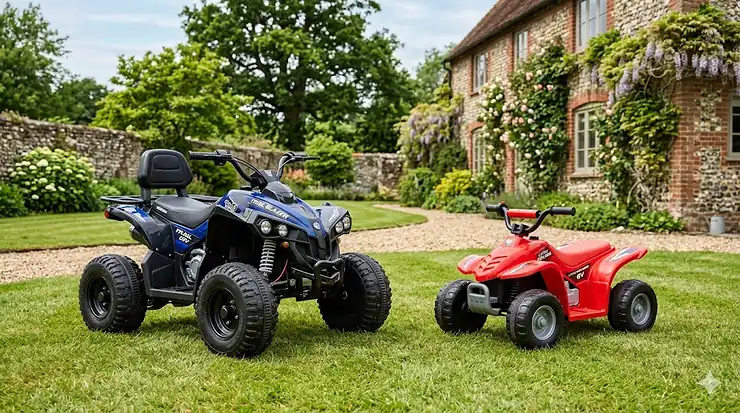
Choosing between a 12v vs 6v quad bike can feel overwhelming when you’re standing in the toy aisle or scrolling through Amazon. I’ve been there myself, wondering whether that extra voltage actually matters or if it’s just marketing fluff. Here’s the truth: voltage isn’t just a number on the box—it fundamentally changes how your child experiences their electric quad bike.
The power difference between these two options affects everything from how fast your toddler zooms across the patio to whether they can tackle that slight slope in your back garden. A 6v model might putter along at a gentle 2-3 km/h (perfect for nervous first-timers), whilst a 12v variant can reach 4-6 km/h, giving older children that thrilling sense of speed they crave. But speed isn’t the whole story—terrain capability, battery life, safety features, and price all shift dramatically based on your voltage selection.
In this comprehensive guide, we’ll explore real products available on Amazon.co.uk, decode UK safety regulations, and help you determine which voltage quad bike to buy for your specific situation. Whether you’re shopping for a cautious 2-year-old or an adventurous 5-year-old, you’ll walk away knowing exactly what suits your family’s needs.
Quick Comparison Table
| Feature | 6V Quad Bike | 12V Quad Bike |
|---|---|---|
| Recommended Age | 18 months – 3 years | 3 – 8 years |
| Top Speed | 2-3 km/h (1.2-1.8 mph) | 4-6 km/h (2.5-3.7 mph) |
| Terrain Capability | Flat surfaces, pavements, tiled floors | Grass, gravel, slight inclines |
| Run Time | 40-60 minutes | 45-90 minutes |
| Charging Time | 6-10 hours (18 hours initial) | 12-18 hours (18 hours initial) |
| Price Range (UK) | £40-£70 | £70-£140 |
| Typical Motors | Single motor | Single or twin motors |
| Weight Capacity | 20-25 kg | 25-30 kg |
| Best Use | Indoor/outdoor smooth surfaces | Outdoor adventures, varied terrain |
✨ Just one click – help others make better buying decisions too!😊
Top 7 Quad Bikes: Expert Analysis
1. AIYAPLAY 6V Electric Quad Bike for Kids (Ages 2-6)
This entry-level quad from AIYAPLAY offers brilliant value for parents testing the waters with electric ride-ons. The compact black design features handlebar steering, LED lights, and three pre-loaded music tracks that’ll have your toddler grinning from ear to ear.
Key Specifications:
- 6V rechargeable battery with UK charger included
- Maximum speed: 2.5 km/h
- Suitable surfaces: asphalt, brick, cement
UK customers consistently praise its straightforward assembly process—most parents report getting it ready in under 30 minutes. The gentle speed makes it ideal for nervous riders, though some reviewers note that adventurous 4-year-olds quickly outgrow the limited power.
Price: £45-£60
✅ Pros: Budget-friendly, easy assembly, perfect beginner speed
✅ Music feature keeps little ones entertained
✅ Robust construction for the price point
❌ Cons: Limited terrain capability
❌ Outgrown quickly by confident riders
2. Evo Electric Venom Racer Mini Quad 6V (Green & Black)
The Evo Venom brings sporty styling to the 6v category with its eye-catching green and black finish. This model stands out for its slightly higher build quality compared to budget alternatives, featuring textured tyres and a comfortable seat design.
Key Specifications:
- 6V rechargeable battery (40-minute run time)
- Maximum rider weight: 25 kg
- Product dimensions: H39.5 x W36 x D62 cm
Argos and Amazon UK stock this model regularly, and British parents appreciate the UK-based customer support from HTI (the parent company). The throttle-driven acceleration gives children excellent control, whilst footrests add an authentic quad bike feel.
Price: £50-£70
✅ Pros: Attractive design appeals to boys and girls
✅ Decent 40-minute battery life
✅ UK company with responsive support
❌ Cons: Plastic wheels limit grip on wet surfaces
❌ No reverse function
3. HOMCOM 12V Electric Quad Bike (Multiple Colours)
Stepping up to 12v territory, this HOMCOM model represents the sweet spot for most UK families. Available in green, white, yellow, pink, and red, it combines adequate power with reasonable pricing. The twin motors deliver smooth acceleration, whilst the USB and MP3 ports let children soundtrack their adventures.
Key Specifications:
- 12V dual motors, 50-minute run time
- Two speed settings: 2 km/h and 4 km/h
- LED headlights, music player, horn
- Wear-resistant wheels for multiple surfaces
Customer reviews from Amazon.co.uk highlight the impressive battery longevity—some parents report 2+ hours on gentler terrain. The high/low speed toggle gives you flexibility as your child’s confidence grows, and the soft handles ensure comfortable gripping during longer play sessions.
Price: £75-£95
✅ Pros: Excellent value for 12v power
✅ Handles grass and gravel competently
✅ Wide colour selection
❌ Cons: Assembly instructions could be clearer
❌ Charging cable reports mixed (some units shipped with faulty chargers)
4. GYMAX Kids Electric Quad Bike 12V (With Bluetooth)
GYMAX elevates the 12v experience with modern connectivity features. The Bluetooth integration allows wireless music streaming from your phone, whilst the slow-start function prevents those alarming wheel spins that can frighten younger riders.
Key Specifications:
- 12V battery with soft-start technology
- Bluetooth connectivity for music
- High/low speed modes
- LED lights and realistic horn sounds
UK buyers particularly value the slow-start feature, which gradually builds speed rather than lurching forward. This makes it suitable for 3-year-olds transitioning from 6v models. The build quality feels substantial—several Amazon reviews mention it surviving enthusiastic 5-year-olds without issue.
Price: £90-£120
✅ Pros: Bluetooth adds contemporary appeal
✅ Soft-start technology reduces accidents
✅ Sturdy construction withstands rough play
❌ Cons: Premium pricing
❌ Bluetooth setup occasionally temperamental
5. KALCO TOYS UK 12V Quad Bike (Black/Blue/Pink)
This British-branded quad emphasises robust construction with its metal axles and hard-wearing plastic shell. The dual-speed functionality (slow for beginners, fast for confident riders) makes it a quad that genuinely grows with your child.
Key Specifications:
- 12V 7AH rechargeable battery
- Top speed: approximately 5-6 km/h
- Forward and reverse gears
- Working front lights, ignition sound effects
- Maximum weight capacity: 30 kg
Customer feedback from Amazon UK consistently rates the build quality as exceptional. Parents appreciate that it handles British weather surprisingly well—the robust tyres and sealed battery compartment mean occasional drizzle won’t end playtime prematurely.
Price: £85-£110
✅ Pros: Excellent build quality for UK conditions
✅ Reverse gear adds functionality
✅ Higher weight limit extends usability
❌ Cons: Assembly requires patience (60-90 minutes)
❌ Slightly bulkier for storage

6. Maxmass 12V Electric Quad Bike (Black/Blue/Pink)
Maxmass competes aggressively on features, packing LED lights, Bluetooth connectivity, music player, and a storage basket into their 12v platform. The slow-start mechanism prevents wheelspin, making it genuinely suitable for the younger end of the 3-7 age bracket.
Key Specifications:
- 12V battery with USB/MP3/TF card support
- Bluetooth music streaming
- LED headlights and rear lights
- Storage basket for toys
Amazon UK customers report mixed experiences with speed—some find the “fast” mode disappointingly slow (comparable to a brisk adult walk), whilst others appreciate the conservative speed for safety. The variety of entertainment options (Bluetooth, USB, radio) definitely keeps children engaged during longer outdoor sessions.
Price: £80-£115
✅ Pros: Feature-packed for the price
✅ Storage basket practical for outdoor play
✅ Multiple music input options
❌ Cons: Top speed underwhelms some buyers
❌ Occasional Bluetooth connectivity issues
7. COSTWAY 12V Electric Kids Quad Bike (Multiple Colours)
COSTWAY’s offering rounds out our top picks with a well-balanced 12v quad that doesn’t break the bank. The inclusion of an MP3 player, storage basket, and forward/backward functions makes it feel premium without the premium price tag.
Key Specifications:
- 12V battery system
- MP3 player with headlight integration
- Forward and reverse functions
- Storage basket
- Suitable for ages 3-8 years
UK reviewers on Amazon consistently mention the straightforward assembly and reliable battery performance. Whilst it lacks Bluetooth connectivity, the built-in music player works dependably, and the storage basket proves surprisingly useful for transporting toys between indoor and outdoor play areas.
Price: £75-£100
✅ Pros: Excellent price-to-feature ratio
✅ Reliable battery performance
✅ Storage basket adds practicality
❌ Cons: No Bluetooth (uses built-in MP3 only)
❌ Slightly narrower seat than competitors
✨ Don’t Miss These Exclusive Deals!
🔍 Take your child’s outdoor play to the next level with these carefully selected products. Click on any highlighted quad bike to check current pricing and availability on Amazon.co.uk. These quads will help you create authentic outdoor adventures your children will cherish!
Understanding Voltage: What It Actually Means for Your Child
Let’s demystify the “V” in 6v and 12v. Voltage measures electrical potential—essentially, the force pushing electrons through the quad bike’s motor. Higher voltage doesn’t simply mean “better”; it means different performance characteristics suited to different ages and abilities.
Power Output Explained
A 6v system delivers gentler acceleration and lower top speeds, perfect for developing spatial awareness without overwhelming nervous toddlers. The reduced power also means less strain on young muscles learning to steer and control the vehicle. Think of it as training wheels for the electric ride-on world.
Conversely, a 12v system doubles the electrical potential, resulting in stronger motors that can overcome resistance from grass, gravel, and gentle slopes. This increased power translates to faster speeds (4-6 km/h versus 2-3 km/h) and the ability to carry slightly heavier riders without performance degradation.
According to research on battery-powered toys, the voltage directly correlates with motor efficiency across varied terrains. A 6v quad struggling up even a modest incline will drain its battery rapidly, whilst a 12v model tackles the same challenge with power to spare.
Age-Appropriate Voltage Selection
The question “6v or 12v better for 5 year old” appears frequently in UK parenting forums, and the answer isn’t straightforward. A cautious 5-year-old transitioning from a balance bike might genuinely prefer the controlled pace of a quality 6v model. However, most 5-year-olds possess the coordination and confidence to handle 12v power safely—especially models with dual-speed settings.
UK safety guidelines from organisations like RoSPA emphasise matching the toy’s capabilities to the child’s developmental stage rather than rigidly following age brackets. A mature 3-year-old might thrive on a slow-mode 12v quad, whilst an impulsive 4-year-old could benefit from the inherent limitations of 6v power.
Speed and Performance: Real-World Differences
Maximum Speed Capabilities
Let’s talk actual numbers you’ll experience in your garden. A 6v quad bike typically tops out at 2-3 km/h (roughly 1.2-1.8 mph)—slower than an adult’s walking pace. You can comfortably stroll alongside your toddler, intervening instantly if they head towards flower beds or the neighbour’s cat.
The 12v category varies more widely, with speeds ranging from 4-6 km/h (2.5-3.7 mph) depending on the specific model and whether you’ve selected low or high gear. At 6 km/h, you’re approaching a light jogging pace, which means you’ll need to pay closer attention but can still supervise effectively.
Interestingly, British parents on Mumsnet forums often mention that perceived speed matters as much as actual speed. A 6v quad on a patio feels adequately quick to a 2-year-old, whilst the same child on a 12v model experiences genuine excitement from the increased acceleration, even though the actual speed difference might only be 2-3 km/h.
Terrain Capability Comparison
Here’s where the power difference truly shines. A 6v quad bike performs admirably on:
- Hard pavements
- Tiled patios
- Indoor flooring (hardwood, laminate)
- Smooth concrete
Venture onto grass or gravel, and 6v models struggle noticeably. The motor strains, battery drains faster, and your child’s frustration grows as they repeatedly get stuck or slow to a crawl.
A 12v quad bike expands your terrain options significantly:
- Short-to-medium grass (under 10 cm height)
- Gravel driveways
- Gentle slopes (up to 5-10 degrees)
- Hard-packed dirt paths
- Everything a 6v model can handle
Several Amazon UK reviewers specifically mention purchasing 12v models after their 6v quads proved useless on the family’s grass lawn. The upgrade from 6v to 12v quad essentially unlocks your entire garden rather than restricting play to paved areas.

Battery Life and Charging Considerations
Runtime Reality Check
Manufacturers’ claims about battery life should be taken with a generous pinch of salt. Official specs often quote 45-90 minutes, but real-world UK usage patterns reveal more nuanced performance.
For 6v models:
- Flat surfaces: 40-60 minutes typical
- Grass/gravel: 20-30 minutes (motor works harder)
- Mixed terrain: 30-45 minutes average
For 12v models:
- Flat surfaces: 50-90 minutes typical
- Grass/gravel: 35-60 minutes
- Mixed terrain: 45-75 minutes average
Child weight dramatically affects these figures. A petite 2-year-old (12 kg) will extract maximum runtime, whilst a sturdy 6-year-old (22 kg) will drain batteries noticeably faster. Temperature also plays a role—British winter conditions (below 5°C) can reduce battery capacity by 15-20% compared to summer performance.
Charging Time Requirements
This aspect frustrates many UK parents, so set realistic expectations. Both 6v and 12v quad bikes require lengthy initial charges:
First charge: 18 hours (yes, really)
Subsequent charges: 6-12 hours depending on voltage
The 18-hour initial charge allows the battery to reach full capacity and establish proper chemical formation. Skipping this step (which many impatient parents do) can permanently reduce battery longevity.
For ongoing maintenance, charge the quad bike overnight after each use rather than waiting until the battery completely dies. Lithium-based batteries (found in premium models) don’t suffer from “memory effect,” so partial charging won’t harm them. Older lead-acid batteries benefit from complete discharge cycles occasionally, but most modern UK-market quads use sealed lead-acid batteries that tolerate partial charging reasonably well.
Top tip from UK parents: Keep a charging schedule chart on your fridge. Mark which day the quad was last charged, preventing those disappointing “Sorry darling, it needs charging” moments when your child’s desperate to ride.
Safety Features and UK Regulations
Legal Requirements for Private Land Use
Here’s something many UK parents don’t realise: children’s electric quad bikes cannot legally be used on public roads, pavements, or council-owned parks—regardless of voltage. The Road Traffic Act 1988 classifies these vehicles as motor vehicles, yet they don’t meet road safety standards required for legal operation.
According to guidance from the UK police, kids’ quad bikes and ATVs are strictly for private land only. This means your garden, a friend’s garden (with permission), or designated private riding areas. Riding on public footpaths or parks could technically result in the vehicle being seized, though in practice, police tend to issue warnings for children’s toy quads rather than penalties.
The Toys (Safety) Regulations 2011 govern electric ride-ons for children under 14. These regulations mandate that quads sold in the UK must display either CE or UKCA marking, confirming they meet electrical safety requirements, chemical safety standards, and appropriate warning label provisions.
Essential Safety Gear
Whilst UK law doesn’t mandate protective equipment for private land use, responsible parents should equip children with:
🛡️ Helmet: ECE 22.05 or DOT-approved, properly fitted
🛡️ Knee pads: Cushioned protection for inevitable tumbles
🛡️ Elbow pads: Reduces scrapes during learning phase
🛡️ Closed-toe shoes: Sturdy trainers minimum; avoid sandals entirely
Helmets prove particularly crucial for 12v models where speeds reach 5-6 km/h. At these velocities, a sudden stop or collision with a garden obstacle can result in injury. British parents on forums like Netmums frequently share stories of minor accidents that could have been worse without proper head protection.
Built-In Safety Features to Look For
Modern quad bikes incorporate various safety mechanisms:
Parental remote control: Some 12v models include 2.4GHz remotes allowing parents to override children’s steering and speed—brilliant for nervous first outings.
Soft-start technology: Gradually builds speed rather than lurching forward, preventing wheelspin and loss of control. Particularly valuable for age appropriate voltage matching when a young rider uses a 12v model.
Automatic braking: When the foot pedal releases, the quad stops rather than coasting. This prevents runaway incidents on slopes.
Speed limiters: Adjustable maximum speed settings let you restrict top speed as children build confidence.
Seatbelts: Surprisingly, many budget models omit these. Prioritise quads with functioning lap belts, especially for younger riders.
Cost Analysis: 6v vs 12v Investment
Initial Purchase Price Comparison
Budget constraints influence every family’s decision, so let’s examine realistic UK pricing from Amazon.co.uk and major retailers:
6V Quad Bikes:
- Budget tier: £40-£55 (basic models, limited features)
- Mid-range: £55-£70 (branded options, better build quality)
- Premium 6v: £70-£85 (rare, usually licensed characters)
12V Quad Bikes:
- Budget tier: £70-£90 (single motor, basic features)
- Mid-range: £90-£120 (dual motors, music, lights)
- Premium 12v: £120-£150+ (Bluetooth, remote control, superior build)
The price difference between equivalent-quality 6v and 12v models typically hovers around £30-£40. That might feel substantial when you’re shopping, but consider the longevity factor.
Long-Term Value Proposition
A well-chosen 12v quad bike often represents better value despite higher initial cost. Here’s why:
Usability window:
- 6v model: 18 months to 3-4 years (roughly 2 years)
- 12v model: 3 years to 7-8 years (potentially 4-5 years)
If your child receives a 6v quad at age 2, they’ll likely outgrow it by age 4, prompting either an upgrade purchase or disappointing them with an underpowered toy. Purchasing a 12v model with dual-speed settings at age 3 means they can enjoy it until age 7-8, delivering far more usage hours per pound spent.
Battery replacement costs:
- 6v replacement battery: £12-£18
- 12v replacement battery: £18-£28
You’ll replace batteries every 12-24 months depending on usage intensity. Over a quad bike’s lifetime, this adds £20-£40 to your total investment—roughly equal for both voltage categories relative to their usage periods.
Resale value:
- 6v models: Limited demand, typically £15-£25 on Facebook Marketplace
- 12v models: Stronger market, £35-£60 resale common for well-maintained units
The premium features and longer usability of 12v quad bikes preserve value better. You’ll recoup a higher percentage of your initial investment when your child eventually outgrows the toy.
Making the Decision: Which Voltage Suits Your Family?
Choose a 6V Quad Bike If…
✅ Your child is under 3 years old
✅ Budget constraints favour lower initial investment (under £60)
✅ You have only paved surfaces or indoor space available
✅ Your child shows nervousness around moving toys
✅ You want the absolute safest, slowest option
✅ Temporary use is fine—you’re comfortable upgrading in 12-18 months
Choose a 12V Quad Bike If…
✅ Your child is 3 years or older
✅ You have grass lawns or varied terrain in your garden
✅ Long-term value matters more than minimising upfront cost
✅ Your child has outgrown basic ride-on toys
✅ You want a quad bike that grows with their abilities
✅ Multiple children might use it across age ranges
The “Goldilocks” Solution
Many UK families discover the sweet spot: a 12v quad bike with adjustable speed settings purchased for a mature 3-year-old. Set it to low speed initially (matching 6v performance), then unlock full power as confidence grows. This approach delivers maximum flexibility and value.
Brands like HOMCOM and GYMAX specifically design their 12v models with this progression in mind, offering distinct “slow” and “fast” modes accessible via simple toggle switches. Parents rave about this feature on Amazon UK reviews, noting it eliminates the need for separate purchases as children develop.
Maintenance and Longevity Tips
Battery Care for UK Conditions
British weather poses unique challenges for battery-powered toys. Moisture, temperature fluctuations, and damp conditions can shorten battery life significantly if you don’t take precautions.
Storage protocols:
- Store quad indoors (garage, shed, conservatory) when not in use
- Never leave batteries to freeze in unheated outbuildings—temperatures below 0°C damage cells
- Charge batteries at room temperature (15-25°C) for optimal performance
- If storing long-term (winter months), charge battery to 50-60% and disconnect
Cleaning and weatherproofing:
- Wipe down after grass use to remove moisture and clippings
- Check battery compartment seals regularly—replace if perished
- Apply silicone spray to moving parts annually
- Avoid pressure washers—hand wash only with damp cloth
Tyre Maintenance
Plastic tyres on most budget quads require minimal maintenance but can become slippery when worn smooth. Check tread depth every few months, especially on 12v models used on varied terrain. Some parents report success roughening smooth tyres with coarse sandpaper to restore grip—a simple hack that extends tyre life.
Pneumatic (air-filled) tyres on premium models need regular pressure checks. Under-inflation causes sluggish performance and premature wear, whilst over-inflation creates harsh rides and blowout risk.
Electrical System Checks
Every 6 months, inspect:
- Wiring connections for corrosion (especially battery terminals)
- Motor brushes for wear (replace when under 5mm long)
- Fuses and circuit protection (carry spares)
- Charger functionality (test with multimeter if uncertain)
UK parents report that proactive maintenance extends quad bike lifespans from the typical 2-3 years to 4-5+ years, dramatically improving the value proposition.
Common Problems and Solutions
“The Quad Won’t Start”
Possible causes:
- Dead battery (most common)—charge for recommended duration
- Loose battery connection—tighten terminals
- Blown fuse—locate and replace (check owner’s manual)
- Faulty power switch—test continuity with multimeter
UK parent fix: Several Amazon reviewers mention that simply disconnecting and reconnecting the battery resolves 80% of starting issues. The vibration from use can gradually loosen connections.
“Battery Drains Too Quickly”
Possible causes:
- Battery nearing end of life (typically 12-24 months)
- Cold weather operation reducing capacity
- Overweight rider exceeding specifications
- Steep terrain or long grass overworking motor
Solutions: Replace battery if over 18 months old, restrict use to appropriate terrain, ensure rider weight stays within limits. Some enterprising UK parents on MoneySavingExpert forums discuss battery upgrade quad modifications, though this risks motor damage and voids warranties.
“One Wheel Won’t Turn”
Possible causes:
- Debris jamming wheel mechanism
- Motor failure (one motor in twin-motor systems)
- Broken drive shaft or gearing
Solutions: Remove wheel and clear debris, test motor directly (bypass switch), inspect gears for damage. This repair often exceeds the vehicle’s value on budget models—consider replacement rather than professional repair.
Upgrade Possibilities and Modifications
Can You Upgrade From 6V to 12V?
This question appears constantly in UK parenting forums, and the answer disappoints many: you shouldn’t upgrade from 6v to 12v quad by simply swapping batteries.
The motor, speed controller, wiring, and fuses in a 6v quad are designed for 6v current. Installing a 12v battery will:
- Burn out the motor almost immediately
- Melt wiring insulation creating fire risk
- Void any manufacturer warranty
- Potentially injure your child through electrical failure
Theoretically, you could replace the motor, controller, wiring, and fuses to handle 12v power—but the cost approaches purchasing a purpose-built 12v quad. Save yourself the hassle and potential danger.
Safe Modifications UK Parents Make
Acceptable upgrades:
- Better tyres with improved tread patterns
- LED light upgrades (within voltage specifications)
- Cushioned seat covers for comfort
- Storage basket additions
- Decorative decals and personalisation
Avoid entirely:
- Voltage modifications (battery swaps)
- Motor replacement without expertise
- Removing safety features (speed limiters, fuses)
- Modifications affecting weight distribution or stability
Environmental Considerations
Battery Disposal Regulations
UK law prohibits throwing batteries in regular rubbish. The Waste Batteries and Accumulators Regulations 2009 require proper recycling through designated collection points.
Most local councils operate battery recycling schemes—check your authority’s website. Major retailers like Argos, Currys, and Tesco offer in-store battery collection points. Ensure terminals are taped before disposal to prevent short circuits.
Eco-Friendliness Comparison
Electric quad bikes inherently offer environmental advantages over petrol alternatives:
- Zero emissions during operation
- Quieter (important in residential areas)
- No fuel storage or spillage risks
However, battery production carries environmental costs. A 12v battery has roughly twice the environmental impact during manufacture compared to a 6v unit, though this is offset by longer usable lifespan. Choosing quality models that last 4-5 years rather than disposable toys replaced annually significantly reduces overall environmental impact.
Frequently Asked Questions
❓ How fast can a 12v quad bike go in the UK?
❓ Can I use a 6v quad bike on grass?
❓ What's the best age for upgrading from a 6v to a 12v quad?
❓ How long do quad bike batteries last before needing replacement?
❓ Are 12v quad bikes safe for 3-year-olds?
Conclusion: Making Your Final Decision
The 12v vs 6v quad bike debate ultimately centres on matching voltage to your child’s current abilities whilst considering future growth. For most UK families with children aged 3 and above, the versatility, terrain capability, and longevity of a 12v model justifies the £30-£40 premium over 6v alternatives.
However, if you’re shopping for a cautious 2-year-old taking their first tentative steps into powered toys, a quality 6v quad offers appropriate speed limitations and genuine value. The key lies in honest assessment: are you buying for right now, or investing in multiple years of outdoor play?
Consider your specific circumstances: garden terrain, budget flexibility, number of children who might use the quad, and storage capabilities. A 12v quad with adjustable speeds essentially gives you the best of both worlds—6v gentleness when needed, 12v power as confidence blooms.
Whatever you choose, prioritise safety through proper protective gear, active supervision, and maintaining the quad according to manufacturer guidelines. British gardens provide wonderful opportunities for outdoor play, and electric quad bikes—whether 6v or 12v—create memories that outlast the toys themselves.
Take your time researching, read UK-specific customer reviews on Amazon.co.uk, and trust your parental instincts about which voltage quad bike to buy. Your child’s delighted squeals as they zoom across the patio will confirm you made the right choice.
Recommended for You
- 7 Best 12V Quad Bikes UK 2026: Expert Reviews & Buying Guide
- 7 Best 6v Quad Bike for Toddlers UK 2026
- 7 Best 4×4 UTV for Kids: 2026 UK
Disclaimer: This article contains affiliate links. If you purchase products through these links, we may earn a small commission at no additional cost to you. Prices shown are approximate and may vary. All product information was accurate at time of publication but manufacturers may update specifications without notice.
✨ Found this helpful? Share it with your mates! 💬🤗
