
In This Article
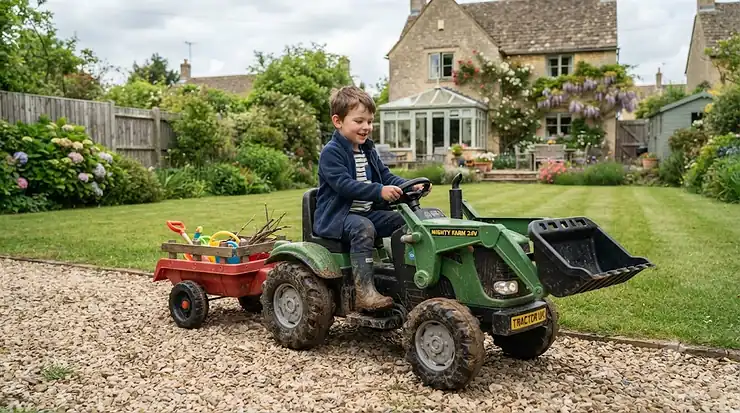
There’s a particular kind of silence that falls over a garden when a seven-year-old realises the 12V car they got at four now crawls along like it’s stuck in treacle. You know the one. The kid’s outgrown the toy, the toy hasn’t outgrown its price tag, and everyone’s a bit deflated. This is exactly the gap a 24v ride on tractor is built to fill.

Twice the voltage of the entry-level ride-ons sounds like a small technical footnote, but in practice it’s the difference between a toy that trundles across a flat patio and one that can genuinely climb a slope, tow a loaded trailer, and carry a nine-year-old without the motor groaning in protest. For families with bigger kids, or two children fighting over the same seat, that extra headroom changes what’s actually possible in the back garden.
This guide focuses on real, currently available 24V ride-on tractors sold to UK shoppers, spanning budget-friendly imports through to properly engineered premium machines. We’ll walk through seven genuine models, compare their motors, batteries, weight limits and trailer options honestly, and dig into the practical questions parents actually ask: is it safe, is it worth upgrading from 12V, and which one will still be fun in eighteen months rather than gathering dust by August. Outdoor, physically active play like this also lines up neatly with the NHS’s recommendation that children get at least an hour of moderate-to-vigorous activity most days — reason enough to take the decision seriously rather than grabbing whatever’s cheapest on page one.
By the end, you’ll know exactly what 24V buys you, which of these seven tractors suits your child’s age, size and garden, and how to dodge the buying mistakes that leave a fun toy stuck in the shed by autumn.
Quick Comparison Table
| Tractor | Motor / Battery | Approx. Top Speed | Trailer Included | Best For |
|---|---|---|---|---|
| Peg Perego Gaucho XP 480W 2 Seat 24V | 480W motor, 24V battery | up to ~8 km/h | No | Premium two-seat off-road play |
| Kids Ride On New Holland 24V Power Sit-In Tractor | Dual motor, 24V | ~6-7 km/h | No | Officially licensed farm role-play |
| Costway 24V Ride On Tractor with Detachable Trailer | Dual 50W motors, 24V/9Ah | ~3.2-6.8 km/h | Yes | Best all-round value |
| Kidsera 24V Ride On Tractor with Trailer & Front Loader | Dual motor, 4-gear, 24V | Varies by gear | Yes | Hands-on digging and hauling |
| Kids Blue 24V High Spec Agri-Power Ride-On Tractor & Trailer | 24V dual motor | ~6-8 km/h | Yes | Mid-range family favourite |
| Kids 24V Battery Powered Tractor Digger with Grabber & Trailer | 24V dual motor | ~6 km/h | Yes | Construction-mad kids |
| Green 6×4 24V Ride On ATV Tractor with Tipping Back & Leather Seats | 24V, 6-wheel drive | ~6-8 km/h | Tipping bed | Bigger kids upgrading from 12V |
Even at a glance, the spread here is wide. The Peg Perego Gaucho XP 480W 2 Seat 24V sits in a different league entirely, built more like a genuine off-road kids’ vehicle than a toy, while the Costway 24V Ride On Tractor with Detachable Trailer and Kidsera 24V Ride On Tractor with Trailer & Front Loader are aimed squarely at families who want strong 24V performance without a premium price tag attached. Notice, too, that trailers aren’t universal — if towing and hauling is the whole point for your child, that column matters more than the horsepower figures.
💬 Just one click — help others make better buying decisions too!😊
Top 7 24v Ride On Tractors: Expert Analysis
Picking seven products for this list wasn’t about finding the flashiest listings — it was about finding genuinely available 24V machines that cover the realistic spread of what UK parents are actually choosing between: budget dual-motor imports, licensed farm-brand tractors, and a proper premium off-roader at the top. Here’s the honest breakdown of each.
1. Peg Perego Gaucho XP 480W 2 Seat 24V — best premium off-road two-seater
Peg Perego has built its reputation on being one of the few ride-on brands that genuinely over-engineers its products relative to the toy market average, and the Gaucho XP is the clearest expression of that in their 24V line-up. The 480W motor is roughly four to nine times more powerful than the small 35-50W motors found in budget imports, and it shows the moment the wheels hit grass or a gentle incline.
What most buyers overlook about this model is that the extra power isn’t really about top speed — UK-market Peg Perego vehicles are typically speed-limited for safety regardless of motor size — it’s about torque under load. Two children on board, a bumpy lawn, and a slight slope is exactly the scenario where a weaker motor stalls and a 480W unit just keeps going. This is a machine built for households with more than one child, older siblings who still want in on the fun, or a large, uneven garden that would defeat a budget tractor within a season.
Aggregated review sentiment for Peg Perego’s premium ride-on range consistently highlights build quality and longevity as the standout strengths, with the trade-off being a noticeably higher price point than generic imports — a pattern that holds across most of their electric vehicle range rather than being specific to one batch of reviews.
Pros:
- ✅ Genuinely powerful 480W motor handles slopes and two riders
- ✅ Two-seat design suits siblings or a parent-assisted ride
- ✅ Reputation for durability well beyond typical toy lifespans
Cons:
- ❌ Sits at the top of the price range for this category
- ❌ Bulkier footprint needs a reasonably sized garden or drive
At the time of research, expect this model to sit in the premium bracket, often several hundred pounds above the budget imports on this list — check current price before buying, as premium ride-ons see genuine seasonal promotions. For families who plan to keep one tractor for years rather than replace it, the value case stacks up better than the sticker price suggests.
2. Kids Ride On New Holland 24V Power Sit-In Tractor — best for officially licensed farm realism
There’s a meaningful difference between a generic “tractor-shaped” ride-on and one that’s actually licensed by a real agricultural brand, and this New Holland model falls into the latter category. For kids who are properly into farming — tractors at shows, toy John Deere sets, watching the neighbour cut silage — the branding accuracy genuinely matters to the play experience in a way that’s easy for adults to underestimate.
Under the bonnet, so to speak, it runs dual motors on a 24V system, which puts it comfortably ahead of the 12V sit-in tractors that dominate the under-6 market. The sit-in cab design, rather than an open frame, also means better wind and weather protection than open-frame alternatives, plus a more “real vehicle” feel that appeals to kids who’ve moved past open ride-on cars.
Reviewers of licensed sit-in tractors in this category tend to flag the driving experience and detailing (working horn, lights, engine sound effects) as the strongest selling point, while noting that — as with most sit-in cab designs — getting a bigger child in and out comfortably needs a slightly wider door aperture than some expect from photos alone.
Pros:
- ✅ Genuine New Holland licensing adds authentic farm detailing
- ✅ Sit-in cab gives better weather and impact protection
- ✅ Dual 24V motors outperform standard 12V sit-in tractors
Cons:
- ❌ No trailer included as standard — sold separately in most listings
- ❌ Enclosed cab design suits a narrower age/height range than open tractors
Prices for licensed 24V sit-in tractors typically fall in the mid-to-upper range for this category; always check current price and confirm trailer compatibility before ordering, since accessory fit varies between production runs.
3. Costway 24V Ride On Tractor with Detachable Trailer — best all-round value pick
This is the tractor that most consistently balances genuine 24V performance against a price that doesn’t require a small negotiation with your bank balance. The spec sheet is refreshingly specific for a budget-tier product: dual 50W motors, a 24V/9Ah rechargeable battery, and a documented top speed range of roughly 2 to 3.7 mph across its speed settings — figures Costway publishes rather than leaves vague, which is worth something in a market full of rounded-up marketing numbers.
What that spec actually means in practice: the dual-motor layout gives noticeably better traction on grass and gravel than single-motor 12V units, because power is split across both drive wheels rather than relying on one motor to do all the work. The 15-degree slope rating and slow-start function are the kind of detail that separates a toy built for tarmac from one built for an actual British garden, which is rarely flat.
The dual control system — foot pedal and steering wheel for the child, parental remote for younger or more cautious riders — is genuinely useful rather than a box-ticking feature, since it lets the same tractor serve a child at 3 and still be relevant at 6 or 7 as confidence grows.
Pros:
- ✅ Detachable trailer switches between solo and hauling mode
- ✅ Dual 50W motors give real traction on grass and gravel
- ✅ Parental remote plus manual controls suit a wider age range
Cons:
- ❌ Plastic-and-metal build isn’t as heavy-duty as premium brands
- ❌ Battery life shortens noticeably on longer grass or inclines
Expect this model in the low-to-mid price bracket, often under £400 depending on current promotions — always check the live listing, as Costway runs frequent seasonal discounts that shift the exact figure.
4. Kidsera 24V Ride On Tractor with Trailer & Front Loader — best for hands-on digging and hauling play
If your child’s idea of a good afternoon involves scooping, lifting, and generally moving things from one pile to another, this is the model built specifically around that instinct. Kidsera’s 24V line uses what it calls a “Johnsoon 24V 550” dual motor setup paired with a 4-gear metal gearbox — and the gearbox detail is the more interesting spec here, because a 4-grade box with metal gears provides noticeably more torque and impact resistance than the simpler 3-gear plastic setups common at this price point.
The metal frame chassis is another genuine point of differentiation rather than marketing fluff: iron-frame construction is meaningfully stiffer and more impact-resistant than the plastic chassis used on many competitors, which matters when the “play” in question involves a working front loader being driven into a sandpit repeatedly.
The 3-in-1 configuration — tractor alone, tractor with front loader, or tractor with detachable trailer — means the same base vehicle adapts as your child’s interests shift from farming role-play toward construction-site fantasy, which is a smart bit of product design for a toy that needs to hold attention across several years rather than several months.
Pros:
- ✅ Metal frame chassis outlasts plastic-bodied competitors
- ✅ 4-gear metal gearbox adds real torque and durability
- ✅ 3-in-1 configuration adapts to changing play interests
Cons:
- ❌ Assembly is more involved given the extra attachments
- ❌ Front loader adds bulk that needs more storage space
At the time of research, this model typically sits in the low-to-mid price range; watch for bundle pricing differences between the front-loader-only and full 3-in-1 trailer configurations, as they aren’t always the same cost.
5. Kids Blue 24V High Spec Agri-Power Ride-On Tractor & Trailer — best mid-range family favourite
Marketed explicitly as more powerful than the average 12V tractor, this UK-stocked model earns its “high spec” tag through a straightforward combination: a proper 24V dual-motor drivetrain, a detachable trailer as standard, and a build clearly aimed at the 5-to-8 age bracket rather than trying to stretch across toddlers through to pre-teens.
Based on the spec comparison with entry-level 12V tractors, the practical upgrade here is less about raw top speed and more about sustained performance — 24V systems maintain power delivery better as the battery discharges, meaning the tractor doesn’t noticeably slow down forty minutes into a play session the way many 12V units do. For families who’ve already been through a 12V tractor and know exactly where it fell short, this is the kind of “next step” product built to answer those specific frustrations.
What the spec sheet won’t tell you, but the general shopping pattern for this category suggests, is that UK stock and trailer sets like this tend to sell through quickly around Christmas and birthdays — worth checking current availability rather than assuming stock year-round.
Pros:
- ✅ Purpose-built for the 5-8 age range rather than stretched wide
- ✅ Detachable trailer included as standard, not an add-on
- ✅ Sustained power delivery holds up better than 12V rivals
Cons:
- ❌ Limited colour/style options compared to bigger global brands
- ❌ Stock availability can be inconsistent around peak seasons
Pricing typically lands in the mid-range bracket for UK-stocked 24V tractor-and-trailer sets; always check current price given the seasonal sales this category tends to run.

6. Kids 24V Battery Powered Tractor Digger with Grabber & Trailer — best for construction-mad kids
Not every child wants a tractor for farming role-play — plenty want one because it looks like proper heavy machinery, and this model leans into that with a working grabber attachment alongside the standard trailer. The core drivetrain follows the same 24V dual-motor formula as most of this list, but the grabber mechanism is the genuine point of difference, letting kids pick up and relocate lightweight objects rather than just drive in circles.
Here’s what most buyers overlook about grabber and digger attachments generally: the play value tends to compound rather than plateau, because a functioning grabber turns every walk around the garden into a mini construction project — moving stones, shifting toy blocks, “clearing” fallen leaves — in a way that a plain tractor bed doesn’t replicate. That’s meaningfully different from a novelty feature that gets used twice and forgotten.
Reviewers of this style of digger-tractor hybrid consistently flag the grabber mechanism itself as the main talking point, both positively (genuinely functional, not just decorative) and as the component most likely to need gentle handling, since moving mechanical parts are inherently more failure-prone than a simple fixed trailer bed.
Pros:
- ✅ Working grabber adds genuine, repeatable play value
- ✅ Combines tractor, digger and trailer in one vehicle
- ✅ 24V dual-motor base matches performance of rivals here
Cons:
- ❌ Grabber mechanism needs gentler handling than fixed parts
- ❌ Heavier overall build than trailer-only tractor equivalents
Expect a mid-range price point reflecting the added mechanical complexity; check the current listing carefully to confirm whether the trailer and grabber are both included as standard or sold as a bundle upgrade.
7. Green 6×4 24V Ride On ATV Tractor with Tipping Back & Leather Seats — best upgrade from 12V for bigger kids
This is the model to look at specifically if your search brought you here because a 12V tractor has been comprehensively outgrown. The 6×4 wheel configuration — six wheels, four of them typically driven — is a genuinely different engineering approach from the 4-wheel layouts used elsewhere on this list, and it shows in stability and traction on rougher, longer-grass terrain that would leave a standard 4-wheel 24V tractor struggling for grip.
Based on the spec comparison, the tipping cargo bed functions similarly to a trailer without the separate towed unit, which some parents actually prefer because it removes the hitch-and-detach step entirely — useful for younger riders in the household who’ll eventually inherit the vehicle but aren’t yet coordinated enough to manage a trailer coupling. The leather-effect seating is a genuine comfort upgrade over the moulded plastic seats standard elsewhere in this category, relevant for bigger kids who’ll be sitting in it for longer stretches.
What most buyers overlook when comparing “upgrade” tractors is that the 6×4 layout, more than the 24V rating alone, is what actually delivers the “handles anything” feel — plenty of 24V tractors are still built on a basic 4-wheel chassis, so if all-terrain capability is the priority, wheel configuration deserves as much attention as voltage.
Pros:
- ✅ 6×4 configuration gives superior traction over rough terrain
- ✅ Tipping bed removes the need for a separate trailer hitch
- ✅ Leather-effect seating suits longer rides for bigger kids
Cons:
- ❌ Larger footprint needs more garden or storage space
- ❌ Among the pricier options if not caught during a sale
At the time of research, this sits toward the upper-mid price bracket, with retailers regularly discounting from a higher RRP — comparing current price against RRP is worth the extra thirty seconds before checking out.
Top 7 at a Glance: Specs & Value
| Tractor | Weight Capacity | Trailer | Price Bracket | Best For |
|---|---|---|---|---|
| Peg Perego Gaucho XP 480W 2 Seat 24V | High (2 riders) | No | Premium | Siblings, tough terrain |
| Kids Ride On New Holland 24V Power Sit-In Tractor | Standard single rider | Sold separately | Mid-upper | Farm-brand realism |
| Costway 24V Ride On Tractor with Detachable Trailer | Standard single rider | Yes | Budget-mid | Best value overall |
| Kidsera 24V Ride On Tractor with Trailer & Front Loader | Standard single rider | Yes | Budget-mid | Digging and hauling |
| Kids Blue 24V High Spec Agri-Power Ride-On Tractor & Trailer | Standard single rider | Yes | Mid | Ages 5-8 family use |
| Kids 24V Battery Powered Tractor Digger with Grabber & Trailer | Standard single rider | Yes | Mid | Construction play |
| Green 6×4 24V Ride On ATV Tractor with Tipping Back & Leather Seats | Standard-high | Tipping bed | Upper-mid | Rough terrain, upgraders |
Read across this table and a pattern emerges: the jump from budget to premium isn’t really about whether the tractor moves — every model here does that competently — it’s about how much abuse the chassis, motors and terrain-handling can absorb before something gives. The Costway 24V Ride On Tractor with Detachable Trailer and Kidsera 24V Ride On Tractor with Trailer & Front Loader earn their value-pick status by covering the essentials without the premium mark-up, while the Peg Perego Gaucho XP 480W 2 Seat 24V and Green 6×4 24V Ride On ATV Tractor with Tipping Back & Leather Seats justify their higher brackets through genuinely different engineering rather than badge value alone.

Setting Up and Getting the Most From Your 24V Ride On Tractor
Getting a new 24V tractor right in the first month makes a bigger difference to its lifespan than almost anything you do afterwards, and most of it comes down to battery habits rather than assembly skill. Fully charge the battery before the first ride, even if the listing says it arrives partially charged — a full initial charge helps the battery cells settle and calibrate properly, which matters more for lead-acid packs (still common at this price point) than lithium ones.
Resist the urge to let a child ride at full throttle in gear four or five straight out of the box. Most 24V tractors have multiple speed settings specifically so a new rider can build confidence gradually; starting in the lowest gear for the first week, regardless of how experienced your child already is on a 12V model, reduces the chance of an early tip-over that puts them off the whole thing.
The most common first-30-days mistake isn’t mechanical — it’s terrain. Parents often assume a 24V tractor can handle anything a ride-on mower could, then are surprised when deep mud or gravel causes wheel spin or motor strain. Stick to lawn, hard-standing, and packed earth for the first few sessions, and only push into rougher ground once you’ve confirmed how the specific model behaves. Finally, build a simple maintenance habit early: wipe down after muddy sessions, check wheel nuts monthly, and store the battery disconnected if the tractor won’t be used for more than two or three weeks — this single habit prevents the majority of “won’t start in spring” complaints reported across this category.
Which 24v Tractor Suits Your Child? Three Real-World Scenarios
The cautious five-year-old with a small garden: here, raw power matters less than controllability. A model with a strong parental remote override — like the Costway 24V Ride On Tractor with Detachable Trailer — lets a nervous first-time rider build confidence while a parent manages speed and direction from a safe distance, gradually handing over control as they grow comfortable.
The confident eight-year-old who’s outgrown a 12V car: this is squarely “upgrade” territory. A child at this age and stage benefits from genuine torque and a wider speed range, making the Peg Perego Gaucho XP 480W 2 Seat 24V or the Green 6×4 24V Ride On ATV Tractor with Tipping Back & Leather Seats better fits than anything still built around a toddler’s cautious pace. Structured, physically engaged outdoor play of this kind also fits the kind of developmentally valuable “risky play” that a scoping review of outdoor adventure research associates with stronger self-confidence and risk-assessment skills as children get older.
Two siblings sharing one tractor: rather than buying two separate machines, a two-seat option like the Gaucho XP, or a single-seat model paired with the Kidsera 24V Ride On Tractor with Trailer & Front Loader‘s trailer (so the younger sibling rides along rather than drives), often resolves the sharing conflict more cheaply and with less garden clutter than doubling up on vehicles.
Upgrade from 12v to 24v: A Buyer’s Decision Framework
If you’re weighing up an upgrade from 12v to 24v rather than buying a first ride-on, a few clear signals make the decision easier than it feels in the moment.
If your child is under 60 lbs and still enjoys the current 12V tractor, hold off — the upgrade won’t add much play value yet, and you’ll get better resale or hand-me-down value from the 12V model by keeping it in use longer.
If the 12V tractor visibly struggles on your lawn — bogging down on slight inclines, slowing noticeably as the battery drains, or simply looking comically small under your child — that’s the clearest practical signal to move up, since it means the current vehicle is actively limiting play rather than just being “not new.”
If two children are fighting over the same 12V seat, a 24V two-seat option or a 24V-plus-trailer combination usually solves the conflict more effectively than buying a second 12V unit, since it keeps both kids in the same play activity rather than splitting them into separate toys.
If budget is the main constraint, the honest answer is that a well-specified 24V tractor in the budget-to-mid bracket, such as the Costway 24V Ride On Tractor with Detachable Trailer, delivers most of the practical upgrade — better torque, trailer capability, sustained power — without stretching to premium pricing that mainly buys brand reputation and marginal extra durability.
What Is a 24v Ride On Tractor?
A 24v ride on tractor is a battery-powered children’s vehicle that uses a 24-volt electrical system — roughly double the power of entry-level 12V ride-ons — to drive one or more motors, giving noticeably better torque, hill-climbing ability, and sustained speed. It suits children roughly aged 5 to 10, particularly those who’ve outgrown a 12V model or need to tow a trailer or attachment.
How to Choose a 24v Ride On Tractor
- Match weight capacity to your child’s current size, not their age. Every model publishes a maximum weight, and exceeding it strains the motor and shortens battery life regardless of what age bracket the box suggests.
- Check the terrain your garden actually presents. Flat patios suit almost any 24V model; longer grass, gravel or slopes favour dual-motor or 6×4 layouts like the Green 6×4 24V Ride On ATV Tractor with Tipping Back & Leather Seats.
- Decide whether a trailer is essential before you shop, not after. Several strong 24V tractors, including the licensed New Holland model, don’t include one as standard.
- Look for dual control modes if the rider is under six. A parental remote alongside manual pedal/steering, as on the Costway 24V Ride On Tractor with Detachable Trailer, extends usable age range considerably.
- Check battery chemistry where it’s listed. Lithium packs charge faster and hold performance better as they discharge, though lead-acid remains common and perfectly serviceable at this price point.
- Weigh metal-frame construction against plastic if durability is the priority, particularly for households where the tractor will see daily after-school use rather than occasional weekend play.
- Compare current price against typical RRP rather than assuming the first number you see is the best available, since this category runs frequent seasonal promotions.

24v vs 12v Ride On Tractors: What Actually Changes
The honest answer is: less about top speed than people expect, and more about sustained real-world performance. A 12V tractor on paper might list a similar 4-5 mph maximum to some 24V models, but that figure is usually only achievable on a flat, dry surface with a light rider — the moment you introduce a slope, longer grass, or a heavier child, the 12V motor’s limited torque shows immediately, whereas a 24V dual-motor setup keeps delivering usable power.
| Factor | 12V Ride On Tractor | 24V Ride On Tractor |
|---|---|---|
| Typical rider weight | Toddlers to ~50 lbs | ~50-90 lbs, bigger kids |
| Hill/slope handling | Struggles above gentle inclines | Handles moderate slopes, 15° in several models |
| Trailer/attachment towing | Light loads only | Genuine hauling capacity |
| Battery sustained output | Noticeably drops as charge depletes | Maintains power longer under load |
Reading across this comparison, the clearest takeaway is that 24V isn’t simply “faster” — it’s more resilient under exactly the conditions British gardens actually present, which is precisely why so many parents end up upgrading rather than starting there from day one. The trade-off is straightforward too: 24V tractors generally cost more and weigh more, so the upgrade only pays off once a child’s size or garden terrain genuinely demands it.
Powerful Ride On Toys: How Much Power Do Kids Actually Need?
It’s tempting to assume more power is always better, but that’s not quite right for this category. Powerful ride on toys built for adult-sized speed thrills belong in a different bracket entirely (and a different age range); for a 24V kids tractor, the goal is sustained, controllable torque rather than outright pace.
What most buyers overlook is that motor wattage alone doesn’t tell the full story — a single 350W motor and dual 175W motors can produce similar peak output, but the dual-motor layout typically delivers better traction because power is split across both drive wheels rather than relying on one wheel to do the work, particularly on grass or uneven ground. This is why several genuinely strong performers on this list, including the Costway 24V Ride On Tractor with Detachable Trailer, use dual smaller motors rather than one large one.
Speed caps matter more than raw power for safety, and most reputable 24V tractors deliberately limit top speed to a fast walking pace (roughly 3-5 mph) regardless of motor size, precisely because uncapped speed on a child’s ride-on is a genuine hazard rather than a desirable feature.
Tractors for Bigger Kids: Sizing, Weight Limits and Comfort
Tractors for bigger kids need to be assessed on more than the age range printed on the box, because children’s heights and weights vary enormously within a single age bracket. The single most reliable check is weight capacity against your child’s actual current weight, ideally with 15-20% headroom to account for growth over the product’s useful life and to avoid straining the motor.
Seat depth and backrest height matter more than most parents expect before their child actually sits in the vehicle — a seat sized for a five-year-old can leave an eight-year-old’s knees uncomfortably bent, which shortens ride time regardless of how powerful the motor underneath them is. Models with adjustable or simply larger seating, such as the Peg Perego Gaucho XP 480W 2 Seat 24V and the Green 6×4 24V Ride On ATV Tractor with Tipping Back & Leather Seats, tend to suit the upper end of the age range noticeably better than compact single-seat imports.
Foot pedal reach is the final, easily overlooked factor: a child whose legs don’t comfortably reach the pedal in a natural driving position will end up steering with one hand and stretching with the other, which is both uncomfortable and a genuine control risk worth testing before committing to a purchase.
24v Ride On Tractor with Trailer: Is It Worth the Extra?
A 24v ride on tractor with trailer costs more than the tractor alone, but the honest analysis is that the trailer usually delivers disproportionate play value relative to its price. Trailers turn a “drive around” toy into a “drive around with a purpose” toy — hauling toys, sand, garden debris, or a younger sibling’s teddy collection — which meaningfully extends how long a child stays engaged per session.
The models on this list that include a trailer as standard, including the Costway 24V Ride On Tractor with Detachable Trailer, the Kidsera 24V Ride On Tractor with Trailer & Front Loader, the Kids Blue 24V High Spec Agri-Power Ride-On Tractor & Trailer, and the Kids 24V Battery Powered Tractor Digger with Grabber & Trailer, generally represent better value than buying a trailer-less tractor and adding a compatible trailer afterwards, since aftermarket compatibility isn’t always guaranteed across brands.
The trade-off worth weighing honestly: a trailer adds towing resistance, which slightly reduces both speed and battery runtime when attached and loaded. For a child who mainly wants to drive fast rather than haul things, a lighter trailer-free model like the Peg Perego Gaucho XP 480W 2 Seat 24V may actually suit better despite the missing accessory.
Common Mistakes When Buying a Ride On Tractor for Older Kids
The single most common mistake is buying based on the age range printed on the packaging rather than your specific child’s height and weight — a “3-8 years” label is a rough guide, not a guarantee, and plenty of tall six-year-olds will outgrow the seating before the stated age ceiling.
A close second: assuming every 24V listing includes a trailer. As this guide has shown, several strong models, including the licensed New Holland tractor, sell the trailer separately or not at all — always check the specific listing rather than assuming based on category norms.
Parents also frequently underestimate garden terrain when comparing specs on a screen. A tractor that looks identical to a rival online can behave very differently once it meets real British grass, molehills, and the odd muddy patch — checking whether a model uses dual motors or a 6×4 layout, rather than voltage alone, avoids disappointment here.
Finally, skipping the weight-capacity check in favour of trusting the marketing photos is a recurring pitfall — photos rarely show an actual nine-year-old riding the product, and manufacturers’ stated capacities exist precisely because exceeding them shortens motor and battery life.
Safety, Regulations and Battery Care for 24v Ride Ons
Any ride-on tractor sold in the UK must comply with the Toys (Safety) Regulations 2011, which cover physical safety, labelling, and conformity marking (UKCA or CE) for products intended for children’s play. Before buying, particularly from a marketplace listing rather than a known retailer, it’s worth confirming the product carries proper UK conformity marking and a UK-based responsible business address — both are quick checks that filter out the least reputable imports.
Battery safety deserves its own attention separate from general toy safety. Always use the charger supplied with the specific model, never substitute a generic one, and disconnect the battery for storage periods longer than a few weeks. For lead-acid battery models — still common in this price bracket — avoid letting the battery sit fully discharged for extended periods, as this shortens lifespan considerably faster than normal use.
On seating and restraint design, a peer-reviewed safety analysis of battery-powered ride-on toy modifications found that a proper harness or seatbelt system meaningfully reduces displacement-related injury risk during typical use, reinforcing that a functioning seatbelt shouldn’t be treated as optional even on the more premium models where it’s sometimes framed as a comfort feature rather than a safety one. Always supervise young or new riders, particularly near driveways, ponds, or anywhere with vehicle traffic, regardless of how capable the tractor’s own safety features are.
Long-Term Cost & Maintenance
The purchase price is only part of the total cost of ownership for a 24V ride on tractor. Replacement batteries, typically needed after two to four years of regular use depending on care and chemistry, are the single biggest recurring cost, generally running a meaningful fraction of the original vehicle price for lead-acid packs and somewhat more for lithium replacements, though lithium batteries usually need replacing less often.
| Cost Factor | Budget/Mid-Range 24V Models | Premium 24V Models |
|---|---|---|
| Typical replacement battery cost | Lower, widely available generic packs | Higher, sometimes brand-specific |
| Expected structural lifespan | 2-4 years with moderate use | 4-7+ years with moderate use |
| Spare parts availability | Variable, brand-dependent | Generally better long-term support |
Looking at the table, the value case genuinely shifts depending on how long you expect to keep the tractor in the family. Buying budget and replacing sooner, versus buying premium once and expecting to hand the vehicle down to a younger sibling, both make financial sense — the mistake is buying premium features you’ll outgrow in a year, or buying budget and expecting seven-year premium lifespan from it. Basic upkeep — wiping down after wet or muddy use, keeping the charging port dry, and checking wheel nuts monthly — costs nothing but materially extends whichever tier you choose.
FAQ
❓ What speed does a 24v ride on tractor reach?
❓ What age is a 24v ride on tractor suitable for?
❓ How long does the battery last on a full charge?
❓ Can two children share one 24v ride on tractor?
❓ Is a 24v ride on tractor with trailer worth the extra cost?
Conclusion
Choosing between seven genuinely different 24V tractors comes down to matching the machine to your specific child and garden rather than chasing the biggest spec sheet. If value and trailer capability top your list, the Costway 24V Ride On Tractor with Detachable Trailer earns its place convincingly. If your garden is rough or your child has properly outgrown a 12V model, the Green 6×4 24V Ride On ATV Tractor with Tipping Back & Leather Seats or the Peg Perego Gaucho XP 480W 2 Seat 24V justify their higher price through genuine engineering rather than badge value.
For construction-obsessed kids, the grabber and front-loader options — the Kids 24V Battery Powered Tractor Digger with Grabber & Trailer and Kidsera 24V Ride On Tractor with Trailer & Front Loader — offer play value that a plain tractor bed simply can’t match. And for families wanting officially licensed farm authenticity, the Kids Ride On New Holland 24V Power Sit-In Tractor remains a strong, if trailer-less, option.
Whichever you choose, the underlying advice holds: check weight capacity against your actual child rather than the age on the box, confirm UK safety marking, and treat the battery with the same care you’d give any rechargeable device. Do that, and a 24V ride on tractor should deliver several genuinely active, screen-free years of garden play.
✨ Don’t Miss These Exclusive Deals!
🔍 Take your search for the perfect 24v ride on tractor to the next level with the seven models covered above. Click through on any highlighted tractor to check current pricing and availability, and give your bigger kid the powerful, garden-ready ride-on they’ve been asking for! 🚜⚡
Recommended for You
- Best Kids Farm Tractor Ride On 2026: 7 Real Picks Compared
- Ride On Tractor With Digger: 7 Best Picks UK Parents Love (2026)
- Ride On Tractor With Trailer: 7 Best UK Picks for 2026
Disclaimer: This article contains affiliate links. As an Amazon Associate, I earn from qualifying purchases. If you purchase products through these links, we may earn a small commission at no additional cost to you.
✨ Found this helpful? Share it with your friends! 💬🤗
