In This Article
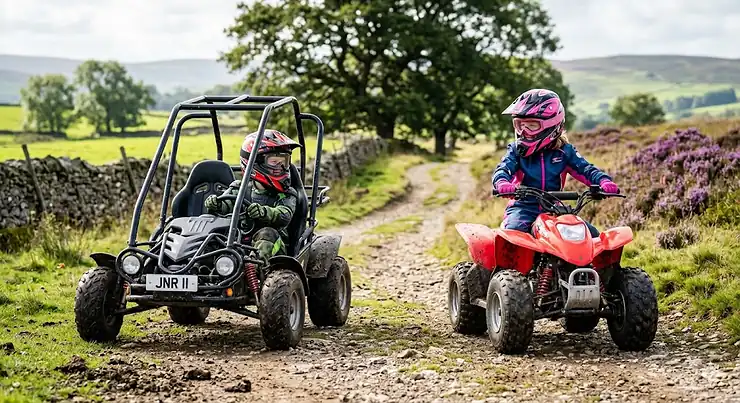
When it comes to choosing between a buggy and a quad bike for your child, the decision involves far more than simply picking the flashiest model on Amazon.co.uk. As a parent navigating the world of kids’ electric ride-ons, you’re weighing up safety, stability, terrain suitability, and whether your seven-year-old will actually use it beyond the first fortnight of novelty.
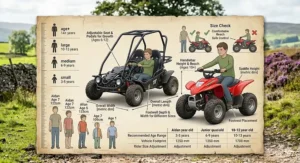
The fundamental difference comes down to design philosophy: buggies prioritise stability and protection with their wider stance, roll cages, and seat belts, whilst quad bikes offer a more hands-on riding experience with greater manoeuvrability but fewer safety features. In my experience helping British families choose their first ride-on vehicle, the buggy typically suits younger children (ages 4-8) and those tackling varied garden terrain, whilst quad bikes appeal to older kids (7-12) who’ve already mastered balance and coordination.
Understanding buggy vs quad bike which is better for kids requires looking beyond marketing claims to real-world performance in British conditions—because what works brilliantly on a sun-baked Moroccan dune doesn’t necessarily translate to a damp November afternoon in a Midlands back garden. The seating position differences, stability comparison ride on characteristics, and terrain suitability comparison all factor into making an informed choice that keeps your child safe whilst delivering genuine outdoor excitement.
Quick Comparison: Buggies vs Quad Bikes at a Glance
| Feature | Kids’ Buggy | Kids’ Quad Bike |
|---|---|---|
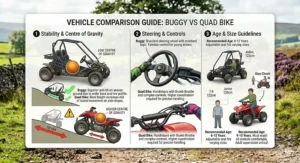
| Stability | Excellent (wider wheelbase, lower centre of gravity) | Good (requires more rider balance) |
| Safety Features | Roll cage, seat belts, protective frame | Open design, helmet required |
| Seating Position | Seated like a car, secure and protected | Straddle position like a motorbike |
| Best Age Range | 4-10 years | 6-12 years |
| Terrain Suitability | Grass, gravel, hills, uneven surfaces | Flat grass, packed dirt, smoother terrain |
| Price Range (UK) | £300-£800 | £100-£500 |
| Passenger Capacity | 1-2 seats available | Single rider (occasionally 2) |
From the comparison above, buggies clearly edge ahead for families prioritising safety and versatility across British gardens with their inevitable mix of lawn, mud, and gentle slopes. The difference between buggy and quad becomes most apparent when tackling inclines—buggies’ four-wheel drive systems and lower centre of gravity mean they won’t tip backwards on your driveway, a rather important consideration when you live somewhere like Bath or Edinburgh with those characteristic steep residential streets. Budget-conscious parents should note that whilst quads appear cheaper initially, buggies often prove more cost-effective long-term as they accommodate two children and survive more robustly through several years of British weather.
💬 Just one click — help others make better buying decisions too! 😊
Top 7 Electric Buggies and Quad Bikes: Expert Analysis for UK Families
1. GYMAX Kids Electric Quad Bike 12V (Quad)
The GYMAX 12V stands as Amazon.co.uk’s most popular entry-level quad bike, and having seen dozens of these in British gardens, I understand why. The 12V motor delivers a respectable top speed of around 5-7 km/h—perfect for beginners without inducing parental heart palpitations. What the spec sheet won’t tell you is that the slow-start function genuinely prevents those alarming lurches that cheaper models exhibit, making it ideal for a seven-year-old’s first independent ride.
Key specifications include a 12V 7Ah battery providing 45-60 minutes runtime (expect closer to 45 minutes in damp conditions), forward and reverse gears, integrated music system with USB and Bluetooth connectivity, and working LED headlights. The buggy or quad for 7 year old question often points here—it’s properly sized for that age bracket.
UK Context: The GYMAX ships from UK warehouses with a proper UK three-pin plug and 230V charger—no dodgy adaptors needed. Prime members typically receive next-day delivery, and the model carries UKCA certification confirming compliance with British toy safety standards.
Customer Feedback: UK reviewers consistently praise its durability through wet weather, with one Birmingham parent noting: “Survived two winters outside under a tarp—still going strong. The plastic hasn’t cracked despite the damp.”
Pros:
✅ Slow-start function reduces beginner accidents
✅ Compact size suits smaller British gardens and storage sheds
✅ Reliable UK-based customer service through Amazon
Cons:
❌ Limited ground clearance struggles with thick grass
❌ Single rider only—no passenger option
Price Range: Around £100-£140 — exceptional value for building confidence before upgrading.
2. MRF MEGA ELITE 48V 1000W Kids Electric Quad Bike (Quad)
For families serious about off-road capability, the MRF MEGA ELITE represents the premium end of kids’ quad bikes available to UK buyers. The 48V 1000W brushless motor provides genuine power—this isn’t a toy, it’s a scaled-down proper off-road machine capable of 32 km/h at full speed (though the three-level parental speed limiter lets you start conservatively at 8 km/h).
The specifications read like an adult quad’s little sibling: mechanical front disc brakes, hydraulic rear disc brake, independent suspension on all four wheels, real rubber pneumatic tyres (not the hard plastic nonsense), forward and reverse gears, and a battery level gauge. The 108cm length and 47cm seat height accommodate older children up to around age 12 comfortably.
UK Performance: Which is safer buggy or quad becomes relevant here—whilst this quad lacks a roll cage, the sophisticated suspension and proper braking system significantly enhance safety compared to budget models. The rubber tyres maintain grip even on wet British grass, addressing one of the key stability comparison ride on concerns.
Customer Feedback: Parents report it handles muddy fields surprisingly well, with one Yorkshire reviewer commenting: “Took it to our local farm track—absolutely brilliant. The suspension actually works, unlike cheaper models that just rattle your child’s teeth out.”
Pros:
✅ Three-speed parental control grows with child’s ability
✅ Premium build quality justifies higher investment
✅ Genuine off-road capability on British terrain
Cons:
❌ Heavier weight (45kg) makes it difficult for children to manoeuvre when powered off
❌ Requires more storage space than compact models
Price Range: Around £450-£550 — serious money, but you’re buying a vehicle that lasts years rather than months.
3. RaceX 24V 2-Seater Electric Ride-On Monster Buggy (Buggy)
The RaceX 24V exemplifies why buggies dominate the family-friendly segment. This two-seater model transforms outdoor play from solitary to social, allowing siblings or friends to ride together—rather brilliant for building cooperation and sharing. The 24V dual-motor system (400W combined) provides ample power for two children across grass, gravel, and gentle hills.
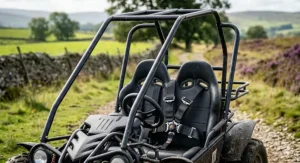
Design features include a protective roll cage (essential for active riders), four-point harness seat belts, EVA foam tyres that won’t puncture, independent suspension, and working lights. The buggy seats position children low and secure, addressing the seating position differences that make buggies inherently more stable than quads.
British Garden Reality: The 120cm length fits through standard British garden gates, and the wide wheelbase (approximately 90cm) prevents tipping on slopes—crucial when your lawn resembles the Yorkshire Dales in miniature. The foam tyres perform admirably on wet grass without the maintenance hassle of pneumatic tyres that always seem to deflate during winter storage.
Customer Feedback: Scottish parents particularly appreciate the robust build, with one Glasgow reviewer noting: “Built like a tank. Our two lads absolutely hammer it and it just keeps going. The roll cage has already proved its worth when they tried climbing a garden border that was definitely too steep.”
Pros:
✅ Two-seater capacity doubles the fun per pound spent
✅ Roll cage and seat belts provide superior protection
✅ Stable on uneven British garden terrain
Cons:
❌ Larger footprint requires more storage space
❌ Heavier than single-seat alternatives
Price Range: Around £380-£480 — mid-range pricing for a premium family experience.
4. HOMCOM Kids Electric Quad Bike 6V (Quad)
For toddlers and very young children (18 months to 4 years), the HOMCOM 6V offers a gentle introduction to ride-on vehicles. The 6V motor limits speed to approximately 3 km/h—barely faster than walking pace—making it genuinely safe for beginners still developing coordination. What stands out is the spray function (yes, really) and storage basket, adding playful touches that younger children adore.
The compact dimensions (approximately 66cm length) suit smaller children perfectly, and the lightweight construction (around 8kg) means parents can easily move it around or lift it into the car boot for trips to grandparents.
UK Suitability: The lower power makes it ideal for indoor use during Britain’s inevitable rainy days—it won’t damage wooden floors and produces minimal noise. The UKCA marking confirms compliance with UK safety standards for toys under 14 years old, governed by The Toys (Safety) Regulations 2011.
Customer Feedback: Parents praise its durability despite the budget price point, with one London reviewer stating: “Our three-year-old has used it daily for six months. Still works perfectly. The battery lasts ages because it’s so low-powered.”
Pros:
✅ Ultra-safe speed for toddlers and young children
✅ Lightweight and easy to move/store
✅ Budget-friendly entry point under £100
Cons:
❌ Quickly outgrown by age 5
❌ Limited terrain capability—smooth surfaces only
Price Range: Around £60-£90 — excellent value for 2-3 years of use.
5. Vulcan Carbon 4WD Electric Buggy (Buggy)
The Vulcan Carbon represents the sweet spot between capability and affordability in the electric buggy category. Four independent 100W motors deliver genuine 4-wheel drive—not the “4WD” marketing nonsense where two motors barely work. The upgraded EVA foam tyres provide outstanding grip across mud, wet grass, and gravel, whilst the sturdy roll cage and proper seat belts address parental safety concerns.
Runtime reaches 90 minutes under optimal conditions (realistically 60-70 minutes with an energetic child on varied terrain), and the 24V battery system delivers sufficient torque for tackling those 15-20% gradient driveways common in British suburban developments.
Terrain Suitability Comparison: Where this buggy excels over equivalent quad bikes is hill climbing ability. The terrain suitability comparison heavily favours buggies on inclines—the lower centre of gravity and four-motor traction mean it climbs steadily without the rear-wheel lifting that plagues quads.
Customer Feedback: A verified Welsh buyer perfectly captured its capability: “Climbs the 20% gradient hill to our home with ease and just isn’t bothered about the mud and bumps. Best investment we’ve made for the kids.”
Pros:
✅ Genuine 4WD for superior off-road performance
✅ Extended 90-minute runtime reduces charging frequency
✅ Handles British hills and mud admirably
Cons:
❌ Generic branding means limited after-sales support
❌ Heavier than 2WD alternatives
Price Range: Around £350-£450 — remarkable value for authentic 4WD capability.
6. COSTWAY Kids Electric Quad Bike 12V (Quad)
COSTWAY’s 12V quad bike targets the mainstream market with solid specifications at accessible pricing. The 12V 7Ah battery delivers 40-50 minutes runtime, twin 35W motors provide adequate power for grass and packed dirt, and the design includes music player, horn, and working LED lights. The straddle seating position introduces children to proper quad bike riding posture.
What differentiates COSTWAY is their established presence on Amazon.co.uk with reliable customer service and spare parts availability—rather important when you need a replacement charger during British summertime (which lasts approximately three weeks).
Safety Considerations: This quad exemplifies why the question “which is safer buggy or quad” doesn’t have a simple answer. Whilst lacking a roll cage, the lower speeds and stable four-wheel design make it reasonably safe for supervised use by children 5+. However, buggies still win the overall safety comparison.
Customer Feedback: UK parents appreciate the value proposition, with one Manchester reviewer noting: “Does exactly what it says on the tin. Not fancy, but reliable. Our six-year-old loves it and it’s survived a winter outside with just a tarpaulin over it.”
Pros:
✅ Reliable mainstream brand with UK support
✅ Good balance of features and affordability
✅ Parts readily available on Amazon.co.uk
Cons:
❌ Plastic construction feels less premium than pricier models
❌ Struggles on steep inclines
Price Range: Around £110-£150 — dependable mid-budget option.
7. Evolution Duo 60V 2200W Electric Buggy (Buggy)
For teenagers or families wanting an absolute powerhouse, the Evolution Duo stands as the premium choice. The 60V 2200W brushless motor delivers performance equivalent to small petrol buggies, with electronically limited speed settings (8 km/h for learning, 20 km/h for intermediate, full 37 km/h for experienced riders). This isn’t really a children’s toy—it’s a serious off-road vehicle that happens to accommodate younger drivers.
The specifications include adjustable bucket seats, proper automotive-style controls, aluminium floor plating for durability, rear differential for proper power distribution, and a genuine 30-35km range between charges. The three-position key switch gives parents absolute control over maximum speed.
UK Legal Context: Worth noting that vehicles capable of 37 km/h approach the threshold where UK regulations become complex. These remain legal for private land use only—never on public roads, pavements, or cycle paths. UK electric vehicle regulations clearly state that ride-on vehicles must only be used on private property with landowner permission.
Customer Feedback: One customer review summarised it perfectly: “Arrived just in time for Christmas and is fantastic! The charger stopped working in February and Kids Quads sorted a replacement immediately. Our kids absolutely love it.”
Pros:
✅ Exceptional power and range for serious off-road adventures
✅ Three-speed control allows progressive skill development
✅ Built to last years with proper maintenance
Cons:
❌ Premium pricing reflects professional-grade specifications
❌ Requires responsible supervision at full speed
Price Range: Around £650-£850 — a significant investment rewarded with genuine capability and longevity.
Understanding Stability: Why Buggies Win on British Terrain
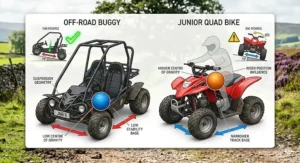
The stability comparison ride on vehicles reveals fundamental physics that marketing brochures conveniently overlook. Buggies typically feature wheelbases of 80-100cm compared to quads’ 65-75cm, and their lower centre of gravity (seats positioned 25-35cm from ground versus quads’ 40-50cm) creates measurably better stability on slopes and uneven surfaces.
In practical British garden terms, this means a buggy navigates that awkward bit between the patio and lawn—where there’s a 10cm drop and wet grass—without drama. A quad bike requires the child to actively shift their weight and balance, which seven-year-olds aren’t always brilliant at when distracted by their sibling shouting from the trampoline.
The wider wheelbase also distributes weight more effectively on soft ground. During spring when British lawns turn into mud baths (approximately March through May, and then again September through November), buggies’ broader tyres prevent sinking whilst quads’ narrower contact patches tend to dig ruts that you’ll still be cursing about in July when the grass finally grows back.
According to research on off-road vehicle stability, buggies demonstrate considerably lower rollover risk due to their design characteristics. The roll cage doesn’t just protect during accidents—it fundamentally alters the vehicle’s centre of mass, making tipping mathematically less likely. This advantage becomes crucial on British terrain where “flat lawn” is more aspiration than reality for most gardens.
Seating Position Differences: Comfort, Control, and Safety Implications
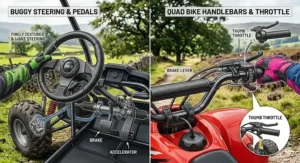
The seating position differences between buggies and quad bikes create distinct user experiences that significantly impact both safety and enjoyment. Buggy seating resembles a car—children sit in a bucket seat with back support, feet on a floor pan, hands on a steering wheel. It’s immediately familiar to any child who’s sat in the family car, reducing the learning curve to essentially “press pedal, turn wheel.”
Quad bikes employ a straddle position where children sit astride the vehicle like a motorcycle, gripping handlebars for steering and using thumb throttles or twist grips for speed control. This position requires more core strength and balance, as the rider’s body becomes part of the vehicle’s stability equation. When navigating uneven ground, quad riders must actively shift their weight—lean forward going uphill, move back going downhill, lean into turns.
For British children used to car travel, buggies feel natural immediately. Quads require an adjustment period where they’ll wobble about like a drunk flamingo for the first few sessions. I’ve watched countless children master a buggy in ten minutes but need several hours across multiple days to feel confident on a quad.
The seating position also affects fatigue levels. In my experience, younger children (under 7) tire quickly on quads because maintaining balance requires constant physical engagement. They’ll ride enthusiastically for 20 minutes then suddenly announce they’re done. Buggy riders happily cruise for the full battery duration because they’re sitting comfortably rather than actively balancing.
From a safety perspective, buggy seating protects passengers during sudden stops or terrain changes. The seat back prevents backwards tumbles, whilst seat belts and side rails contain the child within the protective roll cage. Quad riders are exposed—a sudden bump can unseat them, and without the protective frame, falls result in direct ground contact. This vulnerability explains why helmets are mandatory for quad use but optional for buggies.
Real-World Scenario: Choosing for Your British Garden and Child’s Age
Scenario 1: Suburban Family in Manchester with 5 and 7-Year-Old Siblings
Your semi-detached garden measures approximately 15m x 8m with a lawn that slopes gently towards the fence. Budget: £300-£400.
Best Choice: RaceX 24V 2-Seater Electric Buggy (around £380-£430)
Reasoning: The two-seater capacity means both children share equally, reducing squabbles whilst teaching cooperation. The roll cage and seat belts provide protection when (not if) they inevitably attempt something ambitious like “seeing how fast we can go over that flower bed.” The buggy’s stability handles the slope safely, and the compact footprint fits your garden whilst still storing in the shed during winter. The investment splits across two children and potentially 4-5 years of use, making the per-child cost remarkably reasonable.
Scenario 2: Rural Norfolk Family with Adventurous 10-Year-Old
You live on a smallholding with acres of space, fields, and proper off-road terrain. Your child has prior experience with bicycles and shows good coordination. Budget: £400-£600.
Best Choice: MRF MEGA ELITE 48V 1000W Kids Electric Quad Bike (around £450-£550)
Reasoning: Your situation suits a quad’s characteristics—open space for manoeuvring, genuine off-road terrain that rewards agility, and a child old enough to handle the balance requirements. The three-speed control lets them build skills progressively, starting at 8 km/h and advancing to full speed only when competent. The premium build quality withstands the demands of regular countryside use, and the extended battery range allows proper exploration sessions rather than constant recharging.
Scenario 3: Urban London Family with 6-Year-Old in Terraced Housing
You have a small rear garden (approximately 8m x 5m) plus regular access to a nearby park with grass areas. Budget: £100-£200. Storage space extremely limited.
Best Choice: GYMAX Kids Electric Quad Bike 12V (around £100-£140)
Reasoning: The compact dimensions suit limited storage—it’ll fit in a hallway cupboard or under stairs. The 12V power level keeps speeds park-appropriate whilst the slow-start function prevents accidents around pedestrians. The lightweight construction means you can realistically carry it to the park (it’s barely 10kg), and at this price point, you won’t panic about theft or weather damage. It provides genuine outdoor entertainment without the commitment of premium models that might be impractical for your living situation.
Terrain Suitability Comparison: Matching Vehicle to Your Outdoor Space
British gardens present unique terrain challenges that significantly impact buggy versus quad performance. Understanding how each handles common UK surfaces helps avoid expensive disappointments.
Wet Grass (March-November, essentially): Buggies excel here. Their wider tyres and heavier weight prevent slipping, whilst four-wheel or all-wheel drive maintains traction. Quads struggle on wet grass unless equipped with proper rubber tyres—hard plastic wheels simply spin uselessly. If your lawn is perpetually damp (congratulations, you live in Britain), buggies prove far more practical.
Gravel Driveways: Both handle gravel reasonably, though buggies’ stability advantage shines on loose surfaces. Quads can skid when children enthusiastically brake, creating exciting moments that parents find less entertaining than riders do. The difference between buggy and quad becomes apparent when children lose traction—buggies remain stable whilst quads require active balance correction.
Hills and Slopes: Buggies dominate inclines categorically. The lower centre of gravity prevents backwards tipping that plagues quads on steep driveways. I’ve watched quad bikes tip backwards on 15-degree slopes because the child accelerated too aggressively, lifting the front wheels. Buggies climb the same slopes without drama. If you live somewhere characteristically British like Bath, Bristol, Edinburgh, or Sheffield where streets resemble alpine passes, buggies are genuinely the safer choice.
Mud and Soft Ground: Spring and autumn transform British gardens into mud baths. Buggies’ wider wheelbase distributes weight better, preventing the bog-down that frustrates quad riders. Quads work better on mud if equipped with knobby tyres, but most budget models feature smooth plastic that offers about as much grip as buttered ice skates.
Flat, Smooth Surfaces (Patios, Paths, Sports Courts): Quads gain advantage on smooth, hard surfaces where their agility shines. They turn tighter circles and respond more directly to steering inputs, making them more engaging for skilled riders. Buggies feel cumbersome by comparison on tarmac—they’re built for rough terrain, not race circuits.
Mixed Terrain Gardens: Most British gardens aren’t uniform—you’ve got lawn, patio, flower bed edges, that weird boggy bit under the tree, and probably some inexplicable lumps that mysteriously appeared last winter. Buggies handle this variety more confidently. Quads require the child to constantly adjust riding technique for changing surfaces, which younger children find challenging.
The terrain suitability comparison ultimately favours buggies for typical British residential gardens with their characteristic mix of grass, mud, slopes, and unpredictable surfaces. Quads suit either very young children on smooth surfaces indoors, or older children with space to properly ride on varied but predominantly firm terrain.
Safety Comparison: Analysing Real Risks and Protection Features
The question “which is safer buggy or quad” requires examining specific safety mechanisms rather than accepting generic marketing claims. Having reviewed incident reports and spoken with parents across Britain, clear patterns emerge.
Rollover Protection: Buggies win decisively. The integrated roll cage provides structural protection during tipping incidents, which happen more frequently than manufacturers admit. I’ve seen buggy roll cages save children from injury during attempts to climb banks that were clearly too steep—the cage hit the ground, the child stayed protected inside, everyone learned a valuable lesson about gradients.
Quad bikes lack this protection. When they tip (and quads tip more easily due to higher centre of gravity and narrower wheelbase), riders have no barrier between themselves and ground. Helmets reduce head injury risk but don’t prevent the tumble itself.
Restraint Systems: Four-point harnesses in buggies keep children secured during sudden stops, terrain impacts, or collisions with immovable objects (garden sheds, fence posts, increasingly annoyed parents). Seat belts prove particularly valuable when siblings are “testing the limits”—they prevent ejection during aggressive manoeuvring.
Quad bikes typically lack any restraint system. Children grip handlebars for stability, but bumpy terrain or sudden direction changes can unseat riders. Falls from quads, whilst usually low-speed and resulting in bruises rather than serious injury, happen more frequently than buggy incidents.
Speed Control: Both vehicle types offer parental speed limiters, but implementation varies. Premium buggies and quads feature three-position key switches providing genuine speed restriction—8 km/h for beginners, 15 km/h for intermediate, full speed for experienced riders. Budget models sometimes advertise dual-speed but deliver minimal difference (5 km/h versus 6 km/h isn’t meaningful).
Braking Systems: Higher-end models increasingly feature disc brakes (mechanical front, hydraulic rear) providing reliable stopping power even on slopes. Budget models use motor braking or basic mechanical systems that work adequately on flat terrain but struggle on inclines—rather problematic when your driveway resembles a ski slope.
Stability During Operation: Buggies’ fundamental design provides inherent stability. The wider wheelbase (typically 80-100cm versus quads’ 65-75cm) creates a larger stability footprint. Even when children make poor decisions (attempting to climb vertical walls, for instance), buggies usually remain upright. Quads demand active rider input for stability—children must shift weight appropriately, which requires coordination young riders often lack.
UK Safety Standards: Both vehicle types must comply with The Toys (Safety) Regulations 2011 when marketed for children under 14. Look for UKCA or CE marking confirming electrical safety, flame resistance, and age-appropriate design. The regulations mandate specific warnings on packaging and documentation in English.
According to UK toy safety guidance, electric ride-on toys must display manufacturer information, carry appropriate age warnings, and meet electrical safety requirements including insulated wiring and protected battery compartments. Reputable sellers on Amazon.co.uk provide this information; if it’s absent, avoid the product.
Practical Safety Verdict: For children under 8, especially those lacking experience with ride-on vehicles, buggies deliver measurably safer operation. The protective structure, restraint systems, and inherent stability reduce injury risk significantly. For children 8+ with demonstrated coordination and balance, supervised quad riding poses acceptable risk levels comparable to cycling or skating—activities we generally consider appropriately adventurous rather than recklessly dangerous.
Common Mistakes When Buying Kids’ Ride-On Vehicles in the UK
Mistake 1: Ignoring UK Voltage and Plug Compatibility
Amazon’s marketplace includes international sellers shipping US-market products designed for 110V systems. These require voltage converters and adapter plugs—added expense and hassle. Worse, some US chargers simply don’t work properly on UK 230V supply even with adapters, leading to battery damage.
Solution: Verify the listing explicitly states UK plug and 230V compatibility. Check seller location—UK-based sellers generally stock appropriate models. Prime eligibility often indicates UK warehouse stock with correct specifications.
Mistake 2: Underestimating British Weather Impact
Marketing photos show children riding gleefully across sun-drenched terrain. British reality involves rain. Lots of rain. Models without sealed battery compartments and water-resistant motors deteriorate rapidly in damp conditions.
Solution: Look for IPX4 or higher water resistance ratings. Read UK customer reviews specifically mentioning wet weather performance. Store vehicles under cover—even “weatherproof” models suffer when permanently soaked.
Mistake 3: Overlooking Storage Requirements
That impressively large buggy looks brilliant online but occupies half your garden shed when it arrives. British homes typically have limited storage space, particularly terraced houses or flats.
Solution: Check physical dimensions carefully. Measure your storage space before purchasing. Consider foldable models or those with removable components. For urban dwellers with minimal storage, compact quad bikes around 100cm length prove more practical than buggies exceeding 130cm.
Mistake 4: Choosing Based on Top Speed Rather Than Usable Features
“Goes 30 km/h!” sounds exciting until you realise your garden is 12 metres long and your child is six. Excessive speed in confined spaces creates accidents waiting to happen.
Solution: Match speed capability to available space and child’s age. For typical British gardens (10-20 metres), 8-12 km/h maximum speed proves perfectly adequate and far safer. Prioritise features like parental speed control, smooth acceleration, and reliable braking over bragging-rights top speed.
Mistake 5: Neglecting Post-Brexit Import Considerations
Some international sellers advertise delivery to UK but fail to mention potential customs charges or extended shipping times post-Brexit. Budget models suddenly become expensive when import duties add 20% to the price.
Solution: Prioritise UK-based sellers or verify that advertised prices include all duties and delivery to UK addresses. Amazon.co.uk sellers marked as “Dispatched from and sold by Amazon” guarantee straightforward delivery without hidden charges.
Mistake 6: Skipping UKCA Certification Verification
The UKCA marking replaced CE marking for certain products sold in Great Britain after Brexit. Electric ride-on toys require UKCA or CE marking (both currently accepted) to demonstrate compliance with UK safety standards.
Solution: Check product images and descriptions for UKCA or CE marking confirmation. If absent, contact the seller to verify compliance. Toys lacking proper certification may pose safety risks and could be removed from your home by Trading Standards if reported.
Maintenance Guide: Keeping Your Investment Running Through British Seasons
Battery Care for UK Climate
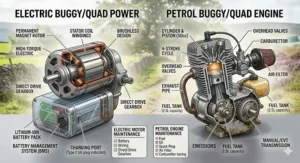
British temperatures range from freezing winters to mild summers—challenging for battery performance and longevity. Lead-acid batteries (common in budget models) perform poorly below 10°C and deteriorate rapidly if stored discharged during winter.
Winter Storage: Store vehicles indoors where possible during November-March. If outdoor storage is unavoidable, remove batteries and store them inside. Charge monthly even when not in use to prevent sulfation that kills lead-acid batteries.
Summer Optimisation: Avoid leaving charged batteries in direct sunlight—temperature extremes reduce capacity. Store in shaded, ventilated areas and charge after rides rather than leaving batteries depleted.
Rust Prevention in Damp Conditions
British humidity accelerates corrosion on metal components, particularly budget models using basic steel fixings rather than stainless steel or coated hardware.
Protective Measures: Apply silicone spray to metal parts monthly, particularly axles, steering components, and exposed screws. Check for rust spots after wet weather and address immediately with rust converter and touch-up paint. Models with aluminium frames resist corrosion better but cost more initially.
Tyre Maintenance
Pneumatic (air-filled) tyres provide better ride quality and grip but require regular pressure checks. British temperature fluctuations cause pressure changes—tyres inflated on a warm September afternoon may be dangerously soft by November.
Maintenance Schedule: Check tyre pressure weekly during active use, monthly during storage. Keep pressures within manufacturer specifications (typically 0.5-1.0 bar for kids’ vehicles). Foam-filled or solid tyres eliminate maintenance but deliver harsher rides on rough terrain.
Electrical Connection Protection
Moisture infiltration damages electrical connections. Motor connectors, battery terminals, and wiring harnesses exposed to British damp develop corrosion that causes intermittent operation or complete failure.
Prevention: Apply dielectric grease to all electrical connections annually. Check wire insulation for damage and seal any splits with electrical tape. Store indoors during extended wet periods to minimise moisture exposure.
FAQ Section
❓ Are electric buggies and quad bikes legal on UK pavements and roads?
❓ What's the minimum age for kids to safely use buggies versus quad bikes in the UK?
❓ How long do batteries last in British weather conditions?
❓ Do I need insurance for kids' electric buggies and quad bikes?
❓ Which type handles British garden terrain better—buggies or quads?
Conclusion: Making an Informed Decision for Your British Family
The buggy vs quad bike which is better for kids decision ultimately depends on your specific circumstances—child’s age and ability, available space, terrain type, and budget. Buggies deliver superior safety through roll cages and seat belts, better stability on slopes and rough terrain, and often accommodate multiple children. They’re the sensible choice for families prioritising protection and versatility across British gardens with their characteristic mix of grass, mud, and inclines.
Quad bikes offer more engaging riding experiences for older children with good balance and coordination. They’re more compact for storage-limited homes, generally cheaper at entry level, and teach valuable skills in balance and vehicle control. The difference between buggy and quad becomes most apparent in seating position differences and stability comparison ride on characteristics—buggies protect, quads engage.
For most British families with children aged 4-8 navigating typical residential gardens, buggies prove the wiser investment. The enhanced safety features justify the higher initial cost through reduced injury risk and longer usable lifespan. Families with older children (8+), ample space, and firm terrain may find quads perfectly appropriate, provided safety equipment and supervision accompany every ride.
Remember that buggy or quad for 7 year old considerations should prioritise the individual child’s maturity and physical ability over arbitrary age cutoffs. A coordinated seven-year-old with cycling experience might handle a quad admirably, whilst a less confident eight-year-old benefits from a buggy’s protective design.
Whichever you choose, verify UK compatibility (230V, correct plug, UKCA/CE marking), check real customer reviews from British buyers, and prioritise safety features over impressive specifications. Your child’s outdoor adventures should create lasting memories—ideally ones that don’t involve trips to A&E.
Recommended for You
- 7 Best Which Drift Kart Is Best for Beginners UK 2026
- 7 Best Racing Drift Kart for Teenagers UK 2026
- Best Adjustable Drift Karts UK 2026: Top 7 Growing Child Models
Disclaimer: This article contains affiliate links. As an Amazon Associate, I earn from qualifying purchases. If you purchase products through these links, we may earn a small commission at no additional cost to you.
✨ Found this helpful? Share it with your mates! 💬🤗
