In This Article
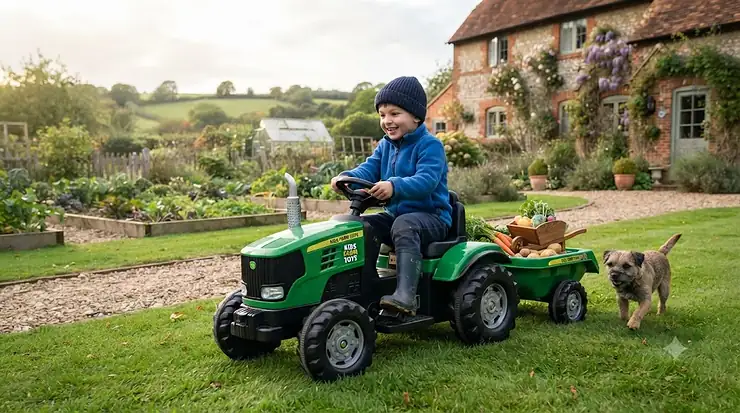
Somewhere between “please can I have a tractor” and the school run tomorrow, most parents end up staring at a wall of near-identical yellow and green plastic on Amazon, wondering which one won’t fall apart by Easter. A large ride on tractor with trailer is exactly what it sounds like — a battery-powered or pedal-driven kids’ vehicle styled after a farm tractor, built with a bigger frame, a higher weight limit, and a detachable trailer for hauling toys, leaves, or whatever treasure a five-year-old has decided is precious this week. It is, in short, the ride-on toy equivalent of a small tank with a shopping trolley bolted to the back.
The trouble is that “large” and “heavy duty” get slapped on packaging with all the rigour of a fairground sign. Some models genuinely handle a muddy garden and a determined seven-year-old; others buckle the first time two kids fight over who gets to sit in the trailer. This guide cuts through that with real products, real specifications, and honest analysis of who each one actually suits — not just a rehash of what the listing already tells you.
We’ve researched seven genuine models spanning budget 24V starters, heavy duty metal-frame builds, a premium John Deere-licensed classic, and two chain-driven Rolly Toys pedal alternatives for families who’d rather skip the charging cable altogether. Whether you’re after a 24v tractor trailer set kids will fight over on Christmas morning, or a properly heavy duty trailer toys can survive daily garden duty, you’ll find a genuine match here — along with the comparison data, buying framework, and maintenance advice that separates a five-year investment from a landfill trip in August.
Quick Comparison Table
Before the deep dive, here’s the shape of the market at a glance. Prices below are indicative ranges based on research at time of writing — always check current pricing, as it shifts with stock and season.
| Tractor | Power Type | Trailer Capacity | Price Range | Best For |
|---|---|---|---|---|
| Peg Perego John Deere Ground Force | 12V electric | Large stake-side, detachable | £300-£400 range | Premium realism & durability |
| Costzon 24V Ride on Tractor with Detachable Trailer | 24V dual motor | Medium, detachable | £150-£220 range | All-round 24V performance |
| Kidsera 24V Ride on Tractor with Trailer | 24V dual motor, 4-gearbox | Medium, detachable | £180-£250 range | Toughest metal-frame build |
| ANPABO 24V Ride On Tractor with Trailer | 24V dual motor | Medium, tiltable & detachable | £130-£190 range | Budget-friendly 24V starter |
| ELEMARA 24V Ride on Tractor with Trailer | 24V, 400W motors | Medium, detachable | £150-£210 range | All-terrain safety features |
| Rolly Toys John Deere Pedal Tractor & Trailer | Pedal, chain-driven | Large, detachable | £150-£220 range | Large-capacity pedal alternative |
| Rolly Toys Caterpillar Tractor with Frontloader & Trailer | Pedal, chain-driven | Extra-large, detachable | £180-£260 range | Biggest hauling capacity |
Looking at the spread here, the split between electric and pedal power is really the first fork in the road. The four 24V electric options give you effortless driving and genuine off-road pulling power, which matters if your garden has any kind of slope or rough grass, while the two Rolly Toys pedal models trade battery convenience for a frame that shrugs off years of daily use without ever needing a charger. Peg Perego John Deere Ground Force sits above both camps on build quality but asks a premium price for it, and if your priority is pure trailer capacity for hauling logs, leaves, or a small sibling’s collection of toys, the Rolly Toys Caterpillar Tractor with Frontloader & Trailer wins on raw volume.
💬 Just one click — help others make better buying decisions too!😊
Top 7 Large Ride On Tractor With Trailer Picks: Expert Analysis
1. Peg Perego John Deere Ground Force — most realistic premium build
The standout here is that this isn’t a generic tractor shape with John Deere stickers slapped on — Peg Perego holds an official licence, and it shows in the panel lines, the badge detailing, and the fact the whole thing feels like it was designed by people who build actual ride-on toys for a living, not a factory that also makes garden furniture. It runs on a 12V/8Ah battery giving two forward speeds plus reverse, and Peg Perego rate it for a 40kg weight limit, which covers most children comfortably through to around age seven or eight.
What the spec sheet won’t tell you, but reviewers note repeatedly, is how much of the appeal comes from the small touches: a genuinely working FM radio built into the dash, an accelerator pedal that doubles as an automatic brake on release, and a second-gear lock so a nervous first-time rider can’t accidentally hit top speed. Reviewers consistently report that assembly takes around an hour for two adults, and that the trailer hitch is simple enough for kids to reattach themselves once shown.
Based on the spec comparison with the four 24V rivals below, this is the pick for families who want something that will still look and function well after two or three children have used it, and who don’t mind paying a premium for a brand with a genuine track record in ride-on engineering. It’s less suited to families chasing raw trailer volume or off-road power, since the 12V motor is gentler than the 24V dual-motor options.
Pros:
- ✅ Officially licensed John Deere design with premium detailing
- ✅ Working FM radio and adjustable two-position seat
- ✅ Strong resale value and multi-child durability
Cons:
- ❌ Sits at the top of the price range for this category
- ❌ 12V motor is less powerful than 24V dual-motor rivals
Prices generally sit in the £300-£400 range depending on retailer and stock; given the build quality and brand reputation, this is a fair value pick for a “buy once” family investment rather than a cheaper set you might replace within a year.
2. Costzon 24V Ride on Tractor with Detachable Trailer — best all-round 24V performer
The standout feature on this one is the climbing ability: Costzon rate the dual-motor 24V setup at up to 20° gradient, which in practical terms means a lawn with a gentle slope or a slightly uneven verge won’t stall it the way a single-motor 12V toy often will. It runs on a 24V 9Ah rechargeable battery and offers three speed settings between roughly 1.9 and 3.7 mph, so you can dial things right down for a nervous three-year-old or open it up a bit for a confident six-year-old.
In practice, that gearing range is the whole story — plenty of 24V tractors only offer a single speed, which forces you to choose between “too fast for a beginner” and “too slow to be fun” once your child gets comfortable. Here you get both ends without buying two toys. The detachable trailer attaches via a simple bolt system, and Costzon also builds in a 2.4G parental remote, letting an adult take over steering and speed entirely for younger riders who aren’t ready to be fully in control.
Reviewers consistently note that the wireless music connection and horn functions are a genuine hit with kids, though a handful mention the trailer plastic is on the thinner side compared with the metal-framed Kidsera below — worth knowing if your child is likely to overload it with bricks or garden stones rather than the intended toys and cushions.
Pros:
- ✅ Three-speed range suits both beginners and confident riders
- ✅ 20° climbing ability handles sloped or uneven gardens
- ✅ Parental remote control for full oversight with younger children
Cons:
- ❌ Trailer plastic is lighter-duty than metal-framed rivals
- ❌ Music and horn functions drain the battery faster over long sessions
At around the £150-£220 range, this represents strong value for the feature set, and it’s the model most likely to satisfy the broadest range of ages within one household.
3. Kidsera 24V Ride on Tractor with Trailer — toughest metal-frame build
What sets this apart on the heading is the iron frame chassis, which Kidsera use specifically to differentiate it from the all-plastic shells common at this price point. Paired with dual 24V motors and a 4-gear metal gearbox — rather than the 3-gear setup found on several competitors — it’s built to handle more torque and take a harder knock without the gearbox teeth stripping, which is a genuinely common failure point on cheaper ride-on tractors after six months of enthusiastic use.
Here’s what to weigh: that extra structural strength adds weight, so this isn’t the toy for a small three-year-old who struggles to push a foot pedal down with any confidence, and the trailer attachment relies on the same solid bolt-through design as the frame, meaning it’s sturdier but marginally less “quick swap” than the clip-style trailers on the ANPABO and ELEMARA models further down this list. Aggregated review sentiment around metal-framed ride-on tractors in this category consistently flags durability as the main draw, with buyers specifically comparing them favourably against all-plastic alternatives that crack at the wheel arches within a season of outdoor storage.
This is the pick for families with more than one child sharing the toy, or for anyone whose garden is more “working farm” than “manicured lawn” — gravel, tree roots, and the odd molehill are exactly where a metal frame earns its keep.
Pros:
- ✅ Iron frame chassis resists cracking under repeated use
- ✅ 4-gear metal gearbox handles greater torque than 3-gear rivals
- ✅ Well suited to being shared across multiple children
Cons:
- ❌ Heavier build makes it less ideal for smaller toddlers
- ❌ Bolt-through trailer attachment is slower to detach than clip designs
Expect this one to sit in the £180-£250 range — a reasonable middle ground between the budget 24V options and the Peg Perego premium pick.
4. ANPABO 24V Ride On Tractor with Tiltable & Detachable Trailer — best budget 24V starter set
The tiltable trailer is the genuine point of difference here — rather than a fixed bed, the ANPABO trailer tips to dump its contents, which turns basic garden hauling into something closer to actual “farm work” play, and it’s a feature usually reserved for pricier models. EVA foam tyres, rather than hard plastic, also give a noticeably smoother ride over paving slabs and bumpy grass, something the spec sheet lists plainly but doesn’t explain: EVA absorbs small vibrations that hard wheels transmit straight up through the seat.
On paper this means a gentler ride for younger children, and reviewers consistently back that up, noting the ride feels less “jarring” than harder-wheeled rivals at a similar price. The parental remote covers speed and direction, and the realistic tractor sound plus working chimney detail add a level of charm that punches above the price bracket. Based on the spec comparison with the other four 24V models here, the trade-off is battery capacity — ANPABO doesn’t publish as detailed a runtime figure as Costzon or ELEMARA, so hedge your expectations toward shorter sessions between charges rather than assuming best-case numbers.
This is the entry point for families who want genuine 24V power and a proper detachable trailer without committing to the £200+ bracket, and it’s a sensible first “big” ride-on for a child stepping up from a 6V or 12V toy.
Pros:
- ✅ Tiltable trailer bed adds genuine dump-and-load play value
- ✅ EVA foam tyres smooth out bumps better than hard plastic wheels
- ✅ Most affordable genuine 24V option in this line-up
Cons:
- ❌ Published battery runtime figures are less detailed than rivals
- ❌ Fewer premium extras (no radio, limited lighting) versus pricier picks
Typically priced in the £130-£190 range, this is the value pick if budget is the deciding factor and you still want real 24V performance rather than a toy that struggles on grass.
5. ELEMARA 24V Ride on Tractor with Easy Detachable Trailer — best all-terrain safety features
The standout advantage on the heading is the 400W dual-motor setup combined with genuinely all-terrain-rated tyres, which Elemara pitch specifically at rougher gardens rather than smooth patios. In practice this means it copes better with tree roots, thicker grass, and the odd garden hose left lying about than several 24V rivals with smaller motors, because more wattage simply means less stalling when the wheels meet resistance.
Elemara also lean into safety more visibly than most competitors at this price, fitting a genuine 3-point seat belt rather than the simpler lap belt found on several rivals, plus a soft-start function that ramps up power gradually rather than lurching forward — a detail that matters enormously for a nervous first-time rider, and one that’s easy to overlook when comparing spec sheets that all just say “safety features included” without saying what they actually are. Reviewers consistently note that the belt and soft-start combination gives real peace of mind for parents of three and four-year-olds specifically, even though the tractor is rated for children up to around eight.
The easy-detach trailer system uses a simple pin mechanism rather than bolts, trading some structural rigidity for genuine one-handed swapping between “tractor mode” and “trailer mode” — useful if your child regularly wants both configurations across a single afternoon of play.
Pros:
- ✅ 400W dual motors handle rougher garden terrain confidently
- ✅ Genuine 3-point seat belt, not just a lap strap
- ✅ Soft-start technology reduces sudden jolts for nervous riders
Cons:
- ❌ Pin-style trailer attachment is less rigid than bolt-through designs
- ❌ Less brand recognition than Costzon or Peg Perego for warranty support
Sitting around the £150-£210 range, this is the safety-conscious pick for parents prioritising terrain handling and belt security over trailer capacity or premium extras.
6. Rolly Toys John Deere Pedal Tractor & Trailer — best large-capacity pedal alternative
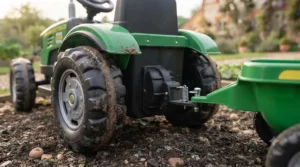
The obvious standout is that there’s no battery at all — this is a chain-driven pedal tractor, officially John Deere licensed, at 134 x 47 x 52cm, which puts it firmly in “large” territory for a pedal ride-on and means older siblings can keep riding it for years after they’d have outgrown a smaller battery toy. The chain-drive mechanism is the same engineering Rolly Toys has used since the brand was founded in Germany in 1938, and it’s genuinely built to be passed down, not thrown away.
What most buyers overlook about pedal tractors versus their electric equivalents is the fitness angle: there’s no motor doing the work, so a child gets a proper leg workout pedalling around the garden, which plenty of parents specifically seek out as a counterbalance to screen time — and unlike a 24V toy, there’s zero charging admin, zero battery degradation over winter storage, and zero risk of a flat battery ruining a spontaneous afternoon outside. Reviewers consistently praise the sturdiness of the frame and the anti-slip pedal surface, with the detachable trailer being large enough for genuinely hauling garden debris, not just a token toy accessory.
The honest trade-off is that pedal power asks more of younger children — a three-year-old may need a push to get started on anything other than flat ground — and there’s no reverse gear or remote override for parents, so supervision near roads or slopes matters more here than with an electric, parent-controllable alternative.
Pros:
- ✅ Chain-driven build with a strong multi-generation reputation
- ✅ No battery, charging, or seasonal maintenance required
- ✅ Large detachable trailer suited to genuine garden hauling
Cons:
- ❌ Requires real pedalling effort — harder for very young children
- ❌ No parental remote override for speed or direction
Expect a price in the £150-£220 range, making it directly competitive with mid-tier electric options while offering a completely different, arguably more active, style of play.
7. Rolly Toys Caterpillar Tractor with Frontloader & Trailer — biggest trailer capacity for hauling
The heading feature is genuinely the size: at 161 x 47 x 55cm this is the largest tractor in the line-up, and it pairs a working front loader — which lifts, tips, and scoops from the driver’s seat — with a large detachable trailer, giving the widest total carrying capacity of anything covered here. Officially licensed Caterpillar branding adds another layer of realism that construction-obsessed kids in particular respond to, based on aggregated review sentiment across pedal tractor buyers generally.
Reviewers consistently note that the frontloader mechanism is sturdy enough to survive genuinely being used to move sand, small stones, and garden clippings, not just posed for photos — which is a meaningful distinction, since plenty of “3-in-1” ride-on toys advertise multi-function play but deliver accessories too flimsy for real use. The rear hitch pin and opening bonnet round out the realism, and like the John Deere pedal model above, chain-drive construction means no charging cycle to manage.
On value: this sits at the top of the pedal-tractor price bracket precisely because you’re getting two attachments — loader and trailer — rather than one, so weigh whether your child will genuinely use both, or whether the simpler John Deere pedal set above better matches how they actually play. For families whose garden play revolves around “building projects” — moving soil, stacking logs, shifting stones — the combined loader-and-trailer capacity here is difficult to match at any price point in this guide.
Pros:
- ✅ Largest overall footprint and combined carrying capacity
- ✅ Working frontloader adds genuine functional play value
- ✅ Chain-driven build with no battery maintenance required
Cons:
- ❌ Highest price among the pedal-powered options
- ❌ Larger footprint needs more garden or storage space
Typically priced in the £180-£260 range, this is the specialist pick for maximum hauling capacity rather than an everyday all-rounder.
Top 7 Products Comparison
| Tractor | Power | Speed/Motor | Weight Capacity | Price Range | Best For |
|---|---|---|---|---|---|
| Peg Perego John Deere Ground Force | 12V | 2 speeds + reverse | ~40kg (88 lbs) | £300-£400 | Premium build & realism |
| Costzon 24V Ride on Tractor | 24V dual motor | 1.9-3.7 mph, 3 speeds | Standard single-rider | £150-£220 | Broadest age range |
| Kidsera 24V Ride on Tractor | 24V dual motor | 4-gear metal gearbox | Standard single-rider | £180-£250 | Multi-child durability |
| ANPABO 24V Ride On Tractor | 24V dual motor | Remote + manual | Standard single-rider | £130-£190 | Budget-conscious buyers |
| ELEMARA 24V Ride on Tractor | 24V, 400W | Soft-start, all-terrain | Standard single-rider | £150-£210 | Safety-first families |
| Rolly Toys John Deere Pedal | Pedal, chain-driven | Rider-powered | Larger frame, multi-year | £150-£220 | Fitness & durability |
| Rolly Toys Caterpillar Frontloader | Pedal, chain-driven | Rider-powered | Largest frame in guide | £180-£260 | Maximum hauling capacity |
Stacking all seven side by side, the real decision usually comes down to power source before anything else — electric versus pedal changes the entire experience, not just the price. Among the 24V options, Kidsera 24V Ride on Tractor with Trailer justifies its higher price over ANPABO 24V Ride On Tractor through its metal frame and gearbox alone, while the two Rolly Toys pedal models trade convenience for a durability profile that simply outlasts most battery-powered rivals over a five-year ownership window.
Benefits vs Traditional Alternatives
| Factor | Large Ride On Tractor With Trailer | Standard Pedal Go-Kart | Small 6V/12V Ride-On Car |
|---|---|---|---|
| Trailer/hauling capacity | High — dedicated detachable trailer | None | Minimal or none |
| Terrain handling | Strong on grass, gravel, mild slopes | Best on flat, hard surfaces | Weak off pavement |
| Age range covered | Roughly 3-8 years | Roughly 4-10 years | Roughly 1-4 years |
| Active play value | Moderate (electric) to high (pedal) | High | Low |
| Typical price range | £130-£400 | £80-£200 | £60-£150 |
The trailer is the genuine differentiator against both alternatives — neither a go-kart nor a small ride-on car gives a child anything to load, haul, or “deliver,” which is exactly the imaginative-play hook that keeps kids returning to tractors specifically rather than treating them as just another car to drive in circles. Go-karts win on raw active play if the tractor in question is electric rather than pedal-powered, while small ride-on cars remain the better choice purely for toddlers under three who aren’t ready for a larger frame or a trailer to manage.
✨ Don’t Miss These Exclusive Deals!
🔍Take your outdoor family toys collection to the next level with these carefully selected tractors. Click on any highlighted item to check current pricing and availability, and give your little farmer hours of genuine outdoor adventure. 🚜
Setting Up And Maintaining Your 24V Tractor Trailer Set
Getting a new 24v tractor trailer set kids will actually enjoy for years, rather than months, comes down almost entirely to what happens in the first thirty days. Charge the battery fully before first use — most manufacturers specify 8-12 hours for the initial charge, even if the battery indicator suggests it’s ready sooner, because lithium and sealed lead-acid cells both perform better long-term when that first cycle is complete rather than topped up early.
Once assembled, check every bolt on the trailer hitch and wheel axles after the first week of use; vibration from rough grass tends to loosen fittings that were only hand-tightened during factory assembly, and a five-minute check with a screwdriver prevents the wobbly-wheel problem that’s a common early complaint across this category. Store the tractor under cover, or at minimum off bare soil, since damp ground speeds up corrosion on metal-framed models like the Kidsera 24V Ride on Tractor with Trailer, and UV exposure fades plastic bodywork faster than most parents expect across a British summer.
For ongoing care, wipe down the battery terminals monthly, avoid leaving any 24V model on charge for more than 24 hours at a stretch, and rotate storage position occasionally if the tractor sits in one spot for weeks — flat-spotting on foam or EVA tyres is a real, if minor, issue after long static storage. A common first-30-days mistake is letting the battery run completely flat before recharging; partial, regular charges extend battery life far better than full depletion cycles, particularly on the sealed lead-acid batteries still used in premium models like the Peg Perego John Deere Ground Force.
Real-World Scenarios: Which Tractor Suits Your Family?
The city-garden family with one determined three-year-old: A smaller garden with paving and a modest lawn calls for something forgiving rather than powerful. The ANPABO 24V Ride On Tractor with Tiltable & Detachable Trailer fits well here — its EVA tyres are gentle on paving, the parental remote lets you manage speed near flower beds or fences, and the lower price makes sense for a child who might only use it seriously for a year or two before wanting something faster.
The rural family with a rough field and two kids sharing: Uneven ground, tree roots, and siblings fighting over the trailer call for genuine toughness. The Kidsera 24V Ride on Tractor with Trailer or either Rolly Toys pedal model handle this scenario best — metal framing and chain drives both shrug off the kind of daily wear a smooth suburban garden never produces, and the larger Rolly Toys trailers genuinely help with real outdoor jobs like moving fallen branches.
The grandparents buying “the good one” for occasional weekend visits: Lower usage frequency but higher expectations on build quality and realism point toward the Peg Perego John Deere Ground Force. It’s priced for buyers who want something that looks and performs like a genuine investment piece rather than a toy that gets replaced next birthday, and the FM radio and adjustable seat mean it stays relevant as a grandchild grows across several visits a year.
Problem → Solution: Fixing Common Large Ride-On Tractor Issues
Problem: The trailer keeps detaching mid-play. This is almost always a loose hitch pin or worn clip rather than a design fault. Check the manufacturer’s hitch tightening instructions first — bolt-through designs like Kidsera’s occasionally need re-tightening after the first few outings as components settle.
Problem: The battery seems to drain faster than advertised. Cold weather genuinely reduces battery capacity on both lithium and sealed lead-acid packs, and running lights, horn, and music simultaneously draws considerably more power than driving alone. Reviewers across several 24V models note this pattern consistently, so treat published runtime figures as best-case rather than guaranteed.
Problem: Wheels are struggling on grass or gravel. This usually points to a mismatch between tyre type and terrain rather than a fault — hard plastic wheels genuinely underperform on grass compared with EVA foam or treaded rubber options, so if your garden is uneven, prioritise models like ELEMARA’s all-terrain tyres over cheaper hard-wheel alternatives.
Problem: A child has outgrown the tractor faster than expected. Weight and height limits vary significantly across this guide, from standard single-rider capacity on the budget 24V models up to roughly 40kg on the Peg Perego. If growth is a concern, the larger-frame Rolly Toys pedal options generally accommodate a wider age range for longer than compact 24V alternatives.
Problem: The trailer capacity feels too small for what the child wants to haul. This is purely a spec mismatch — if garden hauling is a genuine priority rather than incidental play, the Rolly Toys Caterpillar Tractor with Frontloader & Trailer was specifically chosen for this guide because it addresses exactly this limitation better than any 24V rival.
How to Choose a Large Ride On Tractor With Trailer
Picking the right large ride on tractor with trailer among dozens of near-identical listings gets much easier once you work through it as a short checklist rather than scrolling star ratings. Here’s the expert-reasoned order to work through it in:
- Decide electric or pedal first. This single choice shapes everything else — electric suits younger children and those who want speed control via remote, while pedal power suits active play and removes battery admin entirely.
- Match the weight and age rating to your child’s actual size, not just their age. A tall four-year-old may already exceed a “3-8 years” toy’s practical comfort zone well before the stated age ceiling.
- Check the trailer capacity against how it’ll actually be used. Token play needs a small clip-on trailer; genuine garden hauling needs the larger, sturdier designs like Rolly Toys’ offerings.
- Assess terrain compatibility via tyre type. Hard plastic suits patios and pavement; EVA foam or treaded tyres suit grass, gravel, and mixed surfaces.
- Factor in safety features specifically, not just “safety included.” Look for named features — 3-point belts, soft-start, parental remote override — rather than vague marketing language.
- Weigh build material against expected lifespan. Metal-framed or chain-driven builds cost more upfront but typically survive multiple children or several years of daily use better than all-plastic alternatives.
- Confirm storage space before ordering. The larger models in this guide, particularly the Rolly Toys pedal tractors, need meaningfully more shed or garage space than compact 24V options.
Large Ride On Tractor With Trailer vs Standard Ride-On Cars
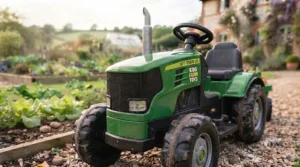
The comparison that trips up a lot of first-time buyers is tractor versus ride-on car, because on the surface both are battery-powered vehicles a small child sits in and drives. The difference that actually matters is functional play. A ride-on car — even a licensed, realistic one — offers essentially one activity: driving. A large ride on tractor with trailer offers driving plus loading, hauling, tipping, and (on frontloader models) scooping, which extends genuine play sessions considerably longer according to aggregated review patterns across both categories.
Terrain handling also diverges sharply. Ride-on cars are generally styled and tyred for smooth surfaces, mimicking road driving, while tractors are built from the ground up for grass and mixed terrain, with tougher tyres and, on the stronger models here, dual motors rated specifically for climbing. If your outdoor space is mostly patio or driveway, a ride-on car may suit better; if it’s lawn, gravel, or a proper garden, a tractor’s terrain-focused engineering is the better-suited category entirely, trailer aside.
Price-wise the two categories overlap heavily, so cost isn’t really the deciding factor — it comes down to whether your child’s play style leans toward “driving fast” (car) or “working the land” (tractor with trailer), and most families with any outdoor space genuinely lean toward the latter once they see how much longer a trailer holds a child’s attention.
What to Expect: Real-World Performance
Specs on a listing page rarely translate directly into what a Tuesday afternoon in the garden actually looks like, so here’s the honest translation. A 24V dual-motor tractor with a stated 20° climbing ability will handle a moderately sloped lawn without complaint, but expect noticeably reduced speed uphill compared with the advertised flat-ground figure — that’s normal physics, not a fault. Battery life quoted by manufacturers (commonly framed in charge cycles rather than exact hours) tends to assume moderate, intermittent use; a child driving continuously with music and lights running will see runtime drop meaningfully below best-case marketing figures.
Trailer capacity in practice means garden debris, toys, and the occasional younger sibling’s teddy collection — not, despite what enthusiastic five-year-olds sometimes attempt, actual rocks or bricks, which exceed the structural rating of every model in this guide and risk cracking hitch components. Reviewers consistently note that the first two weeks of ownership see the heaviest use, with play frequency settling into a more normal pattern afterward — worth remembering if you’re evaluating “was this worth it” based purely on the initial excitement period.
Noise levels vary more than buyers expect: motorised models with horn and music functions are genuinely louder in practice than spec sheets suggest, which matters if you’re in a terraced house with close neighbours, whereas the pedal-driven Rolly Toys options are essentially silent beyond the chain mechanism itself.
Large Ride On Tractors for Big Kids in the UK
Finding a genuinely big kids ride on tractor uk buyers can rely on for an older or larger child means looking past the standard “ages 3-8” banner and checking actual dimensions and weight limits, since UK gardens and UK-specific stockists vary meaningfully from the US listings that dominate search results for this category. Among the seven covered here, the Peg Perego John Deere Ground Force and both Rolly Toys pedal models offer the most room to grow, with larger frames that accommodate taller riders comfortably beyond the point smaller 24V toys start to feel cramped.
UK weather is also a genuine factor that US-centric reviews rarely address: persistent damp means metal-framed or chain-driven builds need slightly more maintenance vigilance against rust than their marketing suggests, and covered storage is worth the effort even for models rated for outdoor use. For families specifically searching for something that suits bigger, older children rather than toddlers, prioritise the higher weight capacities and larger trailer volumes covered earlier in this guide over flashier lighting or sound features, which matter far less once a child is old enough to want genuine hauling capability over noise and lights.
Availability through UK stockists and Amazon’s UK marketplace fluctuates by season — ride-on tractors sell fastest in spring and over the Christmas period, so checking current stock and price ranges ahead of a birthday is genuinely worth doing a few weeks early rather than at the last minute.
Battery Care, Safety & UK Regulations Guide
All genuine ride-on toys sold in the UK must comply with the Toys (Safety) Regulations 2011, which sets essential safety requirements around construction, chemical composition, and labelling, and requires either UKCA or CE marking to be visible on the product or packaging. Before buying from a third-party marketplace seller rather than a recognised retailer, it’s worth checking for that marking specifically, since RoSPA’s toy safety guidance notes that unsafe, unmarked toys can still occasionally slip through online marketplaces despite being illegal to sell.
Battery safety deserves particular attention on the 24V electric models in this guide. Electrical Safety First’s lithium-ion battery guidance recommends always using the charger supplied with the device rather than a third-party replacement, disconnecting the battery once charging completes rather than leaving it on charge indefinitely, and checking regularly for any swelling, damage, or overheating — advice that applies just as much to a child’s ride-on tractor as it does to an e-bike or power tool.
On the activity side, outdoor ride-on play genuinely contributes toward recommended activity levels — the NHS’s physical activity guidance for children under five recommends at least 180 minutes of varied activity daily, including active outdoor play, and pedal-driven models in particular, like the two Rolly Toys options covered here, contribute more directly to that target than electric alternatives since the child is providing the motive power themselves.
Frequently Asked Questions
❓ What age is a large ride on tractor with trailer suitable for?
❓ How long does a 24V tractor trailer battery last per charge?
❓ Can a ride on tractor trailer carry a second child?
❓ Are pedal tractors better than electric for big kids in the UK?
❓ What's the difference between heavy duty trailer toys and standard trailer attachments?
Conclusion
Choosing the right large ride on tractor with trailer really comes down to matching power type, build quality, and trailer capacity against how your family actually spends time outdoors, rather than chasing whichever listing has the flashiest photos. If you want the most polished, longest-lasting option and don’t mind paying for it, the Peg Perego John Deere Ground Force remains the standout premium pick. If broad age coverage and genuine 24V power matter most, the Costzon 24V Ride on Tractor with Detachable Trailer earns its place as the most well-rounded electric option, while the Kidsera 24V Ride on Tractor with Trailer takes it if durability across multiple children is the priority.
Budget-conscious buyers get real value from the ANPABO 24V Ride On Tractor, safety-focused families should look closely at the ELEMARA 24V Ride on Tractor, and anyone wanting to skip batteries entirely — while getting genuinely larger frames and trailers — should compare the two Rolly Toys pedal models, with the Caterpillar Tractor with Frontloader & Trailer offering the single biggest hauling capacity across this entire guide.
Whichever you land on, the research above should mean you’re buying based on real specifications and honest trade-offs rather than marketing language alone — and that’s ultimately what turns a large capacity kids vehicle from a birthday-morning novelty into something that earns its keep in the garden for years.
Recommended for You
- 24v Ride On Tractor: 7 Powerful Picks for Bigger Kids (2026)
- Best Kids Farm Tractor Ride On 2026: 7 Real Picks Compared
- Ride On Tractor With Digger: 7 Best Picks UK Parents Love (2026)
Disclaimer: This article contains affiliate links. As an Amazon Associate, I earn from qualifying purchases. If you purchase products through these links, we may earn a small commission at no additional cost to you.
✨ Found this helpful? Share it with your friends! 💬🤗
