

In This Article
Visit any UK skatepark on a Saturday morning and you’ll see two tribes. One is hurling itself off kickers on stiff little scooters that sound like a dropped toolbox. The other is gliding past on the cycle path with a folded scooter tucked under one arm. The stunt scooter vs standard scooter question looks like a style choice. It’s actually an engineering one, and getting it wrong costs money, skin or both.

What Is the Difference in Stunt Scooter vs Standard Scooter?
A stunt scooter is a rigid, non-folding scooter with a one-piece deck, fixed bars and small 100-125mm wheels, built to survive tricks and hard landings. A standard scooter folds, rolls on larger 145-200mm wheels, and prioritises comfort and portability. Same family, opposite jobs.
The split goes back a long way. Freestyle scootering took off after the early-2000s foldable-scooter craze. Those first foldables were built for simple transport, so they snapped under freestyle abuse. Riders then pushed for purpose-built parts, and the stunt scooter became its own machine.
In this guide I’ve compared seven real scooters, four stunt and three standard. I’ve weighed deck flex and rigidity, trick capability and everyday commuting suitability, and I’ve tried to be honest about what the spec sheets can’t tell you.
Stunt Scooter vs Standard Scooter at a Glance
| Feature | Stunt scooter | Standard scooter |
|---|---|---|
| Deck build | Rigid one-piece extruded aluminium, boxed edges | Lighter-duty deck joined to a folding stem |
| Folding | No, fixed bars | Yes, lever or latch fold for trains and boots |
| Wheels | Small, hard, 100-125mm | Larger, 145-200mm, often softer |
| Weight | Around 3.4-3.6kg for entry-level completes | Roughly 3.75-5.6kg across adult folding models |
| Braking | Flex fender over the rear wheel | Fender, footbrake or hand brake |
| Ride feel | Stiff, direct, buzzy on rough tarmac | Smoother, sometimes suspended |
| Best terrain | Skateparks, smooth plazas | Pavements, towpaths, station-to-office |
| Best For | Learning tricks, e.g. CORE CD1 | Commuting, e.g. Oxelo Town 7XL |
Looking at the table, the headline is that the two designs optimise for opposite things. Deck flex and rigidity favour the stunt scooter, because a stiff, welded structure keeps landing forces in the frame and not in a hinge. Everyday commuting suitability favours the standard scooter, because big wheels, a fold and sometimes suspension make a daily route far less tiring.
Trick capability is where the gap is widest. A folding mechanism simply isn’t designed to take repeated landings. One lesson runs through everything below: pick the scooter for the job you’ll do 90% of the time, not the one you’d like to do on a good weekend.
💬 Just one click — help others make better buying decisions too!😊
Top 7 Scooters Compared: Expert Analysis
I picked four stunt scooters across budget, mid-range and premium, plus three standard scooters. The goal is to show where the stunt scooter vs standard scooter line really falls. Every pick below is a real model, and the specs come from manufacturer and retailer listings and independent reviews.
| Product | Type | Wheels | Weight | Price range | Best For |
|---|---|---|---|---|---|
| CORE CB1 | Stunt, entry | 110mm (listed) | Check listing | Under £90 | A low-risk first stunt scooter |
| CORE CD1 | Stunt, beginner | 110mm alloy-core | About 3.4-3.6kg | £110-£125 | First proper trick scooter |
| CORE CL1 | Stunt, all-rounder | Check listing | Maker: among the lightest | £185-£200 | Progressing teens and adults |
| CORE SL3 | Stunt, park | Hollow Core | Check listing | £230-£260 | Serious park riders |
| Razor A5 Lux | Standard | 200mm | About 4.3kg (9.4 lb) | Around £100, check current price | First adult commuter |
| Oxelo Town 7XL | Standard, dual suspension | 200mm | 5.6kg | Around £110-£120 | Comfort on a budget |
| Micro Speed | Standard, ultralight | 145mm | 3.75kg | Around £120 | Short hops and easy carrying |
The table shows a clear price ladder. The CORE CD1 is the sweet spot for most newcomers to tricks, and the CORE CL1 and CORE SL3 only pay off once you can feel the difference. On the standard side, the Oxelo Town 7XL buys comfort, the Micro Speed buys lightness, and the Razor A5 Lux sits as the dependable middle. Note that wheel size and weight pull in opposite directions in nearly every row.
💬 Just one click — help others make better buying decisions too!😊
1. CORE CB1 — cheapest way into a genuine stunt deck
The CORE CB1 exists to answer one question: will your child keep riding? Its maker pitches it as a rigid, real stunt scooter that skips the premium aftermarket parts a first-year rider won’t miss. Listings describe 110mm wheels and beginner sizing from around six years old.
Those 110mm wheels are the standard stunt size, so the first scooter feels like the real thing rather than a toy with a hinge to wobble. Based on the spec comparison, the trade-off is what’s missing. Expect simpler compression and fewer weight-saving touches, which shows up as a heavier, less responsive feel once trick capability starts to matter. Think of it as a trial run, not a forever scooter.
On reviews, I couldn’t verify a deep independent review base for this model. Read the verified-purchase feedback on the listing yourself, focusing on bar tightness and wheel wear.
Pros:
- ✅ Rigid stunt construction with no folding hinge
- ✅ Lowest entry price in the stunt range
- ✅ Standard 110mm wheel size eases later upgrades
Cons:
- ❌ Skips premium parts that help progression
- ❌ Thin independent review coverage
Expect under £90 (check current price). It’s good value as a low-risk test, weaker value if tricks stick within a year.

2. CORE CD1 — best first stunt scooter for learning tricks
The CORE CD1 is the scooter that most often gets recommended to parents, and the spec sheet shows why. Its deck is extruded aluminium with a boxed design and integrated dropouts, which makes learning grinds easier.
The listing gives 110mm alloy-core wheels, ABEC 9 bearings, IHC compression and a fully integrated headset, with a weight of about 3.4-3.6kg. That’s a spec you’d normally see a tier higher. Integrated compression removes bar play, and bar play is the thing that makes first tailwhips feel sketchy.
The deck is about 4.5 inches wide and the rider height starts around 134cm, so larger-footed adults may find it cramped. The two-piece bar is a shipping-efficiency design, so check the bolts regularly. It lists EN14619 certification and a 100kg rider limit.
Reviewers of entry-level stunt scooters commonly praise rigidity and value, and complain about grip tape and brake wear. I’d treat that as a general pattern and confirm it on the live listing.
Pros:
- ✅ Integrated headset and IHC compression at a low price
- ✅ Light enough for beginners to rotate and whip
- ✅ Wide colour choice keeps kids motivated
Cons:
- ❌ Narrow deck suits smaller feet best
- ❌ Two-piece bar needs regular bolt checks
Expect around £110-£125. That’s strong value if your priority is trick capability on a budget.
3. CORE CL1 — lightweight all-rounder for riders who’ve outgrown beginner kit
The CORE CL1 is the “I know what I’m doing now” scooter. Its maker calls it one of the lightest on the market, with an SL deck, interchangeable nylon dropouts, a sealed-bearing integrated headset and IHC compression. It arrives about 90% pre-built.
Nylon dropouts are a quiet clever detail. They take the wear from grinding, so you replace a cheap part and not the whole deck. The sealed headset means smoother steering and less maintenance. It’s marketed as an adult stunt scooter, so the deck and bars suit taller riders than the CORE CD1.
Weight and deck flex and rigidity pull against each other here. A lighter deck is easier to throw around but leaves less margin for sloppy landings. Riders who still crash-land every attempt may be better off with something chunkier.
I couldn’t verify a deep set of independent customer reviews, so I’m leaning on the spec sheet. Cross-check the live listing for early-life complaints, particularly bar and clamp tightness.
Pros:
- ✅ Interchangeable nylon dropouts protect the deck
- ✅ Sealed headset and IHC compression for tight steering
- ✅ Suits taller teens and adults
Cons:
- ❌ Overkill for complete beginners
- ❌ Independent reviews are thin
Expect around £185-£200. It’s a fair price for the parts, as long as you’ll ride at least a few times a week.
4. CORE SL3 — lightest, fastest-reacting park deck
The CORE SL3 is built for riders who spend their weekends in bowls and on ramps. The third-generation Super Light uses 6061 aluminium throughout, weight-reducing deck cutouts, Hollow Core wheels and IHC compression tuned for instant bar response.
Those cutouts remove material you can feel, which means a quicker flip and a livelier landing. The trade-off is that deck flex and rigidity become something you manage with technique. Hit flat repeatedly and you will test it.
The maker is candid about this. Its warranty page says deck failure is a by-product of the sport, and decks carry a short manufacturer warranty. The brand also says to skip the CORE SL3 if you’re brand new, because you won’t feel the benefit yet. I agree with that advice.
Independent review coverage is limited, so the picture rests on the spec sheet and the maker’s positioning. Check the live listing for recent rider feedback before you pay premium money.
Pros:
- ✅ Lightest, most responsive setup in this lineup
- ✅ Hollow Core wheels cut weight further
- ✅ Tuned for ramps, bowls and park flow
Cons:
- ❌ Wasted on beginners who can’t feel the difference
- ❌ Lightweight decks demand clean landings
Expect around £230-£260. It’s good value for committed park riders and poor value for anyone still learning to bunny hop.
5. Razor A5 Lux — the benchmark 200mm-wheel commuter
The Razor A5 Lux is the scooter other standard scooters get measured against. It rides on 200mm urethane wheels, uses an aluminium frame, folds with a single lever and supports riders up to about 100kg (220 lb). One roundup lists it at about 9.4 lb.
Those big wheels are the whole story for everyday commuting suitability. They roll over small cracks and pavement joins that stop 110mm stunt wheels dead. It’s an honest, simple design with no suspension to service.
Review sentiment is broadly positive. Roundups consistently praise the low weight, reliability and the sheer size of its review base. Common gripes include a slight rattle when new, a handlebar joint that can develop a slight wobble after a couple of hundred miles, and wheels that feel slippery on wet ground. None of that is dramatic, but it’s the price of a folding hinge.
Pros:
- ✅ 200mm wheels smooth out everyday pavements
- ✅ Light and quick to fold for commuting
- ✅ Huge review base and proven reliability
Cons:
- ❌ Handlebar joint can loosen over time
- ❌ Urethane wheels feel slippery when wet
Expect around £100, but check current price as it varies by colour and retailer. That’s strong value for a first adult commuter.

6. Oxelo Town 7XL — comfortable dual-suspension budget commuter
The Oxelo Town 7XL is the scooter you buy when your commute is bumpy and your budget isn’t generous. It brings dual suspension, 200mm wheels and a hand-operated brake at 5.6kg. Decathlon sizes it for riders from 1.45m to 1.95m, and designs it for regular journeys up to around 2km.
An Expert Reviews buying guide called it the most comfortable commuter you could buy under £150. It also flagged compromises. The fold is less elegant than pricier Oxelo models, the wheels are harder and vibrate more on tarmac, and the brakes are not very powerful unless you use hand and foot together. That review was published in 2025, so confirm current details before buying.
Spare parts are available from Decathlon, which matters more than most buyers realise. Owner feedback on Decathlon’s listings is strongly positive, with comfort the top theme. Complaints centre on a kickstand that works loose and wheel damage when the scooter is used by children.
Pros:
- ✅ Dual suspension takes the sting out of rough roads
- ✅ Hand brake plus footbrake for stopping control
- ✅ Spare parts readily available
Cons:
- ❌ Harder wheels transmit some tarmac vibration
- ❌ Brakes feel modest unless used together
Expect around £110-£120. It’s excellent value for a comfort-first commuter.
7. Micro Speed — lightest folding commuter for short hops
The Micro Speed is the scooter for people who dread carrying one. At 3.75kg, it’s about half the weight of Oxelo’s heaviest adult models. That means you can tuck it under an arm on the train without wrecking a shoulder.
Smaller 145mm polyurethane wheels and no suspension sound like a recipe for a rattly ride. Expert Reviews found a shock-absorbing footplate and foam grips did a decent job of calming the worst vibrations. The footplate is smaller, though, so it gets less comfortable over longer journeys. That reviewer thought it ideal for about a mile.
Honestly, for everyday commuting suitability it’s brilliant on a short hop and a compromise beyond that. I’d note the guarantee was only six months at review time, so check current terms. I found independent reviewer commentary here, not a large pool of customer reviews.
Pros:
- ✅ Very light and easy to carry folded
- ✅ Shock-absorbing footplate and foam grips
- ✅ As quick as most folding rivals
Cons:
- ❌ Smaller footplate tires feet on longer rides
- ❌ Short guarantee at time of review
Expect around £120 (check current price). It’s best value for short multimodal journeys, and worse value for a long daily slog.
Practical Usage Guide: Setting Up and Looking After Your Scooter
Most scooters, stunt or standard, arrive nearly ready to ride. Don’t treat “nearly” as “finished”. Here’s what to do in the first 30 days.
- Day one: torque check. Tighten the bar clamp, axle bolts and compression bolts. On a stunt scooter, loose compression is the number one cause of bar wobble. On a folding scooter, make sure the hinge latch seats fully every time.
- Fit before you ride. Stand upright with the bars at hip height and arms relaxed. If you’re stretching or hunching, the scooter is the wrong size, not you.
- Kit up. RoSPA’s scooter factsheet cites US estimates that protective clothing could prevent more than 60% of scooter injuries. It suggests a helmet, plus knee and elbow pads, and wrist protectors for children.
- Weekly: wipe the deck, check brake wear and spin the wheels for grit or flat spots.
- Monthly: re-check every bolt. On a standard scooter, inspect the fold mechanism for play.
The most common mistake in the first month is skidding the rear wheel to stop. On a stunt scooter that flat-spots the wheel fast, and the manufacturer warranty won’t cover it. Use the flex brake gently, and learn to step off instead of locking up.

Real-World Scenarios: Matching Riders to the Right Scooter
The 11-year-old with skatepark dreams. Budget is around £120, usage is two sessions a week at a local park, and goal is learning bunny hops and drops. The CORE CD1 fits this rider. Its integrated headset and IHC compression give a trick-ready platform, and the sizing suits a growing child. If your child is just curious, the CORE CB1 is a lower-commitment way in.
The 16-year-old who’s progressed. Riding most days, they’ve outgrown beginner kit and want something that won’t hold back whips and rotations. The CORE CL1 suits this stage, and the CORE SL3 only makes sense if they’re park-focused and landing consistently.
The 34-year-old rail commuter. They want to travel 1.5 miles to the station, carry the scooter on the train and store it under a desk. Choose between the Micro Speed for carry weight and the Oxelo Town 7XL for comfort. The Razor A5 Lux sits between them. No stunt scooter belongs in this scenario, because it can’t fold.
The parent buying for an 8-year-old. Unsure whether tricks will happen, they want one scooter for school runs and the park. A stunt scooter such as the CORE CD1 works for short rides, but a standard scooter will be gentler on long pavement stretches.
✨ Don’t Miss These Exclusive Deals!
🔍 Take your scooter choice to the next level with these carefully selected models. Click on any highlighted product name to check current pricing and availability. These picks will help you build a setup your whole family will love!
Deck Flex and Rigidity: Why It Matters More Than You Think
Deck flex and rigidity is the least glamorous topic in the stunt scooter vs standard scooter debate. It’s also the most important. A scooter deck is a lever, a shock absorber and a platform all at once.
Stunt decks are usually 6061-T6 aluminium, often extruded with hollow chambers and welded to the head tube. Patent descriptions of extruded decks talk about multi-tube cross-sections that resist both bending and twisting. That is the point. When you land a trick, the energy needs to travel through the frame and into the wheels, not into a hinge.
Standard scooters have the opposite design brief. They need a fold, and any fold is a place where play can develop. Testers of the Razor A5 Lux noted a slight handlebar-joint wobble after a couple of hundred miles. That’s a fair price for portability.
Interestingly, standard scooters sometimes add flex deliberately. The Oxelo Town 7XL uses dual suspension, and the Micro Speed uses a shock-absorbing footplate. Both trade rigidity for comfort, which is exactly right for pavements and exactly wrong for ledges.
The takeaway: stiffness is a feature for tricks and a cost for commuting. The CORE SL3 sits at the stiff-and-light extreme, and the Oxelo Town 7XL sits at the damped, forgiving one.
Trick Capability: What Each Scooter Can (and Can’t) Do
Trick capability comes down to a few unglamorous details. Stunt scooters use fixed, non-folding bars, compression systems that remove play, and a flex fender brake. Decathlon notes the bars on stunt scooters can rotate fully, which tailwhips need, and that flex brakes trade stopping power for lighter weight and less vibration.
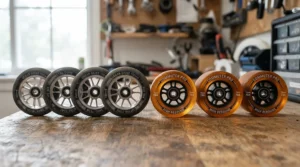
Small wheels matter too. Larger wheels are heavier and less manoeuvrable, which is why the stunt range tops out around 110-125mm. Those wheels are also hard, so a stunt scooter rolls over a crack less gracefully than a Razor A5 Lux does.
A standard scooter can handle gentle stuff, such as hopping a kerb at walking pace or rolling down a small ramp. Anything involving repeated impacts, grinds or rotations belongs on a rigid deck. The early freestyle scene learned this when foldable scooters broke under stress.
Here’s the rule of thumb. If you plan even occasional skatepark sessions, the CORE CD1 is the minimum sensible platform. If you won’t leave the pavement, a stunt scooter’s extra trick capability is wasted, and you’ll feel it every time you ride over cobbles.
Everyday Commuting Suitability: Which Wins on the Street?
On everyday commuting suitability, standard scooters win comfortably. Larger wheels roll over rough surfaces, folding suits trains and offices, and some models add suspension. Expert Reviews’ tester averaged around 5-6mph and suggested starting with journeys of no more than about two miles, because legs tire quickly. Better scooters with bigger wheels help you go further.
A stunt scooter can commute, but it’s a compromise. You get 110mm wheels that buzz over rough tarmac, a narrow deck, twitchy steering and no fold. A CORE CD1 weighs only about 3.4-3.6kg, so carrying it isn’t painful, but it’s awkward to store.
For commuting, choose by distance. Under a mile, the Micro Speed is hard to beat for carrying. From one to two miles, the Razor A5 Lux or Oxelo Town 7XL is more comfortable. A stunt scooter only makes sense if your route ends at a skatepark.
How to Choose: Stunt Scooter vs Standard Scooter
The quick answer: choose a stunt scooter if you’ll do tricks, and a standard scooter if you’ll mainly travel. Then follow these steps.
- Name the main job. Tricks, commuting or mixed? Be honest about the 90% use.
- Check rider height and weight. Bars should reach roughly hip height. Several models above list a 100kg limit.
- Match wheel size to terrain. 110mm for parks, 145-200mm for pavements.
- Decide on folding. If it must fit on a train or under a desk, you need a standard scooter.
- Weigh the carry. Under 4kg is easy, around 5.6kg is noticeable.
- Set a budget with upgrades in mind. Stunt parts upgrade easily, whereas standard scooters are usually replaced.
- Budget for protection. A helmet and pads are part of the purchase.
If you’re torn, a simple decision rule works. If more than 70% of your riding is on public pavements, pick a standard scooter. If it’s mostly smooth concrete and ramps, pick a stunt scooter.
Common Mistakes When Buying a Scooter
The first mistake is buying a standard scooter for tricks. Folding hinges aren’t built for landings, and the failure mode is a bar coming loose mid-air. The second is the reverse, buying a stunt scooter for a two-mile commute and then resenting every crack in the road.
Third is ignoring size. A scooter that’s too small makes children control it badly, and one that’s too big makes them wrestle it. Fourth is paying for premium parts too soon. The CORE SL3 is a beautiful machine, but a beginner won’t feel what they’re paying for.
Fifth is skipping protection. Sixth is buying on colour alone, although I’ll admit a scooter your child loves gets ridden more. Seventh is forgetting the return window. Ride it around the block and check fit before you commit.
Features That Actually Matter (And Those That Don’t)
Features that matter: bar height that fits the rider, wheel size matched to the terrain, a proper headset and compression system on stunt scooters, and a secure fold on standard ones. Add replaceable wear parts, such as nylon dropouts on the CORE CL1.
Features that don’t: marketing numbers like ABEC ratings, which mostly describe bearing tolerances and not real-world speed. Neither do chrome finishes, nor light-up wheels. Colour options are fun, but they won’t change how it rides.
One feature that is often overlooked is spare-part availability. Decathlon sells spare parts for the Oxelo Town 7XL, which extends its working life far more than a flashy spec ever will. It’s boring, and it’s the thing that saves you money in year three.
Long-Term Cost & Maintenance
| Category | Typical outlay | Main running costs | Best For |
|---|---|---|---|
| Entry stunt (CORE CB1, CORE CD1) | Under £90 to £125 | Grip tape, wheels, bearings | Beginners learning tricks |
| Premium stunt (CORE CL1, CORE SL3) | £185-£260 | Decks, wheels, dropouts | Committed riders |
| Budget standard (Razor A5 Lux) | Around £100 | Brake wear, bolt checks | First-time adult commuters |
| Mid standard (Oxelo Town 7XL, Micro Speed) | Around £110-£120 | Wheels, fold-hinge checks | Comfort or portability |
The table shows that purchase price is only half the story. Stunt scooters cost more to keep alive, because grip tape, wheels and bearings wear out. CORE’s own warranty page classes grip tape, grips, headsets and bearings as consumables. Standard scooters cost less to run but are harder to repair when the fold wears out.
On cost-per-use, a CORE CD1 ridden several times a week is excellent value. A Micro Speed used for a daily mile-long hop is also strong. The worst value is always the scooter that doesn’t match its job.
Safety, Standards and UK Rules
Start with the standards. The CORE CD1 listing cites EN14619 certification, which is worth looking for on any stunt scooter. Retailers also point to EN71 testing for children’s models.
Then there’s the law. Expert Reviews notes that Section 72 of the Highways Act 1835 bars riding a “carriage of any description” on a footpath, which technically covers push scooters. Enforcement is another matter. Where you do ride on pavements, give pedestrians priority and plenty of space. Road use is murkier, and local by-laws can differ.
Private electric scooters are a different category. Expert Reviews’ guide described them as illegal on UK roads and pavements, but the rules may have changed, so check gov.uk before buying one. This guide covers push scooters only.
Finally, the kit. A helmet is non-negotiable, and knee and elbow pads are cheap insurance. Replace any helmet after a serious impact, because the foam may be compromised even when it looks fine.

FAQ
❓ Can I use a stunt scooter for commuting?
❓ Is a stunt scooter lighter than a folding scooter?
❓ What age is a stunt scooter suitable for?
❓ Can a standard scooter do tricks?
❓ How much should I spend on my first stunt scooter?
Conclusion
The stunt scooter vs standard scooter question has a clear answer once you stop treating it as a style choice. Tricks belong on a stiff, welded deck with small wheels, and commuting belongs on a foldable scooter with big wheels and a gentle ride. Deck flex and rigidity is the thread running through it all, the same property that makes a stunt deck a joy in the air and a nuisance on cobbles.
For most newcomers to tricks, the CORE CD1 is the sweet spot, with the CORE CB1 as the cautious option and the CORE CL1 and CORE SL3 for riders who’ve earned them. For commuters, the Razor A5 Lux is the dependable all-rounder, the Oxelo Town 7XL buys comfort, and the Micro Speed buys lightness.
Whichever you choose, wear the helmet. Check prices and availability on Amazon UK, as ranges change often.
Recommended for You
- Budget Stunt Scooter: 7 Proven Picks Worth Buying (2026)
- Stunt Scooter For Beginners: 7 Best Picks For UK Riders (2026)
- 2-Wheel Scooter For Kids: 7 Best Picks, Honest Verdicts (2026)
Disclaimer: This article contains affiliate links. As an Amazon Associate, I earn from qualifying purchases. If you purchase products through these links, we may earn a small commission at no additional cost to you.
✨ Found this helpful? Share it with your friends! 💬🤗
