
In This Article
A folding scooter for kids is a child-sized kick scooter whose stem or deck collapses in one or two quick movements. That lets you stow it in a car boot, school cloakroom, hallway cupboard or under a buggy. Most weigh roughly 2.5kg to 4kg, and many have adjustable handlebars that grow with the child.

Picture the school gates at 3.15pm. A small person has scooted half a mile with the energy of a caffeinated whippet, then declared, with total finality, that they are “too tired”. Guess who is now carrying a scooter, a book bag and a PE kit? A folding scooter for kids won’t cancel the tiredness. It does turn that awkward armful into something you can collapse, tuck under one arm and forget about.
There’s a decent health case for getting it right, too. The NHS physical activity guidelines say children aged 5 to 18 should average at least 60 minutes of moderate or vigorous activity a day. Scooting to school is one of the least painful ways to bank some of it. The catch is practical: a scooter that is a nuisance to carry or store soon becomes a scooter that stays at home.
This guide covers seven real models you can find on Amazon UK. It looks at what makes a lightweight folding scooter genuinely light, how a one-step folding mechanism differs from a fiddly one, and when a 2-wheel scooter for older children makes sense. It also covers school bag compatibility and compact storage. Everything here is built from published specifications, parent-tester feedback and retailer listings rather than personal testing. All prices are ranges, so check current price before you buy.
Folding Scooter for Kids: Quick Comparison Table
| Product | Wheels | Age Range | Price Range | Best For |
|---|---|---|---|---|
| Maxi Micro Deluxe Foldable LED | 3 | 5+ | £150-£170 | Premium one-click fold |
| Micro Sprite | 2 | 5-12 | £100-£150 | Lightweight 2-wheel switch |
| Globber Flow Foldable 125 | 2 | 6+ | £60-£90 | Value 2-wheel, taller riders |
| Trunki Folding Scooter | 3 | 3-6 | £70-£90 | Quick fold plus carry strap |
| Yvolution Y Glider NUA | 3 | 3-10 | £100-£115 | Wall-hang storage |
| Mini Micro Suitcase Scooter | 3 | 2-6 | £110-£120 | School bag and travel |
| Lilo & Stitch Light Up Folding In-Line Scooter | 2 | 5+ | Under £40 | Budget first fold-up |
Looking at the table, the Globber Flow Foldable 125 is the value play for a first 2-wheeler, while the Micro Sprite is the pick if every gram counts. Under-fives are better served by the 3-wheel group: the Trunki Folding Scooter, Yvolution Y Glider NUA and Mini Micro Suitcase Scooter. The Lilo & Stitch Light Up Folding In-Line Scooter is the low-risk gamble if you suspect scooting might be a passing phase. Prices are ranges at the time of research and may vary.
💬 Just one click — help others make better buying decisions too!😊
Top 7 Folding Scooter for Kids: Expert Analysis
1. Maxi Micro Deluxe Foldable LED — premium one-click fold for ages 5+
The headline is the fold. A single click collapses the stem, which is as close to a one-step folding mechanism as a three-wheeler gets. According to MadeForMums’ testing, it weighs around 2.5kg, so a Reception or Year 1 child can often lift it themselves. That is the gap between “I’ll carry it” and “it’s too heavy”. The lean-to-steer, three-wheel layout is forgiving for newer scooters. The reinforced fibreglass deck with an anti-slip logo helps keep feet planted in the wet. Based on the spec comparison, this suits families who want a scooter to outlast one winter, ideally passing down to a sibling. Parent testers singled out the induction-powered LED wheels, which need no batteries, and the child tester said she wanted to ride it to school every day. The recurring complaint is the price.
Pros:
- ✅ Single-click fold, easy for small hands
- ✅ Light-up wheels need no batteries
- ✅ Adjustable handlebar and durable build
Cons:
- ❌ Very pricey versus rivals
- ❌ Three-wheel design may feel babyish by age 8
Expect around £150-£170. The premium is real, but spread across siblings it can still work out sensibly.
2. Micro Sprite — featherweight 2-wheeler for confident riders
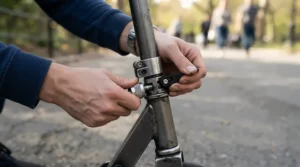
At roughly 2.7-2.85kg depending on the listing, the Micro Sprite is the lightest 2-wheel option here, and it is aluminium rather than plastic composite. Handlebars run from about 63-65cm up to 93-95cm. A five-year-old and a twelve-year-old can use the same frame, and the 100kg rider limit means teens aren’t ruled out. Folding takes two button presses. That isn’t a true single click, but it is quick, and it stands up when folded at around 65cm long, which is handy under a bus seat. Turn-to-steer handlebars behave like a bike’s, which builds balance but is unforgiving for a child still wobbling on three wheels. On paper this is best from about age 6. I couldn’t verify a large independent parent-test pool for this exact model, so treat grand claims cautiously. One retailer-listing buyer did value the adjustable handlebar for a growing nephew.
Pros:
- ✅ Lightest 2-wheel option in this guide
- ✅ Built-in kickstand, stands up when folded
- ✅ Handlebar grows from age 5 to 12
Cons:
- ❌ Two-button fold, not a single click
- ❌ Turn-to-steer is tricky for beginners
Listings suggest roughly £100-£150 depending on colour and LED version. Good value if it lasts years.
3. Globber Flow Foldable 125 — push-button fold on a roomy deck
Globber’s twist is a push-button fold built into the front of the deck, plus a self-standing mode and a trolley mode so you can wheel it like a suitcase. It suits ages 6+ with a 100kg limit, 125mm wheels and four T-bar heights from 81cm to 96cm. Published weights vary by listing, from about 3.3kg to 3.6kg. That is a touch heavier than the Micro Sprite, though you’ll only notice it when your arm is doing the carrying. The wide, triple-layer deck with foam grip tape helps with school shoes. In the spec comparison, this is the best-value 2-wheel scooter for older children who have outgrown three wheels. Independent test data was thin. One retailer-listing buyer reported low deck clearance on raised kerbs and a stiff fold, a single report but worth checking on arrival.
Pros:
- ✅ Push-button fold, no tools needed
- ✅ Four-height T-bar up to 96cm
- ✅ Self-standing and trolley modes
Cons:
- ❌ Slightly heavier than the lightest 2-wheelers
- ❌ Mixed buyer reports on deck clearance
Around £60-£90, with one UK retailer listing it near the bottom of that range. Strong value.
4. Trunki Folding Scooter — quick fold with a built-in carry strap
From the brand famous for ride-on luggage, the Trunki Folding Scooter has a fold quick enough to do at the school gate. The tow strap converts into a carry strap, so your child can sling it over a shoulder. The small size suits ages 3-6 with a 63-78cm handlebar, and a large size (77-91cm) extends its life. It weighs 2.75kg, has a 50kg rider limit, a rear brake and lean-to-steer. MadeForMums testers liked the simple fold and good adjustability, and noted it can be slung in the bottom of a buggy. Their gripes were that it feels quite heavy for its size and that colours are limited to pink and blue. Based on the specs, this is a smart pick for three-to-five-year-olds on short school runs, because the strap gives you a “hook it on the peg” storage habit.
Pros:
- ✅ Pull strap doubles as carry strap
- ✅ Two sizes available
- ✅ Simple, quick fold
Cons:
- ❌ Heavy for a toddler scooter
- ❌ Only pink or blue
Around £70-£90. Fair value if the strap and fold are what you’ll use daily.
5. Yvolution Y Glider NUA — folds flat and hangs on the wall
The Yvolution Y Glider NUA has an accessory slot that lets it hang from a wall hook once folded, which is a genuinely clever answer to compact storage in a small hallway. It covers ages 3 to 10, weighs around 3kg, has a 50kg limit and a 64-80cm handlebar. The rear wheel and footplate are wider than average. MadeForMums reported that a seven-year-old tester folded and unfolded it easily, and praised the light-up front wheels. The downsides were the price and that those wheels are only visible in the dark. Because it is lean-to-steer on three wheels, a confident nine- or ten-year-old may eventually want a 2-wheel scooter for older children. Even so, a seven-year span means the cost-per-year can be favourable.
Pros:
- ✅ Hanging slot for wall storage
- ✅ Wide footplate, adjustable handlebar
- ✅ Covers preschool to age 10
Cons:
- ❌ Pricey for a three-wheeler
- ❌ Light-up wheels only show in the dark
Around £100-£115. Worth it if wall storage is the deciding factor.
6. Mini Micro Suitcase Scooter — scooter with a built-in 13L case
This one earns its place on school bag compatibility. The Mini Micro Suitcase Scooter pairs a Micro scooter with a 13-litre hard-shell case, and it folds down to about 51 x 30 x 25cm. That is within cabin-bag limits for most airlines, though budget carriers differ. It suits ages 2-6, weighs around 3.3kg, supports 50kg, and has battery-free light-up wheels and lean-to-steer. Parent testers said it rides easily and doesn’t feel heavy even loaded. They also cautioned that it is probably not an everyday scooter, that the case is quite small, and that its lifespan is limited. In practice, 13 litres is roughly a Reception-sized bag. It will take a snack, a water bottle and a spare layer, but not a full Year 4 book bag. That makes it excellent for holidays and a decent nursery-run companion.
Pros:
- ✅ Built-in 13L hard-shell case
- ✅ Folds to cabin-bag size
- ✅ Good-quality Micro scooter underneath
Cons:
- ❌ Not ideal for everyday use
- ❌ Small case and limited lifespan
Around £110-£120. Buy it for travel; treat the school run as a bonus.
7. Lilo & Stitch Light Up Folding In-Line Scooter — cheap, cheerful and fold-ready
The Lilo & Stitch Light Up Folding In-Line Scooter is the budget way to test a two-wheel design. It suits ages 5+, weighs around 2.5kg, supports 50kg, and has a 74-80cm adjustable handlebar. It also has motion-activated LED wheels, soft grips, a rear footbrake and a quick-fold mechanism. MadeForMums awarded it bronze in its 2024 toy awards, and testers found it easy to assemble and a hit on dark school drop-offs. The trade-off is robustness. Testers reported it can rattle and feel bumpy, and that children may outgrow it quickly. As honest analysis, that is exactly what you’d expect at this price. It is a sensible stepping stone for a child who loves the character, and a poor choice for a heavy-duty daily commuter.
Pros:
- ✅ Very low price for a folding scooter
- ✅ Light-up wheels, adjustable handlebar
- ✅ Quick fold, easy assembly
Cons:
- ❌ Can rattle and feel less robust
- ❌ Likely to be outgrown quickly
Under £40. Excellent as a trial run, mediocre as a long-term investment.
Top 7 Folding Scooter for Kids: Spec Comparison
| Product | Weight | Fold Style | Storage or Carry Feature | Best For |
|---|---|---|---|---|
| Maxi Micro Deluxe Foldable LED | ~2.5kg | One-click fold | Easy boot and hallway storage | Families wanting a premium, durable fold |
| Micro Sprite | ~2.7-2.85kg | Two-button fold | Kickstand; stands when folded | Confident riders, public transport |
| Globber Flow Foldable 125 | ~3.3-3.6kg | Push-button fold | Self-standing and trolley modes | Value-minded 2-wheel upgrade |
| Trunki Folding Scooter | ~2.75kg | Quick fold | Pull strap doubles as carry strap | 3-5-year-olds on short runs |
| Yvolution Y Glider NUA | ~3kg | Easy fold | Wall-hanging slot | Small hallways, long age range |
| Mini Micro Suitcase Scooter | ~3.3kg | Folds to 51 x 30 x 25cm | 13L hard-shell case | Holidays and nursery runs |
| Lilo & Stitch Light Up Folding In-Line Scooter | ~2.5kg | Quick fold | Basic, light and portable | Budget trial run |
This table shows the trade-off clearly. The Maxi Micro Deluxe Foldable LED and Lilo & Stitch Light Up Folding In-Line Scooter are the lightest, but one is premium and the other is built to a price. The Globber Flow Foldable 125 gives up a little weight in exchange for the most versatile carrying options. If storage is your bottleneck, the Yvolution Y Glider NUA is the only model here that actually gets off the floor.
✨ Don’t Miss These Great Finds!
🔍 Take your school run to the next level with these carefully selected picks. Click on any highlighted item to check current pricing and availability on Amazon UK. These scooters will help you create calmer, quicker, more confident journeys your family will love! 🛴
How to Choose a Folding Scooter for Kids
Choosing a folding scooter for kids comes down to six checks, in roughly this order.
- Match wheels to confidence. MadeForMums notes that most children are ready for two wheels by about age 5. Three-wheel lean-to-steer models suit beginners, while two-wheel turn-to-steer models reward balance.
- Check the weight you’ll be carrying. Your arm will do the carrying, so a lighter scooter wins. A difference of 0.5kg is more noticeable at 3.15pm than on a spec sheet.
- Test the fold. A single click or push button beats a multi-step routine, and a child who can fold it alone will use it more.
- Look at handlebar range. As a general rule, handlebars should sit around the rider’s waist height, so a wider range means more years of use.
- Confirm the brake. A rear footbrake suits older children. Younger ones may need a design that lets you control speed.
- Check spare-part support. Replaceable wheels and brakes keep a scooter alive after a scraped winter.
For the safety side, ROSPA’s scooter factsheet is a sensible companion read on protective gear and where to scoot. Everything beyond these six points is mostly styling.
Lightweight Folding Scooter: How Light Is Light Enough?
“Lightweight” is a slippery word. Among the seven models here, a lightweight folding scooter lands between roughly 2.5kg and 3.6kg. That sounds like a tiny spread, yet the gap is felt at the end of a long walk when your child decides carrying is your job.
The Maxi Micro Deluxe Foldable LED and Lilo & Stitch Light Up Folding In-Line Scooter sit at the featherweight end at around 2.5kg. The Micro Sprite follows at about 2.7-2.85kg. The Trunki Folding Scooter at 2.75kg feels heavy for its size, according to MadeForMums testers. The Globber Flow Foldable 125 is the heaviest 2-wheeler, though its trolley mode largely sidesteps the issue.
A lightweight folding scooter also needs to stay stable, because very light models can feel skittish at speed. Aluminium decks, as on the Micro Sprite, are a reliable way to cut weight without losing rigidity. Cheaper plastic-heavy builds can rattle, as reported on the Lilo & Stitch Light Up Folding In-Line Scooter. So ask whether the weight saving came from smart engineering or cut corners. Reading the deck material and the rider weight limit tells you which.
One-Step Folding Mechanism: What to Test Before You Buy
A true one-step folding mechanism means a single click, press or flick collapses the scooter. It sounds like a luxury until you are standing in a drizzly playground with a child who wants to leave right now.
Here is how the seven models compare. The Maxi Micro Deluxe Foldable LED uses one click, and the Globber Flow Foldable 125 uses a push button. The Micro Sprite needs two button presses. The Trunki Folding Scooter and Lilo & Stitch Light Up Folding In-Line Scooter are described as quick to fold. By contrast, MadeForMums notes that the Liferyder Infinity Scooter needs tools to adjust and fold, which rules it out for daily school-gate use.
Three tests are worth running when it arrives:
- The child test. Can your child fold it unaided? If not, you’ll be the permanent fold operator.
- The click test. The lock should engage with an audible, positive click, and the stem shouldn’t wobble when unfolded.
- The carry test. Fold it, lift it, and walk around the room. It should balance, not flop open.
A one-step folding mechanism is only as good as its lock, so treat any play in the joint as a return-it signal.
2-Wheel Scooter for Older Children: When to Make the Switch
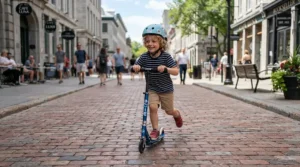
Most children are ready for a 2-wheel scooter for older children somewhere around age 5 to 7. The tell-tale signs are confident balance on three wheels, steering without leaning on you, and a habit of outgrowing the handlebar. Two-wheelers are turn-to-steer, so the handlebar moves the front wheel as on a bike. That gives tighter control but less forgiveness.
Our 2-wheel options are the Micro Sprite, Globber Flow Foldable 125 and Lilo & Stitch Light Up Folding In-Line Scooter. For a child aged 8 or over who wants more speed, MadeForMums also rates the Micro Classic Neochrome. It has bigger 20cm wheels, a one-click fold, a built-in kickstand and a 100kg rider limit, though it weighs about 4.7kg and sits at the premium end.
For a nervous switcher, the Lilo & Stitch Light Up Folding In-Line Scooter is a cheap trial. For a confident six-year-old, the Globber Flow Foldable 125 offers the best value. For a child who’ll scoot daily for years, the Micro Sprite offers the best weight-to-durability balance. Whichever you choose, a helmet and gloves matter more than the logo on the deck.
School Bag Compatibility: Making the School Run Work
School bag compatibility is the unglamorous feature that decides whether a scooter survives September. A scooter that cannot travel with a book bag, PE kit and lunchbox becomes the thing you carry on top of everything else.
Folded lengths on these models run around 65cm for the Micro Sprite, which will not fit inside a standard rucksack. So the realistic approach is to carry it, hook it, or wear it. The Trunki Folding Scooter wins on carrying, because its strap converts to a carry strap that frees your hands. The Mini Micro Suitcase Scooter solves the problem directly with its 13-litre case, suited to nursery and Reception loads rather than a full Year 4 bag.
For older children, school bag compatibility is mostly about balance. A heavy rucksack on a 2-wheel scooter shifts the centre of gravity, so choose a stable deck such as the Globber Flow Foldable 125 and encourage a snug, two-strap carry. Check your school’s scooter policy too, since many ask for scooters to be folded or parked in a designated area.
Compact Storage: Where Does a Folded Scooter Actually Live?
Compact storage is where folding earns its keep. Without it, scooters pile up in hallways like a game of Jenga played by toddlers.
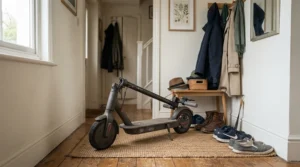
The Yvolution Y Glider NUA has the best answer: a hanging slot that lets it live on a wall hook, using vertical space most homes ignore. The Micro Sprite stands when folded, so it slots into a cupboard or against a wall without toppling. The Globber Flow Foldable 125 has self-standing and trolley modes. The Mini Micro Suitcase Scooter folds to about 51 x 30 x 25cm, small enough for a wardrobe shelf or car boot.
For compact storage at school, check where scooters are kept and whether a folded model gets you into the cloakroom rather than the bike shed. Also think about drying space. A damp scooter folded into a dark cupboard is a rust recipe, so give it somewhere ventilated.
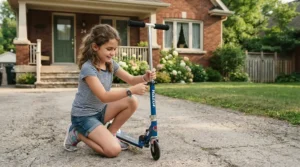
Folding vs Fixed-Frame Scooter: Is the Fold Worth Paying For?
| Feature | Folding Scooter | Fixed-Frame Scooter | Children’s Bicycle |
|---|---|---|---|
| Carrying | Folds to under-arm size | Awkward, no collapse | Bulky, heavy |
| Storage | Cupboard, wall or boot | Hallway space | Shed or garage |
| Durability | Hinge is a wear point | Fewer moving parts | Many components |
| Public transport | Easy | Difficult | Often restricted |
| Best For | Mixed-journey families | Pure park scooting | Longer distances |
The honest trade-off is the hinge. A fixed frame has fewer parts to fail, but a folding scooter for kids can go places the fixed ones can’t. That includes the bus, the boot and the classroom cupboard. If your child only scoots at the park, a fixed frame is simpler. If the scooter has to share life with a rucksack, a buggy or a small flat, the fold pays for itself. Among our picks, the Maxi Micro Deluxe Foldable LED shows the hinge can be engineered robustly, though at a price.
Long-Term Cost of a Folding Scooter for Kids
Judge a folding scooter for kids on cost-per-year, not sticker price. As an illustration, a scooter costing around £120 that lasts four years works out at about £30 a year. A £35 model replaced after one scuffed season costs more over the same period.
| Tier | Price Range | Models | Value Logic | Best For |
|---|---|---|---|---|
| Budget | Under £40 | Lilo & Stitch Light Up Folding In-Line Scooter | Low outlay, shorter lifespan | Trial runs, one-season fun |
| Value | £60-£90 | Globber Flow Foldable 125, Trunki Folding Scooter | Good features for the money | Everyday school runs |
| Mid-premium | £100-£150 | Micro Sprite, Yvolution Y Glider NUA, Mini Micro Suitcase Scooter | Longer age range or special feature | Long-term or specialist use |
| Premium | £150+ | Maxi Micro Deluxe Foldable LED | Durable, hand-me-down friendly | Families with siblings |
The table shows the value tier is where most families will land. If you expect to hand a scooter down, a premium model’s upfront cost spreads thinner. Maintenance is cheap either way: check bolts, keep bearings dry and replace worn brakes. Micro advertises replaceable parts as part of its “built to last” approach, and MadeForMums recommends choosing models with spare parts available.
Safety, Standards and the E-Scooter Law
Folding doesn’t change the safety basics. Children should wear a well-fitted helmet, closed shoes and, ideally, gloves. Start on smooth, quiet surfaces away from traffic. Look for UKCA or CE marking and a clearly stated maximum rider weight, and don’t exceed it.
One legal point trips parents up. Non-motorised kick scooters like those in this guide are not the same as electric scooters. Under GOV.UK’s guidance on powered transporters, privately owned e-scooters may only be used on private land with the landowner’s permission. They are not allowed on public roads, pavements or cycle lanes. That includes children’s electric models, which is why MadeForMums notes that kids’ e-scooters like the Zinc E4 Max are for private property only.
Manual folding scooters are generally fine on pavements and in parks, though be considerate to pedestrians and check local byelaws and school policy. If your child gets hooked on speed, a larger-wheel manual scooter such as the Micro Classic Neochrome is a legal step up, whereas an electric model is not.
Your First 30 Days: Setup, Fold Practice and Maintenance
A scooter that is set up well in week one tends to survive to month twelve. Here is a practical plan.
Day 1: set up and check.
- Check that every bolt and the stem clamp are tight.
- Set the handlebar near your child’s waist height, as MadeForMums recommends.
- Test the brake before the first ride.
Week 1: fold practice.
- Let your child fold and unfold it ten times in the hallway. This is where a one-step folding mechanism proves its worth.
- Practise carrying it with the strap or under one arm.
- Teach “fold before the gate” as a school-run habit.
Weeks 2-4: ride and review.
- Sustrans’ beginner’s guide to learning to ride a scooter is a good companion for building confidence.
- Re-check bolts after the first week of real use.
- Wipe the deck and wheels after wet rides, and store the scooter somewhere dry.
Common first-month mistakes: leaving it outside in the rain, ignoring a loose stem, and letting a child outgrow the handlebar height. Fixing any of these takes minutes, whereas ignoring them can shorten a scooter’s life considerably.
Real-World Scenarios: Which Family Are You?
Scenario 1: the walk-to-school five-year-old. You’re walking 0.8 miles, carrying a book bag, and your child scoots daily. Budget is flexible. The Maxi Micro Deluxe Foldable LED suits a family wanting a durable, single-click fold. The Trunki Folding Scooter is the cheaper pick if the carry strap matters most, since it will hang on a school peg.
Scenario 2: the Year 5 bus-and-scoot commuter. Your ten-year-old scoots to a bus stop three days a week and needs something light and tough. The Micro Sprite is the sensible match, as it is the lightest 2-wheel option and stands when folded at the bus. The Globber Flow Foldable 125 is the value alternative if you want a roomier deck and the trolley mode.
Scenario 3: the small flat and the tight budget. You have no hallway to speak of and a six-year-old who is scooter-curious. The Yvolution Y Glider NUA hangs on the wall if you can stretch the budget. The Lilo & Stitch Light Up Folding In-Line Scooter is the cheap trial if you can’t, and it folds quickly into a corner.
Bonus: the holiday family. If you travel often with a under-six, the Mini Micro Suitcase Scooter doubles as hand luggage, which neatly solves two problems at once.
FAQ
❓ What is the lightest folding scooter for kids?
❓ Which 2-wheel scooter for older children folds without tools?
❓ Can a folding scooter for kids fit in a school bag?
❓ How much should I spend on a folding scooter for kids in the UK?
❓ Is a one-step folding mechanism safe for young children?
Conclusion
The best folding scooter for kids is the one your child will actually carry, fold and ride, so match the model to your family’s day rather than the hype. Choose the Maxi Micro Deluxe Foldable LED for a durable one-click fold, or the Micro Sprite for the lightest 2-wheel build. The Globber Flow Foldable 125 is the value pick for a first 2-wheel scooter for older children. The Trunki Folding Scooter wins on carrying, the Yvolution Y Glider NUA on compact storage, the Mini Micro Suitcase Scooter on bags and travel, and the Lilo & Stitch Light Up Folding In-Line Scooter on price.
Whatever you choose, test the fold, check the weight against your own arm and set the handlebar to waist height. Keep an eye on the minimum and maximum rider weights, and add a helmet to the basket. Your child gets independence, you get a lighter school run, and the hallway stays walkable.
Recommended for You
- Stunt Scooter Vs Standard Scooter: 7 Best Picks For UK (2026)
- Budget Stunt Scooter: 7 Proven Picks Worth Buying (2026)
- Stunt Scooter For Beginners: 7 Best Picks For UK Riders (2026)
Disclaimer: This article contains affiliate links. As an Amazon Associate, I earn from qualifying purchases. If you purchase products through these links, we may earn a small commission at no additional cost to you.
✨ Found this helpful? Share it with your friends! 💬🤗
