In This Article
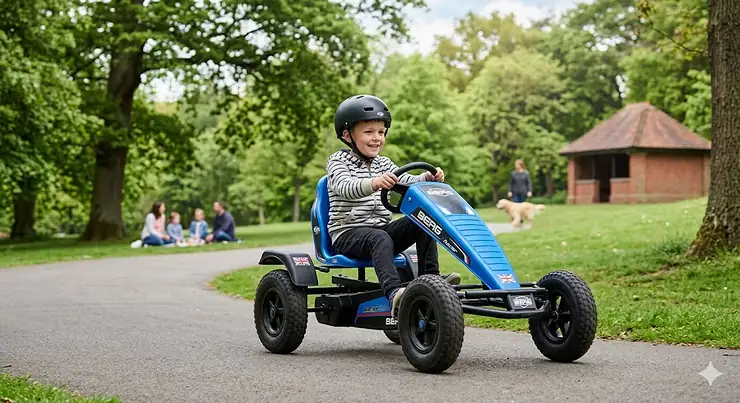
Picture this: it’s a drizzly Saturday morning in suburban Manchester, and whilst half the neighbourhood kids are glued to their tablets, your children are tearing around the garden in a pedal go kart, legs pumping furiously, faces flushed with genuine excitement. No charging cables. No battery anxiety. Just pure, unadulterated fun powered by nothing more than their own two legs.
I’ve spent the better part of two decades watching outdoor play trends come and go, and I can tell you with absolute certainty—pedal go karts are having a rather spectacular moment right now. According to the NHS guidelines for children’s physical activity, kids aged 5-18 need at least 60 minutes of moderate-to-vigorous exercise daily. A pedal go kart ticks that box brilliantly whilst feeling nothing like a chore.
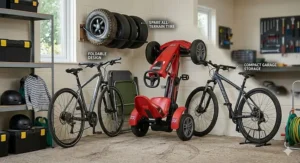
What most parents overlook is the sheer practicality of these machines in British conditions. Unlike electric ride-ons that sulk in damp weather and need mollycoddling through our six-month drizzle season, a decent pedal go kart thrives in the chaos of British family life. Small garden? Compact storage becomes essential. Terraced house with limited outdoor space? You need something that earns its footprint. Concerned about screen time? This is your antidote, wrapped in steel tubing and equipped with proper rubber tyres.
In this comprehensive guide, I’ll walk you through the seven best pedal go karts available on Amazon.co.uk in 2026, covering everything from budget-friendly options starting around £80 to premium BERG models that’ll handle everything from your patio to the local park’s muddy paths. Whether you’re shopping for a determined three-year-old or a lanky twelve-year-old who’s outgrown their last kart, we’ve got you covered with real-world insights you won’t find on product listing pages.
Quick Comparison: Top Pedal Go Karts at a Glance
| Model | Age Range | Price Range (£) | Key Feature | Best For |
|---|---|---|---|---|
| BERG Buddy | 3-8 years | £300-£400 | BFR system, pneumatic tyres | Growing families needing longevity |
| BERG Rally | 4-12 years | £400-£550 | Off-road capability, adjustable seat | Adventurous kids, mixed terrain |
| HOMCOM Racing Style | 3-8 years | £80-£120 | Budget-friendly, EVA wheels | First-time buyers, smooth surfaces |
| HOMCOM Professional | 5-12 years | £100-£150 | Inflatable rubber tyres, handbrake | Value seekers wanting durability |
| vidaXL Pedal Kart | 3-5 years | £70-£100 | Enclosed chain, basic design | Toddlers, occasional use |
| BERG XL Basic Pure | 5+ to adult | £500-£700 | XXL frame, swing axle | Multi-generational use, taller riders |
| Kettler Kettcar (when available) | 3-8 years | £250-£350 | German engineering, freewheel | Quality-focused parents |
From this comparison, it’s immediately clear that BERG dominates the premium end with superior engineering that justifies the extra £200-£300 over budget alternatives. However, for families wanting to test the waters before committing serious money, the HOMCOM Racing Style offers remarkable value under £120—just don’t expect it to survive the rigours of daily abuse from multiple children over several years. The sweet spot for most British families sits in the £150-£300 range, where you’re getting proper pneumatic tyres and metal frames without paying for BERG’s premium cachet.
💬 Just one click — help others make better buying decisions too! 😊
Top 7 Pedal Go Karts: Expert Analysis for UK Buyers
1. BERG Buddy Pedal Go Kart
The BERG Buddy stands as the gold standard for families who want to buy once and pass down through siblings. This Dutch-engineered kart features the renowned BFR (Brake, Freewheel, Reverse) hub system—meaning your child pedals forward, brakes by back-pedalling, and can reverse by continuing to pedal backwards after stopping. It sounds simple, but the mechanical elegance eliminates the hand-strength issues younger children face with conventional handbrakes.
The adjustable seat slides into six positions, genuinely growing from age 3 through to age 8—that’s five years of use, which works out to around £60-£80 per year when you factor in the typical price range of £300-£400. The pneumatic tyres absorb the bumps beautifully, which matters enormously when you’re navigating British pavements with their frost-heaved cracks and uneven surfaces. The swing axle keeps all four wheels planted even when cornering aggressively, preventing the tippy feeling cheaper karts exhibit.
UK buyers particularly appreciate the sealed bearing hubs—you won’t be re-greasing every 500 miles, rather important when riding through our perpetual drizzle and the occasional biblical downpour. Customer feedback consistently mentions the kart’s ability to handle garden lawns, gravel driveways, and tarmac paths equally well, making it genuinely versatile for British suburban life where you might transition from grass to pavement multiple times per ride.
Pros:
✅ BFR system eliminates hand-strength requirements for young children
✅ Pneumatic tyres and swing axle deliver superior ride quality on mixed British terrain
✅ Six-position seat adjustment provides genuine 5+ years of use across growing children
Cons:
❌ Premium pricing puts it out of reach for families on tight budgets
❌ Weight (around 25kg) makes it challenging for very young children to manoeuvre solo
Value verdict: At the £350 mark, it’s not cheap, but amortised over five years and two-plus children, it represents solid value for quality-focused families.
2. BERG Rally Pedal Go Kart
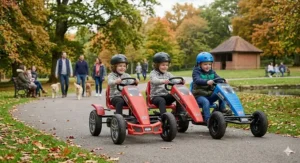
Think of the Rally as the Buddy’s adventurous older sibling. Designed for ages 4-12, it extends the upper age range considerably, which is brilliant for families with older children or those planning to keep the kart in service through pre-teen years. The off-road tyres are genuinely chunkier than the Buddy’s, with deeper tread that grips muddy paths and wet grass—essential if you’re anywhere near the countryside or have a larger garden that gets soggy in our British winter.
The frame sits slightly higher, and the steering geometry feels more responsive, which older children appreciate when they’re racing mates around the park. Where it particularly shines is tackling slopes—the three-speed BFR-3 system on select Rally models provides gearing options, making uphill pedalling significantly easier. This matters if you live in hilly areas like Bath, Sheffield, or Edinburgh’s suburbs, where a single-speed kart quickly becomes exhausting for children.
UK retailers report strong sales in semi-rural areas where families want one kart that transitions from garden to local footpaths and bridleways. The adjustable seat extends even further than the Buddy’s, and I’ve seen ten-year-olds comfortably riding these without looking cramped. The trade-off is price—you’re looking at £400-£550 depending on colour and optional features like the three-speed system.
Pros:
✅ Extended age range (4-12 years) provides exceptional longevity
✅ Off-road tyres and robust construction handle British countryside conditions brilliantly
✅ Optional three-speed system makes hills manageable in challenging terrain
Cons:
❌ Higher price point requires serious budget commitment
❌ Larger footprint demands more storage space—awkward in terraced housing
Value verdict: Worth the premium if you’ve got the outdoor space and children who’ll genuinely use it for adventurous play beyond the garden.
3. HOMCOM Racing Style Pedal Go Kart
Here’s where we enter budget-friendly territory without completely sacrificing quality. The HOMCOM Racing Style typically retails around £80-£120, making it roughly a quarter of the BERG Buddy’s price. What you’re getting is a steel frame, EVA foam wheels (not pneumatic), an adjustable seat, and a functional handbrake—the essentials, competently executed.
The EVA wheels are the telling compromise. They’re puncture-proof and maintenance-free, which sounds wonderful until you ride over anything rougher than smooth tarmac. On paving slabs and garden paths, they’re perfectly adequate. On grass, gravel, or uneven surfaces, the lack of air cushioning becomes apparent—the ride’s considerably harsher, and younger children feel every bump. For families with primarily smooth surfaces (patios, driveways, quiet cul-de-sacs), this isn’t a dealbreaker.
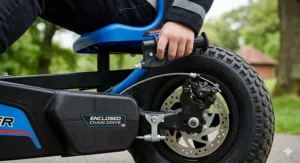
What HOMCOM gets right is the aesthetic—the racing stickers and sporty design genuinely appeal to the 3-8 age bracket. The enclosed chain prevents trousers getting caught, a thoughtful safety feature. UK reviews split fairly evenly: budget-conscious parents praise the value, whilst quality-focused buyers note that intensive use reveals the limitations within 12-18 months. It’s genuinely best suited as a first kart to gauge whether your child will actually use it before committing to premium alternatives.
Pros:
✅ Entry-level pricing makes it accessible for families testing whether go-karts suit their children
✅ EVA wheels are genuinely maintenance-free and won’t puncture
✅ Enclosed chain prevents clothing entanglement—important safety feature
Cons:
❌ EVA wheels provide noticeably harsh ride on anything beyond smooth surfaces
❌ Build quality acceptable but won’t withstand years of intensive multi-child use
Value verdict: Excellent entry point around £100, but view it as a 1-2 year investment rather than a long-term family asset.
4. HOMCOM Professional Pedal Go Kart
HOMCOM’s step-up model addresses the main weakness of their budget line: the wheels. The Professional version features inflatable rubber tyres, immediately improving ride quality on mixed surfaces. You’re looking at £100-£150 typically, positioning it as the sweet spot for value-conscious British families who want something better than the basic model without approaching BERG pricing.
The steel frame feels more substantial than the Racing Style, and the handbrake mechanism is noticeably more robust. The adjustable seat accommodates ages 5-12, though realistically, larger eleven and twelve-year-olds will find it cramped. Where it genuinely excels is durability—UK customer reviews consistently report 2-3 years of regular use without major issues, which is respectable at this price point.
The inflatable tyres transform the riding experience, particularly on British lawns and gravel. You’ll need to check pressure periodically and carry a pump, but the comfort improvement justifies the minimal maintenance. One quirk worth noting: the assembly instructions could charitably be described as “interpretive art”—budget an extra hour beyond the stated assembly time and perhaps enlist YouTube tutorials.
Pros:
✅ Inflatable rubber tyres deliver proper cushioning on varied British terrain
✅ Mid-range pricing (£100-£150) offers solid value without premium costs
✅ Proven 2-3 year durability with regular use based on UK customer feedback
Cons:
❌ Assembly instructions notoriously unclear—plan extra time
❌ Upper age limit (12 years) understates reality; cramped for larger pre-teens
Value verdict: Best all-rounder in the £100-£150 bracket—genuine tyres elevate it beyond budget competition.
5. vidaXL Pedal Go Kart
The vidaXL represents the absolute entry level, typically found around £70-£100. It’s specifically designed for ages 3-5, and that age bracket is genuinely accurate—don’t expect a six-year-old to fit comfortably. The enclosed chain and basic steel construction handle light use adequately, making it suitable for occasional garden play rather than daily thrashing.
What you’re essentially buying is a toe-in-the-water option for toddlers. If your three-year-old shows genuine enthusiasm and uses it regularly, you’ll likely upgrade to something more substantial within 18 months. If they lose interest quickly, you’ve only invested £70-£100 rather than £300-£400. That’s the honest calculus here—it’s an affordability-driven decision, not a quality-driven one.
The plastic seat and basic construction mean it won’t survive British weather without shelter. Store it in a shed or garage; leave it outside through our damp autumn and winter, and rust will compromise the frame within a year. UK buyers in flats or homes without storage should seriously consider whether they can protect this adequately—the money saved upfront evaporates if the kart degrades in six months.
Pros:
✅ Lowest price point (£70-£100) minimises financial risk for uncertain buyers
✅ Enclosed chain prevents toddler clothing entanglement
✅ Adequate for light, occasional use by 3-5 year olds
Cons:
❌ Limited durability—unsuitable for intensive daily use or multiple children
❌ Requires indoor storage; British weather accelerates deterioration significantly
Value verdict: Sensible budget option for testing toddler interest, but understand it’s a short-term solution.
6. BERG XL Basic Pure Pedal Go Kart
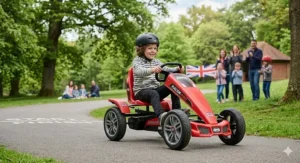
Now we enter the realm of serious family investment. The XL Basic Pure targets ages 5+ through to adults, featuring an extended XXL frame with eight seat positions instead of the standard six. I’ve personally witnessed a 6ft-2in adult riding these comfortably, which is remarkable—this genuinely becomes a multi-generational garden toy rather than something that sits unused once children outgrow it.
The pneumatic tyres are larger than the Buddy’s, the swing axle more sophisticated, and the overall build quality immediately apparent when you first handle one. The BFR system operates identically to smaller BERG models but feels more refined due to the precision engineering. At £500-£700, this sits firmly in premium territory—you’re not just buying a children’s toy; you’re investing in a durable outdoor activity centre for the entire family.
British families with larger gardens particularly appreciate the adult ridability. Parents can actually join in rather than just supervising, which transforms it from a child’s toy into a family activity. The extended frame also means older children (10-14 years) have proper room to grow, unlike mid-range karts where they’re cramped by age eleven. One practical consideration: the larger footprint demands serious storage space—measure your shed before purchasing.
Pros:
✅ Genuine multi-generational use from children through to adults
✅ Eight seat positions provide exceptional growth accommodation
✅ Premium BERG engineering delivers superior longevity—10+ year lifespan typical
Cons:
❌ Premium pricing (£500-£700) requires significant budget commitment
❌ Larger dimensions demand substantial storage space
Value verdict: Expensive upfront but extraordinary value when viewed as a 10-15 year family investment across multiple users.
7. Kettler Kettcar Pedal Go Kart
Kettler’s German-engineered karts deserve mention, though availability on Amazon.co.uk fluctuates considerably in 2026. When in stock, they typically price around £250-£350, positioning between HOMCOM’s mid-range and BERG’s premium offerings. The distinctive feature is Kettler’s freewheel mechanism and dual-brake system—children can coast without pedalling, then brake using either pedals or a separate hand lever.
The build quality reflects German precision manufacturing, with particular attention to bearing quality and frame welding. UK buyers who’ve owned both Kettler and BERG models report comparable durability, though BERG’s BFR system generally receives preference for younger children due to simplicity. Kettler’s advantage emerges with older children who appreciate the coasting ability during downhill runs.
The challenge is supply—Kettler withdrew from the UK market briefly post-Brexit, and whilst models reappear periodically, consistent availability remains elusive. If you find one at a reasonable price and it suits your child’s age range, it’s genuinely worth considering. Just verify the seller’s return policy given the supply uncertainty.
Pros:
✅ German engineering delivers precision build quality
✅ Freewheel mechanism appeals to older children wanting coasting capability
✅ Dual-brake system provides flexibility for different riding styles
Cons:
❌ Inconsistent UK availability makes purchasing uncertain
❌ Replacement parts harder to source than BERG equivalents
Value verdict: Excellent when available, but supply uncertainty makes BERG the safer choice for most UK buyers.
✨ Don’t Miss These Exclusive Deals!
🔍 Take your outdoor play to the next level with these carefully selected products. Click on any highlighted item to check current pricing and availability on Amazon.co.uk. These picks will help you find exactly what you need!
Pedal vs Electric: Why Manual Go Karts Win in British Conditions
Every week, parents ask me whether they should choose a pedal go kart or splash out on an electric model. Here’s the honest answer: for British weather and typical family usage patterns, pedal karts win on nearly every practical measure.
The Battery Reality
Electric go karts sound brilliant until you experience the British winter. Lithium batteries lose 20-30% capacity in cold temperatures, meaning the advertised 60-minute runtime becomes 40 minutes in November. Factor in our damp conditions, and you’re constantly managing charging schedules and worrying about leaving the battery in unheated garages overnight. A pedal go kart? Utterly indifferent to temperature. Rain-soaked? Dry it off and carry on.
The Maintenance Gap
I’ve seen countless electric karts languishing in British sheds because the battery died during winter storage and replacement costs £80-£150—sometimes half the original purchase price. Pedal karts demand almost nothing: occasional chain lubrication (every few months), tyre pressure checks for pneumatic wheels, and that’s genuinely it. No chargers to misplace, no batteries gradually losing capacity, no motors failing after warranty expires.
The Exercise Equation
The NHS recommends children get 60 minutes of moderate-to-vigorous physical activity daily. An electric go kart provides zero exercise—it’s essentially a slow mobility scooter for children. A pedal go kart? Brilliant cardiovascular workout disguised as play. Your eight-year-old will build leg strength, improve coordination, and meet their activity requirements whilst having genuine fun. They won’t notice they’re exercising; you’ll notice they sleep better and have more energy for focused activities like homework.
The Cost-Per-Use Calculation
Electric karts typically cost £200-£500, last 2-3 years before battery replacement becomes necessary, and provide zero physical activity. Pedal karts cost £80-£700 depending on quality tier, last 5-10+ years with minimal maintenance, and deliver genuine exercise. The maths rather speaks for itself—even a premium £500 BERG spread over 10 years costs £50 annually, whilst a £300 electric kart requiring a £120 battery replacement every 3 years costs £80 annually whilst providing less value.
That’s not to say electric karts are worthless—they suit specific scenarios like children with mobility challenges or families wanting speed thrills. But for the typical British family seeking outdoor play that’s weather-resistant, maintenance-light, and genuinely beneficial for children’s health, pedal go karts triumph decisively.
How to Choose the Right Pedal Go Kart for British Gardens
1. Match the Age Range Accurately
Don’t buy aspirationally. If the product says “ages 5-12,” and your child is four, they’ll struggle with the size and pedal reach. Conversely, an eleven-year-old purchasing a “3-8” model will outgrow it within months. BERG’s adjustable seats genuinely accommodate their stated ranges; budget brands tend to overestimate, so subtract a year from their upper limit for realistic fit.
2. Assess Your Actual Terrain
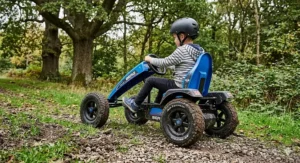
Be honest about where your children will predominantly ride. Smooth patio and driveway? EVA wheels work adequately and save £50-£100. Garden lawn, gravel drive, and local paths? Pneumatic tyres become essential—the comfort difference is night-and-day on British surfaces. Live near countryside with bridleways and muddy tracks? Invest in off-road models like the BERG Rally with aggressive tread patterns.
3. Storage Space Dictates Size
Measure your shed, garage, or storage area before purchasing, particularly for XL/XXL models. A BERG XL measures roughly 130-150cm long—fine in a detached house garage, awkward in a Victorian terraced garden shed. Also consider access: can you actually get a fully-assembled kart through your side gate and into the garden, or will you be disassembling it seasonally?
4. Budget for Your Family Structure
Single child who’ll use it ages 4-8? Mid-range £150-£300 models offer best value. Multiple children spanning ages 3-12? Premium £400-£700 models with extended age ranges become economical when serving three children over a decade. Testing the waters with a three-year-old? Budget £70-£120 options minimise risk if they lose interest.
5. Weather Protection Requirements
British climate demands consideration. If you’ve got indoor storage (garage, large shed), any model works. If the kart lives outdoors under a cover, invest in models with sealed bearings and rust-resistant frames—basically, avoid the absolute budget tier. Coastal areas with salt air? Premium models with corrosion-resistant components become worth the extra investment.
6. Safety Features for Your Location
Handbrakes vs BFR systems matter based on your terrain. Flat suburban estate with gentle slopes? Either works fine. Hilly area with steep drives or sloping gardens? BFR systems (or robust handbrakes on mid-range models) become essential for safe stopping. Also consider visibility if children ride on quiet residential roads—bright colours and reflective stickers improve driver awareness. While pedal go karts fall under toy safety standards rather than playground equipment regulations, the same principles of age-appropriate design and risk assessment apply.
7. Long-Term Value vs Initial Cost
The cheapest upfront option rarely proves cheapest over time. A £70 kart lasting 18 months across one child costs £46 per year. A £400 BERG serving two children for 8 years costs £25 per year per child. Factor in maintenance (essentially nil for pedal karts), no battery replacements, and resale value (premium karts hold value surprisingly well), and the total cost picture often favours buying better once.
Common Mistakes British Parents Make When Buying Pedal Go Karts
Underestimating British Weather Impact
The single biggest error is treating garden toys as if we have California sunshine. Leaving even premium karts exposed to British rain, frost, and damp will compromise components faster than you’d believe. Budget £30-£50 for a proper waterproof cover if you lack indoor storage, and expect to wipe down and oil the chain several times annually. Coastal areas are particularly harsh—salt air accelerates rust even on decent frames.
Ignoring the Assembly Reality
Manufacturers claim “30-60 minute assembly,” which translates to 90-120 minutes for most parents working from those charming instruction diagrams that appear designed by someone who’s never actually assembled the product. Budget proper time, enlist YouTube tutorials for your specific model, and don’t attempt it late at night before a birthday party—that way lies relationship-testing frustration and missing bolts discovered at midnight.
Buying Based on Amazon Photos Alone
Product images show karts on perfect lawns under ideal lighting. Reality involves British gardens with patchy grass, gravel areas, and uneven paving. Read actual UK customer reviews—specifically ones mentioning terrain types and weather conditions—rather than trusting the promotional materials. Look for reviews from British buyers in similar housing types (terrace, semi, detached) to yours for most relevant insights.
Overlooking the UKCA Marking
Post-Brexit, proper toys sold in Great Britain should display UKCA marking confirming safety compliance. Budget imports sometimes skip this, which matters if anything goes wrong—insurance and liability become complicated without proper certification. Stick with established brands selling through legitimate UK Amazon channels rather than third-party imports from unclear origins. Research from the University of Exeter found that over a third of children don’t play outdoors after school, highlighting why investing in quality outdoor play equipment matters for children’s physical and mental development.
Misjudging Indoor/Outdoor Balance
Pedal karts are outdoor toys fundamentally. Yes, some parents allow usage in garages or large conservatories during winter, but these aren’t lounge-friendly items. If you’ve got minimal outdoor space (small courtyard garden, no nearby parks), seriously consider whether a pedal kart suits your situation. They need room to build up speed and manoeuvre—cramped spaces quickly lead to frustrated children and shelved karts.
Forgetting Second-Hand Value
Premium brands (particularly BERG) hold resale value remarkably well. A well-maintained £400 BERG sells for £200-£250 after 5 years on Facebook Marketplace or eBay, effectively halving your net cost. Budget brands lose value precipitously—that £80 HOMCOM might fetch £20-£30 if it’s still functional. Factor resale potential when calculating true ownership cost, especially for quality-tier purchases.
Real-World Scenarios: Matching Karts to British Family Life
The Semi-Detached Suburban Family (Birmingham)
Profile: Two children (ages 5 and 8), small-to-medium garden with patio and lawn, single-car garage with limited storage, budget-conscious.
Recommendation: HOMCOM Professional (£100-£150). The inflatable tyres handle their mixed lawn/patio terrain adequately, both children fit the age range, and the price point leaves budget for protective storage cover. In 2-3 years when the younger child outgrows it, they’ll resell for £30-£40 and upgrade to a BERG with expanded savings.
Why not budget tier: Their small garden means intensive use—the £70 models won’t survive two active children sharing daily.
Why not premium: Limited storage space makes the XL models impractical, and their garden size doesn’t justify £400+ investment.
The Rural Cotswolds Family
Profile: Three children (ages 4, 7, 11), large garden and access to country footpaths, detached house with double garage, quality-focused.
Recommendation: BERG Rally with BFR-3 system (£450-£550). The off-road tyres and gearing handle local countryside perfectly, the age range covers all three children (the 4-year-old will grow into it), and they’ve got storage space. This becomes a 10-year investment serving all three children plus potential resale value or even grandchildren eventually.
Why not mid-range: With three children and countryside terrain, cheaper models would face intensive abuse and fail within 2 years.
Why not budget: Simply won’t survive the usage demands or rough terrain.
The London Terrace Family
Profile: Single child (age 6), tiny courtyard garden, street parking only, limited storage, nearby parks.
Recommendation: BERG Buddy (£300-£400) with weatherproof cover. Despite the premium price, the sealed bearings and quality construction handle street storage better than budget alternatives. The child will use it in nearby parks rather than the small garden, so portability and durability matter more than initial cost. Consider it a 5-year park-based activity investment.
Why not larger models: Simply won’t fit in courtyard storage.
Why not budget: Street storage (even covered) demands better weather resistance than cheap frames provide.
Long-Term Cost & Maintenance in the UK
Let’s talk money with brutal honesty. The purchase price tells only part of the ownership story. Here’s what actual British families spend over a typical 5-year ownership period:
Budget Tier (£70-£120 models)
- Initial cost: £95 average
- Replacement parts (wheels, chains): £20-£30 over 2 years
- Likely replacement needed after 2 years with intensive use
- Total 5-year cost: £95 initial + £25 parts + £95 replacement = £215
- Cost per year: £43
Mid-Range (£150-£300 models)
- Initial cost: £200 average
- Replacement parts: £15-£25 over 5 years (primarily tyres)
- Weather cover: £35
- Total 5-year cost: £260
- Cost per year: £52
Premium (£400-£700 models)
- Initial cost: £550 average
- Replacement parts: £20-£30 over 10 years
- Weather cover: £50 (larger size)
- Resale value after 5 years: -£250
- Total 5-year cost: £370
- Cost per year: £74
The numbers reveal something fascinating: premium models cost £74 annually whilst mid-range costs £52—a £22 difference that buys significantly better quality, longer lifespan, and substantial resale value. The budget option appears cheapest annually (£43) but delivers the shortest usable life and worst resale value.
Maintenance Reality Check
Regardless of tier, actual maintenance proves minimal:
- Chain lubrication: 3-4 times annually (£5 spray lasts years)
- Tyre pressure checks: monthly for pneumatic wheels
- Annual frame inspection: 10 minutes checking for rust spots
- Bolt tightening: twice yearly, 15 minutes
Total annual maintenance time: under 2 hours. Total maintenance cost: under £10 annually. This contrasts sharply with electric ride-ons requiring battery management, charging schedules, and eventual £80-£150 battery replacement.
FAQ: Your Pedal Go Kart Questions Answered
❓ Are pedal go karts safe for UK pavements and roads?
❓ How do pedal go karts handle British rain and damp conditions?
❓ What's the minimum garden size needed for a pedal go kart?
❓ Can adults actually ride children's pedal go karts safely?
❓ Do pedal go karts need assembly, and how difficult is it?
Conclusion: Choosing Your Family’s Perfect Pedal Go Kart
After two decades watching outdoor play trends evolve, I’m more convinced than ever that pedal go karts represent one of the smartest investments British families can make. They hit that rare sweet spot: genuinely fun for children, physically beneficial, weather-resistant, maintenance-light, and durable enough to serve multiple children over years.
The choice ultimately hinges on your specific circumstances. Budget-conscious families testing the waters? The HOMCOM Racing Style around £100 provides adequate entry without serious commitment. Families with multiple children wanting 5+ years of service? The BERG Buddy or Rally models justify their £300-£550 pricing through superior engineering and longevity. Single-child families in compact urban settings? Mid-range options like the HOMCOM Professional at £150 balance quality and practicality.
What you absolutely shouldn’t do is dismiss pedal go karts as old-fashioned in our increasingly electric world. The simplicity is their genius—no batteries dying mid-ride, no charging schedules disrupting spontaneous play, no motors failing after warranty expiration. Just reliable, engaging physical activity that meets NHS exercise recommendations whilst feeling nothing like exercise to children.
The British climate we all complain about actually favours pedal karts over electric alternatives. Damp autumn mornings that devastate battery performance? Pedal karts don’t notice. February frost that halves electric runtime? Irrelevant when you’re human-powered. Summer downpours that send electric riders scrambling? A bit of rain never hurt a decent pedal kart.
Start with honest assessment of your family’s needs: children’s ages, available space, terrain types, storage options, and realistic budget. Then choose accordingly from our reviewed options. Remember that buying quality once typically costs less over time than replacing budget alternatives repeatedly. Your children won’t care about the brand name—they’ll care whether it’s fun, fits properly, and handles their favourite riding spots reliably.
That’s genuinely all that matters: happy children pedalling furiously around gardens and parks, building strength and coordination whilst creating the sort of screen-free childhood memories that actually last. The rest is just details.
Recommended for You
- 24v vs 12v Go Kart: 7 Best UK Models Compared 2026
- Best 24v Electric Go Kart UK 2026: 7 Racing Karts for Kids
- 7 Best 12V Go Kart for Kids UK 2026
Disclaimer: This article contains affiliate links. As an Amazon Associate, I earn from qualifying purchases. If you purchase products through these links, we may earn a small commission at no additional cost to you.
✨ Found this helpful? Share it with your mates! 💬🤗
