
In This Article
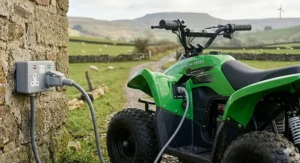
Picture this: it’s a drizzly Saturday afternoon in your back garden, and your child is beaming from ear to ear, confidently navigating their first quad bike around the lawn. But before that magical moment arrives, you’re faced with a rather critical decision — electric quad vs petrol quad for children. It’s not just about which one goes faster or costs less. In the UK, with our unpredictable weather, compact gardens, and specific legal restrictions, choosing the right quad bike for your child involves weighing up safety, running costs, maintenance demands, and whether you fancy listening to a lawn mower-level racket every weekend.

Electric quad bikes have surged in popularity across Britain, particularly for younger riders aged 18 months to around 8 years. They’re whisper-quiet, emit zero fumes, and won’t have your neighbours filing noise complaints. Petrol quads, on the other hand, deliver that authentic off-road experience with longer ride times and more robust performance for older, more experienced children. The catch? They’re louder, require regular maintenance, and need proper storage away from the elements — rather important when you’re dealing with British rain nine months of the year.
What most UK parents don’t realise is that both types are strictly confined to private land under current regulations. Children’s quad bikes cannot legally be ridden on public roads, pavements, or council-owned parks, regardless of whether they’re battery or petrol-powered. This means your investment needs to make sense for garden use, private fields, or dedicated off-road facilities. In this guide, I’ll break down the electric quad vs petrol quad for children debate with real-world insights tailored to British families, including expert analysis of seven top models available on Amazon.co.uk, running costs in pounds, and practical advice for making the right choice.
Quick Comparison: Electric vs Petrol Quads at a Glance
| Feature | Electric Quad | Petrol Quad |
|---|---|---|
| Best For | Ages 18 months – 8 years, beginners, noise-sensitive areas | Ages 8+, experienced riders, longer ride sessions |
| Typical Price Range | £55 – £200 | £400 – £900+ |
| Run Time Per Charge/Tank | 45 – 60 minutes | 2 – 4 hours |
| Refuel/Recharge Time | 8 – 12 hours | 5 minutes |
| Noise Level | Whisper-quiet (under 60dB) | Loud (85-95dB) |
| Maintenance | Minimal (battery care only) | Regular (oil, filters, spark plugs) |
| Yearly Running Cost (UK) | Around £20 – £40 in electricity | Around £80 – £150 (fuel + parts) |
| UK Weather Performance | Battery range drops 10-15% in cold/wet | Generally consistent, needs waterproofing care |
From this comparison, the trade-offs become clear. Electric quads win on convenience, cost, and neighbourly relations, whilst petrol models offer superior endurance and a more authentic riding experience. For most UK families with younger children (under 8), limited garden space, and terraced or semi-detached housing, electric quads represent the practical choice. If you’ve got older kids, acres of private land, and don’t mind a bit of mechanical tinkering, petrol quads deliver the goods.
The real deciding factor often comes down to your child’s age and riding environment. A 3-year-old navigating a compact British garden doesn’t need a petrol quad’s extended range — they’ll be perfectly content with 45 minutes of electric-powered adventure. Meanwhile, a 10-year-old tearing across a farm in rural Wales will quickly outgrow the limitations of a 6V battery-powered model.
💬 Just one click — help others make better buying decisions too! 😊
Top 7 Quad Bikes for Children: Expert Analysis
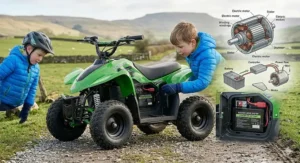
1. GYMAX Kids Electric Quad Bike 12V (£110 – £130)
The GYMAX 12V Electric Quad stands as one of the most popular choices on Amazon.co.uk for good reason — it strikes that sweet spot between features and affordability that British parents appreciate. This quad features a 12V rechargeable battery, dual speed settings (3 km/h and 6 km/h), forward and reverse functions, and enough bells and whistles (literally — it has music, lights, and a horn) to keep young riders entertained.
What sets this model apart in the British market is its build quality relative to price. The four textured tyres handle damp grass remarkably well, which matters enormously when you’re dealing with perpetually soggy British lawns from October through March. At 83L × 53W × 55.5H cm, it’s compact enough for smaller gardens yet substantial enough that it doesn’t feel like a toy. The 12V battery delivers approximately 45 minutes of ride time on a full charge, and whilst that might sound brief, it’s actually ideal for younger children whose attention spans and stamina match perfectly with that duration.
Parents on Amazon.co.uk consistently praise the GYMAX for its sturdy construction and straightforward assembly, though several UK reviewers note that the initial charge takes the full 12 hours — plan accordingly before gifting. The maximum load capacity of 25 kg suits children aged 3-7 years, and the adjustable speed limiter gives parents control as confidence grows. One aspect worth mentioning: this is an electric quad, so wet weather performance is solid, but avoid deep puddles and standing water to protect the battery housing.
Pros:
✅ Dual speed settings for gradual skill progression
✅ Bluetooth connectivity and built-in music for entertainment
✅ Excellent grip on damp British grass
Cons:
❌ 45-minute run time may feel short for enthusiastic riders
❌ Takes 8-12 hours to fully recharge
Price verdict: At around £110-£130, this offers exceptional value for families seeking a reliable first quad that’ll survive multiple British winters with proper care.
2. HOMCOM 6V Kids Electric Quad Bike ATV (£55 – £70)
For parents seeking an entry-level option that won’t break the bank, the HOMCOM 6V Quad Bike delivers surprising quality at budget-friendly prices. Available in multiple colours (red, pink, green, black), this compact quad bike suits toddlers and very young children aged 18-36 months. The 6V battery powers a single forward gear reaching speeds of 2.5-2.8 km/h — gentle enough for confident first-time riders yet thrilling enough to spark genuine excitement.
What I appreciate most about this model for the UK market is its size. Measuring just 72L × 40W × 45.5H cm, it fits comfortably in compact British gardens, sheds, and even conservatories when stored during wetter months. The four wide, wear-resistant wheels provide stability on various surfaces including paving slabs, short grass, and even indoor use (though that might test your sanity). UK reviewers on Amazon.co.uk frequently mention how easy assembly is — most report 20-30 minutes from box to first ride.
The HOMCOM runs for approximately 45 minutes per charge, and the battery takes 8-12 hours to recharge fully (first charge requires 8-9 hours). At this price point, don’t expect premium features like MP3 connectivity or multiple speeds, but the basic horn and forward-only operation keep things delightfully simple for very young riders. One consideration for British buyers: this quad performs best on dry, flat surfaces. Damp grass significantly reduces traction, so save riding sessions for those rare sunny British days or invest in an outdoor mat.
Pros:
✅ Remarkably affordable for budget-conscious families
✅ Perfect beginner size for toddlers
✅ Simple operation reduces overwhelming features
Cons:
❌ Limited to very young riders (18-36 months)
❌ Reduced performance on wet grass
Price verdict: At £55-£70, this represents excellent value for introducing toddlers to quad riding without major financial commitment. Just manage expectations around longevity — most children outgrow it within 12-18 months.
3. AIYAPLAY Honda Licensed 6V Electric Quad (£80 – £100)
The AIYAPLAY Honda Licensed Quad brings official Honda branding to the electric quad market, and whilst that might seem like mere cosmetics, the licensing actually ensures certain build quality standards. This 6V model targets the same 18-36 months age bracket as the HOMCOM but adds a touch more refinement in both design and features. The Honda branding appears prominently on the bodywork, LED headlights function during operation, and the overall aesthetic feels closer to a real quad bike.
From a British parent’s perspective, what distinguishes this model is attention to realistic details. The working horn, functional lights, and foot pedal operation (rather than hand throttle) create an authentic driving experience that genuinely engages young children. Several UK Amazon reviewers specifically mention their children’s delight at the “real bike” features. At 65.5L × 38.5W × 43.5H cm, it maintains that compact footprint essential for British gardens whilst delivering 45 minutes of ride time at speeds up to 2.8 km/h.
Assembly takes roughly 30-40 minutes, and most UK buyers report straightforward instructions, though the motor attachment (secured underneath with cable ties) occasionally confuses first-time assemblers. The textured wheels handle British lawns reasonably well in dry conditions, though wet grass remains challenging for all 6V models at this weight. One practical advantage: the relatively light construction (around 8-9 kg) means parents can easily lift and move it for storage, crucial when you’re navigating narrow British hallways and sheds.
Pros:
✅ Honda licensing adds authentic design appeal
✅ Functional lights and horn enhance realism
✅ Lightweight construction for easy storage and transport
Cons:
❌ Premium price for features that don’t extend ride time
❌ Still limited to very young children
Price verdict: At £80-£100, you’re paying a modest premium for the Honda branding and slightly better build quality. Worth it if brand authenticity matters to your family, but the HOMCOM delivers similar functionality for less.
4. COSTWAY 12V Electric Quad Bike with Music (£95 – £120)
The COSTWAY 12V Quad enters the competitive mid-range electric quad market with a compelling package of features tailored for slightly older children (ages 3-8). This model ups the ante with a more powerful 12V battery system, dual motors for improved torque, and an entertainment suite including USB port, MP3 connection, and pre-loaded music. The build feels noticeably more robust than 6V alternatives, with a maximum load capacity of 30 kg and a sturdier steel frame that British parents will appreciate during inevitable garden collisions.
What makes this particularly suitable for UK families is the adjustable speed control. You can limit maximum speed while children develop confidence, then gradually increase as skills improve — rather handy when you’re navigating a typically obstacle-laden British garden complete with flower beds, trampolines, and washing lines. The 12V system delivers speeds up to 5-6 km/h, and the dual motors maintain consistent power even on slight inclines (useful if your garden isn’t perfectly flat, which most British ones aren’t).
UK Amazon reviewers consistently praise the COSTWAY’s performance on various surfaces, with several noting it handles damp grass better than expected. The battery life averages 40-50 minutes depending on terrain and rider weight, and the 8-10 hour charging time aligns with overnight charging convenience. One aspect worth considering: at 88L × 54W × 56H cm, this quad demands slightly more storage space than compact 6V models. If you’re working with a typical British garden shed already crammed with bikes, lawn mowers, and forgotten gardening tools, measure twice before purchasing.
Pros:
✅ Dual motors provide better torque and hill-climbing ability
✅ USB and MP3 connectivity keep children entertained
✅ Adjustable speed control grows with rider confidence
Cons:
❌ Larger dimensions require more storage space
❌ Slightly shorter battery life than some 12V competitors
Price verdict: At £95-£120, the COSTWAY offers solid mid-range value, especially if your child responds well to musical entertainment during rides. The dual-motor system justifies the modest price increase over basic 12V models.
5. Maxmass 24V Electric Quad Bike (£150 – £200)
For families seeking a more powerful electric option that bridges the gap toward petrol performance, the Maxmass 24V Quad represents the upper tier of battery-powered children’s quads available on Amazon.co.uk. This beast features a 24V battery system with significantly improved speed (up to 8-10 km/h), longer run time (60-70 minutes), and build quality that approaches entry-level petrol quads. The increased voltage translates to better performance on challenging terrain, including moderate hills, longer grass, and even light mud — all scenarios you’ll encounter in typical British countryside.
What sets the Maxmass apart in the UK market is its suitability for older children (ages 5-10) who’ve outgrown 6V and 12V models but aren’t quite ready for petrol quads. The combination of higher speeds, extended battery life, and more robust construction means this quad actually delivers a genuine off-road experience rather than just garden cruising. Several UK reviewers specifically mention using these on farm tracks and designated off-road areas, where the 24V system proves its worth.
The larger footprint (approximately 95L × 60W × 60H cm) and 35 kg maximum load capacity accommodate older, heavier children comfortably. British parents should note that whilst the purchase price creeps toward petrol quad territory, the running costs remain significantly lower — roughly £30-£40 annually in electricity versus £100+ for petrol and maintenance. The 10-12 hour charging time remains a consideration, so managing expectations around daily use is important.
Pros:
✅ Significantly more power for older children
✅ 60-70 minute run time suits longer riding sessions
✅ Handles rougher terrain including hills and mud
Cons:
❌ Price approaches entry-level petrol quads
❌ Requires substantial storage space
Price verdict: At £150-£200, this represents the premium end of electric quads. Excellent value if you need electric power with near-petrol performance, but consider whether a basic petrol quad might serve better at similar prices.
6. Renegade Kids Electric Quad 1000W (£180 – £220)
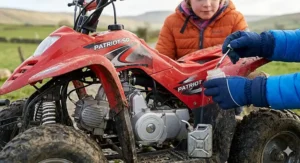
Whilst the Renegade 1000W Electric Quad isn’t always directly available on Amazon.co.uk (availability fluctuates), it’s worth mentioning as it represents the apex of children’s electric quad performance available to UK buyers through various channels. This high-specification model features a 48V battery system paired with a powerful 1000W motor, delivering speeds up to 18-20 km/h — genuinely thrilling for experienced young riders aged 8-12.
The Renegade’s British appeal lies in its build quality and feature set. Three-speed settings (approximately 5 mph, 9 mph, and 18 mph) with removable speed limiter keys give parents precise control over progression. The battery indicators show remaining charge clearly, and the 20Ah capacity delivers 60-90 minutes of riding time depending on speed settings and terrain. UK specialist retailers like Quads4Kids stock these regularly, and whilst they occasionally appear on Amazon.co.uk, checking dedicated quad bike retailers often yields better availability and support.
For British families with genuine off-road access — farms, large rural properties, designated riding areas — the Renegade bridges the gap between toy quads and proper junior ATVs. The robust construction withstands British weather admirably when properly maintained, and the sealed components protect against our infamous drizzle. One significant consideration: at this performance level, proper safety gear becomes absolutely essential. Budget an additional £50-£80 for a quality helmet, gloves, and protective pads.
Pros:
✅ Genuine performance approaching petrol quad levels
✅ Three adjustable speed settings with parental control
✅ Substantial build quality for long-term use
Cons:
❌ Limited Amazon.co.uk availability
❌ Requires significant safety equipment investment
Price verdict: At £180-£220 (when available), this represents premium electric quad performance. Excellent for experienced riders with proper riding environments, but overkill for casual garden use.
7. Generic 50cc Petrol Quad (Various Brands on Amazon.co.uk) (£400 – £600)
Whilst Amazon.co.uk’s selection of children’s petrol quads is somewhat limited compared to electric models, several brands offer 50cc petrol quads in the £400-£600 range, typically targeted at children aged 8-14 years. These entry-level petrol models feature pull-start engines, single-cylinder 2-stroke or 4-stroke motors, and basic safety features including throttle limiters and kill switches. What you’re getting is authentic petrol quad performance — extended ride times (2-4 hours on a tank), realistic engine sounds, and the mechanical experience older children crave.
For UK buyers, the value proposition of petrol quads becomes more complex when you factor in total cost of ownership. The initial purchase price sits around £400-£600, but you’ll need to budget for petrol (roughly £60-£80 annually for moderate use), regular maintenance including oil changes every 20-30 hours (£15-£25 each), air filter cleaning, and eventual spark plug replacements. Over a three-year ownership period, you’re looking at £200-£300 in running costs beyond the purchase price — significantly more than electric quads.
However, petrol quads deliver advantages electric models simply cannot match. The 2-4 hour run time means extended riding sessions without mid-afternoon charging breaks. Refuelling takes literally 5 minutes versus 8-12 hours for electric recharging. For families with older children who’ve outgrown electric quads and have access to proper riding areas (farms, dedicated tracks, large private land), petrol quads represent the natural progression. The mechanical knowledge children gain from basic maintenance — checking oil, cleaning filters, understanding engine operation — adds educational value beyond mere entertainment.
Pros:
✅ Extended 2-4 hour ride times without recharging
✅ Authentic engine experience for older children
✅ Quick refuelling enables all-day riding
Cons:
❌ Significantly higher running costs (£80-£150 yearly)
❌ Loud operation (85-95dB) problematic for residential areas
❌ Requires regular maintenance knowledge
Price verdict: At £400-£600 initial cost plus ongoing expenses, petrol quads suit families committed to serious off-road riding with older, experienced children. Not economical for casual use.
Understanding UK Regulations: Where Can Children Ride Quad Bikes?
Here’s something that catches many British parents off guard: children’s quad bikes — both electric and petrol — cannot legally be ridden on public roads, pavements, council parks, or any public land in the UK. The Road Traffic Act 1988 is rather clear on this point. These vehicles are classified as motor vehicles, yet children’s models don’t meet the construction and use regulations required for road legality. Even if you managed to register, tax, and insure a children’s quad (you can’t, they’re not designed for it), riders would need appropriate licences, which children obviously don’t hold.
So where can UK children legally ride quad bikes? Private land with the landowner’s explicit permission. This means your own garden, a relative’s farm, private woodland you have access to, or commercial off-road riding facilities that specifically cater to children’s quad bikes. What it emphatically does not include is the local park, council playing fields, waste ground, footpaths, bridleways, or anywhere accessible to the public — even if it looks empty.
Under Section 34 of the Road Traffic Act, riding mechanically propelled vehicles on common land, moorland, or footpaths without lawful authority is illegal. Police can seize vehicles under Section 59 of the Police Reform Act 2002 if they’re being used in a manner causing alarm, distress, or annoyance. Several UK parents have discovered this the hard way when well-meaning Christmas morning rides in the local park resulted in police intervention and confiscated quads. The enforcement varies by area, but the law itself is consistent across England, Scotland, and Wales.
Additionally, there’s an agricultural exemption that confuses many people: children under 13 cannot legally drive or ride any tractor or self-propelled vehicle (including quads) when it’s being used in agricultural operations. This means even on your own farm, if the quad is being used for actual farm work, children under 13 are prohibited. Recreational use on private land remains fine, but agricultural use has stricter age requirements.
For Northern Irish readers, note that helmet requirements differ — wearing a crash helmet whilst riding a quad bike is legally mandatory in Northern Ireland (with fines up to £500 for non-compliance), whilst it’s only strongly recommended (but not legally required) in England, Scotland, and Wales. The Health and Safety Executive emphasises that helmets prevent most quad bike fatalities. Regardless of legal requirements, proper safety equipment is non-negotiable. Budget £50-£100 for a quality motocross helmet, gloves, knee pads, and elbow pads.
Real-World Performance: British Weather Challenges
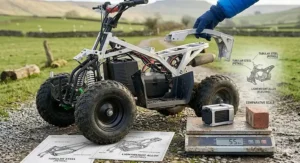
Let’s address the elephant in the rain-soaked room: British weather absolutely affects quad bike performance, and it’s something manufacturers’ specifications rarely acknowledge. Electric quads face particular challenges during our notoriously damp climate. Lithium-ion and lead-acid batteries both experience reduced capacity in cold temperatures — expect approximately 10-15% less run time when temperatures drop below 10°C, which describes roughly half the British year. A quad advertised as delivering 60 minutes might realistically provide 50-52 minutes on a grey November afternoon.
More significantly, British rain creates performance challenges for electric quads. Whilst most models feature some degree of weather resistance, they’re not waterproof. Riding through deep puddles or during heavy downpours risks water ingress into battery compartments and electrical connections. UK parents consistently report better longevity when electric quads are primarily used during dry conditions and stored indoors between uses. If your child insists on riding during light drizzle (they will — British children are remarkably undeterred by rain), dry the quad thoroughly afterwards and check connection points for moisture.
Petrol quads handle wet weather somewhat better from a performance standpoint — the engine doesn’t care about rain — but they introduce different maintenance challenges. Metal components are prone to rust in Britain’s humid climate, especially if quads are stored in damp sheds or garages. Regular application of protective spray to bolts, chains, and exposed metal significantly extends lifespan. The air filter requires more frequent checking and cleaning when riding in wet, muddy conditions — something you’ll encounter regularly on British fields and tracks.
Garden surface matters enormously. Short, dry grass poses no problems for any quad bike. Longer grass (above 10 cm) challenges 6V electric models significantly, often causing them to struggle or stall. Damp grass reduces traction across all models, with lighter electric quads spinning wheels where heavier petrol quads maintain grip. Mud, whilst fun, demands more power — 12V electric quads handle light mud adequately, but petrol quads dominate in properly muddy British conditions.
One often-overlooked consideration for British buyers: storage space. Terraced houses, semi-detached properties, and even many detached homes feature limited storage. Electric quads generally fold or stack more easily than petrol quads, and they don’t require ventilated storage (petrol fumes mandate proper airflow). If your garage or shed is already crammed with bikes, lawn mowers, and accumulated garden paraphernalia, measure carefully before committing to larger quad models.
Cost Analysis: True Ownership Expenses in Pounds
Purchase price tells only part of the financial story. Let’s break down realistic three-year ownership costs for both electric and petrol quads in the UK, because this is where the economic differences become starkly apparent.
Electric Quad (12V model, £120 purchase price):
- Initial purchase: £120
- Electricity costs (45 mins daily use, 4 days weekly, 9 months yearly): approximately £8-£12 annually (based on current UK electricity rates of roughly 24p per kWh)
- Battery replacement (if needed after 2-3 years): £30-£50
- Maintenance: minimal — occasional tyre checks, connection cleaning
- Total 3-year cost: approximately £145-£180
Petrol Quad (50cc model, £500 purchase price):
- Initial purchase: £500
- Petrol costs (moderate use, 9 months yearly): £60-£80 annually
- Oil changes (every 20-30 hours, roughly 3-4 yearly): £15-£25 per change = £50-£80 annually
- Air filter cleaning supplies: £10-£15 annually
- Spark plugs, maintenance parts: £20-£30 annually
- Total 3-year cost: approximately £740-£920
The numbers don’t lie: electric quads cost roughly one-fifth as much to run over three years compared to petrol models. For budget-conscious British families, this represents substantial savings. However, these calculations assume moderate use and proper maintenance. Neglected petrol quads rack up higher repair bills, whilst improperly stored electric quads may need premature battery replacements (£30-£80 depending on voltage).
There’s also an environmental cost consideration, though it’s harder to quantify in pounds. Electric quads produce zero direct emissions, whilst 50cc petrol engines emit carbon dioxide and other pollutants. For environmentally conscious families (and Britain has increasingly embraced green initiatives), this factor weighs beyond mere economics. Additionally, noise pollution affects your relationship with neighbours — rather important in closely-packed British housing. A petrol quad’s 85-95 decibel output rivals a lawn mower, whilst electric quads hum along at under 60 decibels.
Making Your Decision: Which Quad Suits Your Family?
After comparing specifications, costs, and real-world performance, the decision framework becomes clearer. Choose an electric quad if you’re dealing with children under 8 years old, have limited storage space, live in a residential area where noise matters, want minimal maintenance commitment, and primarily plan garden or light off-road use. Electric quads excel in these scenarios, delivering excellent value and convenience whilst keeping both children and neighbours happy.
Choose a petrol quad if your child is 8 or older with riding experience, you have access to proper off-road areas (farms, designated tracks, large private land), extended ride sessions matter (2-4 hours versus 45-60 minutes), you’re comfortable with mechanical maintenance, and noise isn’t a concern. Petrol quads provide authentic off-road experiences and performance that electric models simply cannot match at any price point.
There’s also a middle ground worth considering: start with a quality electric quad for younger children, then transition to petrol when they’re older and more experienced. This approach spreads costs over time, allows skill development on safer equipment, and means you’re not investing £500+ in a petrol quad only to discover your child’s interest wanes after three months. Many UK families successfully follow this progression, with hand-me-down electric quads benefiting younger siblings or cousins.
For families with multiple children of different ages, the economic case for electric becomes even stronger. A well-maintained electric quad easily serves 2-3 children over 5-7 years, with minimal running costs throughout. Petrol quads demand more maintenance as hours accumulate, and mechanical wear increases costs over extended family use.
Safety First: Essential British Standards and Equipment
Regardless of whether you choose electric or petrol, safety equipment is non-negotiable. Whilst UK law doesn’t mandate helmets for quad riding in England, Scotland, and Wales (it does in Northern Ireland), responsible parents don’t leave this to legal minimums. Budget £50-£100 for proper safety gear, including a DOT or ECE-approved full-face or three-quarter helmet, motocross gloves with palm protection, knee pads, elbow pads, and sturdy over-ankle boots.
Check that any quad bike you purchase displays appropriate British Standards markings. Electric ride-on toys should comply with EN 71-1-2-3 (toy safety standards) and EN 62115 (electrical toys). Post-Brexit, look for UKCA marking on products, though CE marking remains acceptable during the transition period. These certifications ensure the quad meets basic safety requirements for construction, electrical safety, and chemical composition.
Supervision is paramount, particularly for children under 8. Even the safest quad can result in accidents without adult oversight. Establish clear riding boundaries, inspect the riding area for hazards (holes, hidden obstacles, steep slopes), and enforce safety rules consistently. Consider creating a simple riding zone marked with cones or rope to define safe areas.
Training matters more than many parents realise. Spend time teaching proper throttle control, braking technique, and safe turning before allowing independent riding. Many accidents occur in the first few sessions when children are still developing muscle memory and judgment. Commercial off-road centres across the UK offer children’s training courses, and whilst they represent an additional expense (£30-£60 typically), the safety investment pays dividends.
Common Mistakes UK Buyers Make (And How to Avoid Them)
The most frequent mistake British parents make is underestimating the importance of private land access. Purchasing a quad without confirmed riding locations leads to disappointed children and expensive ornaments gathering dust in garden sheds. Before buying, secure explicit permission for private land use, whether that’s your own garden, a relative’s farm, or commercial facilities. Don’t assume “no one will mind” if you use the local playing field — they will, and you risk confiscation.
Another common error is choosing based solely on price without considering total cost of ownership. That £60 electric quad looks tempting until you realise it’s a 6V model your 6-year-old will outgrow in 8 months. Similarly, the £450 petrol quad seems reasonable until maintenance costs accumulate. Factor in realistic usage patterns, expected longevity, and running costs before making final decisions.
Many UK buyers overlook British weather implications. Purchasing a basic electric quad without weather-resistant features for a child who insists on riding in all conditions (classic British determination) leads to premature failures. If your family won’t be deterred by drizzle, invest in more robust models with better sealing and plan for indoor storage.
Storage planning frequently gets neglected until after purchase. That 95L quad looked manageable in the Amazon photo but becomes surprisingly unwieldy when you’re trying to squeeze it into an already-full British garden shed alongside bikes, lawn mowers, and assorted junk. Measure your storage space before ordering, and consider vertical storage solutions or wall-mounted racks.
Finally, skimping on safety equipment is penny-wise and pound-foolish. Proper helmets, pads, and protective gear cost £50-£100, but they’re non-negotiable investments in your child’s wellbeing. Don’t let a £100 quad investment be undermined by avoiding a £60 helmet purchase.
Long-Term Value: Resale and Hand-Me-Down Potential
British parents love extracting maximum value from purchases, and quad bikes offer decent resale potential if properly maintained. Electric quads in good condition typically retain 40-50% of original value after 2-3 years of use, particularly popular brands like GYMAX and HOMCOM. Facebook Marketplace, Gumtree, and local parent groups provide ready markets for used quads. Clean the quad thoroughly, take quality photos in good light, be honest about condition, and price competitively (£30-£80 for used 6V models, £60-£100 for 12V models).
Petrol quads hold value somewhat better — 50-60% retention after 2-3 years — but this assumes proper maintenance records. Buyers of used petrol quads rightly worry about mechanical condition, so maintaining service history and demonstrating regular oil changes, filter replacements, and proper storage significantly aids resale. Expect £250-£400 for well-maintained used 50cc quads originally purchased around £500.
For families with multiple children or cousins, hand-me-down potential is enormous. A quality 12V electric quad easily serves 2-3 children over 5-7 years with minimal additional investment. Replace worn tyres (£15-£25 for a set), refresh batteries if needed (£30-£50), and you’ve essentially recycled a £120 investment across multiple children. This dramatically improves cost-per-child economics.
The environmental benefits of extending product lifecycles align with increasingly important sustainability values. Rather than contributing to landfill waste, passing quads between children or selling them onwards ensures maximum use from manufacturing resources. It’s a small but meaningful contribution to reducing consumption — something British parents increasingly prioritise.
Frequently Asked Questions
❓ Are electric or petrol quads safer for children in the UK?
❓ What's the realistic battery life for electric quads in British weather?
❓ Can children ride quad bikes in UK public parks or playing fields?
❓ How much does it cost to run electric versus petrol quads in the UK?
❓ Do I need insurance for children's quad bikes on private UK land?
Conclusion: Making the Right Choice for Your Family
The electric quad vs petrol quad for children debate ultimately comes down to your specific family circumstances, available riding environments, and what you prioritise in the ownership experience. For most British families with younger children, limited space, and residential settings, electric quads deliver the optimal combination of convenience, cost-effectiveness, safety, and neighbourly relations. They’re whisper-quiet, require minimal maintenance, cost pennies to run, and provide perfectly adequate performance for garden and light off-road use.
Petrol quads serve a different audience — families with older children, proper off-road access, and willingness to invest time in mechanical maintenance. They deliver authentic riding experiences, extended session times, and performance capabilities electric models cannot match. If you’ve got acres of private land, a 10-year-old with riding experience, and mechanical inclination, petrol quads justify their higher costs and maintenance demands.
The seven models reviewed represent the strongest options currently available to UK buyers on Amazon.co.uk and specialist retailers. From the budget-friendly HOMCOM 6V (£55-£70) perfect for toddlers, through mid-range workhorses like the GYMAX 12V (£110-£130), to premium electric options approaching petrol performance like the Maxmass 24V (£150-£200), there’s a quad for every age, budget, and skill level. Petrol options start around £400-£600 and suit experienced riders seeking serious off-road capabilities.
Remember: regardless of which type you choose, prioritise safety equipment, secure appropriate riding locations before purchase, factor in realistic total costs of ownership, and supervise young riders consistently. Start conservative with power levels and progress gradually as skills develop. British weather demands indoor storage and some flexibility around riding sessions, but don’t let our climate deter investment — proper care ensures years of outdoor enjoyment regardless of occasional drizzle.
Recommended for You
- Go Kart vs Buggy for 7 Year Old: 7 Best UK Options 2026
- Buggy vs Quad Bike Which is Better for Kids? UK Guide 2026
- 7 Best Which Drift Kart Is Best for Beginners UK 2026
Disclaimer: This article contains affiliate links. As an Amazon Associate, I earn from qualifying purchases. If you purchase products through these links, we may earn a small commission at no additional cost to you.
✨ Found this helpful? Share it with your mates! 💬🤗
