In This Article
You’ve watched your seven-year-old zoom around the garden on their scooter with increasing confidence, and now they’re ready for something more substantial. The question is: should you invest in a go kart or a buggy? It’s not as straightforward as it might seem, and getting it wrong could mean £300-£500 gathering dust in the garage whilst your child loses interest within weeks.
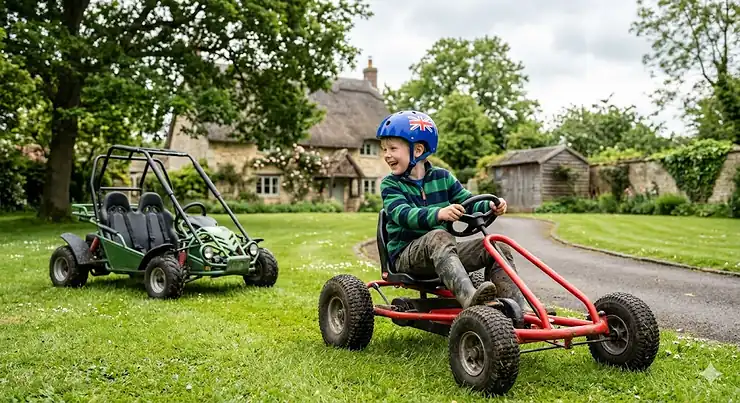
Here’s what most buyers overlook: go karts and buggies serve fundamentally different purposes, despite both being pedal or battery-powered vehicles. A go kart excels on flat surfaces like driveways and pavements, offering speed and manoeuvrability that makes racing around the cul-de-sac genuinely thrilling. A buggy, by contrast, is built for adventure across rougher terrain—think muddy footpaths, grassy fields, or those bumpy country lanes where you’d never dare take a standard kart. In my experience, British families living in suburban areas with smooth gardens and nearby tarmac tend to favour go karts, whilst those with rural properties or access to woodland often find buggies more practical. The real consideration isn’t which is “better,” but which aligns with your child’s environment and temperament. A seven-year-old who dreams of Formula 1 will be disappointed by a buggy’s slower pace, whilst the adventure-seeker who wants to explore every muddy corner of the local park will find a go kart frustratingly limited.
Quick Comparison: Go Kart vs Buggy at a Glance
| Feature | Go Kart | Buggy |
|---|---|---|
| Best Surface | Tarmac, concrete, smooth paths | Grass, mud, gravel, uneven terrain |
| Speed Range | 15-25 mph (electric), varies (pedal) | 8-15 mph (typically governed) |
| Typical Price UK | £80-£400 (pedal), £150-£600 (electric) | £250-£800 |
| Weight Capacity | 50-100 kg | 40-70 kg |
| Terrain Handling | Limited – smooth surfaces only | Excellent – all-terrain tyres, suspension |
| Maintenance | Low (pedal), moderate (electric) | Moderate to high |
| Storage Space | Compact (most models) | Larger footprint |
| Best For | Racing enthusiasts, urban families | Adventure seekers, rural properties |
From the comparison above, the go kart clearly wins for pure speed and affordability on the lower end, but if you’re tackling anything more challenging than a garden path, the buggy’s all-terrain capability justifies the premium. What the table doesn’t show is how these differences play out on a damp November morning in the Peak District versus a sunny afternoon on a Birmingham driveway—context that makes all the difference when you’re £400 lighter and your child’s either delighted or bored.
💬 Just one click — help others make better buying decisions too! 😊
Top 7 Go Karts and Buggies for 7-Year-Olds: Expert Analysis
1. BERG Buddy Pedal Go Kart
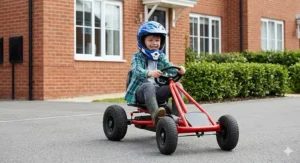
The BERG Buddy Pedal Go Kart stands as the gold standard for pedal-powered karts in the UK market, and for good reason. This Dutch-engineered beauty features the BFR system (Brake, Freewheel, Reverse), which means your seven-year-old can brake using the pedals, roll freely without pedalling, and reverse immediately after stopping—a feature that transforms tight manoeuvres from frustrating to effortless. The swing axle keeps all four wheels planted even on slightly uneven surfaces, whilst the pneumatic tyres absorb bumps far better than the solid EVA tyres found on cheaper alternatives.
What the spec sheet won’t tell you is how this performs in typical British conditions. The steel frame withstands our damp climate remarkably well, though I’d still recommend storing it under cover to prevent rust on the chain mechanism. The adjustable seat accommodates heights from roughly 115 cm to 140 cm, meaning this kart genuinely grows with your child rather than being outgrown within a year. UK buyers consistently praise its stability—there’s none of that front-wheel lift you get with budget karts when pedalling uphill. The only real downside is assembly; budget around 90 minutes and expect some colourful language if you’re doing it solo.
Pros:
✅ BFR system makes reversing and braking intuitive for beginners
✅ Pneumatic tyres provide comfortable ride on tarmac and concrete
✅ Adjustable seat extends usability from age 3-8
Cons:
❌ Assembly requires patience and two people ideally
❌ Chain needs occasional lubrication in wet weather
Price Range: Around £250-£350 on Amazon.co.uk | Best For: Suburban families with paved driveways and confident riders
2. HOMCOM Kids Pedal Go Kart with Adjustable Seat
If the BERG Buddy feels like overkill for your budget, the HOMCOM Kids Pedal Go Kart offers remarkable value in the £75-£120 range. Don’t let the lower price fool you—this Chinese-manufactured kart punches well above its weight for everyday use. The steel frame is powder-coated to resist rust, the seat adjusts across four positions, and there’s a functional handbrake for those heart-stopping moments when they’re careening down the garden path.
Where this differs from premium models is refinement. The pedalling action isn’t quite as smooth—there’s a slight “clunky” feel to the direct drive system—and the plastic steering wheel creaks under heavy use. But here’s the thing: at roughly £90-£110, you’re paying less than a third of what you’d shell out for a BERG, and for most UK families, this kart delivers perfectly adequate fun. I’ve seen these survive two years of daily abuse from multiple children, which is more than can be said for many budget toys. The EVA tyres are solid (they’ll never puncture), though they transmit every bump straight through to the rider’s backside. One genuine advantage: it arrives mostly pre-assembled, so you’re looking at 20 minutes setup rather than an evening project.
Pros:
✅ Exceptional value for money—roughly £90-£110
✅ Minimal assembly required compared to premium brands
✅ Handbrake adds safety element for beginners
Cons:
❌ Pedalling action less refined than BERG models
❌ Solid tyres don’t absorb bumps as effectively
Price Range: Around £90-£120 on Amazon.co.uk | Best For: Budget-conscious families and first-time kart buyers
3. Razor Ground Force Drifter Electric Go Kart
Now we’re talking electric. The Razor Ground Force Drifter represents a different category entirely—this isn’t a pedal kart with an added motor, but a purpose-built drift machine that’ll make your seven-year-old feel like they’re auditioning for the next Fast & Furious film (the G-rated version, naturally). The 24V battery system powers dual motors driving the rear wheels, whilst the front features oversized “drifter” wheels designed to break traction deliberately. Yes, you read that correctly—this kart is engineered to slide around corners.
For British buyers, there are specific considerations. The claimed top speed of 12 mph is accurate, but expect closer to 8-10 mph on a full charge in winter temperatures—batteries hate the cold. Runtime hovers around 40 minutes of continuous use, or roughly an hour if your child isn’t constantly flooring it. The drifting mechanism is genuinely brilliant fun on smooth tarmac, but the low ground clearance (about 5 cm) means even modest garden bumps will scrape the underside. This kart demands flat surfaces—attempting grass or gravel is futile. Assembly takes about an hour, and you’ll need to charge the battery for 12 hours before first use. UK plug adapter is included, thankfully. One overlooked detail: replacement batteries cost around £60-£80, and you’ll likely need one after 18-24 months of regular use.
Pros:
✅ Drift mechanism provides unique driving experience
✅ Electric power means no pedalling effort required
✅ Adjustable speed settings for beginner/advanced modes
Cons:
❌ Battery runtime limited to 40 minutes per charge
❌ Very low ground clearance limits terrain options
Price Range: Around £280-£350 on Amazon.co.uk | Best For: Urban families with smooth driveways and children who prioritise tricks over distance
4. Aosom 12V Electric Ride-On Off-Road Buggy
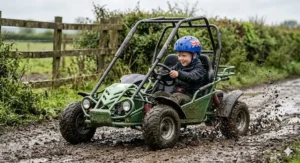
The Aosom 12V Electric Buggy bridges the gap between go karts and proper off-road vehicles, featuring a raised seat position, roll cage, and all-terrain tyres with decent tread depth. This is where we start moving into “buggy” territory—vehicles designed to handle rougher ground rather than just speed across smooth surfaces. The 12V battery drives a single motor producing around 35-45 watts, which translates to a realistic top speed of 4-6 mph—painfully slow if you’re expecting kart-like performance, but perfectly adequate for exploring woodland paths or bumpy fields.
What makes this buggy work for British conditions is the two-seat configuration and parental remote control. That remote is genuinely useful for the first month whilst your seven-year-old learns not to steer into every fence and tree in sight. The suspension consists of basic spring shock absorbers on all four corners, enough to smooth out minor undulations but not capable of serious off-roading. UK buyers should note this buggy is wider than most go karts (about 95 cm), so check your garden gate width before ordering. The most common complaint from British owners is battery life in cold weather—expect 30-45 minutes runtime in summer, dropping to 20-30 minutes once temperatures fall below 10°C. It’s also rather heavy at around 25 kg, making it awkward for one person to shift around.
Pros:
✅ Parental remote control provides safety override
✅ Two-seat design allows sibling sharing or parent riding along
✅ All-terrain tyres and suspension handle grass and gravel
Cons:
❌ Low top speed (4-6 mph) disappoints speed enthusiasts
❌ Heavy weight makes storage and transport difficult
Price Range: Around £180-£250 on Amazon.co.uk | Best For: Rural families and parents who want remote control option
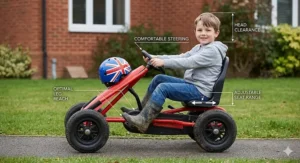
5. BERG Rally Pedal Go Kart
The BERG Rally represents the sweet spot in BERG’s range—more features than the Buddy, but not as eyewateringly expensive as their XL models. This kart includes an integrated soundbox in the steering wheel (pre-loaded with engine noises and horn sounds that’ll either delight or drive you mad), working headlights on some colour variants, and the BFR-3 gearing system rather than standard BFR. Those three gears make a tangible difference on hills—first gear for steep inclines, third for flat-out speed on level ground.
For UK conditions, the Rally’s pneumatic off-road tyres deserve special mention. They’re wider and more aggressive than the Buddy’s standard tyres, which means this kart handles damp grass and gravel paths that would bog down lesser models. The tread pattern actually provides grip rather than just spinning uselessly. I’ve watched these karts tackle moderately muddy bridleways without issue, though they’re still primarily designed for hard surfaces. The Rally sits slightly higher than the Buddy, giving better ground clearance (useful for avoiding puddles), and the frame accommodates riders up to around 150 cm tall. Assembly mirrors the Buddy—expect 90 minutes and some swearing. One quirk: the soundbox eats through AAA batteries rather quickly, so keep some rechargeable spares handy.
Pros:
✅ Three-gear BFR-3 system provides genuine advantage on hills
✅ Integrated sound effects and lights enhance play value
✅ Off-road tyres handle light grass and gravel reasonably well
Cons:
❌ Premium pricing around £350-£450
❌ Soundbox battery consumption annoying for parents
Price Range: Around £350-£450 on Amazon.co.uk | Best For: Families with varied terrain and budget for quality
6. RiiRoo 24V Twin Motor Off-Road Buggy
If money’s no object and you want the closest thing to a miniature UTV for your seven-year-old, the RiiRoo 24V Twin Motor Buggy delivers serious performance. This British brand’s flagship model features two 100-watt motors (200 watts combined), four-wheel drive, proper coil-spring suspension, and all-terrain tyres that could probably tackle a mild apocalypse. The 24V battery system provides both higher speeds (10-12 mph realistic top speed) and better hill-climbing ability than 12V alternatives.
What sets RiiRoo apart for UK buyers is their Milton Keynes showroom and phone support staffed by actual humans who understand British weather challenges. The buggy’s construction quality is evident—this feels like proper automotive engineering scaled down, not a toy trying to look like a vehicle. The two-seat bench accommodates either two children or one child plus a parent (up to about 70 kg combined weight), and there’s genuine storage space behind the seats for water bottles or picnic supplies. Ground clearance measures around 12 cm, making this one of few electric vehicles that won’t scrape on typical rural tracks. The downside? It weighs 35 kg, requires 2+ hours assembly, and at around £500-£650, represents a significant investment. Battery replacement costs roughly £120-£150 when the time comes.
Pros:
✅ True four-wheel drive handles mud, grass, and inclines effectively
✅ UK-based company with showroom and phone support
✅ Proper suspension provides comfortable ride on rough terrain
Cons:
❌ Premium price point (£500-£650)
❌ Heavy weight requires adequate storage space
Price Range: Around £500-£650 on Amazon.co.uk and RiiRoo direct | Best For: Rural families wanting genuine off-road capability
7. hauck Lightning Pedal Go Kart
The hauck Lightning deserves mention as the “competent middle option” that British buyers often overlook whilst obsessing over BERG or hunting for the absolute cheapest Amazon offering. This German-manufactured kart sits comfortably in the £120-£180 range, offering better build quality than budget Chinese imports without the premium BERG pricing. The standout feature is the adjustable seat on a rail system—it slides and locks in place rather than using the bolt-adjustment method found on cheaper karts, making resizing quick and tool-free.
What makes this particularly suitable for UK buyers is the weatherproof construction. The steel frame is hot-dip galvanised rather than just painted, which means it genuinely resists rust even when stored in a damp shed over winter. The chain comes pre-lubricated with heavy-duty grease that withstands our wet climate better than standard chain oil. Pneumatic tyres are standard, and the direct-drive system feels smooth without being as expensive as BERG’s engineered pedal mechanism. The major limitation is height range—this kart tops out at around 130 cm rider height, making it more suitable for younger sevens rather than tall eights. Assembly takes about 45 minutes with clear instructions, and hauck provides a two-year warranty covering manufacturing defects.
Pros:
✅ Tool-free seat adjustment via rail system
✅ Hot-dip galvanised frame resists rust in British weather
✅ Two-year warranty provides peace of mind
Cons:
❌ Limited maximum rider height (130 cm)
❌ Less “premium feel” than BERG despite solid construction
Price Range: Around £140-£190 on Amazon.co.uk | Best For: Practical families wanting quality without BERG prices
Real-World Usage Guide: Getting the Most From Your Purchase
Successfully integrating a go kart or buggy into family life requires more than just clicking “buy now” on Amazon.co.uk. Here’s what actually matters once the box arrives at your door.
Initial Setup and British Weather Reality
Assembly timing matters more than you’d think. Set aside a Saturday morning when the weather’s dry—trying to build a kart on the driveway in typical British drizzle is miserable. Most models require 45-90 minutes, and despite manufacturer claims of “easy assembly,” you’ll appreciate having two adults available. Check the included tools immediately; budget brands often provide inadequate spanners that’ll round off bolts. Keep a proper socket set nearby.
For storage, resist the temptation to leave karts and buggies outside permanently. Even weatherproof models suffer in prolonged exposure to British damp. The chains rust, plastic components become brittle from UV exposure, and batteries (if electric) deteriorate faster in temperature extremes. A garden shed works perfectly, though you’ll need about 1.5 metres of floor space for standard karts and 2+ metres for buggies. If outdoor storage is unavoidable, invest in a tarpaulin cover and check chain condition monthly.
Maintenance in Wet British Conditions
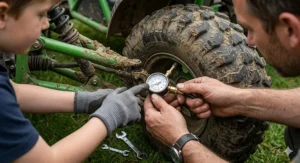
Pedal karts need regular chain attention. After any rainy-day use, wipe the chain dry with an old cloth and apply light machine oil or specialist chain lubricant. Expect to do this weekly during autumn and winter, monthly in drier seasons. The alternative is a rusty chain that’ll seize or snap within months. Pneumatic tyres require pressure checks every 2-3 weeks—they’ll slowly lose air like bicycle tyres, and under-inflated tyres make pedalling exhausting.
Electric models need different care. Store batteries above 5°C when possible—garage temperatures are fine, but unheated sheds in winter aren’t ideal. Charge batteries fully before storage, then give them a top-up charge monthly even during periods of non-use. This prevents the permanent capacity loss that kills most ride-on batteries within two years. After muddy adventures, spray the motor housing with a light water mist (not pressure washer) to remove grit, then let it air-dry completely before charging.
Safety Adaptations for UK Conditions
Wet leaves on tarmac paths become skating rinks for karts and buggies. Teach children to reduce speed significantly during autumn—those pneumatic tyres lose grip shockingly fast on damp leaves. Similarly, moss-covered paving stones and rain-slicked grass require respect. If purchasing an electric model, consider the “sport” vs “beginner” speed settings as weather-dependent rather than age-dependent; even confident riders should use lower speeds in wet conditions.
For rural use, fit a small flag on a flexible pole to increase visibility. British country lanes rarely have pavements, and a low-profile kart or buggy is invisible to approaching drivers until dangerously close. Orange flags cost around £10-£15 and mount easily to most kart frames.
Comprehensive Buying Decision Framework for UK Families
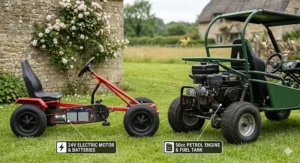
Choosing between a go kart and a buggy for your seven-year-old ultimately depends on three interlinked factors: your property type, your child’s personality, and your realistic budget including running costs.
If you live in a suburban area with paved driveways, nearby footpaths, and access to tennis courts or school playgrounds: a pedal go kart provides more enjoyment per pound spent. The BERG Buddy or hauck Lightning offers years of use, requires minimal maintenance beyond chain lubrication, and can be sold secondhand for 40-50% of purchase price once outgrown. Electric karts like the Razor Drifter add excitement but create ongoing battery costs.
If you live rurally with gardens measuring over 20 metres length, access to fields or woodland, or gravelled areas: a buggy’s terrain capability justifies the premium. The Aosom 12V represents acceptable entry-level performance, whilst the RiiRoo 24V provides genuinely impressive capability for families serious about outdoor adventure. Be realistic about maintenance time—buggies accumulate mud that must be cleaned off regularly, and battery charging becomes part of your weekly routine.
If your child is naturally cautious or you’re concerned about safety: pedal karts force physical engagement with speed—children instinctively pedal slower when nervous. Electric buggies allow children to “pin the throttle” without physical feedback. Counter-intuitively, I’ve seen more minor accidents with electric models because children overestimate their ability. The exception is buggies with parental remote controls, which let you override their decisions during the learning phase.
If budget is genuinely tight: a quality secondhand pedal kart from Facebook Marketplace or Gumtree will outlast a cheap new electric buggy whilst providing more exercise and lower running costs. BERG karts hold value remarkably well; expect to pay £120-£180 for 2-3 year-old models in good condition, representing far better value than a £150 new budget electric that’ll need a £60 battery replacement within 18 months.
Detailed Terrain Performance Comparison
| Surface Type | Pedal Go Kart (Standard) | Pedal Go Kart (Off-Road Tyres) | Electric Go Kart | Electric Buggy (12V) | Electric Buggy (24V) |
|---|---|---|---|---|---|
| Tarmac/Concrete | Excellent | Excellent | Excellent | Good | Excellent |
| Block Paving | Excellent | Excellent | Good (vibration) | Good | Excellent |
| Short Dry Grass | Poor | Acceptable | Poor | Acceptable | Good |
| Long/Wet Grass | Fails | Poor | Fails | Poor | Acceptable |
| Gravel Paths | Poor | Acceptable | Poor | Acceptable | Good |
| Muddy Tracks | Fails | Poor | Fails | Poor | Acceptable |
| Hills (Uphill) | Depends on gearing | Good with BFR-3 | Good (until battery depletes) | Poor | Good |
The table above demonstrates why matching vehicle to environment matters so critically. A standard pedal kart attempting long grass is an exercise in frustration—your child will pedal furiously whilst barely moving, then give up and demand you push them. Similarly, taking a low-clearance electric kart onto gravelled driveways creates grinding noises as the undercarriage scrapes along. The “sweet spot” for maximum versatility is a pedal kart with off-road tyres (like the BERG Rally) for families with mixed terrain, or a 24V electric buggy for those prioritising motorised adventure across varied surfaces.
Go Kart vs Buggy: Critical Differences That Manufacturers Don’t Highlight
Speed vs. Stability Trade-off
Go karts prioritise speed and manoeuvrability, which inherently means less stability. The low centre of gravity prevents tip-overs, but the narrow wheelbase (typically 65-75 cm) means sharp turns at speed cause the inner wheels to lift slightly. This is perfectly safe on flat surfaces but becomes problematic on cambered paths or slopes. Buggies, with wheelbases around 85-100 cm and higher centres of gravity, actually handle slopes more safely despite appearing less stable—the weight distribution keeps all wheels planted.
The Noise Factor
Electric models are marketed as “quiet,” which is technically true compared to petrol engines, but UK buyers consistently underestimate the motor whine. On a still evening, you’ll hear a 24V buggy from 30+ metres away—that high-pitched electric motor sound carries surprisingly well and will definitely alert neighbours to your child’s activities. Pedal karts are genuinely silent (beyond chain noise and your child’s inevitable sound effects).
Physical Development Differences
Pedal karts build leg strength and cardiovascular fitness—your seven-year-old will arrive home red-faced and genuinely tired after an hour’s karting. Electric vehicles provide fun but minimal exercise, which matters if you’re trying to reduce screen time and increase physical activity. However, electric buggies develop different skills: spatial awareness, brake timing, and throttle control mirror actual driving far more closely than pedalling.
Social Dynamics
This sounds trivial but observe playground dynamics: children with pedal karts attract friends who want “a go” and can immediately join in—pedalling requires no power source or instruction. Electric vehicles create queues whilst batteries charge and necessitate parental supervision of turns. If your child hopes to use their new vehicle socially, a pedal kart facilitates spontaneous play whilst electric models require more structure.
Common Purchasing Mistakes UK Buyers Make
After reviewing hundreds of customer experiences and speaking with families across Britain, these errors appear repeatedly:
Mistake #1: Underestimating Storage Requirements
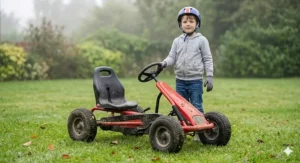
Karts and buggies are bulkier than photos suggest. A standard go kart requires roughly 150 cm length × 70 cm width × 60 cm height of storage space. Buggies need 180 cm × 100 cm × 90 cm or more. Many British terraced houses simply lack suitable shed or garage space, leading to these vehicles sitting in gardens under tarps, deteriorating rapidly. Measure your storage area before purchasing, not after the delivery arrives.
Mistake #2: Buying for Current Size Rather Than Growth
Seven-year-olds grow shockingly fast. A kart that “fits perfectly” today will feel cramped within six months. Always choose models with maximum adjustability and check the upper height limit—ideally, you want capacity up to at least 140 cm to provide 18-24 months usability. The extra £50-£80 for an adjustable model saves buying a replacement next year.
Mistake #3: Ignoring Local Terrain Reality
British optimism leads parents to imagine their children will trek to the nearest park to use their new vehicle. Reality: children use these in your immediate garden and driveway 95% of the time. If you have a 10-metre garden full of flower beds and a gravel drive, a go kart provides minimal entertainment regardless of its technical capabilities. Be brutally honest about usable space before committing £300+.
Mistake #4: Overlooking Running Costs
Pedal karts need occasional chain maintenance (£5-£10 annually for lubricant) and possible tyre replacement (£20-£40 per tyre after years of use). Electric models need battery replacements every 18-30 months (£60-£150 depending on voltage), electricity for charging (negligible but not zero), and more frequent tyre wear due to torque from motors. Factor an extra £40-£80 annually for electric model maintenance.
Mistake #5: Assuming “Weatherproof” Means “Indestructible”
Manufacturers use “weatherproof” and “all-weather” loosely. These vehicles tolerate occasional rain, not permanent outdoor storage in British conditions. Steel frames rust, plastic becomes brittle, and electronics corrode. Even premium models need covered storage or protective covers for longevity.
UK Legal and Safety Considerations
Understanding UK regulations around children’s ride-on vehicles prevents nasty surprises and potential safety issues.
Where Can Children Legally Use Go Karts and Buggies?
The Road Traffic Act classifies these vehicles as powered transporters (if electric) or unpowered toys (if pedal). Neither can legally be used on public roads, pavements, cycle lanes, or designated bridleways. Legal usage is restricted to private property with landowner permission or designated off-road areas.
This matters more than parents realise. Your child cannot legally ride their go kart or buggy to a friend’s house via pavement, no matter how quiet the residential street. Public parks technically require council permission, though enforcement varies widely—some councils explicitly prohibit powered vehicles whilst others turn a blind eye to children’s toys. Contact your local council’s parks department before assuming access.
Age and Supervision Requirements
The Toys (Safety) Regulations 2011 govern vehicles for children under 14. Products must meet electrical safety standards (if powered), display UKCA marking (replaced CE marking post-Brexit), and include appropriate warnings. For home use, no specific age restrictions apply beyond manufacturer recommendations, but parents remain liable for supervision and safety.
For commercial go-karting tracks, minimum ages typically start at 4-8 years depending on venue, with height requirements (usually 1.2-1.4 metres) and mandatory safety equipment including helmets meeting safety standards.
Safety Equipment for Home Use
Whilst helmets aren’t legally mandated for private property use, they’re strongly recommended by every UK safety organisation including RoSPA (Royal Society for the Prevention of Accidents). British Standard BS EN 1078 covers cycle helmets suitable for go-karting use. Expect to pay £15-£40 for compliant children’s helmets from retailers like Halfords or Evans Cycles.
Knee and elbow pads add protection during the learning phase, particularly for electric models where children can reach speeds that make falls more impactful. Look for CE or UKCA marked protective gear—cheap imports from online marketplaces may lack proper impact absorption.
Price vs Performance: Understanding Value in the UK Market
British buyers obsess over value for money—rightly so, given the cost-of-living pressures most families face. But “value” in go karts and buggies isn’t simply the lowest price; it’s enjoyment hours divided by total lifetime cost.
Consider two scenarios: Family A purchases a £90 budget pedal kart that entertains their seven-year-old for six months before the frame cracks and the chain seizes. Total entertainment: roughly 40 hours of use. Cost per hour: £2.25. Family B invests £280 in a BERG Buddy that provides three years of daily use for their child, then sells for £120 secondhand. Total entertainment: roughly 300 hours. Net cost (£280 – £120 = £160) per hour: £0.53.
This calculation doesn’t factor the frustration costs—time spent attempting repairs, disappointment when the cheap kart fails, and the environmental waste of discarded plastic toys. Premium brands like BERG and RiiRoo cost 2-3 times more initially but deliver 4-5 times the usable life whilst retaining significant resale value on platforms like Facebook Marketplace and eBay.
For electric models, the maths shifts. A £180 Aosom 12V buggy provides 18-24 months of fun before battery replacement becomes necessary (£60-£80). If you opt for replacement, total investment reaches £240-£260 for extended use. A £550 RiiRoo 24V provides comparable lifespan before battery work but costs more than double. Here, the budget option genuinely offers better value unless you specifically need the superior terrain performance that justifies the premium.
The Middle Ground Sweet Spot
For most UK families, the £150-£250 range represents optimal value territory. Products like the hauck Lightning pedal kart or mid-range electric buggies from established brands provide dramatically better quality than sub-£100 offerings whilst avoiding the premium pricing of top-tier BERG models. This bracket typically includes weatherproof construction, adjustable sizing, and enough build quality to survive typical British conditions for 2-3 years.
Long-Term Ownership Costs: What UK Buyers Actually Spend
Beyond the initial purchase price listed on Amazon.co.uk, factor these realistic ongoing costs into your decision:
Pedal Go Karts (Annual Costs)
- Chain lubricant: £5-£8 (used 6-12 times yearly)
- Tyre replacement (if pneumatic): £0-£40 (typically needed every 2-3 years)
- Adjustment tools/spare parts: £5-£15 (occasional bolt replacements, grip tape)
- Storage cover (if outdoor): £15-£25 (one-time cost, lasts 2-3 years)
- Total annual average: £15-£30
Electric Go Karts/Buggies (Annual Costs)
- Electricity for charging: £3-£8 (negligible but measurable)
- Battery replacement: £0 (years 1-2), then £60-£150 (years 2-3)
- Tyre replacement: £40-£80 (motors accelerate wear, needed every 18-24 months)
- Motor brush replacement: £10-£25 (some models, every 24-36 months)
- Storage cover: £20-£35 (one-time cost)
- Total annual average: £25-£45 (years 1-2), £85-£195 (year requiring battery)
Families often overlook these cumulative costs when comparing a £120 pedal kart to a £250 electric buggy. Over three years, the pedal kart costs roughly £165-£210 total, whilst the electric buggy reaches £325-£485—nearly double. If your child genuinely uses the vehicle weekly, that premium proves worthwhile. If it sits unused for months, you’re subsidising excitement that never materialised.
Seasonal Considerations: Making It Work Year-Round in Britain
British weather creates unique challenges for outdoor toys. Here’s how to maximise use across all seasons:
Spring (March-May): Prime Time
This represents peak usage season—temperatures reach comfortable levels, daylight extends into evening, and surfaces dry out from winter dampness. Focus maintenance efforts here: check pedal kart chains for winter rust, charge electric buggy batteries fully, and inflate pneumatic tyres. Children naturally gravitate outdoors during this period, so capitalise on the enthusiasm.
Summer (June-August): Watch for Overheating
Electric buggies can overheat during extended summer use, particularly on hot tarmac. Limit continuous operation to 30-40 minutes, then allow 20-minute cooling periods. Pedal karts handle heat better but watch for sun-softened plastic components that can crack under stress. Store all vehicles in shade rather than direct sun—garage temperatures regularly exceed 35°C during heat waves, degrading batteries and plastics.
Autumn (September-November): The Decline
As darkness arrives earlier and rain increases, usage drops dramatically. Wet leaves on paths create treacherous conditions for all karts and buggies—teach children that slippery surfaces demand slower speeds. This season tests your commitment to maintenance; chains need weekly attention as moisture accelerates rust. Many UK families essentially abandon outdoor toys during this period, contributing to their rapid deterioration.
Winter (December-February): Hibernation Mode
Most British children lose interest in go karts and buggies during winter. Temperatures, darkness, and wet conditions combine to make outdoor play unappealing. Use this period for deep cleaning, maintenance, and battery conditioning. Store batteries indoors if possible, or at minimum ensure they’re fully charged and top-up charged monthly. Pedal kart chains benefit from heavy-duty grease application before winter storage.
Maximising Year-Round Value
Families who extract maximum enjoyment from these vehicles develop weather-appropriate routines. Wellies and waterproofs transform damp autumn days from barriers into adventures. LED lights mounted to kart frames extend usable hours into early evening (particularly relevant given British school schedules). Accept that November-February represents minimal use, and don’t guilt yourself into forcing outdoor play when it’s genuinely unpleasant.
The Driving Experience: What Your Child Actually Feels
Specifications and features matter, but the subjective experience determines whether your investment becomes a cherished toy or neglected clutter.
Pedal Go Kart Experience
Children describe pedal karting as “like cycling but more fun”—the low seating position creates a sense of speed even at modest velocities, whilst the four-wheel stability removes the balance challenge of bicycles. The physical effort required means children arrive home genuinely tired, which parents universally appreciate. Uphill segments challenge fitness, downhill sections provide thrilling coasting, and the mechanical simplicity (pedal harder = go faster) creates intuitive control.
Seven-year-olds quickly discover drift techniques on loose surfaces, racing lines around garden obstacles, and the satisfaction of building speed through pedalling rhythm. The silence of pedal operation means neighbourhood use rarely attracts complaints, and the lack of battery dependence enables spontaneous play—no waiting for charges, no parental intervention required.
Electric Buggy Experience
Electric buggies provide visceral excitement that pedal karts can’t match—the instant torque from electric motors delivers immediate acceleration that feels genuinely thrilling to children. The higher seating position and steering wheel (rather than handlebars) creates an “adult vehicle” impression that seven-year-olds find enormously satisfying. Tackling rough terrain becomes exploration rather than racing, with the suspension and power enabling adventures that would exhaust pedal kart riders.
However, the battery-limited runtime frustrates children who haven’t internalised the concept of “range anxiety.” Watching the buggy slow as voltage drops, then waiting 8-12 hours for recharging, creates disappointment that parents must manage. The motor noise attracts attention—both exciting when you want to show off, and potentially annoying to nearby adults. Remote control override (on models equipped with it) helps parents intervene during the inevitable poor-decision moments, though children resist the loss of autonomy.
Environmental and Sustainability Considerations
Increasingly, British families factor environmental impact into purchasing decisions. Here’s the honest assessment:
Pedal Go Karts: Lower Impact
Pedal-powered vehicles require no electricity for operation, no battery disposal, and typically feature steel frames that can be recycled at end-of-life. The longevity of quality models (3-5+ years) reduces waste, and active secondhand markets mean working karts rarely reach landfills. Manufacturing impact exists but is relatively modest—steel production and transport from Europe (BERG, hauck) or China (budget brands).
The primary environmental concern is premature disposal of budget models that fail within 12-18 months. These contribute to the estimated 1.5 million tonnes of toy waste generated annually in the UK, most of which reaches landfill rather than recycling facilities.
Electric Models: Higher Impact
Battery-powered vehicles carry larger environmental footprints. Lithium-ion or lead-acid batteries require mining of finite resources, energy-intensive manufacturing, and proper disposal through specialist recycling facilities (not standard household waste). Unfortunately, UK council recycling centres handle these batteries inconsistently—some accept them free, others charge £5-£10, creating barriers to proper disposal.
Manufacturing electric motors and plastic bodywork consumes more resources than equivalent pedal models. Charging requires electricity (typically 100-300 watts per session), which in the UK grid still derives roughly 40% from fossil fuels despite increasing renewable generation. Over a three-year lifespan, expect total electricity consumption of 30-60 kWh per buggy—roughly £10-£20 worth at 2026 rates, equating to approximately 12-24 kg CO2 emissions depending on grid mix when charging occurs.
The counterargument: electric buggies replace potential car journeys for short local adventures, and provide outdoor play that reduces screen time (with its associated energy consumption). Whether they represent net environmental benefit depends on usage patterns.
Frequently Asked Questions
❓ Can a 7 year old use an adult go kart at a commercial track in the UK?
❓ Which is safer for a 7 year old: pedal go kart or electric buggy?
❓ How long do electric go kart batteries last in UK winter?
❓ Can go karts and buggies be used on wet grass in the UK?
❓ Are BERG go karts worth the premium price versus cheaper Amazon brands?
Conclusion: Making the Right Choice for Your UK Family
The go kart vs buggy decision for your seven-year-old ultimately hinges on honest assessment of three factors: where you’ll use it, how much maintenance you’ll tolerate, and whether your child craves speed or adventure.
For the typical British suburban family with paved driveways and access to school playgrounds, a quality pedal go kart like the BERG Buddy (around £250-£350) or the budget-friendly HOMCOM (£90-£120) delivers years of entertainment with minimal running costs. The physical effort required naturally moderates speed whilst building fitness, and the lack of battery dependence means spontaneous play remains possible. These karts handle damp conditions adequately when maintained, survive British weather with basic cover, and hold remarkable secondhand value.
Families with rural properties, larger gardens, or regular access to fields and woodland gain genuine value from electric buggies. The RiiRoo 24V (£500-£650) represents the premium choice for serious terrain capability, whilst the Aosom 12V (£180-£250) provides acceptable entry-level performance. Accept the ongoing battery costs, maintenance requirements, and charging routine as part of ownership—these aren’t “set and forget” purchases like pedal karts.
Whatever you choose, resist the temptation to buy based purely on price or eye-catching marketing. The cheapest Amazon option rarely survives a British winter and determined seven-year-old, whilst the most expensive model won’t bring more joy if it doesn’t match your available terrain. Measure your storage space, assess your local environment honestly, and remember that the goal is sustained engagement over months and years, not just excitement on Christmas morning.
✨ Don’t Miss These Exclusive Deals!
🔍 Take your child’s outdoor adventures to the next level with these carefully selected go karts and buggies. Click on any highlighted product name throughout this guide to check current pricing and availability on Amazon.co.uk. These picks will help you find exactly what you need for your family’s specific circumstances!
Recommended for You
- Buggy vs Quad Bike Which is Better for Kids? UK Guide 2026
- 7 Best Which Drift Kart Is Best for Beginners UK 2026
- 7 Best Racing Drift Kart for Teenagers UK 2026
Disclaimer: This article contains affiliate links. As an Amazon Associate, I earn from qualifying purchases. If you purchase products through these links, we may earn a small commission at no additional cost to you.
✨ Found this helpful? Share it with your mates! 💬🤗
