In This Article
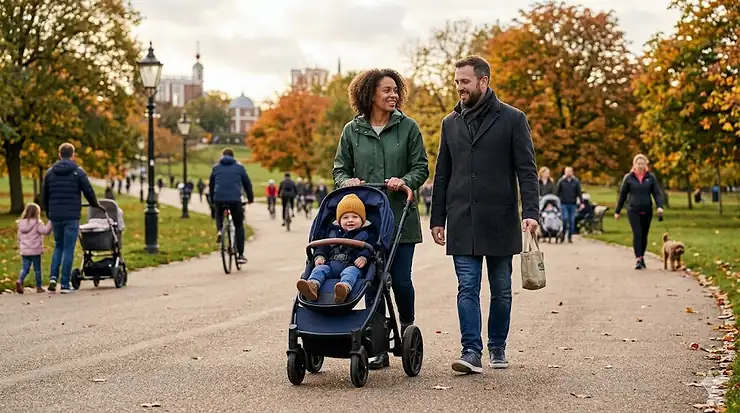
Buying a buggy is one of those decisions that seems simple until you’re standing in a shop aisle — or more likely, scrolling Amazon.co.uk at 11pm — staring at 47 nearly identical-looking prams, all claiming to be the safest thing since bicycle helmets. The truth is, knowing which safety features to look for in kids buggy separates a genuinely protected child from one riding around in a frame that merely looks reassuring.
Britain’s pavements don’t make it easy. We’re talking kerbs, cobblestones, the occasional burst of October rain that would make a duck reconsider its life choices, and the narrow aisles of a Morrison’s on a Saturday morning. A buggy that handles all of this safely — without tipping, rolling, or swallowing your toddler’s fingers in a folding mechanism — requires more than a shiny chassis and a good marketing team.
This guide cuts through the noise. We’ve researched real products available on Amazon.co.uk, consulted UK safety standards (including the BS EN 1888 series that governs all pushchairs sold in Britain), and gathered feedback from real UK parents to give you a genuinely useful buying framework. Whether you’re a first-time parent in Nottingham or replacing a battered old pram in Cardiff, here’s everything that actually matters.
Quick Comparison: Top Buggies for Safety – At a Glance
| Buggy | 5-Point Harness | Parking Brake | Suspension | BS EN 1888 Compliant | Best For | Price Range |
|---|---|---|---|---|---|---|
| Joie Litetrax Pro | ✅ | One-touch | 4-wheel | ✅ | Everyday city use | Around £200–£250 |
| Out n About Nipper V6 | ✅ | Flip-flop-friendly | All-wheel | ✅ | Off-road/rural | £350–£450 range |
| Silver Cross Clic 2 | ✅ | Foot brake | Basic | ✅ | Travel/compact | Around £200–£300 |
| Bugaboo Butterfly 2 | ✅ | Foot brake | Front & rear | ✅ | Travel + daily | £400–£500 range |
| Cosatto Wow 3 | ✅ | Dual brake | All-wheel | ✅ | Birth-to-toddler | £500–£600 range |
| Maclaren Techno XT | ✅ | Foot brake | Front suspension | ✅ | Compact urban | £200–£280 range |
| Britax B-Agile M | ✅ | Rear wheel brake | 4-wheel | ✅ | Budget safety-first | £180–£230 range |
The table makes a useful starting point, but the spec sheet never tells the whole story. The Joie Litetrax Pro, for instance, wins on value-per-safety-feature ratio for UK parents doing school runs and high street shopping. But if you live somewhere rural — say, on the edge of the Peak District or anywhere in rural Wales — the Nipper V6’s all-wheel suspension becomes significantly more than a nice-to-have. We’ll unpack each option in detail below.
💬 Just one click — help others make better buying decisions too! 😊
✨ Don’t Miss These Exclusive Deals!
🔍 Take your buggy search to the next level with these carefully selected products. Click on any highlighted item to check current pricing and availability on Amazon.co.uk. These picks will help you find exactly what you need!
Top 7 Kids Buggies with Outstanding Safety Features: Expert Analysis
1. Joie Litetrax Pro Pushchair – Best All-Round Safety for UK Families
The Joie Litetrax Pro earned Silver at the Mother & Baby Awards 2026 for Best Pushchair, and it’s not hard to see why — this is a buggy that’s thought seriously about what British parents actually encounter day-to-day.
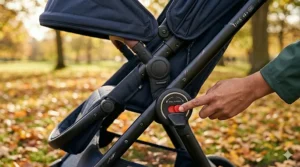
The SoftTouch 5-point harness adjusts to three heights as your child grows, which matters more than people realise: a harness set at the wrong height sits incorrectly across the shoulders, reducing protection at the precise moment you need it most. The one-touch braking system is the feature that genuinely stands out — you can engage it wearing trainers, wellies, or the flimsy sandals you were rushing out in before the school run. The four-wheel suspension handles the transition from tarmac to those rutted cycle-path surfaces that seem to exist solely to test your wrists. A UPF 50+ extendable canopy keeps British summer rain — and, on those rare occasions it cooperates, actual sunshine — at bay.
UK customers note the compact fold makes it genuinely manageable in smaller cars and terraced-house hallways. Suitable from birth to 22kg (around four years).
✅ One-touch brake works with any footwear
✅ 5-point harness adjusts to 3 heights
✅ 4-wheel suspension for uneven pavements
❌ Forward-facing only
❌ Basket capacity on the modest side
Price range: Around £200–£250 — excellent safety value for the price tier. Check current pricing on Amazon.co.uk.

2. Out n About Nipper V6 Pushchair – Best for Off-Road Safety
The Out n About Nipper is the kind of buggy that parents in rural Derbyshire or the Scottish Borders swear by — and for good reason. The V6 builds on everything beloved about the V5 with a redesigned under-seat basket and a new one-hand fold that actually works one-handed (a revelation if you’ve ever wrestled with a previous-generation Nipper while holding a wriggling toddler).
The three-wheel configuration and all-wheel suspension means this pram doesn’t just tolerate rough terrain — it thrives on it. Muddy footpaths, gravel drives, and tree-root-strewn park paths that would rattle a standard city buggy are simply non-events here. The flip-flop-friendly foot brake — Nipper’s trademark feature — means the parking brake engages reliably regardless of your footwear, solving one of the most common real-world safety failures of cheaper buggies. The five-point harness is robust and straightforward to use even in gloves during colder months.
UK parents consistently praise its longevity: this is a buggy that easily serves two or three children across five or more years without safety features deteriorating.
✅ All-wheel suspension for rural terrain
✅ Flip-flop-friendly foot brake
✅ Robust 5-point harness
❌ Bulkier than city-only buggies
❌ Not ideal for very narrow shop aisles
Price range: £350–£450 range — a long-term investment that earns its price. Available on Amazon.co.uk; Prime-eligible for fast delivery.
3. Silver Cross Clic 2 Stroller – Best Compact Safety for Travel & City Life
Silver Cross is a British institution — the brand has been making prams since 1877, which is either reassuring or alarming depending on your perspective. The Clic 2 represents the brand’s modern travel stroller, and its safety credentials are quietly impressive.
The five-point harness is padded and adjustable, the foot brake is reliably positioned, and the seat reclines to a near-flat position that’s genuinely suitable from birth — unusual for a travel stroller in this class. The bumper bar serves double duty as a car seat adaptor for Nuna and Joie infant seats (no separate adapters required), which reduces the awkward fumbling that often happens when transferring a sleeping baby. For UK parents navigating compact flats, public transport, or easyJet overhead lockers, the Clic 2’s sub-7kg weight is a safety feature in itself: exhausted parents carrying heavy prams on stairs make mistakes.
Reviewer feedback from UK parents highlights excellent performance on smooth urban surfaces — tarmac, shopping centre floors, short grass — though it’s not the right choice for gravel or cobblestone.
✅ Lightweight and manageable — reduces fatigue
✅ Near-flat recline suitable from birth
✅ Bumper bar doubles as car seat adaptor
❌ Limited suspension for rougher terrain
❌ Not ideal for heavy off-road use
Price range: Around £200–£300 — solid value for a travel-focused safe stroller. Available on Amazon.co.uk.
4. Bugaboo Butterfly 2 Compact Stroller – Best Premium Travel Safety
The Bugaboo Butterfly 2 sits at the premium end of the compact stroller market, and the safety engineering reflects that. The seat unit features front and rear suspension that genuinely smooths out the jarring that cheaper travel strollers transfer directly to your child’s spine on uneven surfaces.
The five-point harness system is well-designed — simple to buckle even when a toddler has decided they’d rather not cooperate — and the brake is positioned consistently where your foot naturally lands. What most buyers overlook about this model is the compatibility with a wide range of infant car seats (wider than the original Butterfly), which means you can build a genuinely safe travel system without improvising with adaptors. In wet British conditions, the canopy coverage is above average for a travel stroller, though a rain cover (sold separately) remains essential for British autumn use.
UK customers with children in the 6–18 month range particularly appreciate the compact fold and the quality feel that doesn’t come apart after six months of daily use.
✅ Front and rear suspension
✅ Wide car seat compatibility
✅ Premium build durability
❌ Higher price point
❌ Additional adaptors needed (different from original Butterfly)
Price range: £400–£500 range. Check current pricing on Amazon.co.uk.
5. Cosatto Wow 3 Pram & Pushchair – Best From-Birth Safety System
The Cosatto Wow 3 is one of the most comprehensive birth-to-toddler systems on the UK market, and its safety spec is genuinely impressive across every stage of your child’s development. The dual-brake system — a combination of foot brake and secondary locking — is the standout safety feature here, providing redundancy that cheaper single-brake systems lack.
All-wheel suspension handles the varied British terrain well, and the five-point harness system is adjustable through multiple growth stages without requiring you to rethread anything. The carrycot included with the system is lie-flat by design, meeting the NHS guidance recommendation that young babies should lie flat for all but short journeys. For UK parents wanting one pram from hospital to nursery, the Wow 3’s design philosophy is built around not having to buy a second buggy — which, at around £500–£600, represents genuine long-term value despite the upfront cost.
UK reviews consistently highlight the quality of the fabrics in the notoriously damp British climate — they don’t degrade or go mouldy the way cheaper textiles do after repeated soakings.
✅ Dual-brake system for added security
✅ NHS-compliant lie-flat carrycot
✅ All-wheel suspension
❌ Higher initial investment
❌ Bulkier than lightweight options
Price range: £500–£600 range. Available on Amazon.co.uk with Prime delivery.
6. Maclaren Techno XT Pushchair – Best Compact Urban Safety
Maclaren invented the modern folding buggy in 1965 — a fact that becomes relevant when you understand why their folding mechanisms are still among the most reliable and finger-safe on the market. The Techno XT is the brand’s most safety-focused full-featured compact pushchair.
The four-position recline system includes a near-flat option for sleeping toddlers, and the five-point harness is padded and adjustable. Front-wheel suspension handles urban kerbs and pavement cracks without transmitting every imperfection to your child. The self-standing fold is a genuine safety feature: it means you don’t prop the buggy against something and return to find it has fallen onto your child. UK parents in cities particularly value the slimline profile — at 49cm wide, it navigates London Underground corridors and narrow shop aisles without the stress of a wider all-terrain model.
The harness has been praised by UK parents for being quick to operate — which sounds trivial until you’re juggling a bag, keys, and an impatient three-year-old at a zebra crossing.
✅ Trusted folding safety mechanism
✅ Slimline for urban navigation
✅ Self-standing fold prevents tip-overs
❌ Limited off-road capability
❌ Not suitable from birth without accessories
Price range: £200–£280 range. Available on Amazon.co.uk.
7. Britax B-Agile M Pushchair – Best Budget Safety-First Choice
Britax has been a cornerstone of child safety product development in the UK since the 1970s, and the B-Agile M carries that heritage into an accessible price bracket without abandoning the fundamentals. For parents who want a safety-certified, reliable buggy without stretching to premium pricing, this is the most sensible option on this list.
The four-wheel suspension handles the standard UK pavement experience — cracked paving slabs, kerb drops, the occasional adventure into a park — adequately for daily use. The five-point harness is straightforward and reliable. The rear wheel parking brake is firm and consistent. What the B-Agile M doesn’t offer is the redundancy systems of pricier models — it’s a single brake, basic suspension, no secondary locking — but everything it does offer, it does correctly and to BS EN 1888 standards.
UK buyers on a tighter budget consistently rate this model highly for reliability over time. Spare parts are available through UK retailers, which matters more than it sounds if you’re using a buggy daily for three-plus years.
✅ BS EN 1888 compliant from a trusted UK brand
✅ Reliable 5-point harness
✅ Budget-accessible safety
❌ Single brake system only
❌ Basic suspension — not for serious off-road use
Price range: £180–£230 range — the safest choice per pound. Available on Amazon.co.uk.
What “BS EN 1888 Compliant” Actually Means for Your Child
This is the certification that every pushchair sold in the UK must carry, and yet most parents have never heard of it — which is precisely why it’s worth explaining properly.
The BS EN 1888 standard (full designation: BS EN 1888-1:2018+A1:2022) is the British and European standard for wheeled child conveyances. What this means in practice is rigorous: a certified buggy has undergone stability testing, impact resistance assessments, entrapment hazard evaluations, and a rolling road durability test that subjects the wheels to 72,000 obstacle passes at 5 km/h. The folding mechanism is activated and deactivated 200 times under load. Every safety harness is stress-tested. Every brake is verified.
Post-Brexit, UK-sold pushchairs operate under the General Product Safety Regulations 2005 and comply with BS EN 1888 standards. It’s worth noting that the UK’s Business Companion guidance for traders explicitly requires that prams carry a label confirming BS EN 1888 compliance — usually found on the frame or seat fabric. If you’re buying second-hand, check for this label. If it’s absent or illegible, treat the buggy with caution.
One practical nuance: the standard tests pushchairs at walking speed. It does not test for jogging or running pace — which is why all running buggy manufacturers are legally required to specify their products are for walking use, with jogging at the owner’s risk. Worth knowing if you’re eyeing a Nipper V6 with fitness ambitions.
Real-World Scenario: Which Buggy Suits Your UK Life?
The London Family, Postcode TW or SW
You’re navigating tube lifts (when they work), narrow shop doorways, and busy pavements. Weight and fold compactness are almost as important as safety specs, because a buggy you can barely lift becomes a safety hazard on stairs. The Silver Cross Clic 2 or Maclaren Techno XT are your safest options — lightweight enough to handle public transport safely, certified to the same BS EN 1888 standards as heavier models.
The Suburban Family, Somewhere Near a Park
You do school runs on tarmac, Saturday park visits on wet grass, and the occasional foray down a muddy footpath. This is the sweet spot where the Joie Litetrax Pro earns its money — enough suspension for mixed terrain, a reliable brake for hills, and a sensible weight for daily use. The Cosatto Wow 3 is the upgrade if you’re planning siblings.
The Rural Family, Lanes and Footpaths
Gravel, grass, tree roots, and the kind of ground that swallows standard buggy wheels whole. This is unambiguously Out n About Nipper V6 territory. The all-wheel suspension and flip-flop brake aren’t marketing language here — they’re the features that keep your child safe when the terrain is genuinely varied and unpredictable.
How to Choose Safety Features to Look for in Kids Buggy: 7 Expert Criteria
Choosing a buggy based on safety isn’t complicated, but it does require knowing which features are engineering substance versus marketing decoration.
- Five-point harness, full stop. A three-point harness is inadequate for an active toddler. The five-point system — two shoulder straps, two waist straps, one crotch strap — distributes restraint across five points of the body, which is the difference between a child that stays seated and one that slides forward in a sharp stop.
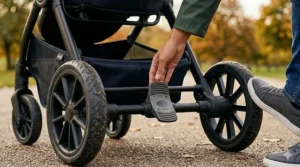
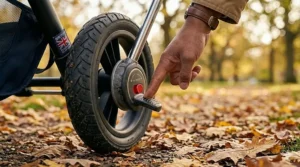
- Brake that works with your actual footwear. Test any brake while wearing the shoes you normally walk in. Flip-flop-friendly designs (like the Nipper’s) matter in summer. Rear-wheel parking brakes should lock positively, not wobble or require repeated stamping.
- Primary and secondary fold locking. British trading standards require a primary and secondary locking device on folding chassis. If a buggy only has one locking point, that is a non-compliance red flag — not a minor inconvenience.
- Suspension appropriate to your terrain. Suspension isn’t just about comfort. A buggy without suspension on rough ground jolts unpredictably, which affects steering control and stability. On a sloped pavement — common in older British towns — this becomes a genuine safety issue.
- BS EN 1888 certification label. Check the frame or seat fabric for this label. No label, no guarantee. Simple.
- Canopy coverage. In Britain, this isn’t about sunshine. A canopy that extends properly protects against rain-related visibility issues — both yours and your child’s — and prevents windscreen-like rain blindness when you’re pushing into a headwind. A UPF 50+ rating is useful for the occasional sunny week too.
- Age and weight appropriateness. Every buggy has a maximum weight rating (typically 15–22kg) and often a minimum age. Using a forward-facing seat before a child has sufficient neck strength — typically before six months — is a safety risk that no amount of certification can mitigate. Always check and respect the manufacturer’s guidelines.
Common Mistakes UK Parents Make When Buying a Buggy
Some of these will be familiar. Some might surprise you.
Ignoring the terrain they’ll actually use it on. A sleek city stroller might look magnificent in the showroom and then immediately fail the moment it meets a cobblestone high street in York or a gravel driveway in Somerset. Be honest about your real daily environment, not your aspirational one.
Overlooking the fold locking mechanism. This is the most under-discussed safety issue in buggy buying. A chassis that folds accidentally while in use — even partially — is a serious injury risk. Always check that both primary and secondary locks engage positively and require deliberate action to release.
Buying second-hand without checking certification. RoSPA guidance is clear: used pushchairs must still meet BS EN 1888 standards. If the safety harness is frayed, the brake is sticky, or the frame shows damage from a previous accident, the item may no longer meet the standard regardless of its original certification.
Assuming “lightweight” means “less safe.” Lighter buggies have had exactly the same certification requirements since the standard was updated. The Maclaren Techno XT and Silver Cross Clic 2 weigh under 7kg and comply fully with BS EN 1888. Weight and safety are independent variables.
Fitting the wrong rain cover. An ill-fitting rain cover can restrict airflow and create overheating risk, particularly for young babies. Always use the manufacturer’s own rain cover or one explicitly rated as compatible.
✨ Don’t Miss These Exclusive Deals!
🔍 Check current prices and availability on the buggies mentioned above — click any highlighted product to go straight to Amazon.co.uk. These carefully selected options will help you find the safest buggy for your family!
UK Regulations, Safety Standards & What to Look For on the Label
Every pushchair and buggy sold in the UK — new or second-hand — must comply with the Wheeled Child Conveyances (Safety) Regulations 1997, and the recommended compliance route is testing against BS EN 1888. This isn’t optional guidance; supplying an unsafe product is a contravention of the General Product Safety Regulations 2005, which Trading Standards enforce.
Post-Brexit, the picture is slightly more nuanced than before. The UK has retained the BS EN 1888 series as its standard, and UK-sold products no longer require CE marking (CE marking is an EU requirement). However, because the UK and EU standards remain closely aligned — the BS EN prefix essentially means the British Standard adopts the European Norm — a product with genuine CE certification to EN 1888 is meeting the same technical standard as a UKCA product.
For Northern Ireland buyers, note that CE marking remains required under the Windsor Framework for products placed on the NI market. This doesn’t affect most purchases from Amazon.co.uk, but it’s worth knowing if you’re comparing prices between NI and GB retailers.
What to check physically on any buggy:
- A label on the frame or seat fabric confirming BS EN 1888 compliance
- The manufacturer’s name and UK contact address
- Maximum user weight and age range printed clearly
- A “Do not leave child unattended” warning (mandatory under the standard)
- Evidence of both primary and secondary fold-locking devices
The British Standards Institution (BSI) maintains the definitive reference for current standards. If you’re uncertain whether a product meets current requirements, their website provides verification resources.
Benefits of Modern Safety Features vs Older Buggies: Is It Worth Upgrading?
| Feature | Pre-2018 Buggies | Modern BS EN 1888:2018+ Buggies | Practical Difference |
|---|---|---|---|
| Harness standard | 3-point or basic 5-point | Padded, height-adjustable 5-point | Better restraint across growth stages |
| Fold locking | Often single lock | Primary + secondary mandatory | Reduces accidental collapse risk |
| Brake testing | Basic | 200-cycle durability test | Brakes remain effective after heavy use |
| Wheel durability | Variable | 72,000 rolling road test cycles | Wheels stay safe longer |
| Chemical safety | Limited testing | Comprehensive chemical hazard testing | Safer fabric and frame materials |
| Best For | Budget/second-hand | New purchase, first buggy | Peace of mind for daily use |
The gap between a buggy made before the 2018 standard update and a current-compliant model is meaningful — particularly in harness design, fold locking, and brake durability testing. For parents inheriting an older buggy from a family member, the analysis above gives a useful checklist of what to physically verify before use.
Long-Term Cost & Maintenance: What UK Parents Actually Spend
The purchase price is only part of the story. A buggy bought in the £180–£250 range might represent excellent value if it’s robust — but if it requires a new set of rear wheels after 18 months of daily use on British pavements, the maths shifts considerably.
Replacement parts availability is a practical safety consideration. British brands like Silver Cross, Britax, and Maclaren maintain UK spare parts networks, meaning a broken brake cable or damaged harness buckle can be replaced rather than rendering the whole buggy unsafe. Less common brands — particularly grey-import models purchased from third-party Amazon sellers — may have no UK spare parts support whatsoever.
Rain cover longevity matters in Britain more than almost anywhere. Budget rain covers crack and split within a season of UV exposure and repeated folding. The manufacturer’s own cover, or a premium third-party replacement in the £25–£40 range, is money well spent.
Harness cleaning is a safety maintenance issue, not just hygiene. Most UK manufacturers recommend spot-cleaning harness webbing only — machine washing can degrade the tensile strength of the straps, which means they pass visual inspection but no longer hold safely under load. Check your manual.
Tyre pressure, for buggies with pneumatic tyres (like the Nipper V6), should be checked monthly. Under-inflated tyres compromise suspension performance and make the buggy harder to control — both of which matter on sloped pavements and rough terrain.
FAQ: Safety Features to Look for in Kids Buggy
❓ What safety standard should a UK buggy comply with?
❓ Is a 5-point harness really necessary in a buggy?
❓ Can I use a second-hand buggy safely in the UK?
❓ What's the difference between CE and UKCA marking on buggies?
❓ At what age can a baby use a forward-facing buggy seat safely?
Conclusion: The Safety Checklist That Actually Matters
Right. Let’s pull this together without wasting your time. The safety features to look for in kids buggy come down to a handful of non-negotiables: a five-point adjustable harness, a brake system that works reliably with your actual footwear, primary and secondary fold locking, BS EN 1888 certification, and suspension appropriate to the terrain you’ll genuinely use.
Everything else — canopy coverage, rain cover quality, replacement parts availability, weight limit headroom — is the layer of practical safety that makes the difference between a buggy that stays safe over three years of British weather and one that slowly deteriorates into something you should probably retire.
Of the seven options we’ve reviewed, the Joie Litetrax Pro represents the strongest combination of safety features and value for most UK parents. Rural families should look seriously at the Out n About Nipper V6, and those prioritising travel or compact city use will find the Silver Cross Clic 2 or Maclaren Techno XT meet the same certification standards in a lighter, more manageable package.
Buy from reputable UK retailers or verified Amazon.co.uk sellers, check the BS EN 1888 label is present, and don’t compromise on the harness or the brake. Everything else is negotiable.
✨ Don’t Miss These Exclusive Deals!
🔍 Ready to find your perfect buggy? Click any highlighted product above to check current pricing and availability on Amazon.co.uk — Prime members get free next-day delivery on most of these picks!
Recommended for You
- Best Off Road Ride On Toys UK 2026: 7 Expert Picks
- Best Summer Ride On Toys for Garden Kids Will Love in 2026 (UK)
- Best Ride On Buggy for Birthday Gift UK 2026: 7 Wow-Factor Picks
Disclaimer: This article contains affiliate links. As an Amazon Associate, I earn from qualifying purchases. If you purchase products through these links, we may earn a small commission at no additional cost to you.
✨ Found this helpful? Share it with your mates! 💬🤗
