In This Article
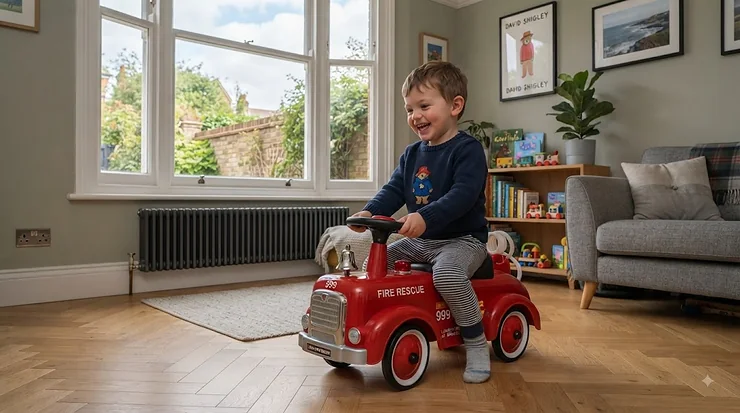
A fire engine ride-on toy is a wheeled play vehicle styled like a fire truck, designed for toddlers and young children to sit or push along, often featuring lights, sirens, a steering wheel and role-play extras such as a hose or ladder. If you’ve ever watched a toddler freeze mid-tantrum the second a real fire engine rumbles past, you already understand the appeal here. There’s something about flashing lights and a good siren that short-circuits every other thought in a small child’s head, and toy manufacturers have been cashing in on that fascination for decades.
The tricky part isn’t finding a fire engine ride-on toy — Amazon alone returns dozens of near-identical red plastic trucks. The tricky part is working out which ones are genuinely worth the money, which will actually support your toddler’s gross motor skill development, which will survive a British garden (mud, gravel, that one paving slab that’s slightly higher than the rest), and which are just a shiny box that’ll be forgotten by February. We’ve dug through real specifications, aggregated customer feedback and current UK safety standards to put together an honest shortlist, from six-month-old push-along toys right through to battery-powered sit-ins for pre-schoolers. Whether you’re buying for a first birthday or trying to win over a stubborn three-year-old who insists on being called “Chief,” this guide should save you a fair bit of scrolling.
Quick Comparison Table
| Product | Type | Age Range | Price Guide | Best For |
|---|---|---|---|---|
| HOMCOM Foot-to-Floor Fire Engine | Push/foot-to-floor | 18 months–5 years | Under £40 | Budget first ride-on |
| HOMCOM 4-in-1 Sit-In Fire Engine | Sit-in, multi-mode | 18 months–5 years | £55-£65 range | Amazon’s Choice all-rounder |
| Chad Valley Fire Engine 6V | Battery-powered | 3-6 years | £90-£120 range | Sirens and sound-effect fans |
| Mercedes-Benz Antos Fire Engine | Push-along | 1-3 years | £45-£60 range | Licensed realism |
| Fisher-Price Chime & Ride Fire Truck | Infant push-along | 6 months+ | Under £25 | Fire engine push along toy for toddlers |
| Kiddimoto Wooden Fire Engine | Wooden ride-on | 12 months+ | £65-£85 range | Eco-conscious buyers |
| Little Tikes Cozy Fire Truck | Classic foot-to-floor | 18 months-5 years | £90-£110 range | Long-term durability |
Looking at the spread above, the gap between the cheapest and priciest option isn’t really about quality so much as category — a foot-to-floor pusher and a 6V battery vehicle are almost different product types wearing the same red paint job. Families with a genuinely young toddler (under two) should lean towards the lighter, simpler end of this table, while parents of a confident three- or four-year-old will get more mileage from the battery-powered or sit-in options. We’ll unpack exactly why in the sections below.
💬 Just one click — help others make better buying decisions too!😊
Top 7 Fire Engine Ride-On Toys: Expert Analysis
1. HOMCOM Foot-to-Floor Fire Engine — best budget pick under £40
The standout here is simple: at under £40, this is one of the more accessible entry points into fire engine ride-on toys without dropping into unbranded, unreviewed territory. It’s a foot-to-floor design, meaning there’s no pedal mechanism or battery — your toddler propels it by walking their feet along the ground, Flintstones-style, which is exactly what’s recommended for building leg strength before a pedal bike is on the cards.
Rated for ages 18 months to 5 years, it’s built around a moulded plastic body with four wheels, a non-slip seat and a low centre of gravity that makes tipping over unlikely on flat ground. Real-world meaning: that low seat height matters more than it sounds, because a toddler’s sense of balance is still developing and a taller sit-in vehicle is genuinely more prone to wobble on uneven patios.
Based on the spec comparison with pricier sit-ins in this list, what you’re sacrificing here is the lights-and-sirens theatre, not core safety or build quality. This is the toy to buy if your child is still finding their feet, quite literally, and you’d rather test the “fire engine” enthusiasm before committing to a £100 battery-powered version.
Aggregated review sentiment sits at 4.3 out of 5 from 26 ratings on Amazon UK at the time of research, with feedback generally positive on ease of assembly, though as with any budget ride-on, a handful of reviewers note the plastic feels lighter-duty than premium alternatives.
Pros:
- ✅ One of the cheapest genuine fire engine ride-ons available
- ✅ Foot-to-floor design supports early leg-strength development
- ✅ Low, stable seat height suited to younger toddlers
Cons:
- ❌ No lights, siren or sound effects included
- ❌ Lighter-duty plastic than premium sit-in models
Price sits comfortably under £40, and for a first ride-on that a toddler might use for six to twelve months before graduating to a trike, the value case is strong — check current price and stock before ordering, as budget ride-ons tend to move quickly.
2. HOMCOM 4-in-1 Sit-In Fire Engine — Amazon’s Choice all-rounder
What stands out immediately is the “4-in-1” framing: this model is designed to adapt as a child grows, transitioning from a supported push-along through to an independent ride-on as confidence builds. It currently holds Amazon’s Choice status for fire engine ride-on searches, with 4.5 out of 5 stars from 83 ratings — a meaningfully larger review pool than most competitors in this category, which adds a layer of trustworthiness to that rating.
The sit-in design includes a proper seat with backrest, a steering wheel with horn function, and underseat or rear storage for stashing a helmet or toy hose. In practice, that storage compartment is more useful than it sounds — it’s the difference between a tidy hallway and tripping over loose fire-fighting accessories every morning. Suitable from around 18 months through to roughly 5 years, though taller four- and five-year-olds may find the seat snug toward the upper end of that range.
Here’s what most buyers overlook about this model: the “4-in-1” adaptability means it’s genuinely one of the few ride-ons in this list that could realistically be the only fire engine toy a family buys, rather than something outgrown within a year. Reviewers consistently report satisfaction with the sturdiness of the frame and the ease of switching between play modes, though a small minority mention that assembly takes longer than the box suggests.
Pros:
- ✅ Amazon’s Choice with a large, largely positive review base
- ✅ Adapts across several developmental stages
- ✅ Useful underseat storage for role-play accessories
Cons:
- ❌ Assembly reportedly takes longer than expected for some buyers
- ❌ Seat may feel snug for children near the upper age limit
At around the £55-£65 mark, this sits firmly in mid-range territory, and on a cost-per-month-of-use basis it’s arguably the best value pick in this entire list given how long a well-reviewed 4-in-1 design tends to stay relevant.
3. Chad Valley Fire Engine 6V Powered Ride On — best for sirens and sound-effect fans
The standout feature here is the 22W motor paired with genuine working red and blue flashing lights — this is the model to reach for if “sirens and sound-effect toys” is specifically what you’re shopping for, rather than a quieter push-along. Chad Valley is a long-established own-brand name recognised across UK toy retail, which adds a layer of trust for parents wary of unfamiliar battery-toy manufacturers.
Powered by a 6V rechargeable battery, it reaches a genuinely toddler-safe top speed of around 3km/h (roughly 1.86mph), with a forward/reverse switch operated via a simple pedal-and-lever setup rather than anything resembling a real accelerator. Charge time runs 8-10 hours for around 1-2 hours of continuous play, and the maximum weight limit sits at 30kg — worth checking against your child’s current weight and a bit of headroom for growth. What most buyers overlook about battery ride-ons generally is that “1-2 hours of continuous use” rarely maps onto real play sessions, which are typically start-stop rather than nonstop driving, so actual charge-to-charge coverage often stretches across several shorter outings.
Reviewers of Chad Valley’s battery ride-on range consistently flag the lights and horn as genuine highlights for younger children, though as with most 6V ride-ons in this price bracket, a recurring theme in aggregated feedback is that charge time feels long relative to play time — a fair trade-off for many families, less so for others.
Pros:
- ✅ Working flashing lights and siren sounds included
- ✅ Toddler-safe capped speed of around 3km/h
- ✅ Recognised, trusted own-brand name
Cons:
- ❌ Long charge time relative to play time (8-10hrs for 1-2hrs use)
- ❌ Heavier and less portable than push-along alternatives
Expect to pay in the £90-£120 range for a 6V ride-on of this spec — not the cheapest option here, but if working lights and sirens are non-negotiable, this justifies the extra outlay over the push-along models further down this list.
4. Mercedes-Benz Antos Fire Engine Push-Along — best for licensed realism
The standout advantage is the official Mercedes-Benz Antos licensing, which gives this push-along a level of styling detail — proper cab shaping, realistic proportions — that generic “fire engine shaped” toys simply don’t replicate. For parents who care about design authenticity as much as play value, that licensing is the whole pitch.
It’s a foot-to-floor push-along rather than pedal- or battery-powered, aimed at the 1-3 year age bracket, with light-up features and sound effects designed for role-play rather than realistic driving dynamics. Underseat storage is included, which — as with the HOMCOM sit-in above — turns out to matter more in daily use than it sounds on a spec sheet, since toddlers accumulate an alarming number of “fireman tools” within days of getting a fire engine toy.
On paper, this sits in a slightly unusual middle ground: more premium-feeling than a basic HOMCOM push-along thanks to the licensing and build detail, but without the battery power of the Chad Valley model. Based on the spec comparison, it’s best suited to families who want their fire engine push along toy for toddlers to look genuinely polished — perhaps for a first birthday gift where presentation matters — rather than families chasing maximum play features per pound.
Aggregated retailer feedback on Smyths’ push-along ride-on range points to consistent praise for build sturdiness and ease of first use, with underseat storage frequently highlighted as a practical bonus rather than a gimmick.
Pros:
- ✅ Officially licensed Mercedes-Benz Antos styling
- ✅ Light-up features add role-play realism
- ✅ Underseat storage for toys and accessories
Cons:
- ❌ No battery power — foot-to-floor only
- ❌ Narrower age window than adaptable sit-in models
Typically priced in the £45-£60 range, it sits above the cheapest foot-to-floor options but below full battery-powered ride-ons — a reasonable middle price for a licensed product.
5. Fisher-Price Chime & Ride Fire Truck — best fire engine push along toy for toddlers under one
This one earns its spot specifically for the youngest end of the age range: Fisher-Price designed it for babies from around six months, well before most “fire engine ride-on toys” become age-appropriate. The standout mechanic is a fire hose that spins 360 degrees and clicks — a genuinely clever bit of cause-and-effect engineering that rewards a baby’s earliest exploratory pushing and pulling.
Pushing or pulling the truck triggers a chime sound, which sounds like a small detail but is doing real developmental work: it reinforces the connection between a baby’s own movement and an outcome in the world, a concept occupational therapists often describe as building early cause-and-effect understanding. The compact size is genuinely built for small hands rather than scaled down from a toddler product, and the bright colour palette follows established guidance on what captures very young infants’ attention.
What most buyers overlook about “ride-on” branding here is that it’s not a seated ride-on in the traditional sense — a baby crawls alongside and pushes it, more comparable to a walker toy than a seated truck. Reviewers consistently describe it as a reliable early gift, particularly praised for encouraging crawling and cruising in babies who are on the cusp of mobility.
Pros:
- ✅ Suitable from around 6 months, earlier than most alternatives here
- ✅ Encourages crawling through cause-and-effect chime sounds
- ✅ Compact and sized appropriately for small hands
Cons:
- ❌ Not a seated ride-on — designed for pushing alongside, not sitting in
- ❌ Outgrown faster than sit-in or foot-to-floor alternatives
At under £25, it’s one of the most affordable entries here, and given how briefly babies use any single toy at this age, that lower price point makes sense as a value proposition rather than a compromise.
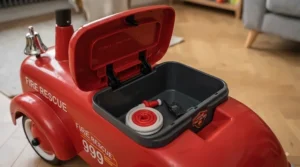
6. Kiddimoto Wooden Fire Engine Ride On — best for eco-conscious buyers
The standout feature is the material itself: sustainably sourced birch plywood rather than moulded plastic, which immediately sets this apart from every other entry on this list. For parents actively trying to reduce the amount of plastic entering the house — or simply after a toy that looks good left out in a living room rather than shoved in a cupboard — this is the obvious pick.
Suitable from 12 months and up, it includes a working steering wheel that genuinely turns the front wheels, plus underseat storage built into the wooden frame. Here’s what the spec sheet won’t tell you outright, but is worth weighing: wooden ride-ons generally distribute weight differently to plastic ones, often feeling more stable at low speeds precisely because they’re heavier, though that same weight makes them less practical to lug in and out for daily outdoor use compared with a lightweight plastic pusher.
Based on the broader pattern across wooden ride-on toys as a category, durability tends to be the headline strength — birch plywood construction typically outlasts injection-moulded plastic by a wide margin, and scuffs read as “character” rather than damage in a way scratched plastic never quite manages. The trade-off is indoor-leaning use, since untreated or lightly varnished wood generally fares worse than plastic in wet British weather.
Pros:
- ✅ Sustainably sourced birch plywood construction
- ✅ Working steering wheel with genuine turning function
- ✅ Built to outlast plastic alternatives with fair care
Cons:
- ❌ Less weather-resistant than plastic ride-ons for outdoor storage
- ❌ Heavier to carry or reposition than lightweight plastic models
Priced in the £65-£85 range, it’s a premium purchase relative to plastic foot-to-floor toys, but the resale and hand-me-down value of well-made wooden toys tends to be notably higher, which is worth factoring into any value verdict.
7. Little Tikes Cozy Fire Truck — best for long-term durability
The standout here is heritage: Little Tikes’ “Cozy” range is one of the longest-running ride-on toy families in the world, and this fire truck variant carries the same reputation for near-indestructible moulded plastic that’s made the original Cozy Coupe a playground fixture for generations. If durability is your single biggest priority, this is the pick.
It’s a classic foot-to-floor design suitable roughly from 18 months to 5 years, featuring a working door, a water tank play feature and enough structural weight to withstand genuinely rough outdoor use — driveways, uneven grass, being reversed into a fence by an over-enthusiastic three-year-old. What most buyers overlook about the “Cozy” range specifically is that replacement parts are widely available years after purchase, since Little Tikes maintains a dedicated parts programme — a rare thing in toys, where most ride-ons are simply binned the moment a wheel cracks.
Reviewers across the wider Little Tikes Cozy range consistently highlight longevity as the standout theme, with many noting the toy survives being handed down between siblings or even passed on second-hand years later, still fully functional. The trade-off is aesthetic simplicity — no lights, no battery, no sirens — which puts it at odds with children specifically drawn to the “sirens and sound-effect toys” end of this category.
Pros:
- ✅ Renowned for exceptional long-term durability
- ✅ Spare parts remain available years after purchase
- ✅ Suitable for genuinely rough outdoor play
Cons:
- ❌ No lights, sounds or battery-powered features
- ❌ Higher upfront price than basic foot-to-floor alternatives
Expect to pay in the £90-£110 range, which looks steep next to the HOMCOM budget pick, but on a cost-per-year basis — given how many families report multi-child use — it’s genuinely one of the better long-term value propositions in this list.
Top 7 Products at a Glance
| Product | Rating (aggregated) | Power | Standout Feature |
|---|---|---|---|
| HOMCOM Foot-to-Floor Fire Engine | 4.3★ (26 ratings) | Foot-to-floor | Lowest entry price |
| HOMCOM 4-in-1 Sit-In Fire Engine | 4.5★ (83 ratings) | Foot-to-floor / push | Amazon’s Choice, adaptable |
| Chad Valley Fire Engine 6V | Strong own-brand reputation | 6V battery | Working lights and siren |
| Mercedes-Benz Antos Fire Engine | Consistently positive | Push-along | Licensed realistic styling |
| Fisher-Price Chime & Ride Fire Truck | Long-standing trusted range | Push-along | Suitable from 6 months |
| Kiddimoto Wooden Fire Engine | Well-regarded niche brand | Foot-to-floor | Sustainable birch construction |
| Little Tikes Cozy Fire Truck | Long-running trusted range | Foot-to-floor | Multi-generation durability |
The pattern that jumps out here is that no single product wins on every metric — the HOMCOM 4-in-1 Sit-In Fire Engine has the strongest review volume, but the Little Tikes Cozy Fire Truck likely wins on sheer lifespan, and the Chad Valley Fire Engine 6V is the only genuinely battery-powered option with real sirens. Your priority (budget, noise tolerance, longevity, or eco credentials) should decide the winner far more than star ratings alone.
✨ Don’t Miss These Exclusive Deals!
🔍 Take your toddler’s role-play collection to the next level with these carefully selected fire engine ride-ons. Click on any highlighted item to check current pricing and availability. These picks help create authentic firefighter adventures your family will love!
How to Choose a Fire Engine Ride-On Toy
Picking between seven genuinely different products can feel harder than it should, so here’s a practical, numbered framework:
- Start with age and stage, not the picture on the box. A six-month-old needs a push-along like the Fisher-Price model, not a sit-in — matching developmental stage to design avoids frustration and wasted money.
- Decide how much noise you can live with. Battery-powered models with sirens are genuinely more engaging for many children, but they’re also genuinely louder — be honest about your tolerance before buying.
- Check your outdoor surface. Gravel driveways and rough grass favour sturdier, weightier ride-ons; smooth patios and indoor play suit lighter foot-to-floor designs.
- Weigh battery convenience against charge time. A 6V ride-on offers theatre and realism, but an 8-10 hour charge for 1-2 hours of play needs planning around, especially for spontaneous outings.
- Think about siblings and resale. If durability and hand-me-down value matter, prioritise reputation for longevity over flashy features.
- Factor in storage space. Sit-in and battery models are bulkier to store than compact push-alongs — a real consideration in flats or smaller gardens.
- Confirm the weight limit against your child’s current weight, with headroom. Buying right at the limit shortens the toy’s useful life considerably.
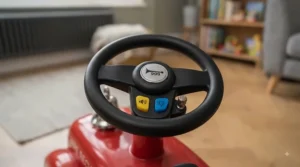
Fire Engine Push Along Toy for Toddlers: What Sets Them Apart
Push-along fire engine toys occupy a specific developmental niche, and it’s worth understanding why they’re often the smarter first purchase rather than jumping straight to a sit-in or battery-powered model. Health professionals generally describe the toddler years as a period of rapid gross motor development, where activities that encourage walking, pushing and balancing directly support the muscle groups a child needs before running or riding a pedal toy becomes realistic — a pattern reflected in NHS guidance on how cruising along furniture builds the confidence toddlers need for independent walking.
A push-along fire engine — whether the infant-focused Fisher-Price Chime & Ride Fire Truck or the toddler-scaled Mercedes-Benz Antos Fire Engine — essentially turns that natural developmental drive into structured play. The child controls the pace entirely with their own legs, there’s no motor doing the work, and the resistance of pushing a weighted object (rather than an empty pram or trolley) adds a small but real strength-building element. What most parents overlook is that push-along toys typically bridge a longer age window than they expect, often remaining engaging from first steps through to around age three, simply because a toddler’s relationship with “driving” the vehicle changes as their confidence grows — from wobbly first pushes to confident zooming around the kitchen island.
The trade-off, honestly, is theatre. Push-along toys generally can’t match the sirens-and-lights spectacle of a battery-powered model, which is exactly why families torn between the two should think about which stage their child is actually at, rather than which toy looks more exciting in a photograph.
Car-Shaped Ride-On Under £40: What You Actually Get
Budget is often the deciding factor for a first ride-on toy, so it’s worth being upfront about what changes — and what doesn’t — once you drop below the £40 mark. Based on the spec comparison across this list, the HOMCOM Foot-to-Floor Fire Engine is the clearest example of what a genuinely sub-£40 fire engine ride-on toy delivers: solid, safety-tested moulded plastic construction, a stable low seat, and foot-to-floor propulsion, without lights, sirens or battery power.
What most buyers overlook when hunting for a car-shaped ride-on under £40 is that the missing features aren’t really cut corners — they’re the mechanical components that cost the most to manufacture. A motor, battery, charging circuit and sound module add real cost; a moulded plastic shell with wheels and a seat does not. In practice, this means a well-reviewed sub-£40 ride-on is rarely a “worse” toy in terms of build safety, just a simpler one in terms of features.
Where buyers do need to be more careful at this price point is review volume and brand recognition. A £15 unbranded “fire engine ride-on” with no reviews and no traceable UK importer address is a genuinely different risk profile to a recognised own-brand product like HOMCOM’s range, even at a similar price. Checking for a UKCA or CE mark, an importer address, and a reasonable review history matters more at the budget end than anywhere else in this list, because it’s precisely where corners are most likely to be cut by less scrupulous sellers.
Practical Usage Guide: Setup, First Rides and Maintenance
Getting a new fire engine ride-on toy right in the first month makes a genuine difference to how long it lasts and how much your toddler actually uses it, so here’s what Amazon’s product listings won’t walk you through.
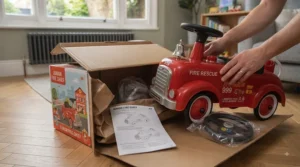
First 24 hours: Most ride-ons, sit-in or push-along, arrive part-assembled and need wheels, a steering wheel or a seat back attached. Do this on a flat, clear surface — garages and kitchen floors work better than carpet, where small screws vanish instantly. For battery models like the Chad Valley Fire Engine 6V, give the battery its full initial charge (typically the stated 8-10 hours) before the first ride, even though the temptation to let an excited toddler test it immediately is real; an undercharged first run can affect battery longevity down the line.
First 30 days — common mistakes to avoid: The single most frequent error is under-tightening wheel nuts or axle bolts after assembly, which leads to a wobbly ride that feels like a fault but is actually a five-minute fix with the supplied tools. Second, many parents skip reading the weight and age guidance properly, letting an older sibling “have a go” on a toy rated for a much younger, lighter child — foot-to-floor and battery ride-ons alike are engineered around specific weight tolerances, and exceeding them regularly can stress the frame.
Ongoing maintenance: For plastic foot-to-floor models, a monthly check of wheel axles for grit or grass build-up keeps movement smooth — a stiff wheel is almost always debris, not a mechanical fault. Battery ride-ons benefit from a full discharge-recharge cycle roughly every couple of months if used infrequently, which helps preserve battery capacity over the toy’s lifespan. Wooden ride-ons like the Kiddimoto Wooden Fire Engine should be brought indoors or covered during wet weather, since even sealed birch plywood will warp with repeated soaking.
Optimisation trick most listings don’t mention: For sit-in and 4-in-1 designs like the HOMCOM 4-in-1 Sit-In Fire Engine, periodically re-check the seat and backrest fixings as your child grows heavier — a bolt that felt perfectly snug at 18 months can loosen under a sturdier three-year-old’s weight over time.
Real-World Scenarios: Matching the Toy to Your Toddler
Scenario one — the cautious 14-month-old just finding their feet. A child at this stage typically benefits most from a push-along design with a low centre of gravity and no motorised speed to manage. The Fisher-Price Chime & Ride Fire Truck, or the slightly older-skewing Mercedes-Benz Antos Fire Engine, both fit well here — the emphasis is on encouraging confident, independent movement rather than delivering excitement through features.
Scenario two — the boisterous three-year-old obsessed with sirens. For a child who’s already mobile, confident, and specifically drawn to fire engines because of the noise and drama, a feature-rich option pays off. The Chad Valley Fire Engine 6V or the HOMCOM 4-in-1 Sit-In Fire Engine deliver genuine sirens, lights and horn functions that match this level of enthusiasm, and the added structure (seatbelt-style safety features, capped speed) suits a child old enough to understand basic ride-on rules.
Scenario three — the family prioritising longevity and multiple children. If this fire engine needs to survive two or three siblings, plus the occasional cousin at Christmas, durability trumps features. The Little Tikes Cozy Fire Truck is purpose-built for exactly this use case, with its reputation for surviving years of rough outdoor play and the reassurance of an established spare-parts programme if something does eventually break.
Emergency Vehicle Role Play: Why It’s More Than Noise
It’s tempting to write off “emergency vehicle role play” as simple novelty, but there’s genuine developmental substance behind why children gravitate toward fire engines, ambulances and police cars specifically. Role play involving occupations and helpers is widely recognised in early years education as a way children process real-world concepts — safety, helping others, rules and consequences — through a format they can control and repeat as often as needed.
What most parents overlook is that the specific appeal of emergency vehicles, as opposed to, say, a generic toy car, tends to centre on drama and purpose: a fire engine has somewhere urgent to be, which gives a toddler’s imaginative play a narrative arc rather than aimless driving. Products with role-play extras — a helmet, a hose, opening doors, a working ladder — extend this further by letting a child act out the “job” rather than just the vehicle, which is a meaningfully richer form of pretend play.
Based on this pattern, buyers choosing between two otherwise similar fire engine ride-on toys should weigh role-play extras more heavily than they might initially assume. A model with a genuine opening door and hose, like the Little Tikes Cozy Fire Truck, tends to sustain a child’s interest longer than a purely aesthetic red plastic shell, precisely because it supports more elaborate storytelling rather than just transportation.
Toddler Ride-On Safety: Regulations and Practical Checks
All fire engine ride-on toys sold legitimately in the UK must comply with the Toys (Safety) Regulations 2011, the UK’s implementation of established toy safety standards. In practice, this means every product on this list should carry a UKCA or CE mark, along with traceable manufacturer or importer details — and it’s genuinely worth checking for these on the product listing and the toy itself before buying, particularly at the budget end of the market. The UK government maintains a full list of designated standards for toy safety in support of the Toys (Safety) Regulations 2011, covering everything from mechanical and physical properties through to the chemical safety of paints and plastics used.
Beyond the legal baseline, a few practical checks make a real difference. First, always confirm the stated weight and age range against your own child rather than relying on general “toddler” branding — a toy rated for 18 months to 5 years is engineered around an average within that spread, not the extremes. Second, for battery-powered ride-ons, always supervise charging and never leave a battery charging unattended overnight, standard advice that applies to any rechargeable children’s product. Third, outdoor ride-ons should be used on flat, obstacle-free surfaces where possible; even a foot-to-floor toy with a low centre of gravity can tip on a steep camber or loose gravel.
Age grading itself is a genuine safety mechanism rather than a marketing suggestion — products rated for children over 36 months typically carry that guidance because of small parts risks, not because a younger child “wouldn’t enjoy it” as much. Checking this detail carefully before buying, especially for products with detachable accessories like helmets or hoses, is one of the simplest ways to avoid a genuine hazard rather than just a fit issue.
Sirens and Sound-Effect Toys: Getting the Noise Level Right
Sound is arguably the single biggest differentiator between the products in this list, and it’s worth thinking through deliberately rather than assuming louder is automatically better. Models like the Chad Valley Fire Engine 6V and the HOMCOM 4-in-1 Sit-In Fire Engine include genuine siren and horn functions, which are enormously engaging for children specifically drawn to emergency vehicles — but that same feature is the single most common source of parental regret in aggregated feedback on sound-effect ride-ons generally.
What the spec sheet won’t tell you, but plenty of parents will, is that a fire engine’s siren doesn’t get quieter with repetition — if anything, a toddler who’s discovered a horn button will trigger it more, not less, over the following weeks. Before buying a model specifically for its sound effects, it’s worth checking whether the volume is adjustable or the sound can be muted, a feature increasingly common on newer battery ride-ons but far from universal.
On the other end of the spectrum, the Fisher-Price Chime & Ride Fire Truck and the wooden Kiddimoto model offer a middle ground worth considering: gentle chime sounds or no built-in sound at all, letting a child provide their own siren noises through imaginative play. Reviewers of quieter ride-on ranges consistently note this as a genuine advantage for households with younger siblings, home offices, or simply lower noise tolerance — a legitimate and common priority that’s easy to overlook when every product listing leads with “exciting sound effects” as a selling point.
Common Mistakes When Buying a Fire Engine Ride-On Toy
The most frequent mistake, by a wide margin, is buying purely on price without checking the age and weight range against your specific child — a toy that’s technically “for toddlers” can still be a poor fit if your child sits at either extreme of that range. A close second is underestimating storage space; sit-in and battery ride-ons are considerably bulkier than the product photos suggest once they’re sitting in a hallway rather than a showroom.
Another commonly overlooked issue is charge-time planning for battery models — buying a 6V ride-on without realising the 8-10 hour charge cycle means it genuinely can’t be used spontaneously on a whim; it needs to be charged the night before. Parents also frequently skip verifying UKCA or CE marking on lesser-known budget brands, which matters considerably more for battery-powered products given the additional electrical safety standards involved — most legitimate toys are tested against the EN 71 safety standard or its UK-designated equivalent, and it’s worth checking a listing references this before buying from an unfamiliar seller.
Finally, a subtler mistake: choosing a toy based on how exciting it looks in marketing photography rather than matching it to the child’s actual developmental stage. A stunning battery-powered fire engine is wasted on a fourteen-month-old who isn’t yet steady enough to manage a steering wheel and a pedal simultaneously — the simpler push-along would serve that child far better, regardless of how it photographs.
Fire Engine Ride-Ons vs Traditional Pedal Cars
| Factor | Fire Engine Ride-On | Traditional Pedal Car |
|---|---|---|
| Typical age start | 6 months (push-along) | Around 3 years |
| Propulsion | Push, foot-to-floor or battery | Pedal-powered |
| Role-play features | Sirens, lights, hoses common | Rare |
| Physical development focus | Balance, early leg strength | Leg strength, coordination |
| Best For | Younger toddlers and role play | Older, coordinated children |
The core distinction here is developmental readiness rather than one category simply being “better.” A fire engine ride-on toy generally suits a much wider and younger age bracket, precisely because push-along and foot-to-floor designs don’t demand the coordinated pedalling motion a traditional pedal car requires. Pedal cars, by contrast, tend to better serve children around three and up who’ve already mastered basic gross motor coordination and want a faster, more “grown-up” feeling ride. For families torn between the two, the honest answer is that they’re rarely direct competitors — many households end up owning both at different stages, rather than choosing one over the other permanently.
Long-Term Cost and Maintenance
| Product Type | Typical Price Range | Ongoing Costs |
|---|---|---|
| Push-along (Fisher-Price, Mercedes-Benz Antos) | Under £25 – £60 range | None significant |
| Foot-to-floor plastic (HOMCOM, Little Tikes) | Under £40 – £110 range | Occasional wheel/axle checks |
| Battery-powered (Chad Valley) | £90-£120 range | Electricity for charging, eventual battery replacement |
| Wooden (Kiddimoto) | £65-£85 range | Weather protection, occasional oiling |
Looking at total cost of ownership rather than sticker price alone changes the picture somewhat. A battery-powered ride-on’s upfront cost is only part of the story — over several years, occasional battery replacement (a realistic expectation for any rechargeable toy used regularly) adds a modest but real ongoing cost that push-along and simple foot-to-floor toys simply don’t carry. On the other hand, products built for longevity, like the Little Tikes Cozy Fire Truck, often work out cheaper per year of actual use than their upfront price suggests, particularly if they’re handed down between siblings rather than replaced.
Problem → Solution: Fixing Common Ride-On Issues
Problem: the ride-on squeaks or feels stiff after a few months outdoors. This is almost always grit or moisture in the wheel axles rather than a manufacturing fault. A quick wipe-down of the axle area and, where accessible, a small amount of silicone-based lubricant (never oil-based, which attracts more dirt) typically resolves it.
Problem: a battery ride-on won’t hold charge like it did initially. Rechargeable batteries in toys like the Chad Valley Fire Engine 6V naturally lose some capacity over repeated charge cycles — this is standard battery chemistry, not necessarily a fault. If charge time has dropped dramatically and suddenly rather than gradually, checking the charger connection and contacts for corrosion is the first troubleshooting step before assuming the battery itself has failed.
Problem: my toddler has lost interest faster than expected. Before assuming the toy itself is the issue, consider whether it matches their current developmental stage — a push-along bought at six months may simply need a break and reintroduction once walking is more confident, rather than being genuinely “outgrown.”
Problem: the seat feels loose on a sit-in model. As covered in the maintenance section above, growing children apply more force to fixings over time. A five-minute check and re-tightening of visible bolts, using the tools supplied at purchase, usually resolves this without needing a replacement part.
Problem: siren or sound buttons have stopped working. On battery models, this is most commonly a low-battery issue affecting the sound module before it affects drive power, since sound circuits often draw differently to the motor. A full recharge before troubleshooting further saves unnecessary contact with customer support.
Frequently Asked Questions
❓ What age is best for a fire engine ride-on toy?
❓ Are battery-powered fire engine ride-ons safe for toddlers?
❓ Do fire engine ride-on toys need assembly?
❓ What's the difference between foot-to-floor and push-along fire engines?
❓ Can a fire engine ride-on toy be used indoors?
Conclusion
There isn’t a single “best” fire engine ride-on toy, and honestly, anyone claiming otherwise is skipping past the fact that a six-month-old and a confident three-year-old need almost entirely different products. What matters is matching the toy to your child’s actual stage — push-along for early walkers, foot-to-floor for steady toddlers on a budget, battery-powered for children who want the full sirens-and-lights experience, and durable classics like the Little Tikes Cozy Fire Truck for families planning to hand the toy down between siblings.
Across the seven products covered here, the HOMCOM 4-in-1 Sit-In Fire Engine stands out as the strongest general-purpose pick thanks to its Amazon’s Choice status and broad review base, while the HOMCOM Foot-to-Floor Fire Engine remains the smartest entry point if budget is the deciding factor. Whichever you land on, check current pricing, confirm the UKCA or CE marking, and match the weight and age range honestly to your own child rather than the box’s broadest claim — that’s genuinely the difference between a toy that gets six months of use and one that becomes a firm household favourite for years.
Recommended for You
- Truck Ride-On Toy: 7 Best Picks for Outdoor Play in 2026
- Sports Car Ride-On for Toddlers: 7 Best Picks for 2026
- Cozy Coupe for Girls: 7 Best Pink Ride-Ons in 2026
Disclaimer: This article contains affiliate links. As an Amazon Associate, I earn from qualifying purchases. If you purchase products through these links, we may earn a small commission at no additional cost to you.
✨ Found this helpful? Share it with your friends! 💬🤗
