In This Article
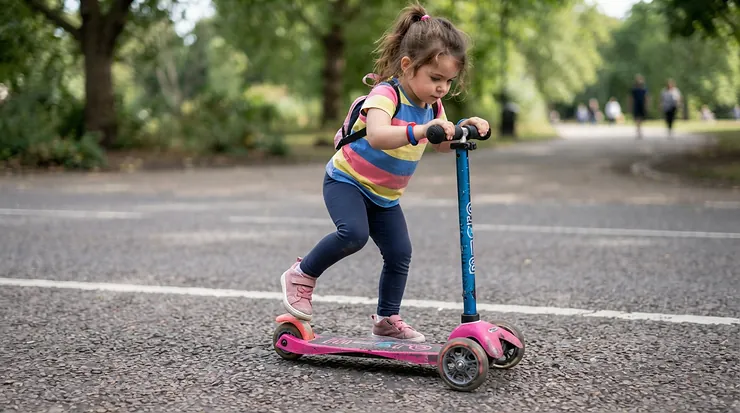
A micro scooter for toddlers is a small, lightweight, low-deck kick scooter, usually with three wheels and a lean-to-steer or steering-lock mechanism. It is designed for children aged roughly one to five. It builds balance, coordination and confidence, and many models convert from a seated ride-on into a stand-on scooter as your child grows.

Every UK school gate has a small fleet of them, usually abandoned in a heap by the railings. That’s the easy bit. The hard bit is picking the right micro scooter for toddlers when listings disagree about age, weight limits and what “three-in-one” actually means. One retailer says a model suits two-year-olds, the next says three and above, and the box says something else again.
This guide sorts that out. It covers three-wheel toddler stability, what a parent steering handle accessory really does, and minimum age guidance you can trust. Charities such as Barnardo’s strongly recommend helmets for every child on a bike or scooter, and that advice shapes every recommendation below.
One honest note on method. Everything here comes from manufacturer specifications, UK retailer listings and parent-tested round-ups, not hands-on testing. Where I couldn’t verify something, I say so. Treat it as a research-led shortlist, then check the live listing before you buy.
Quick Comparison: Micro Scooter for Toddlers at a Glance
| Product | Age guidance (as listed) | Parent push handle? | Price tier | Best For |
|---|---|---|---|---|
| Mini Micro Deluxe LED | 2-5 years | No (separate push kits exist) | Mid-to-premium | Steady two-year-olds ready to stand |
| Micro Mini to Grow LED Deluxe | About 12 months-3 years | Check kit contents | Premium | Buy-once families starting early |
| Micro Mini2go Deluxe Plus | Mostly 18 months-5 years | Yes, removable push bar | Premium | Parents of 18-month-olds |
| Globber Go Up Deluxe Lights | From 15 months | Yes, push handle | Roughly £80-£115 range | Flexible 3-in-1 value |
| Globber Primo Foldable Lights | 3+ | No | Mid-budget | Graduating three-year-olds, travel |
| smarTrike T3 T-Scooter | 2-3+ (listings vary) | No | Budget | Low-risk first scooter |
| Oxelo B500 | Child height 80-120cm | No | Around £40 | Tightest budgets |
Looking at the table, the real dividing line is age, not brand. If your child is under two, only the seated, push-handle models (Micro Mini2go Deluxe Plus, Globber Go Up Deluxe Lights) make sense. From two upwards, the Mini Micro Deluxe LED is the lightweight benchmark, and the budget picks (smarTrike T3 T-Scooter, Oxelo B500) trade polish for price. Prices are approximate bands at the time of research and move constantly, so check the current price before you decide.
💬 Just one click — help others make better buying decisions too!😊
Top 7 Micro Scooter for Toddlers: Expert Analysis
Before the individual reviews, a word on sources. Mumsnet’s parent-tested kids’ scooter round-up is a useful sanity check, and it rates the Mini Micro Deluxe as its best overall pick. Where independent review data exists for a model below, I summarise it as aggregated sentiment. Where it doesn’t, I say so rather than fill the gap.
1. Mini Micro Deluxe LED — the lightweight benchmark for ages 2-5
The standout here is weight. At roughly 1.95kg, this is a scooter a two-year-old can genuinely lift over a kerb, which is rarer than it sounds.
The adjustable handlebar runs from about 49cm to 68cm, so shorter toddlers aren’t stretching for the grips. The UK listing quotes a 35kg maximum rider weight, which most children won’t reach before they outgrow the deck anyway. Some overseas listings quote higher limits, so go by the UK page. The wheels light up with no batteries to replace.
Based on the spec comparison, this is the first model I’d shortlist for a child who walks steadily and is ready to stand on a deck. Lean-to-steer means there is no steering lock to fight; the child shifts their weight to turn. That feels intuitive but takes a few outings, and it’s the wrong tool for a child who still needs a seat.
Parent reviewers in Mumsnet’s round-up describe it as durable, well engineered and easy for small children to manage. It is their best overall pick.
Pros:
- ✅ Very light for toddlers to lift and carry
- ✅ Intuitive lean-to-steer on a low deck
- ✅ Battery-free LED wheels and grippy footplate
Cons:
- ❌ No seat or steering lock for younger toddlers
- ❌ Pricier than budget three-wheelers
Price tier: mid-to-premium; check current price. A strong value verdict if it will be used daily.

2. Micro Mini to Grow LED Deluxe — a starter kit that grows with your child
The standout here is longevity. Micro’s own UK guide positions it for roughly 12 months to 3 years, built around the standard scooter, with attachments removed as confidence grows.
The spec detail is thin in the sources I could verify, so confirm weight limits and kit contents on the live listing. What the structure tells you is that it’s a staged product. Your child begins with support, then the attachments come off to reveal the stand-on scooter underneath.
On paper this suits parents who know they want a micro scooter for toddlers from the earliest age and hate buying twice. The caveat is that staged kits cost more up front, and a child who’d have been happy on a plain scooter at two won’t use the early stages. Don’t confirm a push handle is included unless the listing says so.
I couldn’t find independent review data specific to this model. The underlying standard scooter has a strong reputation with parent reviewers, but that isn’t a verdict on this kit.
Pros:
- ✅ Starts earlier than a standard stand-on scooter
- ✅ Becomes the proven stand-on scooter later
- ✅ One purchase covers several stages
Cons:
- ❌ Higher outlay than a plain scooter
- ❌ Limited verifiable detail on kit contents
Price tier: premium; check current price. Good value only if you’ll use the early stages.
3. Micro Mini2go Deluxe Plus — seat, storage drawer and removable push bar
The standout here is the parent steering handle accessory built in. A push bar stores in the drawer under the seat, so you can take over when little legs tire.
Most listings recommend it from 18 months to 5 years, though one retailer says from 1 year and another says 36+ months, so check the box label. The bar adjusts from about 49cm to 67cm, and a typical listing quotes about 1.95kg without the seat and 3.6kg with it. The maximum user weight is 50kg, and the deck is around 11cm by 30cm. The lean-to-steer action works the same as on the standard scooter.
For a parent of a wobbly 18-month-old, I’d weigh this against Globber Go Up Deluxe Lights. This one carries toys and snacks in the drawer, which solves the “who holds the teddy” problem. The trade-off is price and extra weight while the seat is fitted.
I couldn’t verify enough independent UK reviews for this specific model to summarise sentiment, so rely on the specifications and your own checks.
Pros:
- ✅ Removable push bar stores in the drawer
- ✅ Seat converts to a stand-on scooter
- ✅ Storage drawer for toddler essentials
Cons:
- ❌ Premium price tier
- ❌ Heavier while the seat is fitted
Price tier: premium; check current price. Worth it if you’ll genuinely use both ride-on and scooter stages.
4. Globber Go Up Deluxe Lights — three-in-one flexibility at a mid-range price
The standout here is range. It works as a ride-on, a walking bike and a scooter, and the push handle is adjustable for the parent.
Listings give a minimum age of 15 months, though one UK retailer’s warning says 18 months, so check the box. Ride-on mode is intended for up to roughly 36 months. The scooter handlebar adjusts across four heights, from about 67.5cm to 82.5cm. It folds, lights up with no batteries, and has a steering-lock button that fixes the front wheels straight. The deck supports up to 50kg and the whole thing weighs about 3.89kg.
My read is that it’s the sensible middle path. It costs less than the premium Micro kits and still covers a wide age span. The steering lock is its clever trick: with the front wheels locked, a nervous toddler only has to balance, and you unlock steering later. The weight is the compromise, as it’s noticeably heavier than a stripped-back scooter.
For reviews, one Mumsnet tester noted that a three-year-old found a heavier, seated extending scooter trickier to manoeuvre than a lightweight standard one. That’s a category theme worth remembering rather than a verdict on this model.
Pros:
- ✅ Ride-on, walking bike and scooter in one
- ✅ Steering lock helps nervous beginners
- ✅ Folds, with battery-free light-up wheels
Cons:
- ❌ Heavier than a stripped-back scooter
- ❌ Minimum age wording varies by retailer
Price: roughly £80-£115 range at the time of research. Excellent value for under-threes.
5. Globber Primo Foldable Lights — the folding pick for confident three-year-olds
The standout here is the fold. A push button collapses the scooter, which matters when it lives in a boot or a hallway cupboard.
It’s listed for ages 3 and over, so it isn’t a pick for under-threes. The T-bar has three heights (67.5cm, 72.5cm and 77.5cm). It weighs about 2.5kg, the deck holds up to 50kg, and the front wheels are 121mm with an 80mm rear. The steering-lock button is here too, and the dynamo wheels brighten the faster you go.
What this means in practice is that it’s a graduating scooter. If your child has outgrown a seated model, or you’re buying for a confident three-year-old, it offers stability and a fold at a friendlier price than the premium kits. It’s about 0.55kg heavier than the lightest option, which a small child will notice when carrying it.
Mumsnet’s round-up picks it as best budget, noting it isn’t as lightweight as the Mini Micro Deluxe but folds for travel. That’s a fair summary.
Pros:
- ✅ Push-button fold for boots and hallways
- ✅ Lockable steering aids first rides
- ✅ Larger front wheels soften bumpy paving
Cons:
- ❌ Not intended for under-threes
- ❌ Heavier than the lightest rivals
Price tier: mid-budget; check current price. Good value for three-year-olds.
6. smarTrike T3 T-Scooter — a budget starter with a lockable handlebar
The standout here is the T-lock. It switches between a fixed upright “practice” bar and a tilting “freestyle” mode.
Age guidance conflicts. One UK parent blog says suitable for ages 2 and up, while a retailer listing says 3 and above. Treat it as a three-year-old scooter unless the box says otherwise. A retailer quotes a 20kg maximum weight, which a child nearing five may approach. Features include PU wheels, a rubber-textured footboard and a rear foot brake.
Analytically, it’s a sensible low-risk trial if you’re unsure your child will take to scooting. The fixed-bar practice mode removes the steering confusion, and the foot brake is easy to find. The lower weight ceiling means it has a shorter life than the Globber options.
Independent sentiment is mixed in a useful way. One UK reviewer found it slightly juddery but the best of the budget options tested. A parent blogger said their three-year-old found the foot brake and soft grips easy to use.
Pros:
- ✅ T-lock gives a safe practice mode
- ✅ Easy-reach rear foot brake
- ✅ Budget-friendly entry to scooting
Cons:
- ❌ Reported as slightly juddery
- ❌ Low 20kg weight limit shortens its life
Price tier: budget; check current price. Fine value as a first scooter.
7. Oxelo B500 — the cheapest sensible three-wheeler
The standout here is price. Decathlon’s UK page lists it at around £40, with light-up wheels and a patented steering system.
Rather than an age band, it’s sized by child height, 80cm to 120cm. That’s a more honest measure than a birth-date label, because a tall two-year-old and a small four-year-old can both fit. It has an improved deck, enlarged wheels and a dual-material brake that guides foot placement. Oxelo B900, an age-adjustable 18-months-to-5-years version, costs around £80 and mirrors the premium tier.
It’s an own-brand product, so availability beyond Decathlon varies. Check where it’s stocked before you plan around a particular retailer. Based on the spec comparison, it’s the pick when the budget is tight and the child is already confident. I wouldn’t choose it for an unsteady first scooter.
The UK listing shows 655 reviews at the time of research, but I couldn’t verify the themes behind them, so I won’t characterise them.
Pros:
- ✅ Lowest price among sensible three-wheelers
- ✅ Height-based sizing is easy to check
- ✅ Light-up wheels and guided foot brake
Cons:
- ❌ Limited independent review detail
- ❌ Retailer availability varies
Price: around £40 at the time of research. Hard to beat for value if the fit is right.
Top 7 Specification Snapshot
| Product | Weight | Maximum rider weight | Handlebar / sizing | Best For |
|---|---|---|---|---|
| Mini Micro Deluxe LED | About 1.95kg | 35kg (UK listing) | 49-68cm | Lightest everyday scooting |
| Micro Mini to Grow LED Deluxe | Check listing | Check listing | Staged kit | Early starters |
| Micro Mini2go Deluxe Plus | 1.95kg / about 3.6kg with seat | 50kg | 49-67cm | Seat plus push bar |
| Globber Go Up Deluxe Lights | About 3.89kg | 50kg | 67.5-82.5cm (scooter) | 3-in-1 value |
| Globber Primo Foldable Lights | About 2.5kg | 50kg | 67.5-77.5cm | Folding for travel |
| smarTrike T3 T-Scooter | Check listing | 20kg | Dimensions 59.5 x 26.5 x 63cm | Budget practice mode |
| Oxelo B500 | Check listing | Check listing | Child height 80-120cm | Tight budgets |
Read across the weight column and a pattern emerges. Seated convertibles sit around 3.6-3.9kg while stripped-back scooters sit nearer 2kg, so choose the heavier ones only if you’ll use the seat. The weight limits also show how long each model lasts: the smarTrike T3 T-Scooter has the shortest life, while the Globber and Micro Mini2go options carry far more. Anything marked “check listing” is a gap in what I could verify, not a hidden flaw.
First 30 Days: How to Set Up and Use a Micro Scooter for Toddlers
A good set-up beats a good scooter. Spend ten minutes on it and the first month goes far more smoothly.
Days 1-3: fit and feel. Set the handlebar so your child’s hands rest comfortably without their shoulders hunching or their arms reaching up. Tighten the clamp and check it again after the first ride. Let them stand on the stationary deck, rock it and get used to the feel. With models that have a steering lock, keep it engaged at first.
Week 1: flat and boring. Choose a smooth, flat, traffic-free spot. Mumsnet’s scooter safety guide advises supervising young children, measuring their head for a properly fitting helmet, and being wary of hills because scooters pick up speed quickly.
Weeks 2-4: build skills. Introduce gentle turns, then stopping. Teach the rear brake as a deliberate foot press, since it’s the habit that matters most later.
Maintenance routine. Weekly, wipe the deck and check the clamp. Monthly, spin each wheel and listen for roughness. Decathlon’s guidance treats wheels and bearings as wearing parts, which is true of any scooter.
Common first-month mistakes: handlebar too high, riding on slopes too soon, skipping the helmet, and expecting a two-year-old to tackle kerbs. Most are fixed by lowering expectations and the bar.
Real-World Scenarios: Matching a Micro Scooter for Toddlers to Your Family
Specs are abstract. Here are four household profiles (hypothetical, not real testers) matched to the models above.
The 18-month-old in a flat-heavy city. The parents want one purchase to last three years and don’t mind carrying it up stairs. The Micro Mini2go Deluxe Plus or Globber Go Up Deluxe Lights fits best. The Go Up costs less, while the Micro adds a storage drawer. Budget accordingly.
The 2.5-year-old on a daily nursery walk. The route is half a mile of pavement. Lightness matters most, because the child will want to carry it. The Mini Micro Deluxe LED is the natural fit.
The three-year-old visiting grandparents. The car boot is small and the scooter lives in a hallway. The Globber Primo Foldable Lights folds flat and is stable enough for a confident beginner.
The tight-budget first-timer. Cost matters more than polish. The smarTrike T3 T-Scooter or Oxelo B500 gives a low-risk trial. If your child loves it, you can upgrade later.
In each case, the right choice follows from how your child will actually use it. Frequency, storage and the child’s current confidence matter more than brand reputation.
How to Choose a Micro Scooter for Toddlers
Picking the right micro scooter for toddlers is easier with a simple order of questions.
- Start with age and readiness. If your child is under two or can’t stand steadily, choose a seated, push-handle model. Over two and steady, a stand-on scooter works.
- Check weight and height limits. They range from 20kg to 50kg across these models, so a lower limit means a shorter life.
- Weigh the scooter. Under 2kg is easy for toddlers to lift. Over 3.5kg suits convertibles only if you’ll use the seat.
- Decide on steering. Lean-to-steer is intuitive for many children, while a steering lock helps nervous beginners.
- Pick convertible or stand-on. Convertibles cost more but cover more years. Stand-on is lighter and simpler.
- Confirm the parent-handle situation. If you want a push handle, check it’s included or compatible.
- Budget for safety gear. A properly fitted helmet isn’t optional.
Three-Wheel Toddler Stability: What the Design Really Does
Three-wheel toddler stability is the main reason parents pick this category, and it’s genuine but limited.
Two front wheels and a low deck give a wide base that tolerates wobbles a two-wheeler wouldn’t. A lower deck also means a shorter drop, and larger front wheels (121mm on the Globber Primo Foldable Lights) roll over cracks and bumps more calmly than small ones.
The steering mechanism changes how that stability feels. With Mini Micro Deluxe LED-style lean-to-steer, the child turns by shifting weight. With a steering lock, as on Globber Go Up Deluxe Lights, the front wheels stay straight until you release them. The smarTrike T3 T-Scooter offers a locked upright bar in practice mode and tilt in freestyle.
Stability isn’t immunity, though. Small wheels still catch on kerbs, and brakes on small wheels have limited grip. Some public-health bodies abroad are noticeably more cautious about scooters for very young children for exactly that reason. So three-wheel toddler stability means a forgiving first scooter, not a licence to relax supervision.
Parent Steering Handle Accessory: When You Need One
A parent steering handle accessory is for the stage where your child wants to scoot but can’t yet steer or keep going. You hold the handle, they stand or sit, and everyone gets there.
Two routes exist. The first is a built-in handle, as on the Micro Mini2go Deluxe Plus (the push bar stores in the drawer) and the Globber Go Up Deluxe Lights (adjustable push handle). The second is an add-on kit. Mumsnet notes a pushalong kit can turn the Mini Micro Deluxe into a transitional scooter for younger toddlers, and one retailer says to combine a standard model with a separate 3-in-1 push set.
Compatibility is the catch. One retailer states the Mini2go parents’ handlebar only fits that Deluxe model. Before buying any parent steering handle accessory, confirm it fits your exact scooter. Also remember it’s a convenience, not a safety device: toy scooters are generally labelled for domestic use and not for traffic.

Minimum Age Guidance: When Is a Toddler Ready?
Minimum age guidance is the most confusing part of this category. The same scooter can appear with three different ages depending on the retailer.
Listings I found suggest roughly this pattern. Seated ride-on modes start at 12-18 months (Globber Go Up Deluxe Lights at 15 months, Micro Mini2go Deluxe Plus mostly at 18 months). Stand-on scooters like the Mini Micro Deluxe LED start at 2. Models like the Globber Primo Foldable Lights are 3+. The smarTrike T3 T-Scooter appears at both 2 and 3+, and the smarTrike Xtend is listed for 3 to 12.
UK toy-safety guidance for importers notes that toys unsuitable for under-threes need a specific warning. So if a label says “not suitable for children under 36 months”, take it literally.
Ignore the number if your child doesn’t match it. Practical readiness checks: can they walk steadily, stand without holding on, and follow a simple “stop” instruction? If any answer is no, wait or choose a seated model. For minimum age guidance, the box label and the instructions always trump a retailer summary.
Micro Scooter for Toddlers vs Balance Bike
| Scooter | Balance bike | Seated convertible | |
|---|---|---|---|
| Typical start | About 2 years | Varies by model | From about 15 months |
| Skill built | Balance, steering by weight | Balance and gliding | Balance, with parent help |
| Storage | Light, often foldable | Bulkier | Heavier |
| Best For | Mini Micro Deluxe LED | Pure balance training | Globber Go Up Deluxe Lights |
Both build balance, but they build different habits. A balance bike mimics the pedalling bike’s posture. A micro scooter for toddlers teaches balance on a standing deck and, with lean-to-steer, an early feel for turning. Neither is “better”; they’re complementary.
If you want to cover both, a hybrid such as the Globber Go Up Deluxe Lights (walking-bike mode plus scooter) is the cheapest way to try each. For a child who just wants to zoom, a dedicated scooter is simpler and lighter. Pick based on how much space you have and how soon you’ll switch to a pedal bike.
Safety, Regulations and Helmets
Safety starts before the first ride, with the label. In Great Britain, toys must meet essential safety requirements under the Toys (Safety) Regulations 2011 guidance published on gov.uk, and that guidance notes that CE-marked goods remain recognised alongside UKCA. In practice, look for a UKCA or CE mark and a manufacturer name on the product or packaging.
Instructions matter too. Retailer listings often carry a line such as “designed for domestic use, not for use in traffic”, plus a reminder that protective equipment is recommended. Take both seriously. A properly fitted helmet is the single most useful extra, and Barnardo’s and Mumsnet both stress it.
Make children visible with bright clothing, and add reflectors and lights when light is low. Supervise near roads and driveways, avoid slopes while the skill is new, and replace any helmet after a knock.
Finally, remember that guidance varies by country. Some overseas bodies take a more cautious line on scooters for the very young, so supervision and choosing an age-appropriate model matter more than any single rule.
Long-Term Cost & Maintenance
The sticker price tells you little. What matters is cost per month of real use.
Take the Globber Go Up Deluxe Lights at roughly the £100 mark. If it serves from about 15 months to around 4 years, that’s roughly £3 a month over 33 months, and the same logic applies to any convertible. By contrast, the Oxelo B500 at around £40 costs less up front but covers a narrower window, since it suits an already-confident child.
Running costs are small but real. Wheels and bearings wear, and Decathlon’s guidance treats them as wearing parts and notes its workshop can order spares. A retailer’s brand summary for Micro highlights long-term parts availability, which is useful if you plan to hand the scooter down. Check spares exist for your model before you buy.
The cheapest way to cut costs is to match the scooter to your child’s real stage rather than an aspirational one. A model with two unused stages is just an expensive scooter.

FAQ
❓ What is the best micro scooter for toddlers under two?
❓ Can I fit a parent steering handle accessory to any scooter?
❓ How much should I spend on a micro scooter for toddlers?
❓ Are light-up wheels worth paying extra for?
❓ What weight limits should I check before buying?
Conclusion
Choosing a micro scooter for toddlers comes down to three decisions. First, match the model to your child’s actual stage, using minimum age guidance as a starting point and the box label as the final word. Second, decide whether you want the extra help of a seat and a parent steering handle accessory, or the simplicity of a stand-on scooter. Third, think about how much three-wheel toddler stability you need right now versus how long you want the scooter to last.
For most families with a steady two-year-old, the Mini Micro Deluxe LED is the safest shortlist starter. For under-twos, the Micro Mini2go Deluxe Plus and Globber Go Up Deluxe Lights are the sensible seated options, and the Globber Primo Foldable Lights suits a confident three-year-old. The smarTrike T3 T-Scooter and Oxelo B500 keep costs down.
Whatever you choose, buy a properly fitted helmet, supervise every ride, and check the live listing for age, weight and compatibility details before paying.
✨ Ready to Get Rolling?
🛴 Pick the micro scooter for toddlers that fits your child’s stage, click through to check current pricing and availability, and give your little one a safe, confident start on wheels. Happy scooting! 🚀
Recommended for You
- Mini Micro 3-in-1 Vs Mini Micro Deluxe: 7 Best Picks (2026)
- Mini Micro Vs Maxi Micro: 7 Best Scooters Compared (2026)
- Micro Scooter For 3 Year Old: 7 Proven Picks (2026)
Disclaimer: This article contains affiliate links. As an Amazon Associate, I earn from qualifying purchases. If you purchase products through these links, we may earn a small commission at no additional cost to you.
✨ Found this helpful? Share it with your friends! 💬🤗
