In This Article
Mini Micro vs Maxi Micro is the sizing choice between Micro Scooters’ two best-known three-wheeled, lean-to-steer kids’ scooters. The Mini suits roughly ages 2-5 (children up to about 110cm tall). The Maxi suits ages 5-12 (about 110-152cm), with a taller handlebar, a longer deck and a higher weight limit.
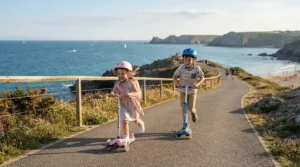
Now for the part the sizing chart leaves out. Almost every British shed has a scooter graveyard: the wrong size bought too early, or the right size bought twice. The Mini Micro vs Maxi Micro decision is really a bet on timing. The Mini gives you a smaller, lighter, more confidence-building machine for about three years. The Maxi gives you a scooter that can plausibly last until secondary school. Neither bet is wrong, but each is wrong for the wrong child.
Scooting is also a handy way to bank activity. NHS guidance for under-fives says pre-schoolers should get at least 180 minutes of physical activity a day, including at least an hour at moderate-to-vigorous intensity. A pavement scoot to nursery is an easy place to collect some of it.
This guide compares seven real scooters, from the Mini Micro Deluxe to the Maxi Micro Deluxe Foldable LED, plus two non-Micro rivals. It’s built on published specifications and aggregated parent-tester reports, not claims of hands-on testing. It pays special attention to growing-child longevity: how many seasons you really get for your money. Prices are ranges only, so check current price on amazon.co.uk before you buy.
Quick Comparison: Mini Micro vs Maxi Micro at a Glance
| Feature | Mini Micro Deluxe | Maxi Micro Deluxe |
|---|---|---|
| Age and height guide | 2-5 years; about 80-110cm | 5-12 years; about 110-152cm |
| Max rider weight | 35kg (50kg on foldable versions) | 50kg |
| Handlebar range | About 49-68cm | About 67-92cm |
| Scooter weight | Roughly 2kg | Roughly 2.5kg |
| Best For | Toddlers and small pre-schoolers learning to balance | Primary-school children, and tall confident four-year-olds |
The Mini Micro Deluxe wins on lightness and a low starting handlebar, which is what a two-year-old actually needs. The Maxi Micro Deluxe wins on everything that scales with a growing child: weight limit, handlebar range and deck size. The overlap zone is the four-year-old, where height and confidence matter more than the candles on the cake. We unpick that below.
💬 Just one click — help others make better buying decisions too!😊
Top 7 Scooters for Mini Micro vs Maxi Micro Shoppers: Expert Analysis
Here are seven scooters worth your attention, ordered from smallest rider to biggest. Each entry sticks to published specs and aggregated reviewer sentiment, then explains what the numbers mean in practice.
1. Mini Micro Deluxe — featherweight first scooter for under-fives
At roughly 2kg, the Mini Micro Deluxe is light enough for a toddler to haul upright after a wobble, which is half the battle of keeping small children scooting.
The handlebar adjusts from about 49cm to 68cm, so a small two-year-old and a tall five-year-old can both stand upright without stooping. The standard non-folding version carries a 35kg rider limit, well above what most under-fives weigh. That limit and the 110cm height guide are what will end its useful life.
Based on the spec comparison, this is the right call for children under about 100cm or those still finding their balance, because the low bar and short deck make lean-to-steer forgiving. Its weakness is runway: once a child reaches the top of the handlebar range, there’s nowhere left to go.
Reviewers on Mumsnet describe the tilt-to-steer action as smooth, the footbrake as easy to use and the build as tough enough for years of heavy use. The recurring complaint is cost against a short window of use, plus the lack of a fold.
Pros:
- ✅ Roughly 2kg, easy for toddlers to lift
- ✅ Handlebar starts low at about 49cm
- ✅ Tough build with replaceable parts
Cons:
- ❌ Pricey for roughly three years of use
- ❌ Does not fold for storage
Expect around £90-£100 (prices vary; check current price). Verdict: strong value for a genuinely small child, weaker value for one already tall for their age.
2. Mini Micro Deluxe Foldable LED — one-click fold with a higher weight limit
The Mini Micro Deluxe Foldable LED adds a one-click folding stem and motion-powered light-up wheels. That makes it the Mini for families who carry the scooter as often as they ride it.
Micro’s UK listings give it a 50kg rider limit and a weight of about 2.1kg, with the same 68cm top handlebar height as its fixed-stem sibling. In practice the higher weight limit means a sturdy child isn’t pushed out early, but height remains the true ceiling. The induction-powered wheels need no batteries, so there’s nothing to forget to charge.
Here’s what to weigh: a fold only earns its keep if you’re boot-loading, bus-hopping or living in a flat with a tiny hallway. If the scooter lives in a garden shed, the standard model gives you the same riding experience for less.
I couldn’t verify enough independent, standalone review data for this exact variant to summarise honestly. Reviews of the wider Mini line consistently praise stability and easy steering, and those traits should carry over.
Pros:
- ✅ Folds quickly for car boots and hallways
- ✅ 50kg limit covers heavier small children
- ✅ Battery-free LED wheels add visibility
Cons:
- ❌ Costs more than the fixed-stem Mini
- ❌ Hinge adds a part to check
Budget around £105-£115. Verdict: worth it for commuters and small-space households, optional for everyone else.
3. Maxi Micro Deluxe — one scooter that can span primary school
The Maxi Micro Deluxe is the scooter parents buy once and hand down twice, thanks to a handlebar that stretches from about 67cm to 92cm.
It’s rated for ages 5-12 and a 50kg rider. Some retailers note it was tested above 50kg, but 50kg is the labelled figure, so work from that. The front wheels are around 120mm, and larger wheels roll over pavement joins and tarmac cracks that stop smaller ones. At roughly 2.5kg it stays carryable.
In its Maxi Micro Deluxe review, Mumsnet praised the stable, quick-feeling ride, one-minute assembly and the availability of spare parts. US testers at Wirecutter called it the smoothest, quietest scooter in their line-up. They also noted it isn’t ideal for tricks and can feel heavy to very young riders.
My read: this is the best-value pick if your child is already five, or a tall, confident four-year-old. It’s the weaker pick if you want the scooter to fold or if your child is on the small side.
Pros:
- ✅ Huge handlebar range for growing-child longevity
- ✅ Stable three-wheel lean-to-steer ride
- ✅ Replaceable wear parts extend its life
Cons:
- ❌ Costly up front
- ❌ Doesn’t fold like pricier variants
Expect around £145-£160 for LED versions. Verdict: excellent cost-per-year if your child will use it for several seasons.
4. Maxi Micro Deluxe Foldable LED — folds for the school run
The Maxi Micro Deluxe Foldable LED takes the Maxi’s frame and adds a one-click fold, which matters when a scooter has to ride in the boot, under a desk or on the bus.
Listings give it the same 50kg limit and roughly 67-91cm handlebar range. Weight is quoted between about 2.5kg and 2.8kg depending on the retailer, so it’s worth checking the product page. The hinge adds convenience and one more moving part, so give it a quick check now and then.
Mumsnet named this model its pick for older kids. Its tester reported that a six-year-old found the steering easy and the brake effective, and that a four-year-old preferred it to the Mini because it felt more controllable at speed. Parents praised the durability and the ease of passing it to younger siblings. The only consistent negative is the price.
The honest analysis: the fold is a luxury for some and a necessity for others. If your child scoots to school and the scooter then lives in a cloakroom or a car, it pays for itself in convenience.
Pros:
- ✅ One-click fold for cars and flats
- ✅ Wide handlebar range for years of growth
- ✅ Battery-free LED wheels
Cons:
- ❌ Most expensive Micro here
- ❌ Weight varies by retailer spec
Budget around £150-£165. Verdict: best all-rounder for school-run families, if you’ll use the fold.
5. Micro Sprite — two wheels for the child ready to graduate
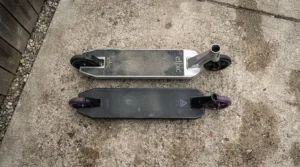
The Micro Sprite is the next rung up: a two-wheeled, aluminium-framed scooter with bike-style steering, a one-click fold and a built-in kickstand.
It’s rated for ages 5-12 and up to 100kg, and weighs roughly 2.85kg. The 100kg limit means it can outlast a child’s growth spurt, and even a teenager’s. But the small wheels are less forgiving on rough ground, and turn-to-steer needs more balance than the lean-to-steer Minis and Maxis.
Mumsnet’s testers liked the speed on the school run and the carry strap, while noting the cost. They also said younger riders may prefer three-wheel stability, and that small wheels get bumpy off-road.
Here’s how I’d frame it: the Micro Sprite is a graduation scooter, not a first scooter. A child who has outgrown or mastered a Maxi Micro Deluxe will usually enjoy it. A five-year-old straight off a Mini Micro Deluxe probably isn’t ready.
Pros:
- ✅ Folds quickly with an integrated kickstand
- ✅ 100kg limit outlasts most childhoods
- ✅ Bike-like steering for confident riders
Cons:
- ❌ Small wheels struggle on rough surfaces
- ❌ Less beginner-friendly than three wheels
Expect around £100-£115. Verdict: good value as a second scooter for older, balanced riders.
6. Globber Junior Foldable Lights Ecologic — steering lock for nervous beginners
The Globber Junior Foldable Lights Ecologic is the most credible budget-minded rival, built around a steering lock that lets a nervous child practise kicking off without veering into the hedge.
It’s listed for roughly ages 2-6+, with a 50kg limit and a weight of about 2.53kg. The foldable frame and trolley mode make it practical for parents. The materials include recycled and plant-based components, though that doesn’t change how long the scooter lasts for your child.
Mumsnet’s editor reviewed it with two boys aged four and five from September 2024. The scooter remained sturdy after well over a year of regular use. Parents liked the steering lock and battery-free lights, but noted it’s happiest on smooth pavements rather than rough ground.
On growing-child longevity, it’s shorter-lived than a Maxi: the age range ends earlier and the handlebar range is more modest. Treat it as a good starter, not a decade-long investment.
Pros:
- ✅ Steering lock builds early confidence
- ✅ Folds with handy trolley mode
- ✅ Battery-free light-up wheels
Cons:
- ❌ Struggles on rough terrain
- ❌ Shorter lifespan than the Maxi
Budget around £65-£75. Verdict: a sensible lower-cost alternative for a preschooler.
7. Banwood Eco Scooter — premium build from recycled materials
The Banwood Eco Scooter is the stylish outsider, made partly from recycled materials including fishing nets and plastic bottles.
It’s listed for ages 3+ with a 50kg limit and a weight of about 2.54kg. The handlebar has three height settings, which gives a modest amount of growing room. It doesn’t fold fully, and the basket is sold separately.
A Mumsnet tester reported more than 12 months of regular use by two children aged four and five, and found it still sturdy with little wear. The main negatives are price and a tendency to struggle on rough terrain and gravel.
My read: it’s the pick if your priorities are looks and materials as well as durability. For pure growing-child longevity, the Maxi Micro Deluxe‘s wider handlebar range gives it the edge.
Pros:
- ✅ Sturdy build after a year of use
- ✅ Stable three-wheel design for beginners
- ✅ Recycled materials with premium finish
Cons:
- ❌ Doesn’t fold fully for travel
- ❌ Basket costs extra
Expect around £79-£90. Verdict: a design-led alternative, priced like a premium scooter.
Top 7 at a Glance
| Product | Ages | Max weight | Price range | Review standing | Best For |
|---|---|---|---|---|---|
| Mini Micro Deluxe | 2-5 | 35kg | £90-£100 | Mumsnet overall pick | Small toddlers |
| Mini Micro Deluxe Foldable LED | 2-5 | 50kg | £105-£115 | Limited independent data | Small-space households |
| Maxi Micro Deluxe | 5-12 | 50kg | £145-£160 | Praised in Mumsnet review | Primary-school years |
| Maxi Micro Deluxe Foldable LED | 5-12 | 50kg | £150-£165 | Mumsnet pick for older kids | School-run commuters |
| Micro Sprite | 5-12 | 100kg | £100-£115 | Mumsnet pick for folding | Confident balancers |
| Globber Junior Foldable Lights Ecologic | 2-6+ | 50kg | £65-£75 | Mumsnet pick for confidence | Budget beginners |
| Banwood Eco Scooter | 3+ | 50kg | £79-£90 | Mumsnet pick for eco | Design-led families |
Prices here are approximate ranges and may vary, so check current price before buying. Read across the table and a pattern emerges. The Micro models trade a higher price for a longer useful life, while the rivals trade lifespan for a lower price. If budget is the deciding factor, the Globber Junior Foldable Lights Ecologic gives the most for the least. If you expect to keep the scooter for years, the Maxi Micro Deluxe and Maxi Micro Deluxe Foldable LED are the more efficient purchases.
Setting Up and Maintaining Your Micro Scooter: A Practical Guide
A good scooter can still disappoint if it’s set up badly. The setup itself is quick: Mumsnet’s tester had the Maxi Micro Deluxe assembled and ready to ride in about a minute.
Set the handlebar height first. Stand your child beside the scooter. The bars should sit around chest height, so they stand upright with slightly bent elbows when riding. Too low and they stoop and wobble; too high and they can’t steer with control.
Check the fixings before the first ride. Make sure the bolts and any folding hinge are tight. On foldable models such as the Mini Micro Deluxe Foldable LED and Maxi Micro Deluxe Foldable LED, confirm the fold clicks fully into place.
A simple maintenance schedule:
- Weekly: wipe the deck and wheels, and check that the wheels spin freely.
- Monthly: check bolts, the footbrake and the grips for wear.
- Each term or growth spurt: re-check the handlebar height.
Mistakes to avoid in the first 30 days:
- Leaving the scooter out in the rain, which shortens the life of any metal parts.
- Skipping a helmet “just for the quick trip”.
- Setting the bars too high in the hope your child will grow into them.
- Ignoring a worn brake. Micro sells replacement brakes, decks and grips, so it’s a cheap fix.
Real-World Scenarios: Which Scooter for Which Family?
These are hypothetical profiles, not real case studies, but they match the situations parents describe most often.
Scenario A: the small two-and-a-half-year-old. Pavement trips to nursery three times a week, a budget around £100, and a child on the petite side. The Mini Micro Deluxe fits best: the low handlebar and roughly 2kg weight make it manageable, and nothing larger will feel safe yet.
Scenario B: the tall four-year-old. A child near the top of the Mini’s height range, riding daily in the park and on the school run. Micro’s UK guidance says the Maxi suits tall four-year-olds. A Maxi Micro Deluxe avoids buying twice, though you should check that the handlebar’s lowest setting suits your child and supervise closely, because the product labelling lists the Maxi from age 5.
Scenario C: two children, seven and three. Buy the Maxi Micro Deluxe Foldable LED for the older child if the scooter gets carried to school. Give the younger one a Mini Micro Deluxe. In a couple of years, the older child may move up to a Micro Sprite, and the Maxi passes to the younger sibling. That sequence is where Micro’s pricing starts to make sense.
✨ Ready to match the right scooter to your child?
🛴 Click through to check current pricing and availability, then compare the weight limit and handlebar range against your child’s height before you order.
Problem → Solution Guide for Micro Scooter Owners
Problem 1: “My child can’t reach the handlebar comfortably.” Check the handlebar’s lowest setting. The Mini Micro Deluxe starts around 49cm, while the Maxi starts around 67cm, so a child who’s too small for the Maxi will usually fit the Mini.
Problem 2: “They’ve outgrown the Mini but aren’t five yet.” Look at height and weight, not just age. If they’re approaching 110cm or the weight limit, a Maxi may be the right step, with extra supervision.
Problem 3: “They’re scared of going fast.” Practise the footbrake on a gentle slope with a “roll and stop” game. A steering lock, as on the Globber Junior Foldable Lights Ecologic, can also help beginners.
Problem 4: “It won’t fit in the car or hallway.” A fold solves this. The Maxi Micro Deluxe Foldable LED and Mini Micro Deluxe Foldable LED both fold with one click.
Problem 5: “It’s dark on the school run.” Light-up wheels add visibility but aren’t a substitute for proper lights, and RoSPA advises avoiding scooting in the dark because scooters have no lights or reflectors of their own.
How to Choose Between Mini Micro vs Maxi Micro in 6 Steps
The quick answer: choose the Mini for small, light children aged 2-4, and the Maxi for children around 5 and older or tall for their age. Then check height, weight and handlebar fit before you buy.
- Measure your child’s height with shoes on. Micro’s own guidance puts the Mini at roughly 80-110cm and the Maxi at roughly 110-152cm.
- Check the weight limits. The standard Mini Micro Deluxe is rated to 35kg, the foldable Mini and the Maxi to 50kg. Micro’s US guidance suggests a child needs around 16kg (35lb) to handle a Maxi’s lean-to-steer properly.
- Test the handlebar height. Bars should sit about chest height. Micro’s UK advice for four-year-olds says shorter or lighter children should stay on the Mini.
- Consider ability, not just age. Micro says the Maxi isn’t suitable for three-year-olds, however big they are.
- Decide whether you need a fold. Foldable versions cost more, so only pay if you’ll use it.
- Budget for the years, not the price. A pricier scooter that lasts seven years can cost less per year than a cheaper one outgrown in two.
Growing-Child Longevity and Long-Term Cost: Which Scooter Lasts?
Growing-child longevity is where the Mini Micro vs Maxi Micro decision gets interesting, because it separates the sticker price from the cost per year of use.
The Mini covers roughly ages 2-5, so about two to three years of riding. The Maxi covers roughly 5-12, so six or seven. Micro’s older comparison of the Mini Micro Original and the Mini Micro Deluxe adds a wrinkle: the Original is described as 3-5 years with a 20kg limit and no adjustable handlebar, while the Deluxe covers 2-5 years with an adjustable bar. If longevity matters, the Deluxe is the safer bet.
| Product | Price range | Likely years of use | Rough cost per year | Best For |
|---|---|---|---|---|
| Mini Micro Deluxe | £90-£100 | 2-3 | £30-£50 | Small toddlers |
| Mini Micro Deluxe Foldable LED | £105-£115 | 2-3 | £35-£58 | Small-space households |
| Maxi Micro Deluxe | £145-£160 | 6-7 | £21-£27 | Long-term value |
| Maxi Micro Deluxe Foldable LED | £150-£165 | 6-7 | £21-£28 | School-run commuters |
| Micro Sprite | £100-£115 | 5-7 | £14-£23 | Confident older riders |
The cost-per-year figures are my own rough arithmetic using the price ranges above, so treat them as a guide. The pattern is clear, though: the Maxi’s longer lifespan more than offsets its higher price. Buying a Mini and then a Maxi costs roughly £235-£280 over about ten years, while a tall four-year-old who goes straight to a Maxi spends roughly £145-£165. Passing the Mini to a younger sibling halves the cost for each child.
Mini Micro vs Maxi Micro for a 4-Year-Old: The Tricky Middle
Four is where parents agonise, and the sources don’t entirely agree. Micro’s UK advice says shorter or lighter four-year-olds should stay on the Mini, while taller ones can use the Maxi. Micro’s US guidance leans towards the Maxi from four, because a Mini would last only a year or two. Mumsnet’s tester found that her four-year-old preferred the Maxi, and found it easier to control at speed.
Retail labelling adds a note of caution. A John Lewis listing for the Maxi Micro Deluxe Foldable LED carries a warning that it’s not suitable for children under 5. Treat that as the baseline, and if you go ahead with a tall four-year-old, supervise closely and use protective gear.
My rule of thumb: if your child is near 110cm, steady on their feet and already comfortable on a scooter, the case for the Maxi Micro Deluxe is strong. If they’re smaller, lighter or new to scooting, the Mini Micro Deluxe is the safer choice, and they’ll build confidence faster on a machine that fits.
Features That Actually Matter (And Those That Don’t)
Matter:
- Handlebar range. It drives growing-child longevity more than any other spec.
- Weight limit. It’s the other half of the “when will they outgrow it” question.
- Footbrake. A responsive, easy brake builds confidence faster than anything else.
- Replaceable parts. Brakes, decks and grips can be swapped, which keeps a scooter going.
- Scooter weight. If your child can’t lift it, they won’t want to ride it.
Matter sometimes:
- Folding. Brilliant if you carry the scooter; irrelevant if you don’t.
Don’t matter much:
- LED wheels. They’re fun and add some visibility, but they aren’t a lighting system.
- Colour and graphics. Lovely, but they won’t change how long the scooter lasts.
Mini Micro vs Maxi Micro vs Other Scooter Types
| Type | Best age | Main strength | Main trade-off | Best For |
|---|---|---|---|---|
| Three-wheel lean-to-steer (Mini Micro Deluxe, Maxi Micro Deluxe) | 2-12 | Stable, intuitive steering | Premium price | First scooters and growing children |
| Two-wheel turn-to-steer (Micro Sprite) | 5-12 | Speed and agility | Needs more balance | Confident older riders |
| Convertible ride-on (smarTrike Xtend Ride-On Plus) | 3-12 | Grows through several modes | Heavy at around 4.75kg | Buy-once families |
| Tween two-wheeler (Oxelo Mid 9) | Tweens, 1.25-1.75m | Front suspension, handlebar brake | Not for young children | Tall tweens and teens |
Three-wheelers are the most forgiving for young children, while two-wheelers suit those with proven balance. The convertible smarTrike Xtend Ride-On Plus offers genuine long-term value on paper but is notably heavier, and Mumsnet’s tester noted her three-year-old found it harder to manoeuvre than a Mini Micro Deluxe. For most families choosing between the Mini and the Maxi, the three-wheel lean-to-steer design is the sensible default.
Safety, Standards and Sizing Rules Every UK Parent Should Know
Scooters count as toys for safety regulation purposes. Mumsnet notes that EN 71 applies to younger-age scooters and EN 14619 to older-age ones, and the standard should be listed on the packaging or manufacturer’s website. Check it before you buy, especially from marketplace sellers.
RoSPA’s toy safety guidance is a good starting point. It recommends a helmet (a cycle helmet is best), plus knee pads, elbow pads and wrist guards, and it points out that adults should set the example. It also warns that scooters pick up speed quickly on hills and shouldn’t be used where they cause danger to others.
Two further points. Micro’s listings carry warnings that protective equipment should be worn and that the scooter isn’t for use in traffic. And never buy a scooter that’s too big in the hope your child will grow into it, because a scooter that’s too large or heavy is harder to control.
Common Mistakes When Buying a Mini Micro or Maxi Micro
Buying the Maxi too early. A taller bar and extra weight make it harder for a small child to manage. Micro says it isn’t suitable for three-year-olds.
Buying the Mini too late. A child who’s outgrown the handlebar range will hunch and wobble, and the scooter stops being fun.
Ignoring the variant. The standard Mini Micro Deluxe is listed at 35kg, while the foldable Mini is listed at 50kg. Older listings may show different figures, so check the label on the model you’re actually buying.
Choosing on colour alone. It’s tempting, but handlebar range, weight limit and fit matter far more.
Skipping the helmet. The best scooter in the world won’t protect a head.
Paying for a fold you won’t use. If the scooter lives in a shed, the standard model gives you the same ride for less.
Frequently Asked Questions
❓ Is the Maxi Micro worth the extra money over the Mini Micro?
❓ Can I buy a Maxi Micro for a 3 year old?
❓ Does the Mini Micro Deluxe fold?
❓ Where can I buy a Mini Micro or Maxi Micro in the UK?
❓ Can you buy spare parts for Micro scooters?
Conclusion
The Mini Micro vs Maxi Micro question comes down to fit now versus years of use later. If your child is small, light or new to scooting, the Mini Micro Deluxe is the confidence-builder, and the Mini Micro Deluxe Foldable LED is the one to pick if you need to carry it. If your child is five or older, or tall and confident at four, the Maxi Micro Deluxe is the efficient long-term buy, with the Maxi Micro Deluxe Foldable LED worth the extra if you’ll use the fold. The Micro Sprite is the natural next step for balanced older riders, while the Globber Junior Foldable Lights Ecologic and Banwood Eco Scooter suit families who want a different balance of price and style.
On growing-child longevity, the maths favours the bigger scooter, but only when your child can ride it safely now. A scooter that fits for a year beats a bigger one that frightens a child for a year. Whatever you choose, pair it with a properly fitted helmet and pads.
Recommended for You
- Micro Scooter For 3 Year Old: 7 Proven Picks (2026)
- First Balance Bike With Adjustable Handlebars: 7 Best Picks (2026)
- Balance Bikes For 1 Year Olds: 7 Safe Picks For UK (2026)
Disclaimer: This article contains affiliate links. As an Amazon Associate, I earn from qualifying purchases. If you purchase products through these links, we may earn a small commission at no additional cost to you.
✨ Found this helpful? Share it with your friends! 💬🤗
