
In This Article
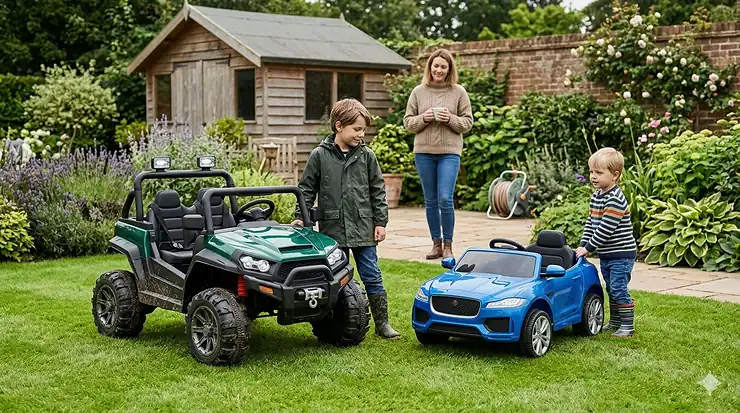
Picture this: your four-year-old’s eyes light up as they grip the steering wheel of their very own off-road buggy, ready to conquer the garden’s bumpy terrain. But before that magical moment arrives, you’re facing a crucial decision that’ll impact years of outdoor fun: 24v 4wd buggy vs 12v which is better for your family?

I’ve spent countless hours researching this exact question, and here’s what really matters. The voltage difference isn’t just about numbers on a box – it’s about whether your child can actually tackle that grassy slope in your back garden, how long they’ll enjoy their ride before needing a recharge, and frankly, whether you’ll need to upgrade in six months when they’ve outgrown a less powerful model.
The UK’s Toy Safety Regulations of 2011 regulate electric ride-on cars for children under 14, ensuring they meet stringent electrical, chemical, and labelling safety standards. This means every buggy we’ll discuss today complies with British safety requirements, giving you peace of mind whilst your little ones explore.
In this comprehensive guide, we’ll break down exactly what separates 24v and 12v buggies, examine seven real models available on Amazon.co.uk and specialist UK retailers, and help you choose the perfect ride-on for your budget and terrain. Whether you’re navigating muddy countryside paths or smooth suburban driveways, you’ll know precisely which voltage gives you the best value by the end of this article.
Quick Comparison: 24v vs 12v Buggies at a Glance
| Feature | 12v Buggy | 24v Buggy |
|---|---|---|
| Top Speed | 3-6 km/h (1.9-3.7 mph) | 5-10 km/h (3.1-6.2 mph) |
| Motor Power | 2 × 35-45W motors (70-90W total) | 4 × 100W motors (400W total) |
| Typical Price Range | £129-£249 | £349-£549 |
| Battery Life | 45-60 minutes | 60-120 minutes |
| Weight Capacity | 50kg (7.9 stone) | 65-130 lbs (58.9kg/9.3 stone) |
| Terrain Performance | Flat surfaces, gentle slopes | Hills, mud, grass, rough terrain |
| Best For | Ages 3-6, smooth surfaces | Ages 3-8+, off-road adventures |
| Drive System | Usually 2WD (rear wheels) | Proper 4WD (all four wheels) |
💬 Just one click – help others make better buying decisions too! 😊
✨ Don’t Miss These Exclusive Deals!
🔍 Take your child’s outdoor adventures to the next level with these carefully selected buggies. Click on any highlighted item to check current pricing and availability on Amazon.co.uk. These ride-ons will help you create authentic family memories your children will treasure for years!
Top 7 Electric Buggies: Expert Analysis & UK Pricing
After extensive research across Amazon.co.uk and specialist UK retailers like Titan Toys, I’ve identified seven outstanding models that represent the best value across different budgets and requirements. Here’s what UK parents are actually buying in 2026.
1. HOMCOM 12V 2-Seater Kids Electric UTV (Budget Champion)
If you’re dipping your toes into the ride-on world without breaking the bank, this HOMCOM 12V 2-Seater deserves serious consideration. Priced between £149-£189.99 depending on colour choice, it represents exceptional value for younger children on relatively flat terrain.
Key Specifications:
- 2 × 12V motors delivering moderate power for smooth surfaces
- 12V 7AH battery providing approximately 45-60 minutes runtime
- Maximum speed: 3-6 km/h (controllable via parental remote)
UK buyers consistently praise its two-seater configuration, which lets siblings share adventures together. One Amazon.co.uk reviewer noted: “Fits a tall 5 year old and tall 7 year old together. Quite quick but he loves speed.” The electronic bucket attachment proves surprisingly practical for transporting toys, snacks, or treasured garden finds.
✅ Pros:
- Genuinely affordable entry point (under £200)
- Two-seater design promotes social play
- LED headlights and music player included
❌ Cons:
- Struggles on inclines steeper than 5-10 degrees
- 50kg weight limit may restrict older children
Best For: Families with smooth garden surfaces and children aged 3-6 who’ll primarily drive on flat terrain.

2. Renegade UTV-MX 24V 4WD Buggy (Best Mid-Range)
OutdoorToys’ Renegade UTV-MX bridges the gap between budget 12v models and premium 24v beasts. At £349.99 on Amazon.co.uk, it delivers legitimate four-wheel drive capability without the £500+ price tag of top-tier models.
Key Specifications:
- Upgraded 24V 7AH battery system
- Four-wheel suspension for genuine off-road capability
- EVA noise-reduction tyres (much quieter than standard plastic wheels)
This model particularly impressed UK buyers tackling challenging terrain. The leather seats and MP4 player represent thoughtful upgrades over cheaper alternatives, whilst the 2.4G parental remote provides reassuring control for nervous parents watching their little ones navigate bumpy ground.
✅ Pros:
- True 4WD tackles grass, gravel, and gentle mud
- Leather seats more comfortable for extended play
- EVA tyres significantly quieter
❌ Cons:
- Assembly takes 2-3 hours (budget extra time)
- Some buyers reported courier delivery delays
Best For: Parents seeking genuine off-road performance without premium pricing.
3. The Hornet 24v 4WD Off-Road Buggy (Performance King)
Titan Toys’ exclusive Hornet represents what happens when you stop compromising. With four individual 100W motors (400W total output), this beast tackles terrain that would stop lesser buggies cold. Priced around £449-£499, it’s an investment in years of outdoor adventures.
Key Specifications:
- 4 × 100W motors (genuine 4WD system)
- 24V battery delivering up to 90 minutes runtime
- Speed: 5-6 mph depending on rider weight and surface
- Upgraded EVA foam tyres with exceptional ground clearance
One UK parent living in the North Pennines shared: “Climbs the 20% gradient hill to our home with ease and just isn’t bothered about the mud and bumps.” That’s the difference proper motor power makes – it’s not just about speed, it’s about torque to conquer real-world obstacles.
✅ Pros:
- Exceptional hill-climbing ability (up to 20% gradients)
- 90-minute battery life outlasts most competitors
- Remote control override prevents crashes whilst learning
❌ Cons:
- Higher price point (approaching £500)
- Stops suddenly when remote cuts power (no gradual deceleration)
Best For: Rural families with challenging terrain, hills, or muddy conditions who need serious off-road capability.
4. The Vulcan Carbon 24v 4WD UTV (Premium Choice)
Titan Toys’ 2024 upgraded Vulcan Carbon sits at the premium end, typically priced £469-£519. What justifies the investment? Build quality that UK reviewers consistently describe as “second to none” and performance that embarrasses cheaper 12v sports car replicas.
Key Specifications:
- 4 × 100W motors (800W combined 4WD power)
- 24V battery with 90-minute runtime
- Two-speed options (low/high gear selection)
- Spacious enough for children up to age 8+
A verified UK buyer explained the value proposition perfectly: “Put simply, the best ride-on car under £500 I could find for my 3 year old son. 200w per motor, 800w proper 4wd and looks fantastic. Puts the sports car type ride-ons to shame as I noticed they tend to be 12v and with little torque or 4wd.”
✅ Pros:
- Outperforms 12v models significantly in every metric
- Suitable for extended age range (3-8+ years)
- Titan Toys’ exceptional UK customer service
❌ Cons:
- Premium pricing (close to £500)
- 2-hour assembly time recommended
Best For: Parents wanting the absolute best performance and longevity, planning for multiple years of use.
5. GYMAX Kids Electric UTV 12V 2-Seater (Value Alternative)
Not everyone needs four-wheel drive monster trucks. The GYMAX 12V offers a sensible middle ground for families with well-maintained gardens and younger children. Typically priced £179-£229 on Amazon.co.uk, it delivers modern features without the premium 24v price tag.
Key Specifications:
- 12V battery with standard runtime (45-60 minutes)
- Bluetooth connectivity for custom music streaming
- Spring suspension provides smoother riding than rigid chassis models
- USB and FM radio inputs
UK reviewers particularly appreciate the entertainment features – being able to stream nursery rhymes or favourite songs via Bluetooth transforms the experience for 3-5 year olds who might otherwise lose interest quickly.
✅ Pros:
- Modern connectivity features (Bluetooth, USB, FM)
- Good value under £230
- Spring suspension improves comfort
❌ Cons:
- Limited power for anything beyond flat surfaces
- 12V means less torque for grass or gravel
Best For: Urban and suburban families with paved gardens, driveways, or park paths.
6. The Neo 24v 4WD Exclusive Buggy (New Release)
Titan Toys’ brand-new Neo represents their latest engineering, incorporating customer feedback from previous models. Priced competitively at £429-£479, it challenges established models with refined features and improved build quality.
Key Specifications:
- 4 × 100W motors (400W total 4WD power)
- 24V series battery (90-minute runtime)
- Upgraded luxury leather-style seating
- Enhanced ground clearance for obstacle navigation
Early UK adopters rave about Titan Toys’ willingness to arrange pre-birthday delivery and even offer assembly services. One grateful grandparent shared: “We bought the Neo 24v buggy and had Titan assemble the vehicle. It arrived as promised on a pallet ready to be used. Our grandson loves it – the smile on his face was worth every penny!”
✅ Pros:
- Latest design incorporating recent improvements
- Optional assembly service (worth considering)
- Two-seater promotes sibling bonding
❌ Cons:
- Being newest model, fewer long-term reliability reviews
- Similar pricing to established Hornet/Vulcan models
Best For: Parents wanting cutting-edge design with the security of Titan Toys’ proven UK support.
7. Dirt Traxx 24v 4WD Tipper Dumper UTV (Unique Feature Winner)
Something completely different: the Dirt Traxx combines ride-on fun with imaginative construction play. Priced £399-£449, it’s not cheap, but the working tipper function creates unique play possibilities that justify the investment for the right family.
Key Specifications:
- 24V 4WD system (4 × 100W motors)
- Functional tipper bed (actually tips!)
- Gator-style UTV design
- Robust construction for heavy-duty play
UK buyers report exceptional battery life, with one noting: “We spent 2 hours over the park and battery only dropped 1 bar out of 4.” The tipper function lets children transport garden materials, helping with autumn leaf collection or moving mulch – turning play into actually useful assistance!
✅ Pros:
- Unique tipper function adds play value
- Excellent battery efficiency (2+ hours light use)
- Encourages constructive, imaginative play
❌ Cons:
- Tipper mechanism adds weight (affects speed slightly)
- Specialised design may not suit all children
Best For: Families with gardens needing maintenance help, or children fascinated by construction vehicles.
Understanding Voltage: What the Numbers Actually Mean
Let’s cut through the marketing jargon. When manufacturers label a buggy as “12v” or “24v,” they’re referring to the electrical system’s voltage – essentially, the pressure pushing electricity through the motors. Higher voltage doesn’t automatically mean “better,” but it fundamentally changes what the buggy can accomplish.
The Physics Behind the Power
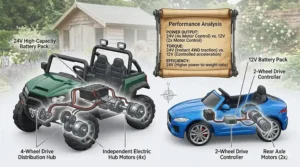
A 12v system typically uses a single 12-volt battery powering two motors (one per rear wheel). Think of it like having two people pushing a wheelbarrow – adequate for flat ground, struggling uphill.
A 24v system employs either:
- Two 12v batteries connected in series (doubling the voltage), or
- A single 24v battery powering four motors (proper four-wheel drive)
This is like having four people pushing that wheelbarrow – hills become manageable, rough terrain poses less challenge, and you’re carrying heavier loads with less strain.
Real-World Performance Differences
On smooth, flat surfaces, the performance gap between 12v and 24v buggies narrows considerably. A quality 12v model will cruise happily across your patio or down a paved drive. However, introduce variables – a gentle grass slope, gravel pathway, or even thick lawn – and the limitations become apparent.
UK buyers specifically noted that 24v models with 800W 4WD systems significantly outperform 12v sports car replicas, which typically offer little torque or four-wheel drive capability. This isn’t marketing hyperbole; it’s observable physics translating into practical capability differences your child will notice immediately.
Battery Life Considerations
Surprisingly, 24v buggies often run longer than 12v equivalents despite their higher power. Why? More efficient motor design and better battery management systems. A typical 12v buggy might manage 45-60 minutes of active play, whilst premium 24v models regularly exceed 90 minutes – some UK buyers report nearly two hours on gentler terrain.
For context, according to UK electrical safety standards, all children’s electric ride-ons must comply with specific battery safety requirements regardless of voltage, ensuring UK-sold models meet minimum safety thresholds.
Motor Configuration: Why 4WD Matters More Than You’d Think
Here’s where the “4wd” designation becomes crucial. It’s not just marketing – it’s the difference between a toy that disappoints after three months and one your child genuinely uses for years.
2WD vs 4WD Explained
Most 12v buggies employ rear-wheel drive (2WD). Two motors power the rear wheels whilst front wheels simply roll along. This works brilliantly on hard surfaces but creates problems when terrain becomes challenging. Hit a muddy patch or thick grass, and those rear wheels spin uselessly whilst front wheels provide zero traction.
Genuine 4WD systems power all four wheels independently. Each wheel receives its own motor, distributing power evenly and maintaining traction when individual wheels encounter obstacles. It’s similar to how proper 4×4 vehicles handle off-road driving – power goes where it’s needed most.
Ground Clearance and Suspension
Premium 24v 4WD buggies typically feature enhanced ground clearance (the gap between chassis and ground). This prevents the buggy from “bottoming out” on uneven terrain – a common complaint with cheaper 12v models where the chassis scrapes against bumps, stopping forward progress completely.
UK customers living in countryside settings specifically highlighted how upgraded EVA foam tyres and superior ground clearance allow 24v models to tackle pot holes, dips, and angled terrain that would strand standard ride-ons. If your garden includes any natural features or less-than-perfect lawn maintenance, this becomes a deciding factor.
Four-point spring suspension (standard on most 24v models, optional on 12v) dramatically improves comfort and handling. Children notice the difference – less jarring over bumps translates to longer, more enjoyable play sessions.
Terrain Analysis: Matching Buggy to Your Garden
Your garden’s characteristics should heavily influence your decision. Let’s break down terrain types and appropriate specifications.
Flat, Paved Surfaces (Patios, Driveways, Pavements)
Recommendation: 12v perfectly adequate
If your child will primarily drive on concrete, tarmac, or smooth paving, save your money. A quality 12v model like the HOMCOM 2-Seater (£149-£189.99) delivers perfectly acceptable performance. The speed limitation becomes a safety feature, and battery life proves sufficient for typical play sessions.
Well-Maintained Lawns and Gentle Slopes
Recommendation: 12v acceptable, 24v preferred for longevity
This grey area depends on lawn thickness and slope severity. Freshly mown, healthy lawn with slopes under 10 degrees? A robust 12v manages acceptably. However, if you’re planning several years of use or have multiple children who’ll inherit the buggy, investing in 24v now prevents the frustration of outgrowing capabilities within 18 months.
Hills, Rough Grass, Gravel, or Multi-Terrain
Recommendation: 24v essential, 4WD non-negotiable
Anything beyond manicured lawn demands proper power. The Hornet or Vulcan Carbon with their 4 × 100W motors aren’t luxuries here – they’re requirements. UK buyers attempting hills with 12v buggies universally report disappointment, with many upgrading within months.
One Titan Toys customer living in the North Pennines specifically purchased the Vulcan after “many ride-ons that just couldn’t perform” in their hilly terrain. Their experience: “This little fella really is the best of the best. Climbs the 20% gradient hill to our home with ease.”
Mud, Wet Grass, and Challenging Conditions
Recommendation: Premium 24v with EVA tyres
Here’s where tyre technology matters as much as motor power. Standard plastic wheels slip catastrophically in mud or wet grass. EVA foam tyres (standard on Titan Toys models, optional upgrades elsewhere) provide dramatically better traction and puncture resistance.
If you live rurally or anticipate year-round outdoor play regardless of weather, budget for a premium 24v model specifically mentioning EVA or rubber tyres. The £100-£150 price premium over standard 24v models pays for itself in reduced frustration and extended usability.
Age Appropriateness and Safety Considerations
Under UK law, electric ride-ons for children must only be driven on private land with the landowner’s permission, never on public roads or pedestrian areas. With legal requirements covered, let’s discuss practical age-matching.
3-4 Years Old: Starting Their Driving Journey
Recommendation: 12v with comprehensive parental remote control
Younger children benefit from lower speeds and simpler controls. The HOMCOM 12V or GYMAX models offer excellent parental override systems, allowing you to control steering and speed whilst your child develops coordination and confidence.
Key features for this age:
- Maximum speed not exceeding 5 km/h
- Easy-to-reach emergency stop on parental remote
- Seat belt (legally required on all UK models)
- Gradual acceleration (avoid models with abrupt starts)
5-6 Years Old: Building Confidence
Recommendation: 12v or entry-level 24v depending on terrain
This transitional age works with either voltage, though many UK parents regret choosing 12v models that children outgrow within a year. If your budget allows, entry-level 24v like the Renegade UTV-MX (£349.99) provides several additional years of appropriate challenge as skills develop.
7-8+ Years Old: Seeking Adventure
Recommendation: 24v essential, premium models ideal
Older children need genuine performance. They’ve mastered basic driving, crave speed (within safe limits), and want to tackle challenging terrain their younger siblings can’t manage. Premium 24v models become the only satisfying option.
The Vulcan Carbon specifically receives praise from UK buyers for accommodating “children up to age 8+” comfortably, whilst cheaper 12v models feel cramped and underpowered for this age group.
Weight Capacity Reality Check
Manufacturers list maximum weight capacities, but smart parents plan conservatively. A buggy rated for 50kg (7.9 stone) performs optimally below 40kg. Performance degrades approaching maximum limits – hills become impossible, battery drains faster, and motors strain audibly.
For reference:
- Average UK 5-year-old: approximately 18-20kg (2.8-3.1 stone)
- Average UK 7-year-old: approximately 23-25kg (3.6-3.9 stone)
Most 12v buggies max out at 50kg, whilst premium 24v models accommodate 60-130 lbs (approximately 27-59kg), providing substantially more headroom for growth.
Battery Technology and Runtime Expectations
Understanding battery specifications helps set realistic expectations and avoid common disappointments plaguing new buyers.
Battery Capacity Decoded
Battery capacity appears as “AH” (amp-hours). Common configurations:
- 12V 7AH (standard budget models)
- 12V 10AH (upgraded 12v models)
- 24V 7AH (standard 24v models)
- 24V 10AH or higher (premium 24v models)
Higher AH ratings deliver longer runtime, though real-world performance depends on terrain, rider weight, and driving style. A 12V 7AH battery might provide:
- 60+ minutes on flat pavement with a 20kg child
- 30-40 minutes on grass with a 30kg child
- 20-25 minutes tackling hills with maximum weight
Premium 24v models with efficient motor management regularly exceed advertised runtimes. The Dirt Traxx customer reporting “2 hours over the park with battery dropping only 1 bar out of 4” demonstrates this advantage.
Charging Requirements and Battery Lifespan
All models require initial charging before first use (typically 6-8 hours). Subsequent charges take 8-12 hours, and manufacturers universally recommend avoiding partial charges for maximum battery longevity.
Following UK electrical safety standards for toys, all ride-ons include certified chargers meeting British safety requirements. Never substitute third-party chargers, regardless of compatibility claims – fire risk isn’t worth the convenience.
Battery lifespan averages 300-500 charge cycles before noticeable capacity reduction. Assuming two play sessions weekly (approximately 100 charges annually), expect 3-5 years before replacement becomes necessary. Replacement batteries cost £30-£80 depending on specification, a worthwhile consideration for long-term budgeting.
Winter Storage Best Practices
UK weather necessitates seasonal considerations. Before extended storage (winter months for many families):
- Fully charge the battery
- Store in a dry, temperature-controlled location (garage, not shed)
- Charge every 2-3 months even when unused
- Inspect tyres and chassis for weather damage
Proper storage extends both battery and vehicle lifespan significantly. Several UK reviewers mentioned buggies performing flawlessly after 2-3 years of seasonal use when stored correctly.
The True Cost of Ownership: Beyond the Purchase Price
Focusing solely on initial price overlooks significant ownership costs that affect true value proposition.
Initial Investment Breakdown
Budget 12v Path:
- Buggy: £129-£189
- Assembly time: 1-2 hours (DIY)
- Immediate accessories needed: Potentially none
- Total first-year cost: £129-£189
Premium 24v Path:
- Buggy: £399-£519
- Assembly time: 2-3 hours (or paid assembly service £50-£80)
- Immediate accessories: Potentially none
- Total first-year cost: £399-£599
Ongoing Costs (Years 2-5)
12v Model:
- Replacement battery (year 3-4): £30-£50
- Potential upgrade to 24v model: £350-£500 (many buyers report this need)
- Total 5-year cost: £509-£739
24v Model:
- Replacement battery (year 4-5): £50-£80
- Upgrade unlikely (grows with child)
- Total 5-year cost: £449-£599
The Resale Factor
Premium 24v models from established brands like Titan Toys maintain surprisingly strong resale value. Quality buggies in good condition regularly fetch 50-60% of original price on Facebook Marketplace or eBay after 2-3 years use.
Budget 12v models typically resell for 20-30% of purchase price, partly because buyers recognise limited capability and shorter useful lifespan. This residual value difference narrows the true cost gap between budget and premium options considerably.
UK Regulations and Safety Compliance
Every buggy sold legitimately in the UK must comply with stringent safety standards. Understanding these requirements helps identify quality products and avoid dangerous counterfeits.
Essential Safety Markings
Look for these certifications on any buggy you’re considering:
- UKCA marking (UK Conformity Assessed) – replaced CE marking post-Brexit
- EN71 compliance – European toy safety standard (still recognised in UK)
- EN62115 compliance – electrical toy safety specific standard
- RoHS compliance – restriction of hazardous substances
Reputable sellers like Amazon.co.uk and Titan Toys only stock properly certified products, but marketplace sellers and unknown importers occasionally offer non-compliant items. If pricing seems suspiciously low (genuine 24v 4WD under £250), question legitimacy.
Testing and Certification Requirements
UK toy safety testing focuses on three critical areas: mechanical and physical properties, flammability, and migration of certain elements (heavy metals and harmful chemicals). All buggies undergo third-party laboratory testing before receiving certification, ensuring they meet minimum safety thresholds for British children.
For parents concerned about chemical safety, all legitimate UK-sold models comply with restrictions on lead, phthalates, and other harmful substances. The HOMCOM, Titan Toys, and other established brands specifically meet or exceed these requirements.
Parental Supervision Requirements
Whilst not legally mandated for use on private property, responsible parents maintain constant supervision during play sessions. This applies regardless of age or experience – even experienced 7-8 year-olds benefit from adult oversight, particularly in unfamiliar terrain or weather conditions.
All models include parental remote controls as standard, allowing adults to override child inputs when necessary. This feature proves invaluable for:
- Emergency stops (obstacles, other children, pets)
- Preventing access to prohibited areas (ponds, steep drops, boundary fences)
- Teaching appropriate driving behaviour through controlled practice
Upgrading from 12v to 24v: When and Why
Many UK families start with budget 12v models, later questioning whether upgrading justifies the additional investment. Here’s how to evaluate that decision.
Signs You’ve Outgrown Your 12v Buggy
Performance-Related Indicators:
- Struggles on terrain it previously managed (battery ageing)
- Child complains it feels “slow” or “boring”
- Physically cramped (child’s knees hitting steering wheel)
- Frequent battery changes mid-play session
Age and Development Signals:
- Child approaching age 6+
- Developed confident driving skills seeking new challenges
- Younger sibling ready to start (hand-me-down opportunity)
- Interest in “helping” with garden tasks (towing, transporting)
Cost-Benefit Analysis of Upgrading
If your current 12v buggy has 1-2 years remaining usable life and your child is under 6, upgrading now may prove premature. However, if those indicators above resonate and your child shows sustained interest in outdoor play, upgrading often reignites enthusiasm that was waning.
One Titan Toys customer explicitly mentioned buying the Vulcan Carbon after “many ride-ons that just couldn’t perform” in their challenging terrain. The upgrade eliminated frustration and extended outdoor play significantly – worth far more than the price difference in their estimation.
Maximising Value from Your Old 12v Model
Rather than viewing your 12v purchase as wasted money, leverage it strategically:
- Sell locally: Facebook Marketplace, eBay, or Gumtree regularly feature ride-ons
- Gift to younger relatives: Nieces, nephews, or friends’ children
- Donate to playgroups: Local nurseries often welcome working ride-ons
- Keep as backup: Having a second buggy enables sibling play without arguments
Realistic resale expectations: expect £50-£90 for a well-maintained 12v model originally costing £150-£200. Not spectacular, but recovers enough to meaningfully offset 24v upgrade costs.
Maintenance Tips for Maximum Lifespan
Proper maintenance extends your investment significantly, regardless of whether you’ve chosen 12v or 24v. UK weather presents particular challenges requiring proactive care.
Post-Play Cleaning Routine
After each outdoor session (particularly in wet or muddy conditions):
- Wipe down exterior with damp cloth
- Inspect wheels for debris (stones, twigs, grass clumps)
- Check battery connections remain tight and corrosion-free
- Dry thoroughly before storage
This 5-minute routine prevents 90% of common issues plaguing ride-ons. Mud left on motors or in wheel assemblies accelerates wear dramatically.
Monthly Deep Maintenance
Once monthly, perform more thorough inspection:
- Tighten all visible bolts and screws (vibration loosens them over time)
- Lubricate moving parts (steering column, wheel axles) with appropriate grease
- Test all electrical functions (lights, sounds, remote control range)
- Inspect tyres for wear or damage
- Clean battery terminals with wire brush if any corrosion visible
Seasonal Preparation
Spring (Pre-Season):
- Fully charge battery after winter storage
- Inspect all components for winter damage
- Test electrical systems thoroughly
- Clean accumulated dust/debris from storage
Autumn (End of Season):
- Deep clean entire buggy
- Apply protective coating to metal components
- Fully charge battery for storage
- Store in dry, temperature-stable location
UK buyers specifically mention batteries as the most common failure point. Following proper storage and charging protocols extends battery life from 2-3 years to 4-5 years in many cases – significant savings on replacement costs.
Common Problems and Troubleshooting
Even premium buggies occasionally develop issues. Here’s how to address the most frequent problems UK buyers encounter.
Buggy Won’t Start or Move
Possible causes and solutions:
- Battery depleted → Charge 8-12 hours, avoid partial charges
- Loose connection → Inspect and tighten battery terminals
- Damaged charger → Test with multimeter, replace if faulty
- Tripped safety switch → Locate and reset (consult manual)
Reduced Speed or Power
Likely culprits:
- Ageing battery → Replace after 300-500 cycles (typically 3-5 years)
- Overweight rider → Respect manufacturer weight limits
- Motor wear → Professional servicing may be required
- Tyre pressure low (if pneumatic tyres) → Inflate to recommended PSI
Steering Problems
- Dirt in steering mechanism → Clean and lubricate
- Damaged steering components → Inspect for broken parts, replace as needed
- Loose assembly → Tighten steering column bolts
Remote Control Not Working
- Replace remote batteries (often overlooked!)
- Re-pair remote with buggy (consult manual for procedure)
- Check for interference from other electronic devices
- Inspect buggy’s receiver unit for damage
Several UK buyers mentioned Titan Toys’ exceptional after-sales support for troubleshooting issues. Amazon.co.uk purchases benefit from Amazon’s customer service, though direct manufacturer contact often provides more specialised knowledge.
Environmental Considerations and Sustainability
Environmentally conscious parents increasingly consider ride-ons’ ecological impact. Here’s the realistic assessment.
Battery Disposal and Recycling
UK law prohibits disposal of lead-acid batteries (used in most ride-ons) with household waste. When batteries reach end-of-life:
- Return to purchase retailer (legal obligation to accept)
- Deliver to local recycling centre (all UK councils accept)
- Battery retailers (Halfords, etc.) accept regardless of purchase location
Proper recycling recovers lead, plastic, and acid for reuse, minimising environmental harm. Never attempt to dismantle batteries yourself – acid leakage poses serious health and environmental risks.
Energy Consumption Reality
Charging a typical 24v 7AH battery consumes approximately 0.2-0.3 kWh per full charge. At current UK electricity rates (roughly £0.25/kWh), that’s 5-8 pence per charge. Assuming two charges weekly across a 6-month outdoor season (approximately 50 charges), annual electricity cost totals £2.50-£4.00 – genuinely negligible.
For context, that’s less energy than running a typical household light bulb for 20-30 hours. The environmental impact of manufacturing and transporting the buggy far exceeds its operational energy consumption.
Longevity vs. Disposability
Here’s where premium 24v models demonstrate environmental advantage. A budget 12v buggy lasting 2-3 years before replacement creates more waste than a premium 24v model serving 5-7 years (potentially across multiple children through hand-me-downs or resale).
The Vulcan Carbon owner noting their “8-year-old daughter could ride for another few years” demonstrates this longevity. Manufacturing one durable product proves more environmentally sound than two disposable items, even accounting for higher initial resource consumption.
Where to Buy: UK Retailer Comparison
Choosing the right retailer affects not just price, but warranty support, delivery experience, and returns handling.
Amazon.co.uk
Advantages:
- Competitive pricing with frequent discounts
- Fast delivery (often next-day with Prime)
- Straightforward returns process
- Extensive customer review database
Disadvantages:
- Assembly always required (no build services)
- Generic customer service (limited product expertise)
- Marketplace sellers vary in reliability
Best for: Budget-conscious buyers comfortable with DIY assembly who prioritise convenience and returns flexibility.
Titan Toys (Direct)
Advantages:
- Specialist knowledge and customer support
- Optional assembly services
- Direct manufacturer warranties
- Exclusive models not available elsewhere
Disadvantages:
- Generally higher pricing than Amazon
- Delivery times can extend during peak seasons
- Smaller product range (focus on premium models)
Best for: Buyers prioritising expert guidance, premium products, and long-term manufacturer relationship over absolute lowest price.
Other UK Retailers
Stores like Robert Dyas, ManoMano, and Wowcher occasionally stock ride-ons, typically offering:
- Mid-range pricing
- Standard delivery options
- Variable customer service quality
- Limited specialist knowledge
These work well for straightforward purchases where you’ve already researched thoroughly and simply need competitive pricing.

Frequently Asked Questions
❓ How long does a 24v battery last compared to a 12v on a single charge?
❓ Can a child transition directly from a balance bike to a 24v buggy, or should they start with 12v?
❓ Are 24v 4wd buggies significantly louder than 12v models, and will they disturb neighbours?
❓ What's the minimum garden size needed to justify investing in a 24v buggy rather than a 12v?
❓ Do 24v buggies require more expensive insurance or pose greater liability risks than 12v models?
Conclusion: Making Your Final Decision
After examining seven top models, dissecting voltage differences, and analysing real UK buyer experiences, here’s the straightforward guidance you need.
Choose 12v if:
- Your garden features primarily flat, smooth surfaces
- Your child is 3-5 years old and developing basic coordination
- Budget constraints make £400+ investments prohibitive
- You’re testing interest before committing to premium equipment
- You anticipate upgrading in 2-3 years anyway
Choose 24v if:
- Your property includes hills, rough grass, gravel, or varied terrain
- Your child is 5+ or you’re planning for multiple years of use
- You want genuine off-road capability rather than pavement performance
- Budget allows £350-£550 for a premium, long-lasting investment
- You value performance and longevity over initial savings
For most UK families reading this guide, I’d recommend the Renegade UTV-MX (£349.99) as the sweet spot between capability and value, or the Vulcan Carbon (£469-£519) for those prioritising absolute performance and longevity.
The 24v 4wd buggy vs 12v which is better question ultimately depends on your specific circumstances, but premium 24v models demonstrate clear advantages in versatility, longevity, and real-world performance that often justify their higher initial cost. Your child’s delighted expression conquering that garden slope will confirm whether you’ve chosen wisely.
Recommended for You
- 7 Best Which 24v Buggy Is Best for 8 Year Olds UK 2026
- 7 Best Off Road Electric Buggy for Kids UK 2026
- 7 Best 24v 4wd Buggy for Children UK 2026
Disclaimer: This article contains affiliate links. If you purchase products through these links, we may earn a small commission at no additional cost to you. Prices shown are approximate and may vary.
✨ Found this helpful? Share it with your mates! 💬🤗
