In This Article
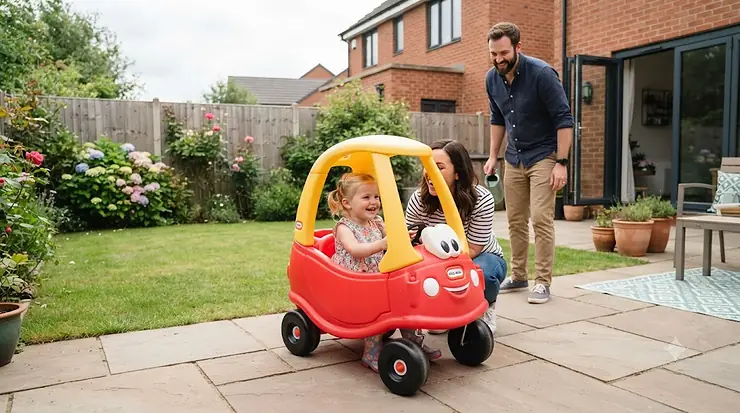
If you’ve spent any time at all in a British garden centre, a soft play car park, or your own nan’s back garden, you already know the silhouette: a squat, cheerful little car with a roof that pops off, a horn that never quite stops working, and a colour scheme so instantly recognisable it barely needs the badge. The Little Tikes Cozy Coupe classic red is, in the nicest possible way, a rite of passage. It’s the toddler equivalent of a first bicycle, minus the stabilisers and the scraped knees.
What is the Little Tikes Cozy Coupe classic red? It’s a foot-to-floor ride-on car for children roughly 18 months to five years, powered entirely by little legs rather than batteries, with a removable floor, opening doors, and a body built to survive a decade of driveway rallies. Since 1979 it’s sold in the tens of millions worldwide, and 2026’s version keeps the same bones while quietly improving the plastic and the safety detailing.
But here’s the honest bit: it isn’t automatically the right choice for every toddler or every budget. Some families need something lighter for a flat, some want a parent-push handle for the pavement to the shops, and some are simply hunting for the cheapest thing that will survive a two-year-old’s enthusiasm. That’s exactly why this guide sits the Cozy Coupe classic red alongside six genuine rivals — Little Tikes’ own siblings and outside competitors — and works through what the spec sheets actually mean once the car is in your hallway.
Quick Comparison Table: Toddler Ride-Ons at a Glance
| Product | Best For | Age Range | Price Range |
|---|---|---|---|
| Little Tikes Cozy Coupe Classic Red | The all-round family classic | 18 months–5 years | around £110–£130 |
| Little Tikes Princess Cozy Coupe | Same durability, themed styling | 18 months–5 years | around £115–£135 |
| Little Tikes Push Car Walker | Younger siblings not yet walking confidently | 18 months+ | around £45–£65 |
| BIG Bobby Car Classic | Tighter turning circle, German build | 12 months–5 years | around £35–£50 |
| Little Smoby My First Ride-On | Very first ride-on, lightest option | 10 months+ | around £25–£40 |
| HOMCOM 3-in-1 Ride-On Slider | Tightest budget | 1–3 years | around £30–£45 |
| Radio Flyer Busy Buggy | Sensory play plus push-walking | 1–3 years | around £35–£55 |
Looking at the spread above, the pattern that jumps out is age range: the Little Tikes Cozy Coupe Classic Red and its Little Tikes Princess Cozy Coupe sibling are built to last from toddling right through to school-gate confidence, which is exactly why they carry the highest price tags — you’re paying for years of use, not months. Budget picks like the Little Smoby My First Ride-On and HOMCOM 3-in-1 Ride-On Slider are aimed squarely at the youngest end of the market and will likely be outgrown sooner. If your toddler is still finding their feet rather than confidently walking, the Little Tikes Push Car Walker and Radio Flyer Busy Buggy earn their keep by doubling as a walking aid first and a ride-on second.
💬 Just one click — help others make better buying decisions too!😊
Top 7 Toddler Ride-On Cars: Expert Analysis
Below are seven genuine, currently sold ride-ons spanning budget, mid-range and premium. Every entry blends real specifications with honest analysis — what reviewers consistently report, and what the numbers mean once wheels hit tarmac.
1. Little Tikes Cozy Coupe Classic Red — the original that started the whole category
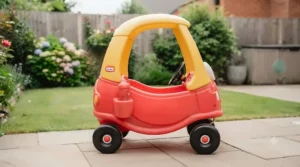
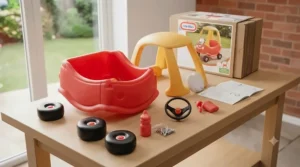
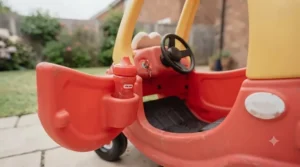
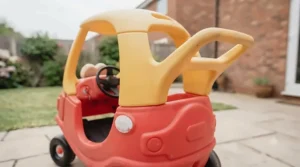
The standout here isn’t a single feature so much as sheer staying power: this shape has barely changed since 1979, and that’s a design compliment, not a criticism. The current version keeps the working “ignition” key click, an opening fuel cap, a lift-off roof for hot days, and doors that genuinely open and shut rather than just looking like they might. The removable floorboard is the clever bit most buyers overlook — take it out and a toddler can Fred Flintstone the car along with their own feet; keep it in and it becomes a scoot-along buggy alternative for the driveway.
Based on the spec comparison against its rivals, the wide wheelbase and low centre of gravity are what make this one noticeably harder to tip than several cheaper foot-to-floor alternatives, which matters more than horsepower ever will on a car with no engine. It suits families who want one car to see a child from first wobbly pushes right through to confident three-year-old cornering, and who have the patio or garden space to store something this substantial. Reviewers consistently note that the plastic shrugs off years of British weather far better than budget alternatives, with many households passing the same car down between siblings or on to neighbours.
Pros:
- ✅ Sturdy build that regularly survives multiple children
- ✅ Removable floor doubles as walker and ride-on
- ✅ Working horn, key, and fuel cap for imaginative play
Cons:
- ❌ Bulkier to store than newer foot-to-floor rivals
- ❌ No push handle for parents on longer walks
At around £110–£130, the value case rests on longevity rather than upfront cost — check current price before buying, as retailers vary.
2. Little Tikes Princess Cozy Coupe — same chassis, girl-themed styling with extra sound effects
The standout feature is the working horn paired with a genuine ignition-click sound, which is one sensory step up from the standard classic model. Under the magenta and lilac paint job, this is mechanically the same platform as the red original: same wheelbase, same removable floor, same rotationally-moulded plastic shell rated for years of outdoor abuse.
What most buyers overlook about this model is that it isn’t simply a repaint — Little Tikes has tuned the horn and ignition sounds specifically for this line, so if your toddler is drawn to cause-and-effect play, this version arguably edges ahead on engagement rather than just aesthetics. Aggregated review sentiment across UK retailers tends to praise the same durability strengths as the classic red, with the main complaint being availability during peak birthday and Christmas periods rather than any build-quality issue.
Pros:
- ✅ Identical durable chassis to the classic red version
- ✅ Working horn and ignition sound effects
- ✅ Same removable floorboard walker function
Cons:
- ❌ Frequently sells out around Christmas and birthdays
- ❌ Slightly narrower colour appeal than the classic red
Priced in a similar £115–£135 range to the original, this is the pick when styling matters as much as substance.
3. Little Tikes Push Car Walker — the 3-in-1 pick for younger, less steady toddlers
The standout advantage is the rear push handle, which the Cozy Coupe line lacks entirely. That single addition changes who this car suits: instead of assuming a toddler can already propel themselves confidently, this model is designed from the ground up for a parent to steer and push while a young child sits and gets used to motion, before graduating to foot power themselves.
At roughly 82cm high, 44cm wide and weighing around 9kg with a maximum load near 23kg, the numbers translate into a genuinely compact footprint for flats and narrow hallways — smaller than the Cozy Coupe’s roomier shell. Suitable from around 18 months and CE certified, this is the honest answer for parents whose toddler simply isn’t ready to power a car themselves yet. Reviewers commonly report that the transition from push mode to independent foot-to-floor happens naturally over a few months, which is precisely the point of a 3-in-1 design rather than a limitation of it.
Pros:
- ✅ Rear push handle for parent-assisted rides
- ✅ Compact footprint suits smaller homes
- ✅ Converts to independent ride-on later
Cons:
- ❌ Smaller seat than the full-size Cozy Coupe
- ❌ Less headroom for taller toddlers
Expect a price in the £45–£65 range, sitting comfortably between budget sliders and the full Cozy Coupe.
4. BIG Bobby Car Classic — the German-engineered rival with the tightest turning circle
The standout feature is the stepless Ackermann steering system, a proper bit of automotive engineering shrunk down for toddlers, which gives this car a noticeably smaller turning circle than boxier rivals. That matters more than it sounds: in a narrow hallway or a crowded soft play car park, a car that can pivot tightly is simply less frustrating for a small driver still working out spatial awareness.
Made in Germany and TÜV-tested to a 50kg weight limit, the Bobby Car Classic is built with a knee recess specifically for older toddlers who’ve outgrown the very smallest ride-ons but aren’t ready for a pedal trike. Here’s what to weigh: it has no doors, roof, or storage boot, so the imaginative “driving to the shops” play that the Cozy Coupe encourages is largely absent — this is a pure kick-and-steer toy rather than a pretend car. Reviewers frequently mention the quiet wheels as a genuine advantage over noisier plastic rivals, particularly welcome for indoor use.
Pros:
- ✅ Tight Ackermann steering turning circle
- ✅ High 50kg weight capacity for older toddlers
- ✅ Quiet wheels suited to indoor play
Cons:
- ❌ No doors, roof, or pretend-play extras
- ❌ Requires basic tool-assisted assembly
Typically found in the £35–£50 range, this is the value pick for families prioritising manoeuvrability over role-play features.
5. Little Smoby My First Ride-On — the lightest, earliest-start option
The standout advantage is the sheer minimum age: suitable from around 10 months, well before most rivals, thanks to a very low, wide, tip-resistant base and lightweight construction that even a barely-walking toddler can shuffle along. French manufacturer Smoby has designed this specifically as a transitional toy between crawling and confident walking, with front and rear anti-topple guards built into the moulding rather than added as an afterthought.
Key specs with real-world meaning: the low weight makes it genuinely easy for parents to move between rooms or in and out of the car boot, which sounds trivial until you’ve wrestled a heavier ride-on up a flight of stairs. On paper this means less “car” and more “confidence-building first mover,” and that’s reflected honestly in aggregated buyer feedback, where the recurring theme is praise for easy assembly and light weight rather than long-term durability claims. It suits younger toddlers and second children who already have hand-me-down toys but need something scaled to their current stage.
Pros:
- ✅ Usable from around 10 months old
- ✅ Lightweight and easy to carry or store
- ✅ Anti-topple design front and rear
Cons:
- ❌ Toddlers typically outgrow it within a year
- ❌ Minimal storage or role-play detailing
At around £25–£40, this is the entry point for the very youngest riders in this guide.
6. HOMCOM 3-in-1 Ride-On Slider — the rock-bottom budget option with genuine versatility
The standout feature is the 3-in-1 claim actually holding up in practice: under-seat storage, a functioning horn, and a manual foot-to-floor slide mode combine to give a surprising amount of play value for the price point. No batteries, no motors — just moulded plastic, a steering wheel, and four wheels built for ages roughly 1 to 3 years.
Here’s what to weigh against the bigger-name entries on this list: build quality reviews are more mixed than for Little Tikes or BIG, with some buyers reporting thinner plastic that flexes more under an enthusiastic toddler than the pricier options. That’s the honest trade-off of a budget price point, and it doesn’t make this a bad toy — it makes it a sensible choice for families testing whether their toddler even enjoys ride-on play before committing to a premium model, or for a second car kept purely for grandparents’ house. Aggregated feedback tends to be positive on assembly speed and initial value, less consistent on long-term wear after a full year of daily use.
Pros:
- ✅ Genuine under-seat storage compartment
- ✅ Lowest price point in this comparison
- ✅ Simple, quick tool-free assembly
Cons:
- ❌ Plastic feels less robust than premium rivals
- ❌ Durability reviews more mixed long-term
Sitting around £30–£45, this is the pick for cost-conscious first-time buyers.
7. Radio Flyer Busy Buggy — the premium sensory-play specialist
The standout feature is the sheer density of interactive detail: 17 separate sensory activities including interlocking gears, a clicking spare tyre, folding wing mirrors and a spinning dashboard, built into a 3-in-1 design that works as a push walker, a ride-on, and simply a stationary activity toy. That last mode is the genuinely clever bit — plenty of ride-ons stop being interesting the moment a toddler stops moving; this one doesn’t.
With a maximum weight capacity of around 42lb (roughly 19kg) and an anti-tip base, Radio Flyer has designed this specifically for the walking-to-riding transition rather than as a long-term car substitute, which is worth knowing before you buy: toddlers tend to graduate out of it faster than they would a full-size Cozy Coupe. As a US-designed product, UK stock tends to come via Amazon’s UK marketplace or specialist importers rather than every high-street toy shop, so availability and delivery times are worth checking before ordering — a detail Amazon listings rarely spell out clearly. Reviewers consistently highlight the fine-motor sensory features as the reason they chose it over a simpler foot-to-floor car, particularly for younger or more sensory-driven toddlers.
Pros:
- ✅ 17 genuine sensory and fine-motor activities
- ✅ Works as walker, ride-on, and static toy
- ✅ Under-seat storage for small treasures
Cons:
- ❌ UK stock and delivery times can vary
- ❌ Outgrown faster than full-size ride-ons
Expect around £35–£55 depending on import route, with the value case resting on developmental features rather than years of service.
Setting Up and Maintaining Your Toddler’s Ride-On: A Practical Guide
Getting a new ride-on right in the first month makes a genuine difference to how long it lasts and how much your toddler actually uses it, and this is exactly the kind of detail an Amazon listing won’t walk you through.
Start with assembly on a flat, hard surface rather than carpet — most foot-to-floor cars, including the Cozy Coupe range, arrive with wheels and a steering column that need firm, level pressure to click properly into place, and doing this on a soft rug makes it easy to seat a component at a slight angle. Once built, check every wheel spins freely before handing the car over; a wheel that catches even slightly will make early pushes far more frustrating for a toddler who’s already working hard on coordination.
For ongoing maintenance, a monthly wipe-down with warm soapy water keeps the moulded plastic looking sharp and stops grit building up in the wheel axles, which is the single most common cause of a ride-on becoming sluggish over time. If a wheel does start squeaking, a small amount of silicone-based lubricant (never oil-based, which attracts more dirt) on the axle usually solves it in seconds. Store the car under cover where possible — UV exposure is what fades bright reds and pinks fastest, more so than rain, which the rotationally-moulded plastic used by brands like Little Tikes and BIG genuinely shrugs off.
The most common first-30-days mistake isn’t mechanical at all: it’s introducing the car on a slope or gravel drive before a toddler has built confidence on a flat path. Start flat, start slow, and let steering confidence come before speed — the imaginative play (horns, doors, “driving to the shops”) tends to follow naturally once the physical side feels safe.
Real-World Scenarios: Which Ride-On Actually Suits Your Toddler?
Specs only tell half the story, so here are three genuine household profiles matched to the products above, with the reasoning spelled out.
The garden-and-driveway family with two children two years apart. Budget around £100–£150, plenty of outdoor storage, and a need for something that survives a hand-me-down. The Little Tikes Cozy Coupe Classic Red is the obvious fit here: the removable floor means the younger sibling can use it as a push-along before their legs reach the pedals-free floor, while the older one gets full foot-to-floor use, and the shell is proven to survive exactly this kind of multi-child rotation.
The flat-dwelling family with limited storage and a toddler still finding their feet. Space is tight, the toddler is around 12–15 months and not yet a confident walker, and there’s no garden — just pavement trips to the local park. The Little Tikes Push Car Walker or Little Smoby My First Ride-On both make more sense than a full Cozy Coupe here: lighter, smaller, and designed around the walking-to-riding transition rather than assuming independent propulsion from day one.
The budget-conscious first-time buyer unsure if their toddler will even take to it. Rather than committing over £100 on a product a toddler might ignore after a week, the HOMCOM 3-in-1 Ride-On Slider or Little Smoby My First Ride-On let a family test the waters. If the toddler is drawn to it daily within a month, upgrading to a Little Tikes Cozy Coupe Classic Red later becomes a low-risk decision rather than a gamble.
How to Choose a Toddler Ride-On Car: 6 Expert Criteria
- Age and walking confidence first, car style second. A toddler who isn’t yet walking steadily will get more genuine use from a push-handle model like the Little Tikes Push Car Walker than from a full foot-to-floor car sat unused in the hallway.
- Weight capacity versus expected years of use. Check the maximum load against how long you actually want the car to last — the BIG Bobby Car Classic‘s 50kg limit buys noticeably more longevity than a lighter-duty budget slider.
- Storage space at home, not just garden space. A car the size of the Little Tikes Cozy Coupe Classic Red needs a genuine spot to live; smaller households often do better with compact options.
- Indoor versus outdoor primary use. Wheel noise and floor-marking matter indoors in a way they simply don’t in a garden — the BIG Bobby Car Classic‘s quieter wheels are a real advantage on laminate or wood flooring.
- Role-play features versus pure mobility. Doors, horns, and opening fuel caps add imaginative value that a plain kick-and-steer car doesn’t offer; decide how much that matters to your toddler’s play style specifically.
- Availability of spare parts down the line. Established brands with strong UK stockist networks make it far easier to source Cozy Coupe replacement parts and stickers years later than newer, less established imports.
Common Mistakes When Buying a Toddler Ride-On
The single most frequent mistake is buying on age recommendation alone without checking current walking ability — a “from 18 months” label doesn’t guarantee an individual 18-month-old is ready for unassisted foot-to-floor propulsion, and a mismatch here is the most common reason a new ride-on gets ignored.
A second common error is underestimating storage: reviewers across nearly every product in this comparison mention storage as an afterthought, only to discover a Cozy Coupe-sized car doesn’t comfortably fit through a narrow side gate or into a small shed. Measure the route from delivery point to storage spot before ordering, not after.
Thirdly, buyers frequently focus entirely on price and miss weight capacity, which quietly determines how many years the toy will actually serve a growing child — a cheaper car with a lower maximum load may need replacing within a single year, which can end up costing more overall than one considered purchase.
Finally, don’t overlook maintenance access: some budget models use wheel and axle designs that are effectively impossible to service or repair once a wheel wears, meaning the whole product needs replacing, whereas established ranges typically have a wider aftermarket for spare wheels and stickers.
Foot-to-Floor Cars vs Battery-Powered Ride-Ons
It’s worth being direct about this comparison, because Amazon search results for toddler ride-ons blend the two categories together in a way that can genuinely mislead first-time buyers.
Foot-to-floor cars like every product in this guide rely entirely on a toddler’s own leg power. The upside is real developmental value — pushing against the ground builds leg strength, coordination, and balance in a way a motor simply can’t replicate, and there’s no battery to charge, replace, or eventually fail. The downside is that a toddler who tires quickly may get less “ride time” per session than they would in a battery car.
Battery-powered 6V and 12V ride-ons, by contrast, remove the physical effort entirely, letting a toddler steer while the motor does the work. They suit slightly older children more confident with directional control, but they bring real running costs: battery replacement every couple of years, charging time before every use, and typically double or triple the upfront price of a foot-to-floor equivalent. They also fall under different UK electrical toy safety standards (BS EN IEC 62115) on top of the general BS EN71 mechanical rules that govern products like the Little Tikes Cozy Coupe range.
For most toddlers under three, a foot-to-floor car remains the better long-term-value, lower-maintenance choice — battery power tends to earn its keep more with children aged three and up who’ve already mastered basic steering.
Little Tikes Cozy Coupe for Different Ages and Stages
Under 18 months: honestly, most children in this bracket aren’t ready for independent foot-to-floor use of the full Cozy Coupe. This is exactly the gap products like the Little Tikes Push Car Walker and Little Smoby My First Ride-On are designed to fill, letting a parent guide movement while confidence builds.
18 months to 2.5 years: the sweet spot for introducing the Little Tikes Cozy Coupe Classic Red properly. Legs are typically strong enough for sustained foot-to-floor propulsion, and the removable floor still offers a fallback push-along mode on tougher days.
2.5 to 4 years: peak Cozy Coupe years, where steering, imaginative role-play (doors, horn, “driving to nursery”), and physical stamina all come together. This is also when the BIG Bobby Car Classic‘s tighter turning circle starts to show its worth for more adventurous cornering.
4 to 5 years and beyond: most toddlers begin outgrowing foot-to-floor cars physically around this point, seat space becoming the limiting factor rather than interest. This is typically when families either retire the car to a younger sibling or begin looking at pedal go-karts and balance bikes as the natural next step.

Where to Buy the Little Tikes Cozy Coupe and How to Find Genuine Replacement Parts
Finding where to buy the Little Tikes Cozy Coupe in the UK is straightforward: it’s stocked through major UK retailers including Amazon.co.uk, Argos, Smyths Toys, and directly via the official Little Tikes UK website, with availability fluctuating most around Christmas and early summer. Checking stock across two or three retailers before committing is sensible, since demand spikes can push a specific colourway temporarily out of stock even when the wider range is available.
For Cozy Coupe replacement parts — stickers, wheels, number plates, and floor panels — the aftermarket is genuinely strong precisely because the car has sold in such volume since 1979. Independent UK sellers on Amazon and Etsy produce replacement sticker sets sized specifically for both the classic and 30th Anniversary Cozy Coupe editions, and personalised number plate accessories are widely available from small UK-based 3D-printing sellers. Genuine wheels and structural parts can also be requested directly through Little Tikes’ own customer service for older models, which is worth trying before assuming a scuffed or cracked panel means the whole car needs replacing.
Problem-to-solution quick reference: a squeaky wheel usually needs a drop of silicone lubricant rather than replacement; faded stickers can be refreshed with an aftermarket sticker set rather than a new car; a cracked floor panel is often replaceable on its own; and a sun-faded body, while cosmetic only, is largely preventable by storing the car under cover between uses.
Toddler Outdoor Play: Why It Matters More Than the Car Itself
It’s easy to focus entirely on the toy and forget the bigger picture: toddler outdoor play is genuinely recommended as a daily habit, not an occasional treat. NHS guidance states that toddlers should be physically active for at least 180 minutes a day, spread across light and more energetic activity, and that active outdoor play is one of the easiest ways to hit that target without it feeling like a chore for either parent or child, according to NHS physical activity guidance for under-fives.
A foot-to-floor ride-on genuinely earns its place in that 180 minutes in a way passive toys can’t. Pushing a car like the Little Tikes Cozy Coupe Classic Red across a garden or park path is moderate-intensity activity that builds leg strength, balance, and early spatial awareness simultaneously — three developmental wins from a single, simple toy. What most parents overlook is that this kind of repetitive, self-directed physical play also supports confidence and independence, since a toddler is controlling the direction and pace entirely themselves rather than being pushed in a buggy.
The practical takeaway: rotating ride-on time with other outdoor activities — ball games, scooting, simple climbing — spreads the 180-minute target across a variety of movement types, which official guidance specifically recommends over relying on any single activity alone.
Safety, Regulations, and Compliance Guide
Every product featured in this comparison is designed to meet UK toy safety requirements, and it’s worth understanding what that actually covers before you buy from any seller, established or otherwise. Toys sold in Great Britain must comply with the Toys (Safety) Regulations 2011, which sets out mechanical, chemical, and labelling requirements manufacturers and importers are legally required to meet, detailed in full in official UK government toy safety regulations guidance.
In practice, this means looking for the UKCA or CE mark on packaging, checking age recommendations match your child’s actual ability rather than just their birthday, and always supervising ride-on play near steps, driveways, or roads regardless of how sturdy the toy is. The RoSPA guide to toy safety specifically flags that legally compliant toys still carry risk if used outside their intended age range or without supervision, which is a genuinely important distinction — compliance is a floor, not a guarantee.
For ride-on specifics: check weight capacity isn’t exceeded, inspect wheels and axles periodically for wear that could cause an unexpected tip, and never allow ride-on play unsupervised near open water, stairs, or roads. None of the products in this guide are designed for road use under any circumstances — all are intended strictly for pavements, gardens, driveways, and indoor play under supervision.
What to Expect: Real-World Performance
On paper, most of these products look similar — four wheels, a seat, a steering wheel. In practice, the differences show up quickly. The Little Tikes Cozy Coupe Classic Red‘s wider wheelbase means noticeably less wobble on uneven garden paths compared with narrower budget models, while the BIG Bobby Car Classic‘s tight turning circle becomes obvious the first time a toddler tries to do a full loop in a small space — it simply needs less room.
Noise is another everyday factor rarely mentioned on product pages: hard plastic wheels on laminate or tiled flooring can be genuinely loud, and reviewers across several budget models specifically mention this as a household consideration, particularly in flats. The BIG Bobby Car Classic‘s quieter wheel design is a real point in its favour for indoor-heavy households.
Finally, expect an adjustment period regardless of which model you choose — most toddlers take a week or two of short sessions before steering clicks, and pushing too hard for independent use in the first few days tends to backfire, leading to frustration rather than confidence.
FAQ
❓ How old should a toddler be for a Little Tikes Cozy Coupe?
❓ Where can I buy Little Tikes Cozy Coupe replacement parts in the UK?
❓ Is the Little Tikes Cozy Coupe suitable for indoor use?
❓ How much weight can a Cozy Coupe hold?
❓ What's the difference between foot-to-floor and battery ride-ons?
Conclusion
There’s a reason the Little Tikes Cozy Coupe classic red has barely changed its silhouette since 1979: the fundamentals — a low, stable stance, a removable floor that adapts to a growing toddler, and genuinely durable plastic — simply work, and six generations of British toddlers have proven it in gardens and driveways up and down the country. But as this comparison has hopefully made clear, it isn’t automatically the only right answer. Younger toddlers still finding their feet are often better served by a push-handle design, budget-conscious families can trial the waters with a lighter slider first, and households short on storage may prefer the BIG Bobby Car Classic’s tighter, more compact footprint.
Whichever model ends up on your driveway, the bigger win is the same: 180 minutes of daily active play, built one small push at a time. Weigh your toddler’s current walking confidence, your available storage, and your budget against the honest comparisons above, and the right choice tends to become obvious fairly quickly.
✨ Don’t Miss These Exclusive Deals!
🔍 Take toddler outdoor play to the next level with these carefully compared ride-ons. Click through on any highlighted model to check current pricing and availability before making your final choice. A little research now means years of genuine backyard adventures for your family!
Recommended for You
- Ride On Tipping Truck 2026: 7 Best Picks Compared
- Electric Ride On Dumper Truck: 7 Best Picks for UK Kids 2026
- Best Ride On Dumper Truck UK: 7 Top Picks for 2026
Disclaimer: This article contains affiliate links. As an Amazon Associate, I earn from qualifying purchases. If you purchase products through these links, we may earn a small commission at no additional cost to you.
✨ Found this helpful? Share it with your friends! 💬🤗
