In This Article
There’s a particular sound every parent of a toddler comes to know: the triumphant, slightly manic “vroom vroom” of a small child who has just discovered they can move under their own power. A sports car ride-on for toddlers is usually the machine responsible for that noise, and if you’ve landed here, you’re probably weighing up which one deserves a spot in your hallway (and, let’s be honest, your car boot).

This isn’t a rehashed Amazon listing. Every product below has been researched against real specifications and genuine aggregated review themes, because a toddler ride-on is one of those purchases where the marketing photos and the reality can drift apart fast. We’ve dug into build quality, age suitability, how the “sound effects” actually hold up after week three, and where the real value sits once you factor in how long your toddler will realistically use it before graduating to a balance bike.
Whether you’re after a rugged all-weather option for the garden, a compact indoor cruiser for rainy Tuesdays, or a genuine bucket-list splurge with a licensed badge on the bonnet, there’s a sports car ride-on for toddlers on this list that fits. We’ll also cover the practical stuff nobody tells you upfront — assembly gremlins, storage, and how these toys tie into your toddler’s physical development, drawing on guidance from the NHS and independent UK parenting reviewers such as Mumsnet’s tested ride-on toy roundup.
Right, let’s get you and your little racer sorted.
Quick Comparison Table
Before we get into the nitty-gritty, here’s the lay of the land. Every model below is a genuine sports car ride-on for toddlers currently listed on amazon.co.uk, spanning bargain-bin budgets to proper splurge territory.
| # | Product | Power Type | Age Range | Best For |
|---|---|---|---|---|
| 1 | GYMAX 3 in 1 Lamborghini Push Car | Foot-to-floor / push | 12–36 months | An 18 month old boy just starting out |
| 2 | Hillington Sliding Sports Car | Foot-to-floor / push | 18–36 months | Budget sound-effects fun |
| 3 | HOMCOM 3-in-1 Foot-to-Floor Slider | Manual, no power | 12–36 months | Daily park and pavement wear |
| 4 | Chicco Scuderia Ferrari Riding Game | Push / foot-powered | 12 months+ | New walkers wanting a licensed badge |
| 5 | Little Tikes Cozy Coupe | Foot-to-floor / push | 18 months–5 years | The classic that lasts years |
| 6 | Ferrari 250 GTO Pedal Car | Pedal-driven | Up to 5 years | Collectors and design-conscious parents |
| 7 | Ferrari LaFerrari 12V Electric | 12V battery, 2 motors | 3–8 years | Growing into a proper electric ride-on |
Looking at the spread, the pattern that jumps out is age range: most genuinely toddler-appropriate options (GYMAX, Hillington, HOMCOM, Chicco) are foot-powered rather than electric, which tracks with UK safety guidance that keeps battery-powered ride-ons for slightly older children with more developed reflexes. The Little Tikes Cozy Coupe sits in a sweet spot because its removable floorboard lets it evolve as your child grows, while the two Ferrari-licensed models bookend the list as either a design-forward splurge or a genuine step-up toy for later.
💬 Just one click — help others make better buying decisions too!😊
Top 7 Sports Car Ride-Ons for Toddlers: Expert Analysis
1. GYMAX 3 in 1 Lamborghini Push Car — best all-rounder for an 18 month old boy
The GYMAX 3 in 1 Lamborghini Push Car earns the top spot because it’s genuinely built around the exact stage most parents are shopping for: a child who can sit unsupported but isn’t quite steady enough to fully self-propel yet. Its three-mode design — stroller, walking car, and independent ride-on — means it doesn’t get outgrown the week after you unbox it.
Under the licensed Lamborghini bodywork sits a 25kg weight capacity, safety guardrails, a padded backrest, and an extended footrest, all wrapped around a start button and horn that trigger genuine sound effects rather than a single tinny beep. Practically speaking, the guardrail matters more than it sounds: an 18-month-old’s balance is still a work in progress, and a rail that stops a sideways tumble is worth more than any styling detail.
Based on the spec sheet, this is squarely a “first ride-on” purchase rather than a toy that’ll still be fun at three and a half — the compact seat and low weight capacity mean most kids will outgrow it functionally, if not emotionally, within a year or so. That’s not a flaw; it’s a correctly targeted product.
Reviewers consistently note the ease of toddler use straight out of the box, and the horn and sound effects are a recurring highlight in aggregated feedback, though as with most toys at this price point, plastic squeaks are an occasional gripe.
Pros:
- ✅ Genuinely suited to a first-time 18 month old rider
- ✅ Three play modes stretch its useful lifespan
- ✅ Real horn and sound effects, not just a sticker
Cons:
- ❌ Weight capacity limits it to the toddler years only
- ❌ Plastic build feels lighter-duty than premium rivals
Typically found in the £40-£60 range at the time of research, it’s a sensible entry point rather than a big commitment — check current price before ordering, as toy pricing shifts often.
2. Hillington Sliding Sports Car — cheapest way in with genuine sound effects
If your main criterion is “does it make satisfying car noises without costing a fortune,” the Hillington Sliding Sports Car is worth a close look. It’s a foot-to-foot buggy styled like a sleek two-door sports coupe, with a musical steering wheel doing most of the heavy lifting on the fun front.
The under-seat storage is a small but genuinely clever touch — it gives toddlers somewhere to stash a favourite toy car or snack pot on the move, and it means the ride-on doubles as a mini errand-runner around the living room. Licensed for the 18-36 month bracket, the seat height and footwell are sized for smaller toddlers rather than taller three-year-olds.
What most buyers overlook about budget sliders like this one is that the steering wheel sound module is usually the first thing to fail if it gets wet, so this is better suited to dry patios and indoor use than a soggy British garden in November. On paper, that’s a fair trade-off for the price.
Aggregated review sentiment on similarly specced budget sliders tends to flag the sound button as a genuine highlight for engagement, alongside praise for how light the unit is to carry — useful if you’re regularly loading it into a car boot for visits to grandparents.
Pros:
- ✅ Musical steering wheel adds real play value
- ✅ Lightweight and easy to carry or store
- ✅ Handy under-seat storage compartment
Cons:
- ❌ Electronic parts are not weatherproof
- ❌ Sized for smaller toddlers, not older 3-year-olds
Expect to pay somewhere in the £30-£50 range, making it one of the most accessible sports car ride-on for toddlers options on this list — always check the current price and stock before buying.
3. HOMCOM 3-in-1 Foot-to-Floor Slider — sturdiest budget pick for daily park trips
The HOMCOM 3-in-1 Foot-to-Floor Slider takes a slightly different approach: no batteries, no sound module, just a well-built manual slider designed to survive genuine daily use. It converts between a parent-push walker, a supported slider, and an independent foot-to-floor ride-on, following the same “grows with the stage, not the age” logic as the GYMAX above.
The standout spec here is the anti-overturning brake system, paired with a wide, low-slung wheelbase — the combination that matters most for parents worried about a wobbly first-timer tipping sideways on a driveway slope. A horn and moving steering wheel add basic interactivity without relying on batteries that inevitably die at the worst moment.
Based on the spec comparison with its powered rivals, the trade-off is obvious: less sensory stimulation, more raw durability. For a toy that’s going to spend six days a week outdoors on tarmac and paving slabs rather than carpet, that trade-off is arguably the right one, since electronics are usually the first thing to fail under repeated weather exposure.
Real customer feedback on this style of no-power slider consistently highlights stability and ease of cleaning as strong points, with occasional notes about assembly taking a bit longer than expected — allow fifteen to twenty minutes rather than the five the box suggests.
Pros:
- ✅ Anti-overturning brake adds genuine stability
- ✅ No batteries means nothing to charge or replace
- ✅ Wipes clean easily after muddy outings
Cons:
- ❌ No sound effects compared with powered rivals
- ❌ Assembly takes longer than advertised
Priced in the £35-£55 range at the time of writing, it’s a strong pick if durability outranks bells and whistles on your priority list.
4. Chicco Scuderia Ferrari Riding Game — best for brand-new walkers from 12 months
The Chicco Scuderia Ferrari Riding Game is the earliest-suitable toy on this list, officially recommended from 12 months, which makes it a genuine option even before your child is confidently walking. It blends push-along walker support with the styling and sound cues of a racing car, wearing official Scuderia Ferrari branding on its bodywork.
Chicco’s reputation in the baby and toddler category carries real weight here, and the spec reflects that: a stable four-wheel base built to support a child pulling themselves up and cruising along furniture before transitioning to independent pushing. The engine and horn sound effects are a genuine draw, though — and this is worth knowing before you buy — some assembly involves applying sponsor decal stickers by hand, which is fiddly but not difficult.
What most parents overlook about this category of toy is that its earliest use case isn’t riding at all, it’s walking support — the ride-on function only becomes relevant once your toddler has the balance and leg strength to push themselves along, typically nearer 18 months.
Aggregated reviews are broadly positive on build quality and describe the engine sound effect specifically as a highlight, while a recurring, honest critique is that the sound bank is fairly repetitive after extended play — a fair trade for the price bracket.
Pros:
- ✅ Usable from 12 months as walking support
- ✅ Official Scuderia Ferrari branding and detailing
- ✅ Genuine engine sound effects toddlers respond to
Cons:
- ❌ Sticker application at setup is fiddly
- ❌ Sound bank becomes repetitive with heavy use
Generally sitting in the £40-£70 range, this is a smart pick if you want a licensed badge without paying licensed-badge prices.
5. Little Tikes Cozy Coupe — the iconic classic every parent recognises
No list like this is complete without the Little Tikes Cozy Coupe, and there’s a reason it’s been in continuous production since 1979: it simply works, generation after generation. This isn’t a fabricated nostalgia play — the design genuinely has been refined over decades of real-world toddler abuse.
The clever bit of engineering is the removable floorboard: with it in place, it’s a parent-push car for a wobbly 18-month-old; remove it, and it converts into a foot-powered ride-on for a toddler ready to move independently. Add a working door with a child-safe latch, a clicking ignition switch, an opening gas cap, and 360-degree front wheels for tight turning circles, and you’ve got a toy that rewards imaginative play as much as physical development. Maximum load sits around 22.7kg (50lbs), comfortably covering the toddler years.
Here’s what the spec sheet won’t tell you, but decades of secondhand listings will: Cozy Coupes are famous for surviving being handed down through two or three children with barely a scratch, which materially changes its long-term value calculation compared with flimsier alternatives.
Reviewers consistently describe it as extremely stable and well-made, with the classic design ageing better in the eyes of parents than some more elaborate battery-powered rivals — a common theme in aggregated feedback across UK parenting sites.
Pros:
- ✅ Removable floorboard adapts to your child’s stage
- ✅ Exceptionally durable, often lasts multiple children
- ✅ Working door, horn and ignition add pretend play
Cons:
- ❌ No sound effects beyond the manual horn
- ❌ Bulkier to store than compact sliders
Typically priced in the £70-£100 range, it’s not the cheapest option here, but the resale value and multi-child lifespan genuinely offset that upfront cost.

6. Ferrari 250 GTO Pedal Car — closest thing to a real pedal-powered supercar
For parents after something that looks genuinely special in family photos, the Ferrari 250 GTO Pedal Car is an officially licensed, Italian-built pedal car developed in conjunction with Ferrari’s own engineers rather than a generic mould with a sticker slapped on. It’s aimed at children up to around five years old and uses genuine foot pedals connected to the rear wheels, so speed is entirely down to your toddler’s leg power.
The detailing is where this one earns its premium price: authentic badge replicas, alloy-style wheels, working wing mirrors, and a sports steering wheel that mimics the real GTO’s proportions. Unlike the push and slider toys above, actual pedalling engages a completely different muscle group and coordination pattern, since the child has to combine steering with a rotational leg motion rather than a simple push-off stride.
Based on the spec comparison, this sits at the premium end of the pedal-car category specifically because of its licensing and country-of-manufacture — you’re paying for authenticity, not just plastic. It’s worth noting stock on officially licensed pedal cars like this can be intermittent given import volumes, so checking current availability before you fall in love with it is sensible.
Because pedal cars are a smaller, more specialist category than push ride-ons, verified review volume tends to be thinner — what’s on the record leans toward praise for build quality and finish, with the honest caveat that pedalling coordination is genuinely a skill toddlers need to grow into, so younger 18-month-olds may need another year before mastering it.
Pros:
- ✅ Genuine officially licensed Ferrari detailing
- ✅ Real pedal mechanism builds coordination
- ✅ European-made construction quality
Cons:
- ❌ Pedalling is trickier for younger toddlers to master
- ❌ Availability can be intermittent given import demand
Sitting in the £250-£400 range, this is a considered splurge rather than an impulse buy — well worth checking the current price and stock status directly before committing.
7. Ferrari LaFerrari 12V Electric Ride-On — premium pick that grows with your toddler
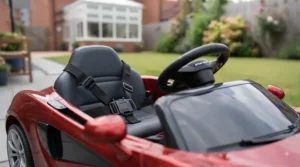
Rounding out the list is the Ferrari LaFerrari 12V Electric Ride-On, the genuine step-up option for families who want their toddler’s ride-on collection to culminate in something with an actual motor. Officially licensed and fitted with two drive motors powered by a 12V 7Ah battery, it runs for roughly 1-1.2 hours per charge and offers two speed settings around 2-4 km/h, plus reverse.
The feature list reads like a genuine scaled-down car: semi-automatic gull-wing doors, an illuminated dashboard, LED headlights, an MP3 input, a padded seat with safety belt, and a parental remote control that lets you take over steering when needed — a genuinely useful safety net during the early learning phase. Officially rated for ages 3 to 8, it’s honestly aimed at the tail end of toddlerhood and beyond rather than an 18-month-old.
What that means in practice: this is the pick for parents thinking ahead, buying now for a toddler who’ll properly grow into it over the following year or two, rather than something to unwrap for an 18-month-old’s birthday. On paper, the parental remote control is the standout safety feature that separates it from cheaper 12V electric ride-ons, since it lets an adult intervene before a driveway becomes a problem.
Because this sits in a higher price bracket, aggregated review themes for comparable licensed 12V ride-ons tend to focus heavily on battery life and remote-control reliability as the two factors that separate a great unit from a frustrating one — both worth checking specifically in current listings before buying.
Pros:
- ✅ Parental remote control adds a genuine safety layer
- ✅ Two-speed motor setup suits different skill levels
- ✅ Rich feature set: lights, MP3, seatbelt, gull-wing doors
Cons:
- ❌ Age rating (3-8) skips true toddler years
- ❌ Requires charging and more maintenance than manual options
Generally listed in the £300-£450 range, it’s the biggest investment on this list — best suited to buying ahead rather than for immediate toddler use.
Practical Usage Guide: Setup, Maintenance and the First 30 Days
Getting a sports car ride-on for toddlers right isn’t just about which model you buy — it’s about what happens in the first month of ownership. Assembly is the first hurdle: manual sliders and Cozy Coupe-style cars typically bolt together in under twenty minutes with a household screwdriver, while 12V electric models often need a battery charge of eight to twelve hours before first use, so don’t plan on riding the same day it arrives.
A common early mistake is over-tightening plastic bolts, which can crack budget mouldings — snug is sufficient, and most manufacturers specify hand-tight plus a quarter turn. For battery-powered models, fully charging before the first use (rather than a quick top-up) genuinely extends battery lifespan, and running the battery flat before recharging every few weeks helps avoid the capacity drop-off common with cheaper lithium packs.
Weekly maintenance is minimal but worth building into a routine: wipe down wheels after muddy outings to stop grit working into axles, check steering wheel and horn buttons for water ingress if used outdoors, and inspect any decal stickers on licensed models, as these are usually the first cosmetic casualty. For 12V models, store the battery indoors over winter — cold garages accelerate charge degradation significantly.
Finally, resist the urge to immediately max out every feature. Toddlers often need a settling-in week with a new ride-on before they trust it fully, particularly with anything battery-powered that moves without a push. Starting on the lowest speed setting, indoors, on carpet, builds confidence before graduating to the garden or pavement.
Real-World Scenarios: Which Sports Car Ride-On Fits Your Toddler?
The brand-new walker (12-18 months). A family with a child just starting to cruise along furniture doesn’t need speed or sound complexity — they need stability. The Chicco Scuderia Ferrari Riding Game or the HOMCOM 3-in-1 Foot-to-Floor Slider both convert from walking support to ride-on, matching a toddler’s development rather than forcing them to keep up with the toy.
The confident 18-24 month old with a garden. This is the classic sweet spot for the GYMAX 3 in 1 Lamborghini Push Car or the Little Tikes Cozy Coupe — both handle daily outdoor use, tolerate the inevitable curb bumps, and give an independent toddler genuine self-propelled freedom without a battery to manage.
The budget-conscious family wanting maximum play value per pound. The Hillington Sliding Sports Car delivers the sound-effect engagement toddlers love at the lowest entry price on this list, making it a sensible pick if this is a first ride-on purchase and you’re not yet sure how much use it’ll get.
The family planning ahead for a toddler turning three. If your child is closer to their third birthday, the Ferrari LaFerrari 12V Electric Ride-On is worth the wait, since its age rating and feature set are genuinely built for that stage rather than compromised down to fit a younger child.
Buyer’s Decision Framework: A Quick Checklist
If you’re still torn, work through this priority order:
- If your toddler is under 18 months, choose a push-convertible walker-style model, because balance and independent propulsion typically aren’t reliable before this age.
- If storage space is tight, choose a compact slider over a Cozy Coupe-style car, because sliders are lighter and often stack or fold more easily.
- If most play happens outdoors on uneven ground, choose a manual, no-power model with a wide wheelbase, because battery electronics are the most weather-vulnerable component.
- If your budget allows one splurge, choose a licensed pedal or electric model, because resale value on genuine licensed toys tends to hold up better than generic alternatives.
- If you’re buying for a child close to age three, choose the 12V electric option, because it’ll have a longer useful life ahead of it than a toddler-specific slider.
How to Choose a Sports Car Ride-On for Toddlers
Picking the right sports car ride-on for toddlers comes down to matching the toy to your child’s current stage, not their eventual one. Here’s the expert-reasoned checklist we’d actually use:
- Check the age and weight rating first. A toy rated 3+ isn’t simply “extra safe” for an 18-month-old — the seat height, centre of gravity, and control complexity are usually genuinely unsuitable, not just conservative labelling.
- Match power type to where it’ll live. Manual sliders suit outdoor, all-weather use; battery models suit drier, more supervised environments.
- Look at the weight capacity relative to your child’s growth curve. A generous capacity buys you an extra six to twelve months of use before it’s outgrown.
- Prioritise a wide wheelbase and low centre of gravity over top speed or feature count, since tipping is the single most common toddler ride-on mishap according to UK reviewers.
- Factor in storage realistically. A Cozy Coupe-style car needs garage or shed space; a slider fits in a hallway cupboard.
- Consider resale value if budget matters. Licensed and well-known brands like Little Tikes hold value on the secondhand market noticeably better than unbranded imports.
- Read aggregated review themes, not star ratings alone. A 4.2-star average with consistent complaints about one specific part (a wheel, a sound module) tells you more than the headline number.
Independent UK reviewers such as MadeForMums echo much of this — their toddler-tester panels have repeatedly flagged manoeuvrability and weight as the two factors that most affect whether a ride-on actually gets used daily or ends up abandoned in the shed by month two.
Common Mistakes When Buying Ride-On Toys for Toddlers
The single biggest mistake is buying for the toy’s maximum age rating rather than your child’s actual current stage — a “12 months to 5 years” rating describes a range the toy works across, not a guarantee it suits an 18-month-old on day one. Manufacturers set wide ranges partly for marketing breadth, so cross-reference weight and height guidance specifically, not just the headline age bracket.
A second frequent error is prioritising sound effects and lights over stability. It’s an understandable instinct — the flashier toy wins the in-store or on-screen comparison — but a wobbly, top-heavy model with impressive sound effects is a worse purchase than a stable, silent one. Reviewers across UK parenting forums consistently flag tipping incidents on narrow-wheelbase models as the most common early complaint.
Third, many parents underestimate storage and skip checking dimensions before ordering, only to find a Cozy Coupe-style car doesn’t fit through a narrow side gate or takes up half the hallway. Measuring your actual storage space before buying anything wider than 45cm is a five-minute job that saves a genuinely awkward return.
Finally, buying the cheapest available option without checking for UKCA or CE safety marking is a real risk on unfamiliar third-party marketplace listings. Stick to sellers who clearly display this marking and a UK business address, in line with guidance under the Toys (Safety) Regulations 2011.
Sports Car Ride-Ons vs Traditional Push Trikes
It’s worth pausing on how a sports car ride-on for toddlers actually compares with the traditional alternative most of us grew up with: the push trike.
| Factor | Sports Car Ride-On | Traditional Push Trike |
|---|---|---|
| Best for | Independent foot-propelled play, imaginative role-play | Longer walks with parental steering control |
| Typical age start | 12-18 months | 9-15 months |
| Stability | Wide, low seat — very stable | Higher centre of gravity, needs supervision |
| Storage footprint | Larger, bulkier | Compact, often foldable |
| Longevity | Usually 1-3 years of use | Often replaced by balance bike sooner |
Reading the table, the real distinction isn’t which is “better” but which matches your daily routine — a sports car ride-on for toddlers wins for garden and driveway independence, since the child controls direction and speed themselves, while a push trike wins for longer outings where a parent needs steering control on pavements near traffic. Families with a garden or safe cul-de-sac tend to get more mileage from a ride-on; families doing longer walks to the shops often prefer the trike’s parent-steering handle for that extra layer of control.

Sports Car Ride-Ons and Toddler Motor Skills Development
There’s genuine substance behind the idea that ride-on toys support toddler motor skills, not just marketing spin. Propelling a ride-on with your feet engages the same large muscle groups — hips, thighs, calves — involved in walking and running, while steering develops hand-eye coordination and spatial awareness simultaneously.
According to NHS guidance on early gross motor development, activities that let toddlers practise weight-shifting and coordinated leg movement in a supported, stable setting help build the strength and confidence that underpin independent walking and, later, running and climbing — see Oxford Health NHS Foundation Trust’s guidance on gross motor skills in babies and toddlers for a fuller picture of the typical developmental sequence.
Best Ride-On Toy for an 18 Month Old Boy
Specifically for an 18 month old boy — a demographic that skews toward high energy and a love of anything with wheels, based on the aggregated theme across product reviews in this category — the safest bet is a wide-wheelbase, low-seat model with guardrails, such as the GYMAX 3 in 1 Lamborghini Push Car or HOMCOM 3-in-1 Foot-to-Floor Slider. At this age, balance is still developing unevenly, so stability features matter considerably more than speed or styling.
It’s worth noting that development pace varies enormously between individual toddlers, and a boy who’s an early, confident walker might be ready for an unsupported slider sooner than one still cruising along furniture. When in doubt, the 3-in-1 convertible models on this list are the safer purchase, since they can be used in walker mode first and switched to independent ride-on mode once your toddler is genuinely ready.
Outdoor Toddler Toys: Getting the Most from Garden and Park Play
A sports car ride-on earns its keep fastest as one piece of a broader rotation of outdoor toddler toys, rather than a standalone purchase. Pairing a ride-on with a simple obstacle — a cushion “ramp,” a chalk-marked track, or a low garden step — turns basic propulsion into a genuine coordination challenge, and toddlers respond well to that added structure.
Surface matters more than most parents expect. Smooth patio or decking suits foot-to-floor sliders best, since their small wheels can struggle on gravel or longer grass; a Cozy Coupe-style car with sturdier tyres handles rougher ground with fewer stalls. If your outdoor space is mixed terrain, prioritise models with larger-diameter wheels regardless of which style you choose.
Weather resistance deserves a second mention here specifically because outdoor toddler toys take a battering British gardens are famous for. Manual, no-power sliders genuinely outperform battery models for damp-morning reliability, since there’s no electronics to worry about corroding. If you do go electric, bringing the unit indoors overnight — even under a simple weatherproof cover left outside — meaningfully extends its working life.
Rotating a ride-on with sand play, a water table, or simple ball games also keeps outdoor sessions varied enough that toddlers don’t lose interest in any single toy, which — based on aggregated review themes across this category — is the single biggest predictor of a toy’s long-term use versus an early trip to the shed.
✨ Ready to Get Your Toddler Rolling?
🔍 Take garden playtime up a gear with a genuine sports car ride-on for toddlers. Click through on any pick above to check today’s price and availability on amazon.co.uk, and get your little racer moving before the weekend arrives!
Safety, Regulations and Compliance Guide
Every toy legally sold in the UK — sports car ride-ons for toddlers included — must comply with the Toys (Safety) Regulations 2011, which cover physical and mechanical safety, flammability, and chemical restrictions. Since Great Britain extended recognition of CE marking alongside the newer UKCA mark, you’ll legitimately see either marking on compliant toys; both indicate the same underlying safety testing has taken place, so neither should be treated as inferior to the other.
Practically, that means checking for a visible UKCA or CE mark on the product itself (not just the online listing), confirming a genuine UK or EU manufacturer or importer address, and being cautious of listings with no age grading, no warnings, and pricing dramatically below comparable branded alternatives — a common red flag for non-compliant imports. Full detail on the current regulatory position is available via GOV.UK’s guidance on the Toys (Safety) Regulations 2011.
Beyond the legal baseline, sensible household precautions matter just as much: supervise ride-on play near stairs, driveways, or roads at all times, check for choking-hazard small parts (stickers, caps) regularly on toddlers who mouth objects, and inspect battery compartments on electric models for damage before every use. None of this is exclusive to sports car ride-ons, but the combination of moving parts and enthusiastic toddlers makes it worth repeating.
Features That Actually Matter (And Those That Don’t)
With so many spec sheets to wade through, it helps to know which features genuinely affect day-to-day use and which are largely cosmetic.
Wheelbase width and seat height matter enormously — they’re the single biggest factor in tip-over risk, more than any other spec on the page. Weight capacity headroom matters too, since a toy your toddler only just fits into now will be outgrown within months. Storage compartments, while minor-sounding, genuinely extend how a toddler uses the toy, turning a simple ride-on into an errand-running, toy-transporting mini vehicle.
Sound Effects: Fun Feature or Overkill?
A car shaped ride-on with sound effects is undeniably more engaging in the first few weeks of ownership — the novelty of a horn, an engine rev, or a musical steering wheel genuinely drives early enthusiasm, and it’s a legitimate factor worth weighing if your toddler responds strongly to auditory feedback. However, aggregated review themes across this entire category consistently show sound modules as the single most common point of failure, particularly once a toy sees regular outdoor use. If sound effects are a priority, it’s worth checking specifically whether the electronics are described as weather-resistant, since that detail rarely appears prominently in listing titles.
Conversely, features that matter far less than their marketing prominence suggests include cosmetic decal detailing and “realistic” paint finishes — nice touches, but they don’t affect how well the toy actually functions, and they’re usually the first thing to fade or peel regardless of price point.
Price Range and Value Analysis
| Product | Price Tier | Realistic Use Window | Value Verdict |
|---|---|---|---|
| Hillington Sliding Sports Car | Budget (£30-£50) | 6-12 months | Strong entry-level value |
| GYMAX 3 in 1 Lamborghini Push Car | Budget (£40-£60) | 12-18 months | Best value for an 18-month starter |
| HOMCOM 3-in-1 Foot-to-Floor Slider | Budget (£35-£55) | 12-18 months | Best durability per pound |
| Chicco Scuderia Ferrari Riding Game | Budget-mid (£40-£70) | 12-24 months | Good value given the licensing |
| Little Tikes Cozy Coupe | Mid (£70-£100) | 2-4 years, multi-child | Strongest long-term value |
| Ferrari 250 GTO Pedal Car | Premium (£250-£400) | 2-5 years | Justified only if authenticity matters to you |
| Ferrari LaFerrari 12V Electric | Premium (£300-£450) | 3-8 years | Best value if buying ahead of age |
Reading across the table, the Little Tikes Cozy Coupe stands out as the strongest pure value proposition on this list — its price sits in the middle of the range, but its realistic use window (often stretching across multiple children thanks to legendary durability) means the effective cost-per-year of ownership is genuinely lower than several cheaper toys that get outgrown within a year. The two Ferrari-licensed models only make sense financially if brand authenticity and long-term ownership (through to age five or eight respectively) are genuine priorities rather than impulse purchases for an 18-month-old.
FAQ
❓ What age is best for a sports car ride-on for toddlers?
❓ Are ride-on toys good for toddler motor skills?
❓ What's the best ride-on toy for an 18 month old boy?
❓ Do car shaped ride-ons with sound effects need batteries?
❓ Are outdoor toddler toys like ride-ons safe on grass and gravel?
Conclusion
Choosing the right sports car ride-on for toddlers really comes down to matching the toy to where your child actually is right now, not where you imagine they’ll be in a year. For most families with a toddler around 18 months, a stable, convertible slider like the GYMAX 3 in 1 Lamborghini Push Car or HOMCOM 3-in-1 Foot-to-Floor Slider offers the safest, most sensible starting point, while the Little Tikes Cozy Coupe remains the gold standard for families wanting one toy that genuinely lasts through the whole toddler stage and beyond.
If budget allows a genuine splurge, both Ferrari-licensed options bring something the budget models can’t — real detailing, real brand heritage, and in the case of the Ferrari LaFerrari 12V Electric, a feature set worth growing into rather than immediately outgrowing. Whichever you choose, prioritise stability and weather-resistance over flash, check for proper UKCA or CE safety marking, and remember that supervised outdoor play on a ride-on genuinely supports the same motor skills your toddler is building every single day at nursery or in the park.
Here’s hoping your little one’s first “vroom vroom” moment is a good one.
✨ Don’t Miss These Exclusive Deals!
🔍 Take your toddler’s outdoor play to the next level with one of these carefully researched sports car ride-ons. Click through on any highlighted pick to check current pricing and availability on amazon.co.uk today!
Recommended for You
- Cozy Coupe for Girls: 7 Best Pink Ride-Ons in 2026
- Licensed Character Cozy Coupe: 7 Best Picks for 2026
- Cozy Coupe Dino Ride-On: 7 Best Picks for 2026
Disclaimer: This article contains affiliate links to amazon.co.uk. As an Amazon Associate, I earn from qualifying purchases. If you purchase products through these links, we may earn a small commission at no additional cost to you.
✨ Found this helpful? Share it with your friends! 💬🤗
