In This Article
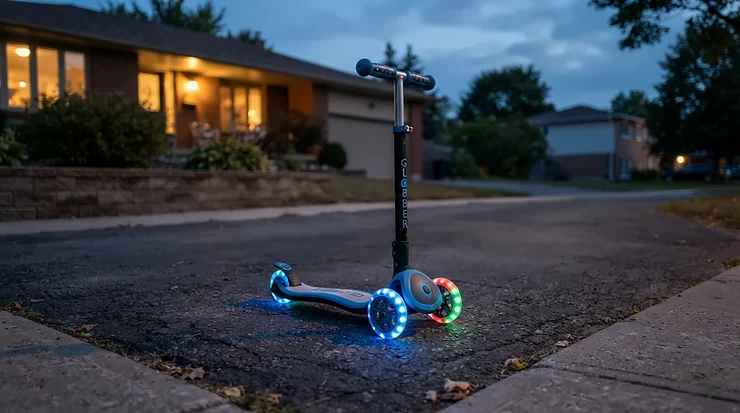
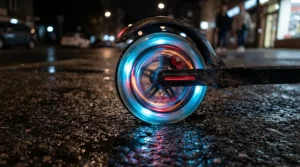
A light-up 3-wheel scooter is a child’s push scooter with two front wheels and one rear wheel, steered by leaning rather than twisting the handlebar, and fitted with LED wheels that glow as they spin. Most use motion-powered lighting instead of batteries, so the glow builds with speed, adding sparkle and a modest visibility boost.
Here’s the thing, though. Walk down any British pavement at 3.30pm and you’ll see dozens of scooters. The ones that make a toddler squeal are the ones that flash. That is the whole pitch of a light-up 3-wheel scooter, and it’s a surprisingly clever one: the same feature that delights a four-year-old (rainbow wheels!) also happens to be useful on gloomy October afternoons.
But “light-up” is not a synonym for “safe”, and a flashy wheel won’t fix a badly sized scooter. I haven’t tested any of these scooters myself. This guide is built from manufacturer specifications, UK retailer listings and published safety guidance gathered in October 2026. Where evidence was thin, I’ve said so rather than papering over it.
As RoSPA’s scooter factsheet points out, children’s scooters fall under the Toys (Safety) Regulations 2011 and shouldn’t be ridden on the road. That shapes everything below. We’ll cover seven real models, the truth about LED wheel batteries, evening/dusk visibility, and whether a 3-wheel scooter for girls differs from a 3-wheel scooter for boys (spoiler: only in colour).
Quick Comparison: Light-Up 3-Wheel Scooter Options at a Glance
| Scooter | Age Range | Lighting | Best For |
|---|---|---|---|
| Mini Micro Deluxe LED | 2-5 | Motion-powered LED wheels | Toddlers and nervous first-timers |
| Maxi Micro Deluxe LED | 5-12 | Induction-powered white LEDs | The long-haul family favourite |
| Globber Primo Plus Lights | 3+ | Dynamo LED wheels (red, green, blue) | Confidence-building with a steering lock |
| Globber Master Lights | 4-14 | Dynamo white LED wheels | Tall kids and fold-flat storage |
| Zinc Light Up Racecar | 3+ | Light-up wheels | Budget buyers who like a racing theme |
| Zinc T-Motion | 3+ | Light-up deck and wheels | Budget buyers who want deck glow |
| BELEEV A9 | 3+ (check listing) | Battery-free wheels plus battery-powered deck | Budget folding with extra effects |
Looking at the comparison above, the two Micro models and the Globber Master Lights are the “buy once, use for years” options, while the Zinc pair and the BELEEV A9 compete on price. If your child is under five, the Mini Micro Deluxe LED is the safest starting point on paper. For anyone expecting a growth spurt, the Globber Master Lights covers the widest age span of the seven.
💬 Just one click — help others make better buying decisions too!😊
Top 7 Light-Up 3-Wheel Scooters: Expert Analysis
Prices below are ranges only, and they move constantly, so check the current price before buying. Availability on amazon.co.uk also varies by colour and seller.
1. Mini Micro Deluxe LED — best first glow for toddlers
The headline trick is that the wheels only light up when your child is actually moving, which turns every wobbly push-off into a tiny light show.
Specs first, then meaning. It’s aimed at ages 2 to 5 and children up to about 110 cm tall, with UK listings quoting a 35 kg rider limit. Some overseas listings quote a higher limit, so trust the UK product page. The deck is short and low, so small legs reach the ground easily. The handlebar adjusts (one listing gives roughly 53-67 cm), and the whole scooter weighs just under 2 kg. That’s light enough for a parent to carry one-handed when the walk home turns ambitious. The wheels are motion-activated with no batteries, and Micro states conformity with EN 14619.
Based on the spec comparison, this is the one for a hesitant first-timer. Lean-to-steer means no fiddly handlebar turning. Retailer listings disagree on whether it has a rear brake, so verify that before buying.
On reviews, the listings I found carry very high star ratings. The review pools I could access were mostly non-UK and short on detail, so treat that as indicative only and check the live UK score.
Pros:
- ✅ Lean-to-steer suits wobbly first-time scooters
- ✅ Wheel lights need no batteries
- ✅ Around 2 kg, easy to carry
Cons:
- ❌ Premium price for a short age window
- ❌ Brake details vary between listings
Price: around £70-£90 (check current price). Micro advertises replaceable parts, which supports hand-me-down value, so it earns its premium if a sibling follows.

2. Maxi Micro Deluxe LED — best for the long haul (ages 5-12)
Where the Mini is about confidence, the Maxi Micro Deluxe LED is about longevity, with bright white wheel lights that survive years of playground abuse.
It’s rated for ages 5 to 12, riders up to 152 cm and a 50 kg limit. The scooter itself weighs about 2.5 kg. The handlebar range runs roughly 67-92 cm on one major UK retailer’s listing, which explains the long lifespan: it grows from a chunky Reception-aged child to a lanky Year 6. The footplate is reinforced fibreglass with silicone grip, and the wheels are non-marking polyurethane. Practically, that means it flexes without sagging and won’t leave scuffs on a hallway floor. The lights use induction rather than batteries, which Micro positions as helpful on dark school runs.
My read is that this is the best all-rounder if you’ll only buy one scooter. There’s also a separate Maxi Micro Deluxe Foldable LED listing with a one-click folding bar, handy for car boots.
For reviews, I couldn’t verify a robust UK sample. Check current UK ratings before committing.
Pros:
- ✅ Fifty-kilo limit covers many years of use
- ✅ Bright white lights suit evening/dusk visibility
- ✅ Reinforced deck resists flexing and slipping
Cons:
- ❌ Costs notably more than budget rivals
- ❌ White-only lights offer less rainbow novelty
Price: roughly £140-£215 depending on retailer and colourway (check current price). Spread over seven years of use, it’s good value despite the sticker shock.
3. Globber Primo Plus Lights — best steering lock for nervous starters
The standout is the steering lock: fix the front wheels straight and your child practises balance first, then releases the button to lean and steer.
It’s for ages 3+, with 121 mm LED front wheels that flash red, green and blue. They run on dynamo lighting, so the faster your child goes, the brighter they glow. The anodised aluminium T-bar has four heights (the quoted range is around 67-83 cm), and the scooter supports 110 lbs (about 50 kg). The listing gives a weight of around 2.33 kg and a low composite deck.
That lock is the clever bit. It’s a two-stage learning curve that suits cautious four-year-olds, and it means one scooter handles both “tentative” and “daredevil” phases.
Reviewer sentiment: I couldn’t verify a meaningful UK review sample for this exact model, so I’m not summarising what buyers say.
Pros:
- ✅ Steering lock builds balance before leaning
- ✅ Battery-free, brightening dynamo wheel lights
- ✅ Flashing colours add serious novelty
Cons:
- ❌ Handlebar tops out lower than Master Lights
- ❌ Warranty excludes wheels, brakes and other wear items
Price: broadly £60-£90, a notch below the Globber Master Lights, though retailers vary (check current price). It offers solid mid-range value for 3-to-6-year-olds.
4. Globber Master Lights — best for tall kids and tight storage
Foldable, wide-decked and built for children up to teenage years, the Globber Master Lights stretches the “kids’ scooter” idea further than most.
It’s listed for ages 4 to 14 with a 50 kg limit. The five-height T-bar runs from 74 to 94 cm, and the deck is extra-wide with EVA foam. Weight varies by retailer (roughly 2.6-3.1 kg, so verify). It also has the patented steering lock, a long rear brake and a push-button fold. The front wheels light up in white on dynamo power, and the scooter carries a two-year warranty (wear items excluded). Globber also says it uses around 25-28% recycled plastic.
The fold matters more than it sounds. In a small hallway or a car boot, a folding light-up 3-wheel scooter is the difference between “we’ll take it” and “we’ll leave it”. It’s also a good pick if you want a 3-wheel scooter for boys or girls approaching the tween years, since the sizing doesn’t look babyish.
Reviews: I couldn’t confirm a deep UK review base, so check live ratings.
Pros:
- ✅ Widest age span of the seven
- ✅ Folds for boots and hallways
- ✅ Wide deck gives older feet room
Cons:
- ❌ Listed weights vary between retailers
- ❌ Overkill for small toddlers
Price: around the £85-£110 range at the time of research (check current price). Strong value if it genuinely lasts a decade of childhood.
5. Zinc Light Up Racecar — best budget racing theme
Brand-new riders rarely need premium engineering, and the Zinc Light Up Racecar leans into theme over spec-sheet bragging.
The listing describes a lean-to-steer frame, light-up wheels, an anti-slip deck, easy-grip handles and a rear footbrake, with four handlebar heights for ages 3 and over. Retailers present it as a British brand’s budget-friendly option. Four heights is a decent growth allowance at this price, and a rear footbrake teaches the stopping habit early.
For a child who wants a scooter that looks like a toy car, this is an easy yes. What the listing didn’t state is a maximum rider weight, so confirm that on the box.
Reviews: the retailer listing I found had no reviews yet, so I can’t summarise buyer sentiment. That’s an honest gap, and a reason to check ratings first.
Pros:
- ✅ Four handlebar heights for growing kids
- ✅ Rear footbrake included
- ✅ Racing styling appeals to young riders
Cons:
- ❌ Rider weight limit unclear in listing
- ❌ Thin review evidence at time of research
Price: mid-£60s at the retailer I found (check current price). Fair value if the theme matters, though similarly priced rivals have more evidence behind them.

6. Zinc T-Motion — best budget pick with deck glow
If wheel lights are good, a glowing deck is better, at least in a four-year-old’s logic.
The Zinc T-Motion is listed with lean-to-steer, a light-up deck and wheels, three handlebar heights, an anti-slip footplate and a rear footbrake, for ages 3 and up. Three heights is fewer than the Zinc Light Up Racecar, so expect a slightly shorter lifespan. The deck lights add shine, but the listing doesn’t say whether they’re battery-powered, so check the manual for LED wheel batteries or deck cells.
My analysis: this is a “good enough” first scooter. Choose it if the deck glow is the deciding factor, otherwise the Racecar’s extra handlebar height is more practical.
Reviews: I found no verified review data for this exact model, so I won’t pretend to.
Pros:
- ✅ Light-up deck adds extra visual flair
- ✅ Rear footbrake for confident stopping
- ✅ Lean-to-steer helps balance learning
Cons:
- ❌ Only three handlebar heights
- ❌ Power source for deck lights unclear
Price: mid-£60s (check current price). Reasonable, if not remarkable, value.
7. BELEEV A9 — best budget folder with extra effects
The BELEEV A9 pairs battery-free wheels with a battery-powered deck light show, which makes it the flashiest budget option here.
Retailer descriptions (including Joybuy’s UK guide) present it as a folding 3-wheeler with lean-to-steer. Related BELEEV 3-wheel listings mention four handlebar heights, multiple light modes and a roughly 50 kg limit, but those details vary by listing, so confirm for the A9 specifically. The wheel lights run off motion, while the deck has its own power, meaning a small battery to replace eventually.
That split is the trade-off: more effects, but one more thing to maintain. Reviews of BELEEV’s wider range frequently praise the wheel lights, and one reviewer of a different model mentioned their child scooting around a darkened room just to see them glow. That’s novelty as motivation to ride in action, though it’s not review evidence for the A9 itself.
Pros:
- ✅ Folds for easy storage
- ✅ Battery-free wheel lights
- ✅ Extra deck lighting effects
Cons:
- ❌ Deck lights need batteries eventually
- ❌ Listing specs vary between retailers
Price: budget territory, usually below the Micro and Globber models (check current price). Good value if you accept the lower brand pedigree.
Specs Side by Side
| Scooter | Rider Limit | Handlebar | Folds? | Light Type | Price Range | Best For |
|---|---|---|---|---|---|---|
| Mini Micro Deluxe LED | 35 kg (UK listings) | Adjustable | T-bar detaches | Motion LED wheels | £70-£90 | Toddlers |
| Maxi Micro Deluxe LED | 50 kg | 67-92 cm | Foldable variant exists | Induction white LEDs | £140-£215 | Long-term use |
| Globber Primo Plus Lights | About 50 kg | 4 heights | Check variant | Dynamo RGB wheels | £60-£90 | Nervous starters |
| Globber Master Lights | 50 kg | 74-94 cm | Yes | Dynamo white wheels | £85-£110 | Tall kids |
| Zinc Light Up Racecar | Not stated | 4 heights | Not stated | Light-up wheels | £60-£70 | Budget theme |
| Zinc T-Motion | Not stated | 3 heights | Not stated | Deck and wheels | £60-£70 | Budget glow |
| BELEEV A9 | Check listing | Adjustable | Yes | Wheels plus battery deck | Budget | Folding value |
I’ve left out star ratings because they differ by retailer and change daily. Check them live. On price, the Zinc pair costs roughly what you’d pay for the Globber Primo Plus Lights, which has clearer published specs, while the Maxi Micro Deluxe LED costs about double the Globber Master Lights for similar published weight limits. The extra spend buys Micro’s reputation, replaceable parts and build detail, not extra lighting.
Your First 30 Days: Setting Up and Maintaining a Light-Up 3-Wheel Scooter
Amazon listings tell you what a scooter has. They rarely tell you how to keep it working. Here’s a practical routine.
Day one: setup that saves tears
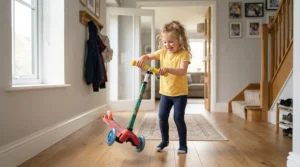
Fit the T-bar so the grips sit around your child’s waist to lower-chest height, not higher. A too-tall bar makes lean-to-steer twitchy. Tighten the clamp fully and re-check after the first ride. On the Globber Primo Plus Lights or Globber Master Lights, start with the steering lock engaged for the first few sessions. Practise in a flat, empty space away from traffic, and add a helmet.
Weekly checks
Lancashire County Council’s scooter top tips for parents recommends confirming that the steering is smooth, the wheels are stable and the brake works before riding. Add one light-up extra: spin each wheel and confirm the LEDs flicker. Wipe grit from the wheel hubs, because dirt is what shortens LED wheel life. If you have a BELEEV A9 or Zinc T-Motion with deck lights, test those too.
Mistakes in the first 30 days
- Letting a child ride downhill before they’ve mastered the brake.
- Storing the scooter wet in a damp garage.
- Skipping the clamp re-check.
- Buying a scooter far too big “to grow into”.
Fix these and a good light-up 3-wheel scooter will outlast the novelty.
Real-World Scenarios: Matching a Light-Up 3-Wheel Scooter to Your Family
Specs are abstract. Families aren’t. Here are three profiles, with reasoning.
The nursery-run family. A three-year-old, a half-mile pavement route three or four times a week, and a parent walking alongside. Budget around £70-£90. The Mini Micro Deluxe LED suits the age window and weight limit, and the motion-lit wheels help the little one feel proud rather than pushed. If funds are tighter, the Zinc Light Up Racecar works, though check the weight limit on the box.
The sibling hand-me-down household. A five-year-old now, a two-year-old in three years. Here, spend more once. The Maxi Micro Deluxe LED takes the older child to age twelve, and Micro’s replaceable-parts approach helps durability. Frequency of use is daily, so build quality matters more than novelty.
The small-flat, big-growth-spurt family. A seven-year-old who’s already tall, limited storage, and weekend park trips. The Globber Master Lights fits: fold it into the cupboard, unfold it for Saturday. The five-height T-bar handles a tall seven-year-old well.
How to Choose a Light-Up 3-Wheel Scooter
Choosing well takes six steps.
- Start with age and height, not looks. Manufacturer age ranges exist for a reason. A scooter too small gets outgrown fast, while one too big is hard to control.
- Check the rider weight limit. Fifty kilos is common in this group, but the Mini Micro Deluxe LED lists 35 kg on UK pages, so a heavier four-year-old could hit the ceiling.
- Look at handlebar range. More heights mean more years of use. The Globber Master Lights offers five.
- Decide on folding. If storage or boots matter, a folder like the BELEEV A9 or Master Lights is worth a premium.
- Understand the light system. Wheel LEDs powered by motion need no upkeep. Deck lights may need batteries.
- Confirm safety markings and warranty. Look for UKCA or CE marking, and read what the warranty excludes.
LED Wheel Batteries: Do You Actually Need Them?
Mostly, no, and that’s the point. On the Mini Micro Deluxe LED, Maxi Micro Deluxe LED and both Globber models, the wheels generate their own light as they spin, via a small magnetic core inside the hub. That means no LED wheel batteries to replace, no charging cable and no dead scooter on Christmas morning.
The catch is what that design implies. The lights glow only while the wheels turn, so a stationary scooter is dark, and slow riding is dimmer than fast riding. Manufacturers describe brightness rising with speed. Expect sparkle, not a torch.
Batteries come back when a scooter adds deck lighting, as on the BELEEV A9. Those effects need power, so the small battery compartment is something to check, ideally with a screwdriver handy. If LED wheel batteries sound like a hassle, choose wheels-only models.
Do these lights matter for features? They’re a nice extra, not the main event. A good deck, brake and handlebar range matter more than lighting, but when two scooters are otherwise equal, battery-free lights tilt the decision.
Evening/Dusk Visibility: What Light-Up Wheels Can and Can’t Do
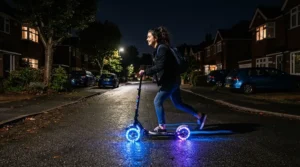
This is where marketing can mislead. Light-up wheels improve how conspicuous a child looks at the front and sides, because moving light draws the eye. The Maxi Micro Deluxe LED‘s bright white glow is a sensible example, and Micro describes its lights as helping on dark school runs.
But evening/dusk visibility is more than wheel sparkle. Wheel LEDs are not headlights. They don’t illuminate the path, they sit low, and they say little about your child’s rear profile. A child stopped at a kerb has no glow at all.
Mumsnet’s scooter safety guide suggests reflective stickers or a clip-on scooter light as extras. I’d add a reflective sash or hi-vis jacket, plus a rule that children stay close to an adult near roads and driveways.
So the practical formula for evening/dusk visibility is: lit wheels for the front and sides, reflective gear for the body, and an adult within arm’s reach. Treat the lights as a bonus layer, never the plan.
Novelty as Motivation to Ride: Does the Glow Get Children Moving?
Parents buy light-up scooters for safety and practicality. Children want them for the lights. Both are legitimate, and novelty as motivation to ride is arguably the most underrated feature on this list.
Think of the glow as a reward loop. A child pushes, the wheels flash, and the flash feels like feedback. That’s why the Globber Primo Plus Lights, with its red-green-blue flashing, may suit reluctant riders better than a plain white glow. It’s also why a BELEEV reviewer’s child scooted around a dark room: the lights were the game.
It matters because activity guidelines are demanding. UK guidance recommends preschoolers get at least 180 minutes of activity a day, and school-age children an average of 60 minutes of moderate-to-vigorous activity. If a flashing wheel turns a ten-minute dawdle into thirty minutes of scooting, that’s real value.
One honest caveat: novelty fades. By week six, lights alone won’t carry the habit. Durable build and a comfortable fit will, so don’t let novelty as motivation to ride override the basics. Pair the glow with fun routines like scooter races to the postbox.
✨ Don’t Miss These Exclusive Deals!
🔍 Take your scooter shopping to the next level with these carefully selected models. Click on any highlighted product to check current pricing and availability. These scooters will help you create evening adventures your family will love!
3-Wheel Scooter for Girls, 3-Wheel Scooter for Boys: Choose by Child, Not by Colour
Search results love dividing the world into pink and blue. The mechanics don’t care.
3-wheel scooter for girls
When shopping for a 3-wheel scooter for girls, ignore the marketing tag and check fit. The Maxi Micro Deluxe LED is sold in pink and purple options, the Globber Master Lights appears in light pink on John Lewis, and the BELEEV A9 is widely listed in pink. If your daughter loves pink, that’s an easy win, but a taller girl will still outgrow the Mini Micro Deluxe LED by size, not colour.
3-wheel scooter for boys
Likewise, a 3-wheel scooter for boys can be any model here. The Zinc Light Up Racecar in red and the Zinc T-Motion in blue lean towards traditional “boy” styling, while Globber offers sky-blue Master Lights. If he wants flashing, choose the Globber Primo Plus Lights.
The real deciding factors
Age, height, weight limit and storage matter far more than colour. Colour is a delight, not a spec, so let your child pick between equally suitable models and move on. A good 3-wheel scooter for girls and a good 3-wheel scooter for boys are exactly the same scooter in a different shade.
Light-Up 3-Wheel Scooter vs Plain 3-Wheel and 2-Wheel Alternatives
| Type | Stability | Light Features | Cost | Best For |
|---|---|---|---|---|
| Light-up 3-wheel | High, lean-to-steer | Wheel LEDs, sometimes deck lights | Mid to premium | Mini Micro Deluxe LED, Globber Primo Plus Lights |
| Plain 3-wheel | High | None | Lower | Tight budgets |
| Light-up 2-wheel | Lower | Wheel or stem lights | Mid | Older confident riders |
The light-up 3-wheel scooter sits in an appealing middle: it keeps the stability that makes 3-wheelers easier for under-sixes, while adding the novelty that plain versions lack. Joybuy’s guide describes 3-wheel designs as generally better for ages 3-5, and two-wheelers become more sensible as balance improves. For a seven-year-old comfortable on wheels, a 2-wheeler might be tempting, but a Globber Master Lights keeps three-wheel stability with older-child sizing.
On cost-per-use, the premium over a plain 3-wheeler is modest if the scooter lasts. Spread across years, the Maxi Micro Deluxe LED can work out cheaper per ride than a budget scooter replaced twice.
Common Mistakes When Buying a Light-Up 3-Wheel Scooter
- Buying on lights alone. Flashing wheels don’t compensate for a poor deck or a limited handlebar range.
- Ignoring the weight limit. The Mini Micro Deluxe LED has a lower UK limit than some assume.
- Trusting overseas specs. Listings differ across countries, and the UK page is the authority.
- Skipping helmets. RoSPA suggests parents consider buying a helmet when buying a scooter.
- Assuming lights equal visibility. As covered above, evening/dusk visibility needs reflective gear and supervision.
Safety, Regulations and Where to Ride
In Great Britain, children’s scooters count as toys under the Toys (Safety) Regulations 2011, which set essential safety requirements and require conformity marking. As of this research, look for UKCA or CE marking on the product or packaging, noting that marking rules have shifted since Brexit, so check current gov.uk guidance. RoSPA also references EN 71, the toy safety standard. Micro states its Mini Micro Deluxe range conforms to EN 14619, the standard for scooters.
Where to ride matters as much as what. RoSPA advises against using scooters on the road. Stick to parks, quiet paths and pavements where permitted, and teach children to dismount at kerbs and walk across. Avoid hills until the brake is mastered, because scooters pick up speed faster than parents expect.

FAQ
❓ What age is a light-up 3-wheel scooter suitable for?
❓ Can my child ride a light-up 3-wheel scooter on the road in the UK?
❓ Are the light-up wheels replaceable if they stop working?
❓ Which light-up 3-wheel scooter is best for a three-year-old?
❓ Is a folding light-up 3-wheel scooter worth paying more for?
Conclusion
Let’s land this. If your child is under five, the Mini Micro Deluxe LED is the safest bet on paper, with lean-to-steer, a small deck and motion-powered lights. If you want one scooter for years, the Maxi Micro Deluxe LED or the Globber Master Lights deliver the longest lifespan, with the Master adding folding. The Globber Primo Plus Lights is the confidence-builder, thanks to that steering lock. And if budget rules, the Zinc Light Up Racecar, Zinc T-Motion and BELEEV A9 make sense, provided you verify the missing specs and check live reviews.
Whichever you pick, remember what the lights can and can’t do. They add joy, motivation and a visibility boost at dusk, but they don’t replace helmets, reflective clothing or an adult nearby. Choose by height and weight, ignore the pink-or-blue marketing, and let the glow do what it does best: get your child outside.
✨ Ready to light up your child’s next adventure?
Click through, check current prices and pick the scooter that fits your family best! 🛴
Recommended for You
- 3-Wheel Scooter For Toddlers: 7 Best Safe Picks For UK (2026)
- Top 3-Wheel Scooters Under £30: 7 Brilliant Picks (2026)
- Folding Micro Scooter: 7 Best Picks For UK Riders (2026)
Disclaimer: This article contains affiliate links. As an Amazon Associate, I earn from qualifying purchases. If you purchase products through these links, we may earn a small commission at no additional cost to you.
✨ Found this helpful? Share it with your friends! 💬🤗
