In This Article
A 3-wheel scooter for toddlers is a low-deck, push-along scooter for children of roughly two to five, with a stable three-point stance and usually a rear foot brake. Most let a child steer by leaning rather than wrestling a handlebar, so first rides are far less wobbly than on two wheels.
Why bother? The NHS says pre-schoolers should get at least 180 minutes of physical activity a day, including an hour of moderate-to-vigorous effort, and that under-fives shouldn’t sit still for long stretches while awake. The full breakdown is in the NHS physical activity guidelines for under-5s. A scooter turns the school run, the park dash and the dreaded “I’m bored” hour into exactly that kind of activity.
Here’s the catch. Search for a 3-wheel scooter for toddlers and you’ll drown in near-identical listings: light-up wheels, pastel decks, “ages 2+” splashed everywhere. Some are brilliant. Some carry a 20kg rider limit that a sturdy four-year-old will sail past. Some whisper “3+” in the small print while the headline shouts “toddler”.
This 3-wheel scooter review compares seven real models on stability, age suitability, weight limits, adjustability and long-term value. It pays special attention to what suits a 3-wheel scooter for 2 year old riders, who are the trickiest age to buy for.
A note on honesty: this is desk research. It draws on manufacturer specifications and aggregated published reviews, not a diary of hands-on testing. Where reliable reviews were thin, I say so. With second birthdays and Christmas looming, that should save you a few evenings of tab-hopping.
Quick Comparison: The Best 3-Wheel Scooter for Toddlers at a Glance
Think of this as your cheat sheet before the detail. Ages and weight limits are the makers’ own figures, and prices are indicative ranges from retailer listings at the time of research. Check current price before you buy.
| Scooter | Maker’s stated age | Max rider weight | Key feature | Price range | Best For |
|---|---|---|---|---|---|
| Mini Micro Deluxe LED | 2-5 years | 35kg | Lean-to-steer, about 2kg | Around £80-£100 | Best all-rounder |
| Micro Mini2Grow Deluxe LED | From about 12 months | Check listing | Seat converts to scooter | Around £110-£130 | One purchase, ages 1-5 |
| Globber Junior Foldable | 2+ | 50kg | Steering lock, folds | Around £50-£75 | Nervous first-timers |
| Oxelo B1 500 | 2-5 (80-120cm) | Check listing | 2.3kg, light-up wheels | Around £40-£60 | Budget-conscious families |
| Chillafish Scotti Glow | 3+ | 50kg | Removable handlebar | Around £45-£60 | Steady, nearly-three riders |
| Paw Patrol Tri-Lite | Check pack | 20kg | Character theme, wheel lights | Around £35-£45 | Character-motivated light riders |
| Globber Go Up Foldable Plus Lights | 15-36 months (ride-on) | 20kg ride-on, 50kg scooter | Three modes in one | Around £90-£115 | Youngest toddlers |
Looking at the comparison above, the Mini Micro Deluxe LED is the safest all-round bet for ages two to five. The Globber Junior Foldable justifies its lower price range for families who want a steering lock and a folding frame. If your child is closer to 15 months, the convertible Micro Mini2Grow Deluxe LED or Globber Go Up Foldable Plus Lights make more sense. Budget buyers should note that the Paw Patrol Tri-Lite lists a 20kg rider limit, so check your toddler’s weight and the minimum recommended age on the pack before the characters win you over.
💬 Just one click — help others make better buying decisions too!😊
Top 7 3-Wheel Scooter for Toddlers: Expert Analysis
The best 3-wheel scooter for toddlers depends on your child’s age, confidence and weight, so these seven span premium to budget and “barely walking” to “ready to race the pigeons”. Each entry turns the spec sheet into everyday meaning, using real specifications and published review themes.
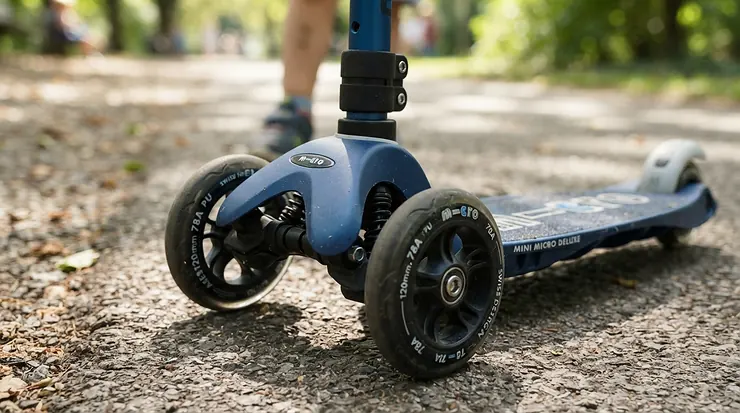
1. Mini Micro Deluxe LED — the benchmark for lean-to-steer stability
The big draw is a deck-and-T-bar design that lets a toddler steer by tilting their body. That is lean-to-steer stability in its purest form.
Micro rates the Mini range for ages two to five. The Deluxe carries riders up to 35kg while weighing just under 2kg itself. That featherweight frame means a two-year-old can drag it up a kerb or into the hallway without a parental rescue mission, while the weight limit stretches well into reception age. The handlebar adjusts from roughly 49cm to 68cm, so smaller toddlers start low and grow into it. The LED wheels light from motion alone, so there are no batteries to replace.
Based on the spec comparison, this suits families who want one purchase to last two or three years, then pass it to a sibling. Micro also sells replacement parts across the scooter, which is rare at this level.
Reviewers consistently describe it as well balanced and hard to tip, and a Mumsnet review noted that a toddler tester managed the rear footbrake. The recurring caveat in the roundups I read is the premium over rivals.
Pros:
- ✅ Intuitive lean-to-steer ride from the first push
- ✅ Feather-light at around 2kg
- ✅ Replaceable parts extend its working life
Cons:
- ❌ Costs noticeably more than budget rivals
- ❌ Doesn’t fold, so storage is bulkier
Expect around £80-£100 at the time of research; prices may vary. It’s dearer upfront, but the cost per year falls sharply if it gets handed down.

2. Micro Mini2Grow Deluxe LED — one purchase from 12 months to scooting
This is a scooter that begins life as a seated ride-on and sheds its attachments as your child develops. Underneath sits the familiar Mini Micro scooter.
Micro describes it as suitable from around 12 months, with motion-powered LED wheels, a silicone anti-slip deck, an adjustable handlebar and a responsive rear brake. In practice, the seated stage lets a very young toddler get comfortable with the object before any scooting is expected. The later stages then use the same lean-to-steer chassis as the Deluxe, so there’s no re-learning when the seat comes off.
The honest trade-off is that you pay for stages you may skip. A confident two-and-a-half-year-old won’t touch the seat. I couldn’t verify a clear weight limit for each seated stage, so check the maker’s listing before buying. It’s the one to consider if you’d otherwise buy a ride-on toy now and a scooter in a year.
Independent reviews of this specific variant were thin in my research. The underlying Mini Micro design is widely praised, but treat the convertible parts as “likely fine” rather than proven.
Pros:
- ✅ Grows from ride-on to proper scooter
- ✅ Same lean-to-steer chassis as the Deluxe
- ✅ Motion-powered wheel lights, no batteries
Cons:
- ❌ Highest upfront cost in this round-up
- ❌ Seat stages are wasted on confident two-year-olds
Around £110-£130. It’s good value only if you’ll genuinely use the early stages.
3. Globber Junior Foldable — a steering lock for nervy first-timers
Globber’s party trick is a patented button that fixes the front wheels so they roll only forwards and backwards, then releases when your child is ready to steer themselves.
The Junior is made for ages two and up, with a three-height aluminium T-bar (54, 61 and 68cm from the ground), a 50kg rider limit and a folding frame. It weighs roughly 2.5-3kg depending on version, with larger front wheels (around 121mm) and a smaller 80mm rear wheel. UK retailer listings also quote a two-year manufacturer’s guarantee.
On paper, the lock suits a toddler who panics the first time the scooter tilts. It behaves more like a stable sled, and it makes parent-assisted riding easier because there’s less wobble to correct. The catch is that locked mode doesn’t teach leaning. You’ll need to unlock it eventually, or your child will never meet real lean-to-steer stability.
I found plenty of manufacturer and retailer material but little independent review coverage I could verify. Call it “promising on paper”.
Pros:
- ✅ Steering lock calms hesitant first rides
- ✅ Folding frame suits small hallways and boots
- ✅ 50kg limit and three heights offer longevity
Cons:
- ❌ Heavier than the Micro options
- ❌ Limited independent reviews to confirm durability
Around £50-£75, with light-up versions at the upper end. Good value for cautious riders.
4. Oxelo B1 500 — Decathlon’s budget-friendly beginner
This one is built for the smallest riders. Decathlon pitches it at children between 80cm and 120cm tall, roughly ages two to five.
It weighs about 2.3kg, with four handlebar positions (45-66cm measured from the deck, not the ground), 125mm front and 100mm rear wheels, and light-up wheels. Decathlon states EN 71 compliance and a two-year warranty excluding wearing parts such as wheels and bearings. Those chunky front wheels should roll over pavement cracks better than the tiny wheels on cheap toy scooters. Decathlon also says it developed the steering with a physiotherapist, which is a marketing claim, though the geometry is clearly aimed at beginners.
Its practical advantage is retail backup. Decathlon says its workshops can order spare parts, which is handy if a wheel wears out. Some markets list it as folding, so confirm that on the UK listing.
I couldn’t verify a meaningful pool of independent UK reviews, so this recommendation rests on specifications, not proven long-term durability.
Pros:
- ✅ Four handlebar positions suit very small toddlers
- ✅ Light at roughly 2.3kg
- ✅ Spare parts available through Decathlon workshops
Cons:
- ❌ Few independent reviews confirm durability
- ❌ Compact 30cm deck may be outgrown sooner
Around £40-£60. Strong value if the specifications hold up.
5. Chillafish Scotti Glow — the stylish step-up for nearly-threes
Scotti Glow stands out for its tool-free removable handlebar and a twin-tip deck with an integrated rear brake. It also comes fully assembled out of the box.
One honest flag first: Chillafish recommends it for ages three and up, so on the maker’s own advice it isn’t a 3-wheel scooter for 2 year old riders. At least one UK retailer listing even carries a small-parts warning for under-threes. Where it shines is longevity. The handlebar runs from 52cm to 72cm, and the 50kg rider limit is generous. It weighs roughly 3-3.7kg depending on the listing, with ABEC-5 bearings and battery-free LED wheels.
Pop the handlebar off and it becomes a carry-along deck, useful for boots and buggy shelves. Pair that with a child who’s nearly three and steady on their feet and it’s a smart, stylish pick. Respect the minimum recommended age rather than pushing it.
A UK specialist roundup flagged it as a strong budget option for young riders. One UK retailer showed a 4.5/5 rating, but from only two reviews, so treat that as anecdote.
Pros:
- ✅ Tool-free removable handlebar for easy storage
- ✅ 50kg limit and 72cm top height for longevity
- ✅ Smooth bearings and light-up wheels
Cons:
- ❌ Maker’s minimum recommended age is three
- ❌ Heavier than the lightest Micro alternatives
Around £45-£60. Good value for a child at or above the stated age.
6. Paw Patrol Tri-Lite — character appeal for lighter riders
If a toddler’s motivation comes from cartoon pups, this is the one that gets them out of the door. It has motion-activated wheel lights, an anti-slip footplate, soft moulded grips, an adjustable handlebar and puncture-proof tyres.
The detail that matters is the listed maximum user weight of 20kg. That’s fine for a small two- or three-year-old, but a sturdy child will outgrow it quickly, so it’s a short-term scooter by design. The puncture-proof tyres mean no pumps and no flats, which is a quiet win for anyone who’s ever fixed a toy tyre at 7am. I couldn’t find a verified minimum age on the listings I reviewed, so check the pack before buying.
Reviewer coverage was limited, and I couldn’t verify a meaningful pool of independent reviews. The appeal rests on the price and theme, not a proven durability record.
Pros:
- ✅ Character theme motivates reluctant riders
- ✅ Puncture-proof tyres mean zero upkeep
- ✅ Lowest price range in this round-up
Cons:
- ❌ 20kg rider limit shortens its lifespan
- ❌ Little independent evidence on durability
Around £35-£45. A sensible starter, but the short working life limits its value.
7. Globber Go Up Foldable Plus Lights — three modes for the youngest riders
This is less a first scooter than a growing-up kit, switching between ride-on, walking bike and scooter at the push of a button.
The ride-on and walking-bike modes are listed for roughly 15 to 36 months, with a 20kg limit in those modes and 50kg in scooter mode. There’s a three-height T-bar, a two-height seat, a steering lock, light-up front wheels and a folding frame. Weight ranges from about 2.5kg to 3.6kg depending on configuration. The listed scooter handlebar range is tall (around 67.5-77.5cm), which signals that scooter mode suits a bigger child than a tiny two-year-old.
So the early value here is the ride-on and walking-bike stages. Think of it as a convertible that eventually becomes a scooter, not a scooter that’s tiny-toddler-ready on day one. That suits parents who want something their 18-month-old can use now.
Independent coverage was limited, and retailer descriptions lean heavily on the safety-lock feature.
Pros:
- ✅ Three modes extend its useful lifespan
- ✅ Steering lock builds early confidence
- ✅ Folds for storage and travel
Cons:
- ❌ Scooter-mode handlebar is tall for small toddlers
- ❌ Ride-on mode capped at 20kg
Around £90-£115. Good value only if you’ll use the ride-on stages.
Spec Showdown: 3-Wheel Scooter Review Table
| Scooter | Stated age | Max rider | Handlebar range | Review depth | Best For |
|---|---|---|---|---|---|
| Mini Micro Deluxe LED | 2-5 | 35kg | About 49-68cm | Strong | Hand-me-down durability |
| Micro Mini2Grow Deluxe LED | From about 12 months | Check listing | Adjustable | Moderate (base model) | Earliest starters |
| Globber Junior Foldable | 2+ | 50kg | 54/61/68cm from ground | Limited | Wobble-prone beginners |
| Oxelo B1 500 | 2-5 (80-120cm) | Check listing | 45-66cm above deck | Limited | Tight budgets |
| Chillafish Scotti Glow | 3+ | 50kg | 52-72cm | Moderate/limited | Steady, nearly-three riders |
| Paw Patrol Tri-Lite | Check pack | 20kg | Adjustable | Limited | Light, theme-driven riders |
| Globber Go Up Foldable Plus Lights | 15-36 months (ride-on) | 20kg / 50kg | 67.5-77.5cm (scooter) | Limited | Under-twos |
The review depth column is the honest bit. Only the Mini Micro Deluxe LED family has a strong, consistent review trail in the sources I checked, which is part of why it tops this 3-wheel scooter review. Handlebar minimums matter most for smaller riders, but measure carefully because the Oxelo B1 500 measures from the deck while the others measure from the ground.
Parent-Assisted Riding: Your First-30-Days Guide
Parent-assisted riding isn’t cheating. It’s scaffolding, and it’s what turns a scooter that gathers dust into one that gets begged for every morning. Here’s a simple month-long plan for any 3-wheel scooter for toddlers.
Days 1-3: stand, don’t scoot. Indoors or on a smooth patio, let your child stand on the deck while you steady the scooter. The goal is simply to feel the deck underfoot.
Days 4-10: walk and glide. Hold your child at the shoulders or hand, not by the handlebar, which tugs the steering the wrong way. Keep sessions to 10-15 minutes. Toddlers tire quickly and bad habits form when they’re exhausted.
Days 11-20: one-foot pushing. Stay alongside as they push off. Introduce the rear brake by saying “step on the back” every single time.
Days 21-30: short solo glides. Choose a flat, smooth park path, away from roads and driveways. UK parenting experts commonly advise practising in parks before pavements.
Throughout, RoSPA’s scooter safety advice is a sensible starting point for kit and supervision.
Common first-month mistakes: setting the handlebar too high (aim for roughly tummy-button height), going straight to busy pavements, marathon sessions, and skipping the helmet because “we’re only going round the garden”. Parent-assisted riding works best when it’s short, frequent and relaxed.
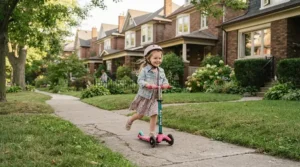
Real-World Scenarios: Matching a Scooter to Your Toddler
Specs are abstract. Here are three typical UK family situations and the picks they point to.
Scenario 1: the flat-dweller with a buggy. You live in a third-floor flat, a stairwell separates you from the pavement, and your two-year-old is nervous. Budget is around £50-£75. A folding frame and a steering lock matter more than a long warranty here, so the Globber Junior Foldable fits. Use it two or three times a week, locked at first, unlocking after a few weeks of parent-assisted riding.
Scenario 2: the hand-me-down household. You’re buying for a second birthday with a younger sibling following. You’ll spend £80-£100 if it lasts. The Mini Micro Deluxe LED, with its replaceable parts and 35kg limit, is built for exactly that. Daily use on a garden path or school run suits it well.
Scenario 3: the early starter. Your 15-month-old watches big siblings scoot and wants in. The Micro Mini2Grow Deluxe LED or Globber Go Up Foldable Plus Lights let them start seated, then graduate. Budget is higher, around £90-£130, but you’re buying several stages.
For a tighter budget and a confident child, the Oxelo B1 500 is worth a look. A character-obsessed three-year-old under 20kg might actually ride more on the Paw Patrol Tri-Lite. Motivation counts as a spec too.
How to Choose a 3-Wheel Scooter for Toddlers
Follow these seven steps to find the right fit.
- Check the minimum recommended age. If a maker says 3+, believe it. It reflects balance and coordination, not just a marketing number.
- Measure your child. Handlebar minimums matter most for small two-year-olds, who should hold the bar around tummy-button height.
- Check weight limits. A 20kg cap means a short lifespan, while 35-50kg lasts years.
- Choose your steering style. Pure lean-to-steer builds skill, while a lock builds confidence first. Some scooters offer both.
- Prioritise a rear brake. Look for one a toddler’s foot can find without thought.
- Think about weight. Anything much above 3kg becomes a burden for a small child to lift or drag.
- Consider parts and warranty. Replaceable parts and a two-year guarantee are worth paying for.
Every 3-wheel scooter review will give you a different winner, so match the scooter to your toddler rather than to a headline.
✨ Ready to Find the Right Fit?
🔍 Take your toddler’s first scooting adventures to the next level with these carefully selected picks. Click on any highlighted item to check current pricing and availability. These scooters will help you create confident, happy rides your whole family will love! 🛴
Lean-to-Steer Stability vs Steering Lock: What Really Matters
Lean-to-steer stability and steering locks look like rivals, but they’re really two stages of the same learning curve.
Lean-to-steer means the front wheels are linked to a tilting mechanism, so shifting body weight turns the scooter. Micro says this builds balance, coordination and core strength, which is a maker’s claim, but the mechanical logic is sound. The scooter is steered by the whole body, not just the hands. Because three wheels stay upright without rider input, a toddler can practise this safely.
A steering lock suits the child who freezes the moment the deck tilts. With the front wheels fixed, the scooter rolls straight, so your child learns pushing and braking first. It also makes parent-assisted riding easier, because there’s less steering to correct.
My analytical take: choose a scooter with lean-to-steer stability from the start if your child is confident. Choose a lock if they’re cautious, but commit to unlocking it, or the skill never develops. Whichever you choose, check that the deck is wide and low enough to keep both feet planted.
Minimum Recommended Age: Is a 3-Wheel Scooter for 2 Year Old Realistic?
Yes, for many children, but “age 2” is a proxy, not a guarantee. The minimum recommended age printed on a box is the maker’s judgement of when a typical child has the balance, strength and coordination to cope.
Across the models here, stated minimums vary. The Mini Micro Deluxe LED and Oxelo B1 500 say two. The Globber Junior Foldable says two and up. The Chillafish Scotti Glow says three. The convertibles start earlier because they begin as seated ride-ons.
For a 3-wheel scooter for 2 year old riders, look for these readiness signs:
- Walks steadily and runs without constant tumbles.
- Can stand on a flat surface holding a support for a few seconds.
- Follows simple instructions like “stop” or “brake”.
- Tall enough to hold the handlebar at about tummy height.
If you’re unsure, start with a convertible or wait a few months. Pushing a child onto a scooter they’re not ready for ends in frustration, not skill. And remember that a 3-wheel scooter for 2 year old use always needs close, hands-on supervision, whatever the stability claims say.
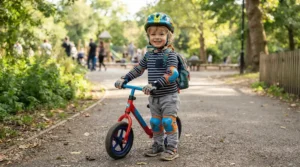
3-Wheel Scooter for Toddlers vs Balance Bike and Trike
Many parents wonder if a scooter is the right first wheeled toy at all. Here’s how the three compare.
| Feature | 3-wheel scooter | Balance bike | Trike |
|---|---|---|---|
| Typical start age | About 2 (some earlier) | About 18 months-2 | About 18 months+ |
| Learning curve | Gentle, lean-to-steer | Steeper balance learning | Very gentle |
| Portability | Often light and foldable | Bulky | Bulkiest |
| Speed potential | Moderate | Higher | Low |
| Best For | Short trips, park sessions | Future cyclists | Youngest riders, parent-pushed |
A scooter gives quick independence and is easy to carry, which is why it wins on school-run logistics. A balance bike teaches the skills closest to cycling, and one specialist retailer observes that children who start on scooters sometimes resist balance bikes, which is a single viewpoint rather than proven fact.
Looking at the table above, a scooter suits families who want portability and short, frequent outings. A balance bike suits parents with cycling ambitions. And a trike suits the youngest riders who need to be pushed.
Safety, Helmets and UK Regulations
Scooters are fun, but toddlers fall a lot. Treat safety as part of the purchase.
Kit. A well-fitted helmet is the minimum. Mumsnet’s scooter safety guide also recommends knee and elbow pads, and consistent supervision near roads and driveways. Reflective stickers or a small light help visibility.
Markings. New toys sold in Britain fall under the Toys (Safety) Regulations 2011, and the CE or UKCA mark is the maker’s declaration that the toy meets them. The gov.uk guidance on the Toys (Safety) Regulations 2011 explains the rules. Oxelo states EN 71 compliance for the Oxelo B1 500, and the same marking is worth looking for on the others. Skates and skateboards require a protective-equipment warning, so look for similar wording on scooters.
Second-hand. Used toys fall under the General Product Safety Regulations 2005 rather than the toy rules, so they don’t need a CE or UKCA mark, but they must still be safe. Check for cracks, sharp edges and loose play before buying.
Practice. Keep early sessions flat and away from traffic. Parent-assisted riding on park paths remains the safest way to learn, and a good 3-wheel scooter review will always repeat this: stability helps, but supervision is what really keeps a toddler safe.
Long-Term Cost & Maintenance
Price on the day is only half the story. A scooter’s cost per year of use tells you far more.
Take a premium model at around £80-£100 that lasts three years: that’s about £27-£33 a year, and less if a sibling inherits it. A budget model at £35-£45 that lasts one year costs more per year of use. That’s why the Mini Micro Deluxe LED, with its replaceable parts and 35kg limit, can beat cheaper scooters over time. The Paw Patrol Tri-Lite, with its 20kg cap, shows the opposite risk.
Warranties matter too. Decathlon quotes two years on the Oxelo B1 500 excluding wearing parts, and UK retailer listings quote two years for the Globber Junior Foldable. Micro sells spare parts so you can repair rather than replace.
Maintenance is simple. Keep the scooter indoors, because a UK expert quoted in a roundup warned that damp can rust the bearings. Wipe the deck, check bolts monthly, and replace worn wheels. A good 3-wheel scooter review should always weigh the cost per year, not just the ticket price.

Frequently Asked Questions
❓ Can I fold a 3-wheel scooter for toddlers to fit in a boot?
❓ Are LED wheels worth paying extra for?
❓ How tall should the handlebar be?
❓ Where can I get spare parts for a toddler scooter?
❓ Is a second-hand 3-wheel scooter for toddlers safe to buy?
Final Verdict: Choosing the Right 3-Wheel Scooter for Toddlers
So which one should you buy? For most UK families, the Mini Micro Deluxe LED is the safest bet, with the strongest review trail, long life and genuine lean-to-steer stability. If your child is cautious, the Globber Junior Foldable adds a steering lock and a folding frame at a lower price range. Younger riders suit the convertible Micro Mini2Grow Deluxe LED or Globber Go Up Foldable Plus Lights. Budget buyers can look at the Oxelo B1 500, though independent reviews are thin. The Chillafish Scotti Glow is best saved for a child at or near three, and the Paw Patrol Tri-Lite works as a short-term, theme-driven starter for lighter riders.
Whatever you pick, respect the minimum recommended age, start with parent-assisted riding on flat paths, and treat a helmet as non-negotiable. A 3-wheel scooter review can narrow your options, but your child’s confidence, size and temperament make the final call.
✨ Ready to Choose?
🔍 Take your toddler’s first scooter ride to the next level with these carefully selected picks. Click on any highlighted item to check current pricing and availability. These scooters will help you create happy, confident adventures your family will love! 🛴
Recommended for You
- Top 3-Wheel Scooters Under £30: 7 Brilliant Picks (2026)
- Folding Micro Scooter: 7 Best Picks For UK Riders (2026)
- Micro Scooter For School Run: 7 Best Picks (2026 Guide)
Disclaimer: This article contains affiliate links. As an Amazon Associate, I earn from qualifying purchases. If you purchase products through these links, we may earn a small commission at no additional cost to you.
✨ Found this helpful? Share it with your friends! 💬🤗
