In This Article
There’s a particular kind of silence that falls over a garden the moment a toddler discovers they can move a truck-shaped object using their own two legs. It lasts about four seconds. Then comes the horn honking, the gravel-crunching, and the increasingly confident demand to be let loose on the driveway unsupervised.
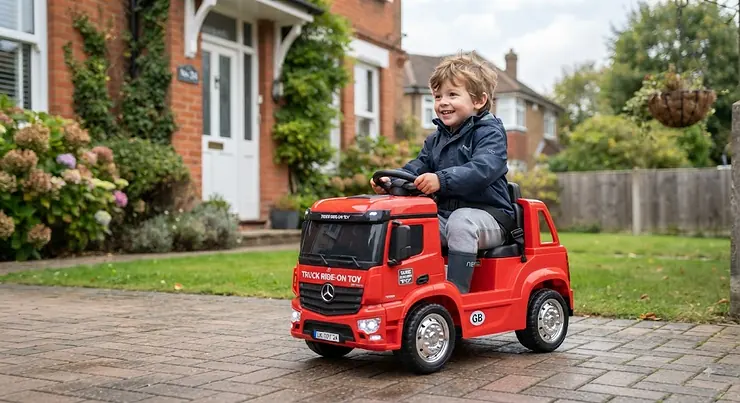
Before any of that, though, there’s the actual buying decision, and it’s more layered than it looks. A truck ride-on toy is a wheeled play vehicle styled like a lorry, dumper, or construction truck, designed for a child to sit in and move either by foot power, pedals, or a small electric motor, typically aimed at toddlers and preschoolers developing balance and coordination. That single category covers everything from a £30 plastic scoot-along to a £200 battery-powered dump truck with a working tipping bed, and the right answer depends far more on your child’s age and your garden than it does on brand recognition.
This guide breaks down seven genuine truck-style ride-ons available through Amazon UK, drawn from real product listings, real specifications, and honestly framed aggregated review sentiment rather than a rewritten features list. We’ll also work through the questions that come up constantly once you start shopping: whether a push-along car ride-on or a pedal car suits your child better right now, what actually makes a construction-themed toy worth the extra cost over a plain car shape, and how a truck ride-on toy fits into a wider outdoor play equipment set-up rather than sitting there as an isolated purchase.
Prices throughout are given as ranges rather than exact figures, since listing prices shift regularly — always check the current price before buying.
Truck Ride-On Toy at a Glance
| Product | Best For | Power Type | Price Range |
|---|---|---|---|
| Rolly Toys JCB Dumper | Durable outdoor pedal play, ages 2½-5 | Pedal | £90-£130 |
| HOMCOM 3-in-1 Ride On Excavator Toy | First-time toddler foot power | Foot-to-floor | £30-£50 |
| Little Tikes Cozy Ice Cream Truck | Younger toddlers, parent-pushed | Push-along/foot-to-floor | £70-£100 |
| DOLU Pedal Operated Ride On Tractor | Budget outdoor pedal option | Pedal | £40-£60 |
| COSTWAY Caterpillar Ride On Tractor | Licensed construction play, budget | Foot-to-floor | £40-£65 |
| HOMCOM 12V Electric Ride On Truck (UTV) | Two children, garden and grass | Electric (12V) | £150-£220 |
| AIYAPLAY Ride On Tractor with Trailer | Electric alternative, hauling play | Electric (12V) | £120-£180 |
The spread here tells its own story: power source is really the first fork in the road, well before brand or styling. Foot-to-floor and pedal options like the HOMCOM 3-in-1 Ride On Excavator Toy and DOLU Pedal Operated Ride On Tractor demand more from the child physically, which is exactly the point for gross motor development, while electric options like the HOMCOM 12V Electric Ride On Truck trade that physical effort for speed, novelty features, and a higher price tag. The Rolly Toys JCB Dumper sits in an interesting middle ground — pedal-powered but built to last years of garden abuse, which explains why it commands a premium over cheaper foot-to-floor plastics.
💬 Just one click — help others make better buying decisions too!😊
Top 7 Truck Ride-On Toy: Expert Analysis
1. Rolly Toys JCB Dumper — best durable pedal truck for years of outdoor use
The standout feature here is longevity by design: this is a chain-driven, licensed JCB dumper with a genuinely working tipping bucket, built from a German manufacturer with over eighty years in children’s pedal vehicles, and it shows in the engineering rather than just the paint job.
Specs worth interpreting properly: the chain-drive pedal mechanism transfers power more efficiently than the simple foot-to-floor gearing found on cheaper trucks, meaning less effort per push for a similar speed, while the anti-slip pedals and rugged wheels are specifically engineered for driveways, patios, and grass rather than smooth indoor flooring alone. Rated for children aged two and a half to five, it’s built with enough headroom in that range to genuinely last through several growth spurts rather than being outgrown within a season.
Based on the spec comparison with the plastic foot-to-floor options on this list, the trade-off is upfront cost against multi-year durability — pedal-driven mechanisms with a working tipping bucket cost more to manufacture than a simple push-along shell, and that cost is passed on directly. This is best suited to families expecting genuine daily outdoor use rather than occasional indoor play.
Reviewers consistently note the toy’s sturdiness as the headline positive, with the listing carrying several hundred ratings and a strong average score — a solid review base by category standards, lending real confidence beyond marketing copy alone.
Pros:
- ✅ Genuine working tipping bucket for pretend construction play
- ✅ Chain-drive pedal mechanism built for outdoor surfaces
- ✅ Strong, well-established review base for confidence
Cons:
- ❌ Higher upfront cost than foot-to-floor alternatives
- ❌ Assembly required and a heavier unit to store
At around £90-£130, it’s a premium pick, but one that genuinely earns its price through build quality rather than branding alone.
2. HOMCOM 3-in-1 Ride On Excavator Toy — best first ride-on for toddlers just starting out
HOMCOM 3-in-1 Ride On Excavator Toy leans into a genuinely useful design choice for the youngest riders: it doubles as a walker and a construction ride-on, meaning a child who isn’t yet confident enough to sit and scoot can use it to practise walking with support first.
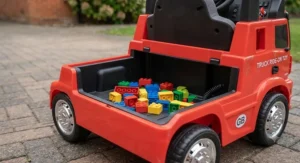
The 90-degree rotating digger body and manually operated bucket are the specific features worth flagging — rather than being purely decorative, the arm genuinely moves and lifts, giving toddlers a tactile cause-and-effect experience that a static plastic truck shape doesn’t offer. The under-seat storage basket doubles as sand or water play storage, which is a nice bit of multi-use design for garden play specifically.
What most buyers overlook about no-power, foot-to-floor toys at this price point is that the lack of pedals or batteries isn’t a downside for very young children — it’s the appropriate level of complexity for 18 to 48 months, when fine motor control for pedalling genuinely isn’t developed yet. On paper this means the toy is correctly matched to its stated age range rather than being an underpowered version of something more advanced.
Aggregated feedback on this style of budget toddler ride-on generally centres on value for money and the anti-fall design at the base, which prevents tipping during the early, wobblier stages of use — a genuinely reassuring detail for first-time parents.
Pros:
- ✅ Doubles as a walker for very young or unsteady toddlers
- ✅ Working rotating digger arm adds genuine play value
- ✅ Anti-fall base design suits first-time riders
Cons:
- ❌ No power source means slower progress than pedal options
- ❌ Best suited to a fairly narrow 18-48 month age window
Priced in the £30-£50 range, this is one of the strongest budget entry points into construction-themed ride-on play.
3. Little Tikes Cozy Ice Cream Truck — best push-along for younger toddlers and shared play
Little Tikes Cozy Ice Cream Truck takes the brand’s decades-old Cozy Coupe formula and reshapes it into a genuine truck body, and the standout feature is the dual-mode design: a removable floorboard lets a toddler foot-power themselves once ready, while the parent-push handle on the back covers the months before that.
Specs that matter in practice: the working door and drop-down tailgate aren’t just cosmetic — they support genuine imaginative play around loading and unloading “cargo,” while the durable, quiet-ride wheels are explicitly designed to suit both indoor and outdoor surfaces, which matters if your outdoor play equipment set-up shares space with a patio or conservatory.
Here’s what to weigh against the Rolly Toys pedal option: this is a push-along and foot-to-floor hybrid rather than a true pedal vehicle, so it’s better matched to children between 18 months and roughly three years old, before pedalling coordination is fully developed. What most buyers overlook is that the parent handle genuinely extends the useful age range downward, letting a child ride passively well before they could operate any pedal-based alternative.
Reviewers consistently note the brand’s decades-long reputation for durability, and the listing carries a substantial volume of UK ratings, giving buyers a strong evidence base beyond a single household’s experience.
Pros:
- ✅ Parent-push handle usable from a younger age than pedal options
- ✅ Working door and tailgate support imaginative loading play
- ✅ Strong, long-established brand reputation
Cons:
- ❌ Not self-propelled by pedals — relies on foot power or a parent push
- ❌ Bulkier than simpler foot-to-floor trucks for storage
Sitting in the £70-£100 range, it’s a mid-to-premium pick justified largely by brand trust and genuine dual-mode flexibility.
4. DOLU Pedal Operated Ride On Tractor — best budget pedal option for outdoor play
DOLU Pedal Operated Ride On Tractor is aimed squarely at the value end of genuine pedal-powered ride-ons, and the standout feature is simply that it delivers true pedal mechanics — not a foot-to-floor push — at a noticeably lower price than premium chain-drive alternatives.
The specification worth interpreting is the sturdy build paired with a working horn: pedal-driven ride-ons at this price point often cut corners on either durability or interactive features, but this model retains both, aimed at outdoor toy use for ages three and up. Based on the spec comparison with the Rolly Toys pick above, the trade-off is a simpler direct-drive pedal mechanism rather than a chain-drive system, which typically means slightly more pedalling effort per metre of travel, though for most driveway and garden use that difference is marginal for a young child.
What most buyers overlook about budget pedal ride-ons is that “budget” doesn’t have to mean flimsy — the core mechanics of pedal-to-wheel transfer are relatively simple engineering, and cost differences between budget and premium pedal vehicles often come down to trim details, branding licences, and bucket or trailer functionality rather than core ride quality.
Independent review volume for DOLU as a brand tends to run lower than for household names like Little Tikes, so it’s worth reading a handful of recent reviews on the specific listing before committing, particularly around long-term pedal durability.
Pros:
- ✅ Genuine pedal mechanics at a budget-friendly price
- ✅ Working horn adds interactive play value
- ✅ Suited to daily outdoor use from age three
Cons:
- ❌ Simpler pedal mechanism than premium chain-drive rivals
- ❌ Smaller brand with a thinner independent review history
At around £40-£60, this is arguably the best value entry point into genuine pedal-powered play on this list.
5. COSTWAY Caterpillar Ride On Tractor — best licensed construction pick on a budget
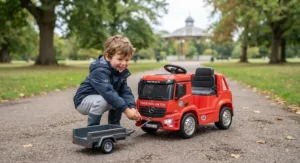
COSTWAY Caterpillar Ride On Tractor brings official Caterpillar branding to a foot-to-floor design with a detachable trailer, and the standout feature is that licensing — construction-mad toddlers tend to recognise and respond to authentic branding in a way that generic yellow plastic simply doesn’t achieve.
The adjustable bucket and under-seat storage are the specs worth unpacking: the bucket genuinely tips for sand, small toys, or garden debris, while under-seat storage adds practical capacity without needing a separate trailer for smaller loads — though the detachable trailer is included for bigger hauling ambitions. It’s designed as a foot-to-floor sliding toy for ages one to three, positioning it as a direct alternative to the HOMCOM excavator above, but with a stronger emphasis on towing and hauling play over digging.
On paper this means COSTWAY is competing less on raw durability than on the Caterpillar licence and the trailer-hauling play pattern specifically, which is exactly the kind of “who should care and why” distinction that matters more than a spec sheet alone. What most buyers overlook when comparing licensed toys is that construction-brand licensing itself doesn’t always mean superior build quality — it’s a real factor worth weighing rather than assuming automatically.
Aggregated sentiment for COSTWAY ride-on toys in this bracket generally centres on assembly ease and value for the included trailer, with the caveat that review counts on newer listings are still building compared with more established competitors.
Pros:
- ✅ Genuine Caterpillar licensing appeals to construction fans
- ✅ Detachable trailer adds hauling and towing play
- ✅ Adjustable tipping bucket for sand and garden debris
Cons:
- ❌ Foot-to-floor only, no pedal mechanism
- ❌ Newer listing with a still-developing review history
Priced around £40-£65, it’s a strong mid-budget choice specifically for children drawn to construction branding and trailer play.
6. HOMCOM 12V Electric Ride On Truck (UTV) — best premium pick for two children and rougher ground
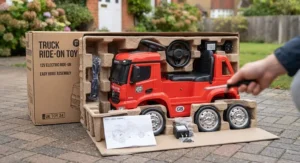
HOMCOM 12V Electric Ride On Truck, styled as a two-seater UTV with a genuine electric tipping bucket and shovel, is the clear step-up option on this list, and the standout feature is the combination of two-seater capacity with working construction functionality rarely found together at this end of the market.
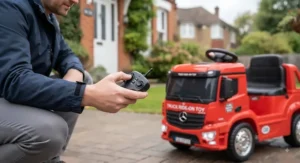
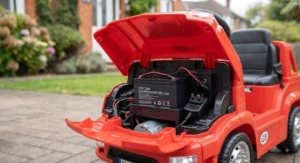
The specification worth interpreting properly is the 12V battery paired with four-spring suspension wheels: this isn’t just a speed spec, it’s what allows the truck to handle grass, gravel, and uneven garden surfaces without the jarring, tippy ride that budget electric ride-ons are prone to on rough ground. A parental remote control adds a genuine safety layer for younger or less confident riders, letting an adult take over speed and direction without ending the ride entirely.
Based on the spec comparison with pedal alternatives, the trade-off is straightforward: significantly higher upfront cost and the ongoing reality of battery charging and maintenance, in exchange for effortless motion, a working horn and music, and genuine two-child capacity that no pedal truck on this list can match. Reviewers consistently note the truck’s tipping bucket function as a specific highlight, with UK buyers describing reliable performance across damp grass and dirt as well as harder surfaces — a genuinely useful data point for anyone shopping specifically for outdoor play equipment rather than smooth patios alone.
Pros:
- ✅ Two-seater capacity with working electric tipping bucket
- ✅ Spring suspension handles grass, gravel, and rough ground
- ✅ Parental remote control adds a real safety layer
Cons:
- ❌ Highest price point on this list by a clear margin
- ❌ Requires battery charging and ongoing maintenance
At around £150-£220, this is a considered investment rather than an impulse buy, best justified by genuine two-child use or a garden with mixed terrain.
7. AIYAPLAY Ride On Tractor with Trailer — best electric alternative for hauling-focused play
AIYAPLAY Ride On Tractor with Trailer rounds out the list as a lesser-known but genuinely competitive electric option, pairing a 12V motor with a detachable trailer aimed squarely at children who enjoy hauling and transporting over digging and tipping specifically.
The remote control and music functions mirror the features found on bigger-name electric ride-ons, and the detachable trailer is the standout practical addition — it converts a single-seat electric ride-on into a genuine two-part hauling set, letting a child tow toys, sand, or garden bits around without needing under-seat storage to do all the work. Start-up sound and shifter-style controls add a layer of realistic pretend-driving detail that budget foot-to-floor trucks simply can’t replicate.
Here’s what to weigh with lesser-known electric brands like this one: you’re trading some of the brand-recognition reassurance of HOMCOM or Little Tikes for a genuinely competitive price point on comparable core electric-ride-on specs, and in a category where battery, motor, and wheel components are fairly standardised across manufacturers, that trade-off is often reasonable. What most buyers overlook is that detachable-trailer models specifically extend outdoor play value by giving siblings or friends something to help with — even if only one child is riding, another can load the trailer.
Reviewers consistently cite the trailer as the differentiating feature over trailer-less rivals, though it’s honest to flag that review volume and long-term brand track record run thinner than for more established competitors, making it worth checking the most recent listing feedback before committing.
Pros:
- ✅ Detachable trailer adds genuine hauling and towing play
- ✅ Competitive pricing against bigger-name electric rivals
- ✅ Realistic start-up sound and shifter controls
Cons:
- ❌ Less brand history than market leaders like HOMCOM
- ❌ Smaller review base to verify long-term reliability
At around £120-£180, it’s a genuinely worthwhile alternative for families prioritising trailer play over tipping-bucket construction features.
Practical Usage Guide: Getting the Most from Your Truck Ride-On Toy
Getting a new ride-on out of the box is only step one — how you introduce and maintain it shapes both safety and how long it lasts. Before the first ride, walk your child through the controls specifically: point out the steering wheel or handlebars, show them how the horn works, and if there’s a pedal or accelerator, let them practise the motion while the toy is stationary before attempting to move.
For pedal and electric models specifically, choose a flat, open space for the first few sessions — a driveway or patio rather than a slope — so your child can build confidence with steering and stopping before tackling uneven grass or gentle inclines. Regularly check wheels and, for electric models, the battery terminals for wear or corrosion; a five-minute monthly inspection catches most mechanical issues before they become safety problems.
Common first-30-days mistakes are worth naming directly: over-supervising to the point of removing all challenge is one, since a certain amount of wobble and low-speed tumbling is how balance genuinely develops, while under-supervising near driveways, steps, or water features is the opposite and more serious mistake. For electric models, resist the urge to let a child use the highest speed setting immediately — most reputable ride-ons include multiple speed settings specifically so children can build confidence gradually.
Storage matters more than parents often expect: keeping a ride-on toy under any kind of cover, even a simple tarpaulin, meaningfully extends the life of both plastic components and, for electric models, the battery — direct sun and rain cycling are the two biggest causes of premature wear on outdoor ride-on toys.
Real-World Scenarios: Matching a Truck Ride-On to Your Child
Consider a toddler around eighteen months, just walking confidently but not yet coordinated enough for pedals. Here, something like the HOMCOM 3-in-1 Ride On Excavator Toy or the parent-push mode of the Little Tikes Cozy Ice Cream Truck is the appropriate match — foot-to-floor or push-assisted movement lets them build confidence without the frustration of a mechanism they can’t yet operate.
A slightly older child, around three to four, who has the coordination for pedalling but craves durability for genuine daily garden use, sits squarely in the territory of the Rolly Toys JCB Dumper or the DOLU Pedal Operated Ride On Tractor — the choice between them largely comes down to budget and whether the working tipping bucket justifies the price gap for your specific child’s play style.
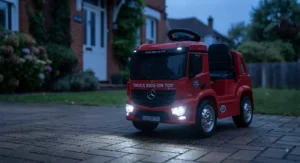
Then there’s the household with two children close in age, or a garden with genuinely mixed terrain — lawn, gravel path, and patio all in one space. This is where the HOMCOM 12V Electric Ride On Truck earns its higher price tag: two-seater capacity and suspension-equipped wheels solve two separate problems that a single-seat pedal truck simply can’t address at once, even if it means a larger upfront spend.
Problem → Solution: Common Ride-On Truck Headaches, Solved
If a pedal mechanism starts squeaking or feels stiff, the fix is usually simpler than it sounds: a light application of silicone-based lubricant on the pedal axle and chain, if fitted, resolves most friction issues, and it’s worth doing this every few months for anything used regularly outdoors, since grit and moisture are the main culprits.
For electric ride-ons that seem sluggish or won’t hold charge, the most common cause isn’t a faulty motor but incomplete charging cycles — many battery-powered ride-ons need a genuinely full charge before first use, often longer than the box suggests, and repeatedly topping up a partially charged battery can shorten its effective lifespan over time.
If a child seems frustrated by a pedal or foot-to-floor toy they can’t yet operate confidently, the solution usually isn’t more practice under pressure — it’s stepping back to a push-along or parent-assisted mode for a few weeks, then reintroducing independent operation once frustration has eased. Forcing the issue tends to create toy avoidance rather than faster skill development.
Finally, for wheels that have picked up grass or gravel debris and started sticking, a quick check and clear-out of the wheel wells resolves the vast majority of “why has my child’s truck stopped moving properly” moments — it’s rarely anything more serious than debris in the moving parts.
✨ Don’t Miss These Exclusive Deals!
🔍 Whether you’re after a first foot-to-floor truck or a premium electric option for two, the right pick makes every outdoor session better. Click through on any product above to check current pricing and availability.
How to Choose Truck Ride-On Toy
Working through these criteria in order gets most parents to a confident decision quickly, without needing to compare every listing on the market.
- Match power type to your child’s current coordination, not their age alone. A confident twenty-month-old may manage foot-to-floor movement better than a cautious three-year-old still building balance.
- Check the age and weight rating against your actual child, not just the box art. Weight limits matter as much as age brackets, particularly for pedal and electric models.
- Think honestly about your outdoor surfaces. Suspension and wider wheels matter far more on grass and gravel than on a smooth patio or driveway alone.
- Decide whether construction-themed features add genuine play value for your child. A working tipping bucket is a meaningful upgrade for a digger-obsessed toddler and largely irrelevant for one who isn’t.
- Factor in storage space realistically. Larger electric UTVs and pedal tractors need more storage than compact foot-to-floor trucks — measure before you buy, not after delivery.
- Weigh review volume alongside star rating. A newer brand with fewer reviews isn’t automatically worse, but it does mean less collective evidence to rely on.
- Check current price against genuine features, not just size. A larger or louder toy isn’t automatically better value — match spend to how often and how long it will realistically be used.
Push-Along Car Ride-On vs Pedal Car: Which Suits Your Child?
This is one of the most common points of confusion for first-time buyers, and it genuinely comes down to developmental stage rather than personal preference alone.
| Factor | Push-Along / Foot-to-Floor | Pedal Car |
|---|---|---|
| Typical Age Range | 12-30 months | 2½-6 years |
| Coordination Needed | Minimal — walking is sufficient | Moderate — requires pedal-leg coordination |
| Speed & Effort | Slower, lower physical demand | Faster, builds leg strength over time |
| Best For | First-time riders, cautious toddlers | Confident walkers ready for a challenge |
| Example on This List | HOMCOM 3-in-1 Ride On Excavator Toy | Rolly Toys JCB Dumper |
The table above makes the developmental logic fairly clear: push-along and foot-to-floor trucks ask almost nothing of a child beyond the ability to walk, which is precisely why they suit the youngest riders, while pedal cars demand the more complex coordinated leg movement that typically doesn’t develop reliably until somewhere between two and a half and three years old. Introducing a pedal truck too early tends to produce frustration rather than faster learning, since the physical coordination genuinely isn’t there yet regardless of enthusiasm. For families wanting one toy to last across this whole window, a hybrid design like the Little Tikes Cozy Ice Cream Truck, with its removable floorboard, is often the more practical long-term choice than committing early to either extreme.
Truck Ride-On for Outdoor Play: What to Check Before You Buy
Buying a truck ride-on for outdoor play specifically, rather than indoor use alone, changes the priority list in ways that are easy to overlook when browsing product photos indoors.
Wheel material and tread matter considerably more outdoors than in. Hard plastic wheels designed primarily for smooth flooring can struggle on grass or gravel, while wider, slightly softer wheels — as seen on the HOMCOM 12V Electric Ride On Truck — handle mixed garden terrain with noticeably less jarring and tipping risk. It’s genuinely worth checking wheel specifications rather than assuming any ride-on will perform equally well outdoors.
Weather resistance is the second major consideration. Most plastic ride-ons tolerate occasional light rain without lasting damage, but batteries, electronics, and any fabric seating components on electric models are considerably more vulnerable, making some form of cover or dedicated storage a near-essential accessory rather than an optional extra for outdoor-focused use.
Physical activity guidance also supports prioritising genuinely active outdoor play over passive indoor alternatives: NHS guidance on physical activity for children under five recommends toddlers and pre-schoolers get at least three hours of activity spread across each day, including active outdoor play specifically — a benchmark that pedal and foot-to-floor ride-ons, which demand genuine physical effort, contribute to far more directly than passive electric models do.
Finally, check that any ride-on marketed for outdoor use includes some ground clearance and a reasonably wide wheelbase; a toy designed purely for flat indoor floors can tip more easily on the gentle unevenness of ordinary garden ground.
Construction-Themed Toys: Why They’re a Perennial Favourite
Construction-themed toys — diggers, dumpers, tractors, and trucks with working parts — occupy a specific and remarkably durable niche in children’s play, and it’s worth understanding why before assuming it’s simply a passing preference.
The appeal largely comes down to cause-and-effect mechanics that plain ride-on shapes don’t offer. A tipping bucket, a rotating arm, or a detachable trailer gives a child a genuine action to perform and a visible result, which research on early childhood development consistently links to engaged, extended play sessions rather than the shorter attention spans typical of purely passive toys. Gross motor skill development in early childhood is closely tied to this kind of goal-directed, physically engaged play, where a child isn’t just moving but working towards a specific outcome like filling and tipping a bucket.
What most buyers overlook about construction-themed pricing specifically is that genuine working parts — a bucket that actually tips, an arm that actually rotates — cost more to manufacture reliably than static decoration, which explains why products like the Rolly Toys JCB Dumper and COSTWAY Caterpillar Ride On Tractor command a premium over otherwise similar truck-shaped ride-ons without functional features. That premium is often worth paying for a child genuinely drawn to digging, tipping, and hauling play specifically, though it’s a poor use of budget for a child who shows no particular interest in the theme.
Licensed branding — JCB, Caterpillar, and similar — adds a further layer of cost that’s worth weighing honestly: it doesn’t inherently improve build quality, but it does tend to improve engagement for children who already recognise the branding from books, television, or real construction sites they’ve spotted locally.
Outdoor Play Equipment: Building a Bigger Set-Up Around Your Ride-On
A truck ride-on toy rarely exists in isolation for long — most gardens evolve into a broader outdoor play equipment set-up over time, and thinking about that bigger picture before buying can save money and storage headaches later.
Surfacing is worth considering early. A ride-on used exclusively on grass will wear differently, and generally more gently on both the toy and any falls, than one used mainly on paving or gravel, which is a genuine factor in choosing between the more rugged suspension-equipped options like the HOMCOM 12V Electric Ride On Truck and simpler foot-to-floor models better suited to smoother surfaces.
Complementary equipment tends to extend play value more than a second ride-on does. A sandpit or water table alongside a construction-themed truck lets a child combine digging, hauling, and tipping into a single connected play scenario rather than isolated activities, which is exactly the kind of extended, goal-directed play that supports the gross motor development benefits outdoor play is known for.
Storage planning deserves genuine thought before purchase rather than after. Pedal and electric trucks are considerably bulkier than foot-to-floor models, and a garden without covered storage space will see faster wear on any ride-on left permanently exposed to the elements — worth factoring into the true cost of ownership beyond the sticker price alone.
Common Mistakes When Buying a Truck Ride-On Toy
The most frequent mistake is buying strictly to the stated age range without considering an individual child’s actual coordination and confidence — age brackets on packaging are useful guidance, not a precise developmental test, and a cautious three-year-old may genuinely need a step down from what the label suggests.
A second common error is underestimating storage and terrain requirements until after delivery. A premium electric truck with suspension wheels is wasted value on a family with only a small paved patio, just as a delicate foot-to-floor plastic truck will struggle and wear quickly on rough gravel it was never designed for.
Third, many buyers focus heavily on branding and construction-theme features without checking genuine review volume and recent feedback. A licensed, feature-rich truck with thin, mostly older reviews carries more uncertainty than a plainer model with a large and recent base of UK ratings.
Finally, it’s easy to overlook battery care requirements when buying an electric model on impulse. Skipping the full initial charge cycle, or leaving a battery flat for extended periods between uses, is one of the most common causes of premature electric ride-on failure — a detail rarely mentioned prominently in product listings.
Frequently Asked Questions
❓ What age is right for a truck ride-on toy?
❓ Are pedal ride-on trucks better than electric ones?
❓ Can a truck ride-on toy be used indoors and outdoors?
❓ Do construction-themed features like tipping buckets matter for play value?
❓ How long does an electric ride-on truck battery typically last per charge?
Conclusion
There’s genuinely no universal “best” truck ride-on toy, and the honest answer depends far more on your child’s current stage and your garden than on chasing the flashiest option available. A toddler just finding their feet needs something like the HOMCOM 3-in-1 Ride On Excavator Toy far more than they need a 12V motor, while a confident four-year-old with a genuine passion for diggers will get years of value from the working bucket on the Rolly Toys JCB Dumper.
If you’re buying for the youngest riders or want maximum flexibility as your child grows, the parent-push mode of the Little Tikes Cozy Ice Cream Truck or the walker-style HOMCOM excavator make sensible starting points. For families with more than one child or genuinely mixed garden terrain, the extra investment in the HOMCOM 12V Electric Ride On Truck tends to pay off in shared use and rougher-ground capability that a single-seat pedal truck simply can’t match.
Whichever you choose, the fundamentals matter more than the badge on the front: match power type honestly to your child’s coordination, check your outdoor surfaces before assuming any wheel will cope, and plan for storage before delivery day rather than after. Get those right, and the truck ride-on toy earns its keep as one of the genuinely reliable ways to get a small child outside, moving, and thoroughly entertained.
✨ Ready to Find the Right Ride-On for Your Family?
🔍 Take the guesswork out of your next outdoor toy purchase. Click through on any product above to check current pricing and availability, and get your garden set up for hours of active play!
Recommended for You
- Sports Car Ride-On for Toddlers: 7 Best Picks for 2026
- Cozy Coupe for Girls: 7 Best Pink Ride-Ons in 2026
- Licensed Character Cozy Coupe: 7 Best Picks for 2026
Disclaimer: This article contains affiliate links. As an Amazon Associate, I earn from qualifying purchases. If you purchase products through these links, we may earn a small commission at no additional cost to you.
✨ Found this helpful? Share it with your friends! 💬🤗
