In This Article
A 3-wheel scooter for balance and confidence is a child’s kick scooter with a wide, stable three-wheeled base that stays upright without help. That stability lets young riders practise pushing, gliding and braking while their balance develops, so wobbles feel manageable rather than scary and confidence builds one successful ride at a time.
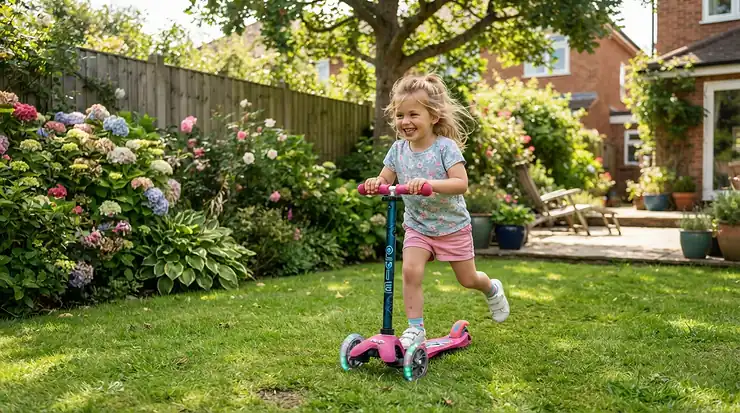
Toddlers are, bless them, all accelerator and no brakes. Put a wobbly two-year-old on a two-wheeler and you’re signing up for grazed knees and a very loud afternoon. A well-chosen 3-wheel scooter for balance and confidence flips the script: the scooter holds itself up, the child does the pushing, and every smooth glide becomes a tiny victory. Stack enough of those victories together and you get better coordination, steadier steering and the real prize, a child who asks to go outside.
That matters more than it sounds. NHS guidance for under-fives recommends that pre-schoolers get at least 180 minutes of physical activity a day, with at least an hour of it moderate-to-vigorous. Scooting ticks that box while feeling like play, which is the only kind of exercise a three-year-old will volunteer for.
This guide covers seven genuinely good options. It also tackles the three topics UK parents search for most: gross motor skill development, wide wheelbase stability and nervous rider tips. A note on method: I haven’t tested these scooters myself. Everything here comes from manufacturer specifications, UK retailer listings and published parent and editor reviews gathered in October 2026, and I flag where the review evidence is thin. Prices are ranges only, so always check the current price before you buy.
Quick Comparison: 7 Best Picks at a Glance
Short on time? Here’s the whole field on one screen.
| Product | Ages (maker’s guidance) | Steering lock | Approx. weight | Price range | Best For |
|---|---|---|---|---|---|
| Mini Micro Deluxe | 2–5 | No (lean-to-steer) | ~1.9kg | £70–£110 | Lightweight all-rounder |
| Mini Micro 3in1 Deluxe Plus | 1–5 | No (seat + push-bar stages) | ~1.95kg (~3kg with seat) | £110–£140 | Very cautious toddlers |
| Maxi Micro Deluxe | 5–12 | No | ~2.5kg | £120–£145 | Taller kids, long-term use |
| Globber Junior Foldable | 2+ | Yes | ~2.5kg | £65–£90 | Nervous first-timers |
| Globber Primo Foldable Lights | 3+ | Yes | ~2.3–2.5kg | £75–£95 | Growing preschoolers |
| Chillafish Scotti Glow | 3+ | No | ~3kg | £50–£65 | Tighter budgets |
| SmarTrike Xtend | 3–12 | Not listed | Not stated | £100–£150 | Longest growth window |
Looking at the table, the Mini Micro Deluxe is the best all-rounder for a typical two-to-five-year-old, while the Globber Junior Foldable is the one to shortlist if fear is the main hurdle, thanks to its steering lock. Budget buyers should note that the Chillafish Scotti Glow undercuts most rivals but sits at the heavier end. The SmarTrike Xtend only pays off if you will genuinely use its longer age range.
💬 Just one click — help others make better buying decisions too!😊
Top 7 Picks: Expert Analysis of Each 3-wheel scooter for balance and confidence
Every pick below answers the same three questions. How stable will it feel to a beginner? Will it fit a growing child? Does the price make sense over time?
1. Mini Micro Deluxe — lightest lean-to-steer all-rounder for ages 2–5
The headline is weight. At roughly 1.9kg, the Mini Micro Deluxe is light enough for a toddler to tip, lift and drag out of the hallway without a parental rescue mission. Micro quotes an age band of 2–5, a 35kg rider limit and a handlebar that climbs from about 48cm to 68cm. The anodised stem resists corrosion, and the silicone lettering on the deck doubles as grip. In practice, small trainers stay planted and the scooter stretches from nursery into Reception.
Based on the spec comparison, this is the sensible default. It has no steering lock, so lean-to-steer does all the teaching. That suits a curious child; a genuinely anxious one may prefer a lock (see picks 4 and 5). Reviewers repeatedly treat it as the benchmark for toddler three-wheelers, and one parent-review site reports using a Mini with its own children from age two to eight, a decent durability signal.
Pros:
- ✅ Feather-light frame toddlers can manage themselves
- ✅ Handlebar range covers ages 2–5 comfortably
- ✅ Grippy deck and rust-resistant stem
Cons:
- ❌ No steering lock for very wobbly beginners
- ❌ Dearer than most direct rivals
Expect around £70–£110 depending on variant. The value verdict is good if it gets handed down to a sibling.
2. Mini Micro 3in1 Deluxe Plus — ride-on seat for the most cautious toddlers
The party trick is the seat. From around 12 months, the Mini Micro 3in1 Deluxe Plus works as a seated ride-on with a parent push-bar and footrests. It then converts into a standing scooter when your child wants to stand. UK retailer listings give an age range of 1–5 and a 20kg limit in ride-on mode, rising to 35kg as a scooter, though some listings quote higher figures, so check yours. Weight is about 1.95kg without the seat and roughly 3kg with it, and the seat height of 26–29cm lets small feet reach the ground.
Here’s what that means in practice. A child who dislikes standing on a moving deck can learn steering and rolling while seated, then graduate. One toddler-scooter specialist notes that seated scooters can ease timid riders in, though most children manage fine without one, an honest caveat. Independent UK reviews of this exact model were thin in my research, so treat “grows with your child” as sound design logic rather than a proven result.
Pros:
- ✅ Three stages from first push-along to scooter
- ✅ Ground-reaching seat height builds early confidence
- ✅ Same lean-to-steer system as the standard Mini
Cons:
- ❌ More parts to store and keep track of
- ❌ Lower weight limit while the seat is fitted
Budget around £110–£140. It’s worth it only if you will use all three stages.
3. Maxi Micro Deluxe — the long-haul pick for ages 5–12
The big idea is longevity. The Maxi Micro Deluxe picks up where the Mini range stops, with a handlebar running from roughly 68cm to 91cm. Micro points out that its lowest setting matches the Mini’s highest, so there’s no awkward gap in between. It weighs about 2.5kg, and UK listings commonly quote a 50kg rider limit (verify on your listing).
Why does this matter for a nervous child? Plenty of five- and six-year-olds are still tentative, and keeping the three-wheel footprint spares them the indignity of a “baby” scooter. The caution is sizing. Micro advises against stepping up before four unless your child is over 110cm, because the extra weight and handlebar height are hard for smaller riders. Roundups commonly name the three-wheel Maxi as the standard first scooter from about four years up, and the sizing logic is consistent across Micro’s guidance and independent reviews.
Pros:
- ✅ Handlebar range lasts well beyond age five
- ✅ Seamless step-up from smaller scooters
- ✅ Sturdy build that survives sibling hand-me-downs
Cons:
- ❌ Too big for most under-fours
- ❌ Premium price tag
Expect around £120–£145. The value verdict is excellent per year of use.
4. Globber Junior Foldable — steering lock for first-ever pushes
Globber’s patented steering-lock button fixes the two front wheels so the scooter only rolls forwards and backwards. For a child’s first wobbly pushes, it’s like stabilisers with the training built in: no sudden swerves, just push and glide. Release the lock later and lean-to-steer takes over.
The Globber Junior Foldable is aimed at ages 2+, with a three-position T-bar at roughly 54, 61 and 68cm. It has 121mm front and 80mm rear wheels, a composite rear brake, a 50kg limit and a weight around 2.5kg. Bigger front wheels roll over pavement cracks more smoothly, which keeps beginners upright. The fold button helps in a boot or a small flat, and a Lights version adds battery-free LED front wheels.
This is the model I’d shortlist first when the problem is fear rather than skill, and it ranks high on my nervous rider tips list. I couldn’t find robust independent UK reviews for this exact model, and the testimonials on the maker’s site are marketing, so weigh the design logic rather than the hype.
Pros:
- ✅ Steering lock tames the first wobbles
- ✅ Folds quickly for storage and travel
- ✅ Three handlebar heights for small toddlers
Cons:
- ❌ Heavier than the lightest Micro frames
- ❌ 68cm top handlebar limits lifespan
Expect around £65–£90. It’s strong value for its target rider.
5. Globber Primo Foldable Lights — bigger steering-lock scooter for 3–7-year-olds
Where the Junior suits two-year-olds, the Globber Primo Foldable Lights suits the next stage. Its T-bar sits at roughly 67.5, 72.5 and 77.5cm, so a tall three-year-old or a hesitant five-year-old isn’t hunching. Globber lists a wide anti-slip deck, a reinforced metal frame, ABEC 5 bearings, a long, wide composite brake, a 50kg limit and a weight of roughly 2.3–2.5kg. Retailers quote an assembled footprint of about 57.5cm long by 28cm wide, a compact stance that stays planted. Globber backs it with a two-year guarantee.
The steering lock is the real draw for wide wheelbase stability in the early weeks: lock it for the first sessions, then release it once glides feel automatic. Battery-free LED wheels glow brighter the faster the child rolls, a cheerful incentive. As with its sibling, independent UK review depth was limited in my sources, so judge it on specification and lock logic.
Pros:
- ✅ Lock-then-lean learning curve for beginners
- ✅ Taller bar suits bigger preschoolers
- ✅ Folds flat with a safe push-button
Cons:
- ❌ Too tall for most two-year-olds
- ❌ Heavier than the lightest rivals
Expect around £75–£95. It’s a sensible mid-price pick.

6. Chillafish Scotti Glow — budget-friendly with a detachable handlebar
The tool-free removable handlebar is the neat touch here. The Chillafish Scotti Glow snaps apart for the boot, a bag or a trip to a friend’s. The handlebar adjusts from 52cm to 72cm, rolling on ABEC-5 wheels with battery-free LED lights and an integrated footbrake on a twin-tip deck. It’s rated for ages 3+ and up to 50kg, measures about 60cm by 25cm, and weighs about 3kg depending on the listing. One UK listing also shows CE certification.
For nervous riders it’s a solid, simple platform, but it has no steering lock, so it suits a child already comfortable standing on a moving deck. At around 3kg it’s heavier than the Micro frames, which matters if you’ll be carrying it. One retailer showed a 4.5 out of 5 average, but from only two ratings, far too few to draw conclusions, so treat it as promising rather than proven.
Pros:
- ✅ Lowest price in this round-up
- ✅ Handlebar detaches without tools
- ✅ Battery-free light-up wheels
Cons:
- ❌ No steering lock for anxious beginners
- ❌ Small review pool so far
Expect around £50–£65. It’s good value if you accept a heavier frame.
7. SmarTrike Xtend — extendable deck that grows from age 3 to 12
Growth is the gimmick, and a clever one. The SmarTrike Xtend has three stages with an extendable footboard and adjustable T-bar, so it stretches from toddler years towards pre-teen. It has LED front wheels and folds for storage; Currys lists it as suitable from 3 and not for children above 12. A parent tester at Mother & Baby found it easy to assemble and manoeuvrable, and her children, aged from two to ten, all took turns on it.
The honest caveat from that review is that the handlebar took a couple of attempts to tighten correctly when changing sizes. I couldn’t confirm a steering lock in the sources I checked, so the SmarTrike Xtend is better for a child who is already wobble-free than for a very fearful beginner. If you want one scooter to survive several years, or several siblings, the maths looks appealing.
Pros:
- ✅ Extendable deck and bar for years of growth
- ✅ LED wheels and a foldable frame
- ✅ Lightweight enough to carry, per a parent tester
Cons:
- ❌ Fiddly to re-tighten when resizing
- ❌ No confirmed steering lock
Expect around £100–£150, at the upper end if bought near RRP. It’s best value for families planning to use the full age range.
Head-to-Head: How the 7 Compare on Fit and Safety Features
| Product | Ages | Max rider weight | Steering lock | Handlebar height | Price range | Best For |
|---|---|---|---|---|---|---|
| Mini Micro Deluxe | 2–5 | 35kg | No | ~48–68cm | £70–£110 | Light, simple scooting |
| Mini Micro 3in1 Deluxe Plus | 1–5 | 20kg seat / 35kg scooter | No | Adjustable T-bar | £110–£140 | Seated starts |
| Maxi Micro Deluxe | 5–12 | ~50kg (check listing) | No | ~68–91cm | £120–£145 | Taller, older kids |
| Globber Junior Foldable | 2+ | 50kg | Yes | 54/61/68cm | £65–£90 | Fearful two-year-olds |
| Globber Primo Foldable Lights | 3+ | 50kg | Yes | 67.5/72.5/77.5cm | £75–£95 | Hesitant 4–6s |
| Chillafish Scotti Glow | 3+ | 50kg | No | 52–72cm | £50–£65 | Value seekers |
| SmarTrike Xtend | 3–12 | Check listing | Not listed | Adjustable, extendable | £100–£150 | Maximum lifespan |
The pattern is clear. Steering-lock models, the two Globbers, win for first-timers, Micro wins on weight and refinement, and the Maxi Micro Deluxe and SmarTrike Xtend win on lifespan. If nervous riders are your priority, pair a lock or a seat with a lightweight frame. If you have two children, the longer-lived options justify the outlay.
Nervous Rider Tips: A 30-Day Confidence Plan
Whatever you buy, technique decides whether a scooter becomes a favourite or a hallway ornament. These nervous rider tips follow a simple four-week ladder, with sessions of 10–15 minutes and always ending on a win.
Week 1 — Stand, don’t go. Helmet on, scooter on grass or a carpet, steering locked if yours has a lock. Practise stepping on, stepping off and finding the footplate. Celebrate boring things loudly.
Week 2 — Push and glide. Move to a smooth, flat, car-free path. One push, then lift the pushing foot and count the glide. Aim for three seconds before you move on.
Week 3 — Brake and stop. Teach the rear brake with a game of “red light, green light”. Brake confidence is where nervous riders gain the most.
Week 4 — Steer. Unlock the steering or switch to lean-to-steer. Set out two shoes as gates and make gentle turns around them.
Parks first, pavements later, is common advice from parenting experts, and RoSPA’s scooter safety guidance is a good checklist for protective kit and supervision. Stop before frustration starts, and never push a child past a flinch. Confidence is built by successes, not by willpower.
Real-World Scenarios: Which Scooter for Which Child?
Specs only matter if they match a real child. Here are three profiles, loosely matched to budget, environment and frequency of use.
Scenario A: Maisie, 2½, cautious, small flat. The family has £80–£100, a communal hallway and park visits twice a week. A steering lock tames the early swerves, and fold-away storage helps in a tight space, so the Globber Junior Foldable is the logical fit. If she refuses to stand at all, the Mini Micro 3in1 Deluxe Plus lets her start seated.
Scenario B: Arlo, 4, confident, big brother’s old scooter. The family wants something light for school-run pavements. The Mini Micro Deluxe is the sweet spot at about 1.9kg, and the Chillafish Scotti Glow is the cheaper alternative if they’ll tolerate extra weight.
Scenario C: Priya, 5½, rattled after a fall. She’s tall for her age and embarrassed about “baby” scooters. A bigger three-wheeler preserves the stability she needs: the Maxi Micro Deluxe for years of use, or the SmarTrike Xtend if the budget allows and she’s past the wobble stage.
✨ Ready to Find Your Child’s Perfect First Scooter?
🛴 Take the guesswork out of scooting with the options above. Click on any highlighted product name to check current pricing and availability on Amazon. A little preparation now means more smiles, steadier rides and fewer tears on the way to the park!
Problem → Solution Guide: Wobbles, Wipe-outs and Wheel Refusal
Even the best scooter hits snags. Here are the most common ones, with fixes.
“They lean but won’t push.” The child is afraid to lift a foot. Practise one-foot stand-and-glide while you hold the handlebar, or use a lock-equipped model such as the Globber Junior Foldable for the first sessions.
“It veers into everything.” Lean-to-steer needs gentle weight shifts, not hard turns. Set out cones in an empty car park or park path and reward wide, slow curves.
“The scooter feels twitchy.” Check handlebar height first. Micro’s own guidance puts grips around tummy-button height. Then check the clamp. A parent tester reported that the SmarTrike Xtend took a couple of attempts to tighten properly after resizing, so recheck after every adjustment.
“They won’t get back on after a fall.” Return to stationary practice and short, easy wins. A seated stage on the Mini Micro 3in1 Deluxe Plus can rebuild trust. Another nervous rider tip: let your child decide when to try again.
“The wheels have gone gritty.” One UK expert quoted in a toddler-scooter test advises keeping scooters indoors, because damp rusts the bearings. A dry hallway beats a wet shed.
Gross Motor Skill Development: What Three Wheels Actually Train
Gross motor skill development sounds clinical, but the idea is simple. According to the Cleveland Clinic’s overview of gross motor skills, gross motor skills are the large movements we make with our arms, legs and torso, and they depend on balance and coordination. Scooting works nearly all of them at once.
Break a single push-and-glide into its parts. One leg stabilises on the deck, which trains single-leg balance. The other leg pushes, adding timing and rhythm. The core keeps the torso upright, the arms hold and steer, and the eyes plan the route. Lean-to-steer adds weight shifting, which Micro highlights as a core part of its design. A three-wheel base lets all of that happen without the fear of an instant tip-over.
Think of a 3-wheel scooter for balance and confidence as a gym where the weights are made of fun. Three wheels reduce the load on balance just enough that a child can concentrate on the pushing and steering. A word of balance, though: a scooter is a tool, not a diagnosis or a cure. If you’re concerned about your child’s movement or coordination, speak to your GP or health visitor.
Wide Wheelbase Stability: Why Stance Beats Speed
Parents search for wide wheelbase stability because tipping is their biggest fear. Technically, the “wheelbase” is the front-to-rear distance, while side-to-side steadiness depends on the track width between the two paired wheels. Manufacturers rarely publish either figure, but listings do give overall footprints. The Chillafish Scotti Glow is roughly 60cm long by 25cm wide, and the Globber Primo Foldable Lights about 57.5cm by 28cm. Those are compact footprints, so stability comes from the three-wheel layout and a low deck, not from sheer size.
Three practical clues help. First, a low deck means a shorter step-up and a lower centre of gravity. Second, larger wheels, such as Globber’s 121mm fronts, roll over cracks more smoothly. Third, a steering lock removes sideways wobble entirely while a beginner finds their feet.
For wide wheelbase stability, don’t chase the longest deck. A giant deck on a tiny toddler is awkward, and it isn’t what keeps small riders upright. Match the scooter to the child’s height, then look for features that actively reduce wobble. The Globber Junior Foldable and Globber Primo Foldable Lights do that with their locks, while the Mini Micro 3in1 Deluxe Plus does it with a seat and push-bar.
How to Choose a 3-wheel scooter for balance and confidence
To choose a 3-wheel scooter for balance and confidence, match the deck and handlebar to your child’s height, decide whether a steering lock or seat is needed, and check the brake and safety markings. Here’s the checklist in order of importance.
- Match height, not just age. Age bands are guidance; a tall four-year-old and a petite four-year-old need different handlebar heights.
- Decide on steering. A lock suits fearful beginners; lean-to-steer suits children ready to learn turns straight away.
- Check the handlebar range. Aim for grips around tummy-button height, with room to raise them as your child grows.
- Weigh the scooter. A 1.9kg frame and a 3kg frame feel very different to a three-year-old, and to you carrying it home.
- Test the brake. A rear foot brake should stop the scooter with gentle pressure, not an ankle-straining stamp.
- Judge the wheels. Larger, smooth polyurethane wheels cope better with pavement cracks.
- Look for safety marking and warnings. UK toys should carry UKCA or CE marking, plus clear age and weight guidance.
3-wheel scooter vs 2-wheel scooter vs balance bike
Which route is best for your child’s first set of wheels? The table summarises the trade-offs.
| Feature | 3-wheel scooter | 2-wheel scooter | Balance bike |
|---|---|---|---|
| Stability when still | Self-supporting | Needs rider balance | Feet reach the ground |
| Typical start age | ~2–3 | Around 5+ | Roughly 18 months–2 |
| Nervous-rider friendliness | High (locks or seats available) | Low | Medium |
| Skills practised | Pushing, braking, lean steering | Full balance | Balance and gliding |
| Best For | Globber Junior Foldable, Mini Micro Deluxe | Confident older kids | Children who love sitting |
One review of two-wheel scooters notes they aren’t suited to under-fives who are still learning to balance. Another toddler-scooter specialist observes that children who start on scooters often resist balance bikes later, so the choice isn’t always interchangeable. For a hesitant child, I’d start with three wheels and move on when glides feel effortless. A balance bike is a fine alternative for a child who prefers sitting, while a two-wheeler is better saved for the confident five-plus.
Features That Actually Matter (And Those That Don’t)
Marketing loves shiny extras. Here’s the expert filter.
Features that matter:
- Steering lock or seat: the strongest anti-wobble tools for a fearful child.
- Rear brake feel: a responsive brake builds more confidence than any gadget.
- Handlebar range: it dictates how many years you’ll get from the scooter.
- Weight: a light frame is easier to pick up after a tumble.
Features that matter less:
- Light-up wheels: fun and battery-free on several models here, but they are a novelty, not a substitute for daylight riding or high-visibility clothing.
- ABEC ratings: the number sounds scientific, but for toddlers the gap between ABEC-5 and cheaper bearings is rarely noticeable.
- Character branding: lovely for motivation, irrelevant for safety.
- Folding: brilliant if you commute, store in a small flat or travel, pointless if the scooter lives in a garage.
Rule of thumb: pay for confidence, not for confetti. If a feature doesn’t reduce wobbles or extend usable life, it’s a nice-to-have.
Common Mistakes When Buying a 3-wheel scooter for balance and confidence
Buyers tend to repeat the same errors.
Buying too big to “grow into”. An oversized scooter is harder to control and can set confidence back, which defeats the purpose.
Skipping the helmet. A scooter is a toy, but falls still happen. Fit a properly sized helmet from the very first ride.
Rushing to two wheels. Moving on because a friend has done so isn’t a good reason. Move on when your child glides smoothly and brakes reliably.
Ignoring markings and warnings. UK toys must meet the Toys (Safety) Regulations 2011, which is why UKCA or CE marking and clear age warnings matter. If a listing omits them, move on.
Leaving it outdoors. Rain damages bearings, as one expert noted in a UK scooter test. A dry hallway keeps the scooter rolling longer.
Choosing by lights or colour alone. Fun matters, but fit, brake and steering matter more.
Long-Term Cost & Value: What You Really Pay Per Year
Sticker price tells only half the story. The table below uses illustrative arithmetic, price range divided by a realistic usable window, so treat the per-year figures as guides, not guarantees.
| Product | Price range | Realistic use window | Approx. cost per year | Best For |
|---|---|---|---|---|
| Mini Micro Deluxe | £70–£110 | ~3 years | £23–£37 | Hand-me-downs |
| Mini Micro 3in1 Deluxe Plus | £110–£140 | ~4 years | £28–£35 | Seated starters |
| Maxi Micro Deluxe | £120–£145 | ~7 years | £17–£21 | Long-term value |
| Globber Junior Foldable | £65–£90 | 3–4 years | £16–£30 | Nervous first-timers |
| Globber Primo Foldable Lights | £75–£95 | ~4 years | £19–£24 | Preschool years |
| Chillafish Scotti Glow | £50–£65 | 3–4 years | £13–£22 | Tight budgets |
| SmarTrike Xtend | £100–£150 | 5–6+ years | £17–£30 | Multi-child families |
The Maxi Micro Deluxe and Chillafish Scotti Glow both come out cheap per year, but for different reasons: one lasts, the other costs little upfront. The Mini Micro 3in1 Deluxe Plus only beats the standard Mini Micro Deluxe on value if the seat stage gets real use. Sibling hand-me-downs transform the maths for any of them, since a well-built scooter that serves two children halves the yearly cost.
FAQs About a 3-wheel scooter for balance and confidence
❓ Is a steering lock worth paying extra for?
❓ What handlebar height is right for my child?
❓ Are light-up wheels worth the extra money?
❓ Can my toddler use a 3-wheel scooter indoors?
❓ Are second-hand 3-wheel scooters safe to buy?
Conclusion
A 3-wheel scooter for balance and confidence is one of the smartest purchases you can make for a young child. It gives you stability on day one, a steady road to gross motor skill development and a gentle route past the wobbles that put some children off for months. If your priority is a lightweight all-rounder, the Mini Micro Deluxe is hard to beat. For fearful beginners, the steering lock on the Globber Junior Foldable or the Globber Primo Foldable Lights is the standout idea. For hesitant toddlers who need to start seated, the Mini Micro 3in1 Deluxe Plus earns its premium. Long-term value goes to the Maxi Micro Deluxe and SmarTrike Xtend, while the Chillafish Scotti Glow keeps costs down.
Whichever you choose, success depends on the ride, not just the scooter. Use the nervous rider tips above, add a helmet and start in a quiet, flat space. Keep sessions short and celebrate the small wins. If wide wheelbase stability is your main worry, remember that fit and technique count as much as footprint.
Recommended for You
- 3-Wheel Vs 2-Wheel Scooter For Kids: 7 Ultimate Picks (2026)
- Light-Up 3-Wheel Scooter: 7 Brilliant Picks For UK Kids (2026)
- 3-Wheel Scooter For Toddlers: 7 Best Safe Picks For UK (2026)
Disclaimer: This article contains affiliate links. As an Amazon Associate, I earn from qualifying purchases. If you purchase products through these links, we may earn a small commission at no additional cost to you.
✨ Found this helpful? Share it with your friends! 💬🤗
