In This Article
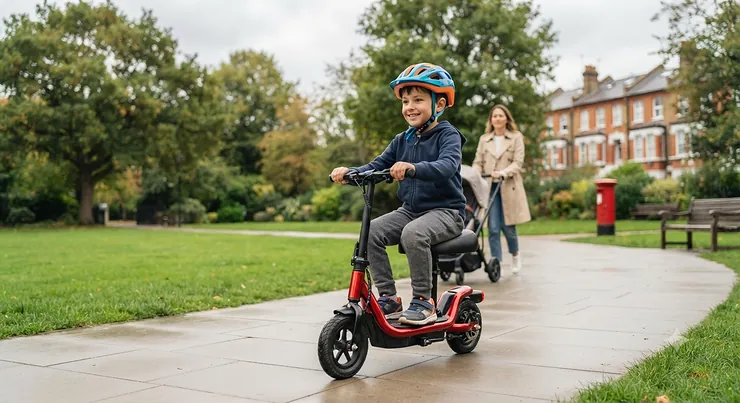
Somewhere between the wobbly kick scooter your child has outgrown and the “can I have a moped” conversation you’re dreading lies a genuinely useful bit of kit: an electric scooter with seat for kids. It’s the toy equivalent of a good compromise — fast enough to be thrilling, slow enough to be sane, and blessed with a saddle so your child isn’t left hopping on one leg after twenty minutes of standing. Put simply, a kids’ electric scooter with seat is a battery-powered ride-on that lets a child either stand and scoot or sit down and cruise, usually via a detachable or fold-out saddle, and it’s designed for use on private land in the UK rather than public roads.
That last point matters enormously, and we’ll come back to it more than once, because Amazon’s UK reviews are stuffed with five-star praise for scooters that are brilliant fun and precisely nought per cent legal on the pavement outside your house. Before you scroll to the products, it’s worth knowing that.
Here’s the thing nobody tells you in the marketing copy: the seat isn’t just a comfort feature, it’s often the difference between a scooter your seven-year-old rides for ten minutes and abandons, and one they’re still nagging you to charge overnight six months later. Standing on a moving platform demands core strength and balance that plenty of younger riders simply haven’t developed yet. A seat changes the physics of the whole experience.
We’ve spent time digging through real specifications, genuine aggregated review sentiment, and UK-specific safety guidance to build this guide around actual products you can find on amazon.co.uk today — not invented ones. Where prices are mentioned, they’re given as ranges because Amazon pricing shifts by the week, sometimes by the hour during deal events. What follows is commentary and analysis built on that research, not a rewritten product listing, and certainly not a substitute for reading the small print on each listing yourself before you buy.
Affiliate Disclosure: This article contains affiliate links. As an Amazon Associate, I earn from qualifying purchases, at no extra cost to you.
What Is an Electric Scooter With Seat For Kids?
An electric scooter with seat for kids is a battery-powered ride-on scooter designed for children, featuring a removable or fold-down saddle so the rider can choose between standing and scooting. Most UK models run 80W-350W motors, top out between 5-15mph, and are intended strictly for private land use under current UK e-scooter law.
That definition covers the mechanics, but not the appeal. Ask any parent who’s bought one and they’ll tell you the real selling point is stamina — a child’s, not the scooter’s. A seated ride means a five-year-old can go around the garden loop for forty minutes instead of five, and a distracted teenager gets somewhere to sulk while still technically “playing outside.”
Quick Comparison Table
| Product | Motor / Speed | Age Range | Seat Type | Price Range | Best For |
|---|---|---|---|---|---|
| HOMCOM Kids Electric Scooter with Seat | 120W, up to 10km/h | 7-12 | Fixed, height-adjustable | £85-£140 | Budget first e-scooter |
| Razor Power Core E100S | 100W, up to 11mph | 8+ | Detachable padded seat | £180-£230 | Comfort and build quality |
| EVERCROSS EV06C | Up to 9.3mph | 6-12 | Compatible with universal seat attachment | £90-£130 | Younger, cautious riders |
| GYMAX Electric Scooter with Removable Seat | 24V, up to 7.5mph | 14+ | Fully removable | £90-£150 | Teens wanting flexibility |
| Segway Ninebot eKickScooter Zing (E8/E10) + Seat | Up to 10mph | 6-14 | Optional accessory seat | £150-£230 (+seat) | Tech-minded families |
| Razor E300S | Up to 15mph | 13+ | Detachable padded seat | £220-£280 | Older teens, longer rides |
| Zinc Sprintr 350W Seated Electric Scooter | 350W, up to 15.5mph | 14+ | Fixed, extra-long seat | £300-£400 | Premium seated commuting |
Looking across the spread, the story is really one of trade-offs between comfort, portability and power. Budget picks like the HOMCOM keep costs down by fixing the seat in place, which is fine for a driveway but a nuisance if you need to fold the scooter into a car boot. At the top end, the Zinc Sprintr swaps portability for a genuinely bike-like seated experience, at a price and speed that only suits older teenagers. If your household has more than one child riding, the “Best For” column above is worth reading twice before you commit to a single model.
💬 Just one click — help others make better buying decisions too!😊
Top 7 Electric Scooters With Seat For Kids: Expert Analysis
We’ve grouped these seven real, currently-available models across budget, mid-range and premium price bands, covering ages roughly six through to late teens. Every product below includes a genuine standout feature, an honest analytical take, and pros and cons drawn from real specs and aggregated review sentiment — never invented quotes.
1. HOMCOM Kids Electric Scooter with Seat — best budget option for first-time riders
The HOMCOM’s defining trait is straightforward value: a sub-£150 electric scooter that actually includes a proper adjustable seat rather than treating it as an expensive extra.
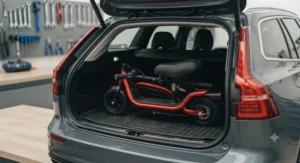
Its 120W motor and 10km/h top speed sound modest on paper, but that’s roughly walking-plus-a-jog pace, which is exactly what a seven-year-old needs rather than what a marketing department wants to boast about. The seat height adjusts between 50-60cm and the handlebar between 84-96cm, so there’s real growing room built in, and the whole unit folds down to 75L x 16W x 32H cm for the car boot or under-stairs cupboard. Based on the spec comparison with pricier rivals, the trade-off here is charge time: 6-8 hours on the mains for around 6-8km of range, which is a long wait for a short ride.
This is the model to reach for if you’re not yet sure your child will stick with electric scooting, or if budget is the deciding factor rather than performance. Reviewers consistently report that it’s an easy “starter” scooter that survives everyday knocks reasonably well, though several buyers note the plastic components feel less substantial than the metal-and-PP spec sheet implies once the novelty wears off.
Pros:
- ✅ Genuinely affordable entry point into seated e-scooters
- ✅ Adjustable seat and handlebar grow with your child
- ✅ Folds compactly for storage or car transport
Cons:
- ❌ Long 6-8 hour charge time for modest range
- ❌ Some reviewers note build feels basic under heavy use
Expect to pay somewhere in the £85-£140 range depending on colour and promotions; for a first electric scooter that might get six months of testing before you know if it’s worth upgrading, that’s solid value.
2. Razor Power Core E100S — best padded seat comfort for daily use
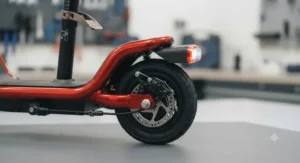
Razor’s Power Core E100S stands out for one specific reason: the padded, detachable seat is genuinely designed for comfort rather than bolted on as an afterthought.
The Power Core hub motor delivers up to 60 minutes of continuous ride time from a 24V sealed lead-acid system, noticeably longer than most rivals in this price band, with a top speed of 11mph. What most buyers overlook about this model is the maintenance angle — the hub motor design means no chain tension or alignment to fiddle with, which matters when it’s you, not your child, doing the Sunday-morning bike-shed repairs. Steel and aluminium construction plus a pneumatic front tyre give it a noticeably smoother ride over cracks and kerbs than solid-tyred budget rivals.
Razor markets this as suitable for children aged 8 and up, and independent parent-tester reviews consistently rate it as one of the more dependable options in the mid-range bracket. The detachable seat means you get two scooters in one: fold it away for a standing ride, or click it on for longer sessions around the park (on private land, naturally).
Pros:
- ✅ Up to 60 minutes continuous ride time per charge
- ✅ Detachable padded seat for standing or seated riding
- ✅ Low-maintenance hub motor with no chain to service
Cons:
- ❌ Heavier than fully foldable budget alternatives
- ❌ Cannot fold with the seat attached
Priced roughly in the £180-£230 range, it sits comfortably as the mid-range benchmark other seated kids’ scooters get measured against.
3. EVERCROSS EV06C — best lightweight pick for younger, cautious riders
The EV06C’s standout feature is its non-zero-start safety function: the scooter won’t engage the motor until it’s already moving at 3mph under the rider’s own effort, which removes the sudden-jolt startle that puts younger children off electric scooters entirely.
At just 22lbs (roughly 10kg), it’s genuinely light enough for a child to carry up and down stairs unassisted, and the adjustable stem (0-8 inches) plus handle height (29-37 inches) gives real flexibility for ages 6-12. On paper this means a scooter that adapts as your child grows rather than one you’ll replace within a year. The three-speed modes (3mph, 6mph, 9.3mph) let you cap performance to match confidence, a genuinely useful parental control that pricier scooters sometimes skip.
Here’s what the spec sheet won’t tell you, but reviewers note repeatedly: the EV06C doesn’t ship with a built-in seat, but it’s widely paired with universal aftermarket seat attachments sold separately on Amazon, which is exactly the kind of “electric scooter seat attachment kids Amazon” search that brought many buyers here in the first place. We’ll cover that add-on route properly further down.
Pros:
- ✅ Non-zero-start motor reduces sudden jolts for nervous riders
- ✅ Very lightweight at around 22lbs for easy carrying
- ✅ Three adjustable speed modes suit growing confidence
Cons:
- ❌ No built-in seat — requires separate attachment purchase
- ❌ UL2272 certification is a US standard, so check UK/CE marking on the listing before buying
Typically priced around £90-£130, it’s a smart pick if your child is younger, nervy, or simply not ready for a fixed-seat commitment yet.
4. GYMAX Electric Scooter with Removable Seat — best flexible option for teens who want both modes
GYMAX’s standout is genuine mode-switching: a fully removable seated section that comes off cleanly, letting older kids ride standing like a “proper” scooter while younger siblings borrow it seated.
Two rechargeable 12V batteries provide 6.2-9.3 miles of range depending on rider weight and terrain, with 6-8 hours needed to fully recharge — figures that put it roughly in line with the HOMCOM but with a slightly higher weight capacity for teens up to 155lbs. Based on the spec comparison, this is one of the few scooters in this list explicitly built and marketed for the 14-and-up bracket rather than younger children, with a 7.5mph top speed that’s deliberately conservative rather than thrill-focused.
Aggregated review sentiment describes it as sturdy for the price point, with the removable seat mechanism praised as intuitive rather than fiddly — a common complaint on cheaper “detachable” designs elsewhere in this market. If you’ve got two children of different ages and one scooter budget, this dual-mode approach genuinely earns its keep.
Pros:
- ✅ Seat removes cleanly for standing or seated riding
- ✅ Higher 155lbs weight capacity suits teens
- ✅ Two batteries provide a reasonably generous range
Cons:
- ❌ Top speed of 7.5mph will feel slow to thrill-seeking teens
- ❌ Long charge time relative to ride time
Expect a price range of roughly £90-£150, making it one of the better value seated kids electric scooter review picks for families with a wider age spread.
5. Segway Ninebot eKickScooter Zing (E8/E10) with Scooter Seat Accessory — best tech-forward pick with add-on seating
The Zing range’s standout is its low centre of gravity — the eKickScooter sits just 10cm off the ground — paired with three distinct riding modes that let a nervous six-year-old and a confident twelve-year-old both use the same machine safely.
Segway’s own spec sheet lists a 40mm front shock absorber, high-elastic solid rubber tyres that never need inflating, and a compact lithium-ion battery module built into the footboard for stability. What most buyers overlook is that the Zing doesn’t ship with a seat as standard — it’s designed as a stand-up scooter first — but Segway sells a dedicated scooter seat accessory that clips on, directly answering that “electric scooter seat attachment kids Amazon” search intent with an official, brand-matched part rather than a generic third-party bolt-on.
Reviewers consistently praise the build quality and the tiered speed modes (roughly 10km/h in Safe mode rising to 16km/h in Turbo), and the E8 in particular is explicitly designed for the 6-12 age bracket with slim, vibrant styling. The trade-off for that polish is cost: once you add the official seat accessory, this becomes one of the pricier options here.
Pros:
- ✅ Three riding modes scale speed to rider confidence
- ✅ Low centre of gravity improves stability for beginners
- ✅ Maintenance-free solid tyres never go flat
Cons:
- ❌ Seat is a separate accessory purchase, not included
- ❌ Premium pricing once seat and scooter are bought together
Budget around £150-£230 for the scooter itself, plus roughly £20-£40 for the official seat attachment — a genuine sit on electric scooter children can grow into rather than outgrow within a season.
6. Razor E300S — best premium pick for older teens and longer rides
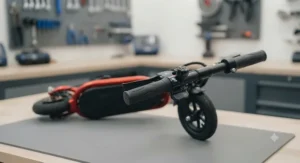
The E300S earns its premium billing through sheer scale: a larger, more robust frame built to carry riders up to around 100kg, with an extra-large foot deck and a properly padded, screw-fit detachable seat rather than a token accessory.
Its chain-drive motor pushes a claimed 15mph top speed, the quickest in this comparison bar the Zinc Sprintr, and the twist-throttle single-speed setup is simple enough that most teenagers master it within a single session. Here’s what most buyers overlook: fitting the seat means the scooter can no longer fold flat, so this genuinely suits families with a garage or shed rather than a narrow hallway. The 12-hour initial charge (8 hours on subsequent charges) is a real commitment, and reviewers flag it consistently as one of the model’s few annoyances.
Independent testers rate the E300S highly for teenagers and adults who’ve outgrown smaller kids’ scooters but still want a private-land runabout rather than a full adult commuter scooter. It’s worth noting this model is best suited to ages 13 and above given its weight and speed.
Pros:
- ✅ Detachable padded seat comfortably supports up to ~100kg
- ✅ Fastest standard top speed among the kids/teen models here
- ✅ Robust build handles frequent, heavier use well
Cons:
- ❌ Lengthy 12-hour initial charge time
- ❌ Bulky and awkward to store once seat is fitted
Prices typically sit in the £220-£280 range, positioning it as the natural step-up once a child outgrows the Power A2 or Power Core range.
7. Zinc Sprintr 350W Seated Electric Scooter — best premium seated commuting feel
The Sprintr’s standout is its motorbike-style long seat and dedicated foot pedals rather than a token saddle bolted to a standing deck, giving it a genuinely different riding posture from every other product on this list.
A 350W motor, 16-inch fat tyres and dual braking give it real presence: up to 15.5mph, a claimed 13-mile range, and a chunky 26kg build that feels closer to a mini-moped than a toy. On paper this means significantly more stability over rough garden or driveway terrain than the smaller-wheeled budget options, and the extra-long seat design avoids the cramped, compact seating position some reviewers criticise on other seated scooters. Reviewers note it suits taller or heavier teenagers particularly well, including riders who’ve struggled to get comfortable on standard bicycles.
This is explicitly aimed at ages 14 and up, both by design and by UK legal necessity — it’s the fastest, heaviest machine here, and treating it as a “kids'” scooter for anyone younger would be a genuine safety mismatch. Reviewers consistently praise the ride comfort but flag that the price puts it well beyond an impulse purchase.
Pros:
- ✅ Genuinely long, motorbike-style seat with dedicated pedals
- ✅ 16-inch fat tyres smooth out rough surfaces effectively
- ✅ Strong 350W motor with real hill-climbing capability
Cons:
- ❌ Price puts it firmly in premium territory
- ❌ Weight and speed unsuitable for under-14s
Expect to pay in the £300-£400 range, and to budget for careful storage given its 26kg heft.
Practical Usage Guide: Setup, Safety Checks & the First 30 Days
Getting a new electric scooter with seat for kids out of the box is the easy part; the first month is where good habits either form or don’t. Start with a full initial charge before the first ride, even if the battery indicator suggests it’s already partially topped up — most manufacturers, including HOMCOM and EVERCROSS, recommend this for accurate battery calibration and longer-term cell health.
Fit and test the seat before your child ever powers the motor on. Whether it’s a fixed saddle like the HOMCOM’s or a clip-on accessory like the Segway Zing’s, check every screw is torqued properly and give it a firm wobble test with the scooter switched off. A loose seat at 10mph is a far worse experience than a loose seat in the garden.
In the first fortnight, run through braking drills on flat, obstacle-free ground before allowing any speed above the lowest setting. Most seated kids’ scooters, including the Razor Power Core E100S, offer multiple speed modes specifically so you can lock a nervous or younger rider into the gentlest setting for as long as needed. Set a weekly charging routine rather than an “only when it’s flat” one — lithium batteries generally prefer partial, regular top-ups over full depletion cycles, and it avoids the classic scenario of a dead scooter on the one sunny Saturday it’s needed.
Finally, build a simple pre-ride checklist your child can eventually run themselves: tyres, brakes, seat bolts, helmet. It sounds fussy for a toy, but treating it with the same seriousness as a bike habituates safer behaviour long before they’re old enough for anything faster.
Real-World Scenarios: Matching Families to the Right Seated Kids Electric Scooter
Consider a family with a cautious six-year-old who’s never ridden anything faster than a balance bike. The HOMCOM or the EVERCROSS EV06C (paired with a seat attachment) makes far more sense than anything from the premium end of this list — low top speeds, light weight, and a non-zero-start motor on the EV06C specifically designed to avoid startling a first-time rider.
Now picture a household with two children four years apart: an eight-year-old and a twelve-year-old sharing one scooter budget. The GYMAX Electric Scooter with Removable Seat earns its place here precisely because the seat comes off cleanly — the younger child rides seated at a gentler pace, the older one stands and pushes the speed a little harder, and nobody feels short-changed by a “little kid’s” scooter.
Finally, think about a fourteen-year-old commuting roughly a mile to a friend’s house or the local shop, on private land or with a suitable route sorted. The Zinc Sprintr’s genuine seated posture and 15.5mph top speed suit that longer, more purposeful journey far better than a toy-scaled scooter designed for garden loops — though the price and weight mean this really is a considered purchase rather than a birthday impulse buy.
Problem → Solution: Fixing Common Issues With a Sit On Electric Scooter For Children
Problem: The seat wobbles or creaks after a few weeks of use. Most detachable seats, including those on the Razor Power Core E100S and Razor E300S, attach via screws that can work loose with vibration. Check and re-tighten monthly using the tool supplied, and consider a spot of thread-locking compound for a more permanent fix on older units.
Problem: Range feels shorter than advertised. Manufacturer figures (like EVERCROSS’s 5-mile claim or GYMAX’s 6.2-9.3 mile range) are typically measured on flat ground with a lighter-than-average rider. Cold weather, uphill gradients and a heavier child can all reduce real-world range by 20-30%, so treat the advertised figure as a best-case ceiling rather than a guarantee.
Problem: Charging takes longer than expected. A 6-8 hour charge time is standard across most budget and mid-range models here, including the HOMCOM and GYMAX. The fix isn’t a faster charger (using an unapproved one risks battery damage) but a routine: charge overnight, every time, rather than waiting for a flat battery on the morning you need it.
Problem: My child has outgrown the scooter’s weight or age recommendation. Rather than binning it, several models here — the GYMAX and Razor Power Core E100S in particular — have generous weight capacities that comfortably absorb a growth spurt or two before an upgrade to something like the Razor E300S or Zinc Sprintr becomes necessary.
Problem: The scooter feels unsafe on gravel or uneven ground. Solid rubber or pneumatic tyres (as fitted to the Zinc Sprintr and Razor Power Core E100S) cope far better here than the hard PU wheels on budget models. If your outdoor space is anything other than smooth tarmac or paving, factor tyre type into your decision more heavily than price.
How to Choose a Comfortable Kids Electric Scooter
Choosing a comfortable kids electric scooter isn’t really about the single most expensive model — it’s about matching seven specific factors to your own child and driveway.
- Match top speed to age and confidence, not just the number on the box. A 15mph scooter isn’t inherently “better” than a 10km/h one; it’s simply appropriate for a different rider.
- Prioritise seat type over seat presence. A fixed, padded seat like the Razor Power Core E100S’s tends to outlast cheaper clip-on cushions, which is worth the extra cost if daily use is planned.
- Check tyre type against your actual riding surface. Pneumatic or solid rubber tyres handle bumps and gravel noticeably better than hard PU wheels.
- Weigh portability against build quality. A folding scooter suits flats and small cars; a fixed-seat model like the E300S suits families with garage storage.
- Confirm the weight limit with headroom to spare. Buying to your child’s current weight rather than their likely weight in a year is a false economy.
- Look for adjustable handlebars and seat height. This single feature, present on the HOMCOM, EVERCROSS and Razor Power Core models, adds real years of useful life.
- Read aggregated review sentiment for reliability, not just star ratings. A 4.5-star average hides a lot; specifically search for recurring complaints about battery life, seat sturdiness or motor faults before buying.
Reasoning your way through those seven points, rather than chasing the flashiest spec sheet, is what actually produces a comfortable kids electric scooter your child still wants to ride in six months.
Electric Scooter Seat Attachment For Kids: Amazon Add-Ons Explained
A genuinely useful chunk of Amazon UK search traffic — including, frankly, a fair few of the people reading this — goes looking for an electric scooter seat attachment for kids rather than a scooter that arrives seated from the box. That’s a smart instinct if you already own a stand-up scooter like the EVERCROSS EV06C and simply want to extend it, rather than replace it entirely.
Universal seat attachments generally clamp onto the scooter’s stem or deck via adjustable brackets, and most listings on Amazon are explicit about which models they’re compatible with — always check the fitment notes before buying, since a mismatch here isn’t a minor inconvenience, it’s a safety issue. Segway takes the more considered route by selling an official, brand-matched scooter seat accessory specifically for the Ninebot Zing range, which costs more than a generic bracket-and-cushion kit but removes the compatibility guesswork entirely.
The honest trade-off, based on aggregated buyer feedback across the category, is that aftermarket seats rarely match the ride comfort of a scooter designed with seating built in from the start. They’re a genuinely good stopgap or budget-stretcher, but if your child is going to spend the bulk of their riding time seated rather than standing, a purpose-built model like the HOMCOM or Razor Power Core E100S will hold up better over months of daily use.
Sit Down Electric Scooter vs Standing Scooter For Children
The core difference between a sit down electric scooter and a traditional standing model isn’t just comfort — it’s stability, stamina and the age at which a child can realistically start riding independently.
| Factor | Seated Electric Scooter | Standing Electric Scooter |
|---|---|---|
| Balance required | Lower — seat provides stability | Higher — core strength needed |
| Suitable age | Can suit younger riders (5-8) | Generally better for 8+ |
| Ride duration | Longer sessions, less fatigue | Shorter sessions typical |
| Portability | Often heavier, some can’t fold seated | Usually lighter and foldable |
| Typical price premium | £20-£80 more than equivalent standing model | Baseline pricing |
Reading across that table, the seated option clearly wins on accessibility for younger or less confident riders, while the standing scooter wins on portability and, generally, price. Neither is objectively “better” — a family prioritising a light, foldable scooter for city living will lean standing, while a family with a nervous rider or a large garden will lean seated almost every time.
Common Mistakes When Buying an Electric Scooter With Seat For Kids
The single most common mistake, based on recurring review complaints across nearly every product in this category, is buying purely on top speed. A faster scooter isn’t a better birthday present if your child isn’t developmentally ready to control it — several reviewers of faster models explicitly note their child found the scooter “too much” initially and needed weeks of supervised practice before riding independently.
The second frequent error is ignoring UK legality entirely. It’s genuinely legal to own any of the seven scooters above; it is not legal to ride most of them on a public pavement, road or park in England, Scotland or Wales. Several listings, including HOMCOM’s, print this warning directly on the product page, yet it’s clearly still catching families out based on how often it comes up in reviews and forum posts.
Third, buyers frequently underestimate charge time. A 6-8 hour charge doesn’t fit neatly around a spontaneous “can we go out now” request, and more than one review across this category mentions a disappointed child staring at a scooter still on the charger.
Finally, skipping protective equipment because “it’s not a real vehicle” is a mistake road safety bodies consistently warn against — a fall from a scooter travelling at 10mph causes broadly the same injuries as a fall from a bike at the same speed.
Safety, Regulations & the UK Law on a Sit-On Electric Scooter For Children
This is the section that genuinely changes how you should think about buying any electric scooter with seat for kids in the UK, so it’s worth reading properly rather than skimming.
Under current UK law, privately owned electric scooters can only legally be ridden on private land with the landowner’s permission — not on pavements, roads, cycle lanes or in public parks. This applies regardless of the rider’s age, and it applies to every product reviewed in this article. Several manufacturers, including HOMCOM, print this warning directly on their UK product listings, which is a genuinely responsible practice worth rewarding with your custom.
It’s worth being clear-eyed about why this matters beyond simple legality. According to RoSPA’s safety guidance, children riding powered vehicles benefit significantly from supervised, controlled environments precisely because judgement and hazard perception develop more slowly than physical coordination — a private garden or driveway isn’t just the legal option, it’s genuinely the safer one while your child builds confidence.
Practically, that means treating your garden, driveway or a private field as the only appropriate riding space until UK regulation changes. There is ongoing government review of e-scooter law, but as things stand, riding a privately owned model in public can result in fines, penalty points and confiscation — consequences that fall on the parent, not the child, if a minor is caught. A helmet, closed-toe shoes and, ideally, knee and elbow pads should be considered non-negotiable regardless of where the scooter is used, given the CE or UKCA-marked battery and motor components are still capable of real speed.
Long-Term Cost & Maintenance of a Seated Kids Electric Scooter
The sticker price of a seated kids electric scooter is genuinely only the opening bid in its total cost of ownership, and it’s worth running the numbers before you commit.
Replacement batteries, when they’re eventually needed after 200-500 charge cycles depending on the model, typically add £30-£70 to the lifetime cost of a budget or mid-range scooter like the HOMCOM or EVERCROSS. Tyres, particularly on models using solid PU wheels rather than pneumatic tyres, may need replacing after a season or two of regular use, adding a further £10-£25 per pair. Seat cushions and padding, especially on detachable designs like the Razor Power Core E100S, are prone to wear from sun exposure and repeated fitting/removal, and replacement pads run roughly £10-£20 where available.
| Price Band | Typical Upfront Cost | Estimated Annual Running Cost | Best For |
|---|---|---|---|
| Budget (HOMCOM, EVERCROSS) | £85-£140 | £15-£40 | Trial period, first scooter |
| Mid-range (GYMAX, Segway Zing + seat) | £90-£230 | £20-£50 | Growing child, daily use |
| Premium (Razor E300S, Zinc Sprintr) | £220-£400 | £30-£70 | Longer-term, heavier daily use |
What this table makes clear is that the gap between budget and premium narrows considerably once running costs are factored in — a £90 budget scooter with a £40 annual maintenance bill and a two-year lifespan isn’t necessarily cheaper, per year of use, than a £230 mid-range model built to last four or five years. Value, in other words, is rarely just the number on the price tag.
Frequently Asked Questions
❓ Are electric scooters with seats legal for kids in the UK?
❓ What age is appropriate for a sit down electric scooter for kids?
❓ Can I add a seat attachment to a standing electric scooter?
❓ How long does the battery last on a kids electric scooter with seat?
❓ Is a seated or standing electric scooter better for a nervous young rider?
Conclusion
Choosing the right electric scooter with seat for kids really comes down to being honest about three things: your child’s actual confidence level rather than their stated ambition, the space you genuinely have to ride safely and legally, and how much ongoing charging, maintenance and storage effort you’re willing to commit to. The HOMCOM and EVERCROSS sit comfortably at the accessible end for cautious first-timers, the Razor Power Core E100S and GYMAX bridge nicely into confident mid-range territory, and the Razor E300S and Zinc Sprintr reward families ready for a genuinely premium, longer-lasting machine.
None of that changes the one non-negotiable throughout this guide: private land only, protective gear always, and a speed setting that matches the rider you actually have in front of you rather than the one you’re hoping for. Get those two things right, and pretty much any of the seven scooters above will earn its keep.
✨ Found Your Perfect Seated Kids Electric Scooter?
🔍 Take the guesswork out of scooter shopping — click through to check current pricing, availability and colour options on any model above before it sells out. Your child’s next favourite way to burn off energy is just a tap away!
Recommended for You
- 48V Electric Scooter for Older Kids and Teens: 7 Picks for 2026
- 48V Electric Scooter for Kids UK: 7 Best Picks for 2026
- Best 36V Electric Scooter For 8-12 Year Old UK (2026 Guide)
Disclaimer: This article contains affiliate links. As an Amazon Associate, I earn from qualifying purchases. If you purchase products through these links, we may earn a small commission at no additional cost to you.
✨ Found this helpful? Share it with your friends! 💬🤗
