In This Article
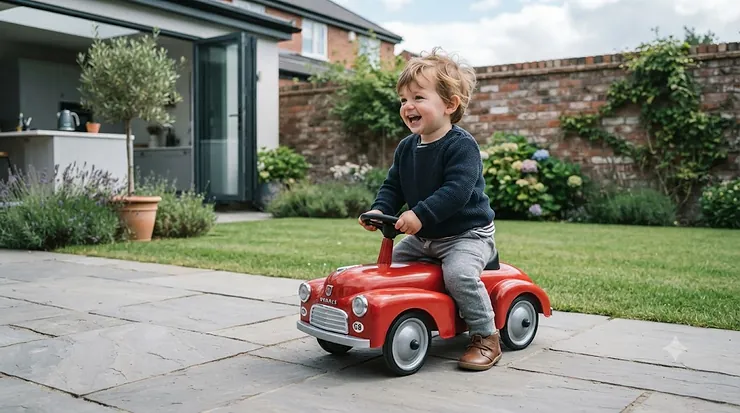
There’s a particular kind of chaos that arrives the moment a toddler discovers they can move themselves around the garden without holding your hand. It’s loud. It’s gleeful. It usually involves at least one flowerbed casualty. And more often than not, it starts with an outdoor foot-to-floor car.

If you’ve never bought one before, the sheer volume of options on Amazon.co.uk can feel like trying to choose a car for yourself, except with more primary colours and considerably more squeaking. An outdoor foot-to-floor car is a wheeled, non-electric ride-on toy that a toddler powers entirely with their own legs, pushing along the ground rather than pedalling or waiting for a battery. No motor, no charging cable, no waiting — just four wheels, a seat, and whatever speed those little legs can manage. They’re built to handle patios, decking and garden paths, which sets them apart from the softer, carpet-only sliders designed purely for indoors.
We’ve spent time researching the real models British parents are actually buying this year, pulling together genuine specs, aggregated review sentiment, and honest comparative analysis rather than a rehash of Amazon listings. You’ll find seven proper products here — budget, mid-range and premium — plus the practical stuff nobody puts on the box: which materials actually survive a British summer (or, let’s be honest, a British October), how to tell a genuinely useful foot-to-floor car from a flimsy one, and where this whole category sits next to push-along ride-ons and pricier electric alternatives.
Quick Comparison Table
Before the deep dive, here’s the shape of the market at a glance. Every product below is foot-to-floor (kid-powered, no batteries), suitable for outdoor use, and genuinely available on Amazon UK at the time of research.
| Product | Age Range | Best For | Price Range |
|---|---|---|---|
| Little Tikes Cozy Coupe | 18 months–5 years | All-round durability and longevity | £55–£75 |
| Little Smoby My First Ride-On Car | 10 months+ | Premium build, earliest starters | £45–£65 |
| HOMCOM 3-in-1 G350 Ride-On Slider | 12–36 months | Budget buyers wanting a licensed look | £30–£45 |
| Scramblebug 4-Wheel Balance Bike | 12–36 months | Omnidirectional balance practice | £25–£40 |
| Dolu Walk & Drive Foot-to-Floor Car | 12 months+ | Cheapest genuine entry point | £20–£32 |
| Aosom Ride Racer Sliding Car | 18–36 months | Lightweight garden cruising | £35–£50 |
| HOMCOM Goodyear-Licensed Quad Walker | 18–36 months | Branded design at a mid-range price | £38–£55 |
Looking across the table, the spread runs from around £20 for the simplest Dolu slider to the mid-£70s for the most heavily built Little Tikes Cozy Coupe. What’s striking is that price doesn’t map neatly onto durability here — the Little Smoby undercuts the Cozy Coupe on price while arguably matching it on build quality, largely because it’s a simpler shape with fewer moving parts to fail. Buyers chasing sheer toughness for daily garden use should weight the Cozy Coupe and Little Smoby above the lighter sliders, which are better suited to occasional or indoor-leaning use.
💬 Just one click — help others make better buying decisions too!😊
Top 7 Outdoor Foot-to-Floor Cars: Expert Analysis
We’ve grouped these across budget, mid-range and premium bands, covering plastic sliders, a balance-bike hybrid and the genre-defining classic. Every product name below is bolded on every mention so you can scan the page and find what you’re after.
1. Little Tikes Cozy Coupe — the 50-year benchmark for durability
The Little Tikes Cozy Coupe isn’t just a toy that’s been around a while — it’s arguably the reason “foot-to-floor car” is a recognisable category at all. The current model keeps the removable floorboard that made the original famous: leave it in and a parent can push via the rear handle, take it out and your toddler drives themselves. That flexibility means one purchase can realistically last from around 18 months right through to age five, which matters a lot when you’re weighing cost per year of use rather than cost at the till. The 360-degree spinning front wheels are the other standout feature — most budget sliders only turn within a narrow arc, so tight garden corners or a cramped patio can be genuinely frustrating for a small child still learning steering.
Weight capacity sits around 50lbs (roughly 22.5kg), which comfortably covers the toy’s full age range, and the moulded polyethylene body is the same rotational-moulding process used on outdoor garden furniture — thick-walled, UV-stabilised plastic designed to survive rain and sun rather than crack after one winter in the shed. Based on the spec comparison with lighter sliders in this list, the trade-off is weight: this is a heavier toy to lift over a doorstep, which matters if you’re moving it in and out daily.
Reviewers consistently report that the Cozy Coupe survives years of rough outdoor play — several UK buyers mention the toy still being in daily use after multiple children and multiple seasons, with the main wear point being sun-fading on the roof rather than structural failure. A recurring complaint is assembly: the doors and windscreen require more fiddly adult assembly than most sliders on this list.
Pros:
- ✅ Removable floorboard grows from push-along to foot-powered
- ✅ 360° front wheels handle tight garden corners easily
- ✅ UV-stabilised plastic built for years of outdoor use
Cons:
- ❌ Heavier to lift and carry than simpler sliders
- ❌ Assembly is more involved than most rivals here
At around £55–£75, the Little Tikes Cozy Coupe sits mid-to-premium, but the multi-year lifespan makes the cost-per-year figure genuinely competitive against toys half the price that need replacing within a season.

2. Little Smoby My First Ride-On Car — best premium pick for early starters
Where the Cozy Coupe waits until 18 months, the Little Smoby My First Ride-On Car is built for children from as young as 10 months, making it one of the earliest genuinely usable foot-to-floor cars on the UK market. French manufacturer Smoby designs and moulds its ride-ons domestically, and the “made in France” detail shows up repeatedly in UK buyer feedback as a marker of trust rather than marketing fluff. The low-slung seat height and front-and-rear anti-tip design are the two features that matter most in practice: a low centre of gravity means a wobbly, brand-new walker is far less likely to tip the car sideways than they would on a taller slider.
What most buyers overlook about this model is that its simplicity is the point — there’s no horn, no lights, no under-seat storage gimmick, just a compact, lightweight shell that’s easy for a small child to physically climb onto and dismount independently. That matters more than it sounds for a 10–12 month old still working out how their own legs function. Reviewers consistently report the ride-on as sturdy and safe for younger toddlers, with several noting the anti-tip bars specifically as reassuring for first-time walkers on uneven patio surfaces.
Pros:
- ✅ Usable from 10 months, earlier than most rivals
- ✅ Low seat height and anti-tip bars suit wobbly first walkers
- ✅ French manufacturing with a strong safety reputation
Cons:
- ❌ Fewer play features (no horn, lights or storage)
- ❌ Smaller size means an early outgrow for tall toddlers
Priced around £45–£65, the Little Smoby represents strong value for a European-made toy in this bracket — you’re paying for engineering restraint rather than bells and whistles, and for very young toddlers that’s exactly the right trade-off.
3. HOMCOM 3-in-1 G350 Ride-On Slider — best for budget buyers who still want branded styling
The HOMCOM 3-in-1 G350 Ride-On Slider takes a well-known luxury car silhouette and turns it into a sub-£45 toddler toy, and on paper this means families get the visual appeal of a “premium” design without the premium price tag. The three-in-one billing refers to its ability to function as a foot-to-floor walker, a slider, and a parent-push ride-on via the rear handle — functionally similar to the Cozy Coupe’s approach, just at a noticeably lower price point.
Key specs worth interpreting rather than just listing: the working steering wheel and horn are purely for engagement (they don’t affect actual steering), and the “3-in-1” storage compartment beneath the seat is small — useful for a couple of toy cars or a snack, not a full toy haul. The seat sits higher off the ground than the Little Smoby, which suits an 18-month-plus rider better than a very early walker. Aggregated customer sentiment on Amazon UK is strongly positive on value for money and ease of assembly, with several reviewers specifically praising how sturdy the toy feels for a boisterous two-to-three-year-old, though this is reported feedback rather than something we’ve verified hands-on.
Pros:
- ✅ Licensed styling at a genuinely low price point
- ✅ Three-in-one design: walker, slider and push-along
- ✅ Under-seat storage for small items
Cons:
- ❌ Higher seat height less suited to very early walkers
- ❌ Steering wheel is decorative, not functional
At around £30–£45, this is a sensible mid-budget pick when styling and brand-look matter as much as raw durability — just don’t expect the multi-year lifespan of the pricier options on this list.
4. Scramblebug 4-Wheel Balance Bike — best for omnidirectional balance practice
The Scramblebug 4-Wheel Balance Bike takes a genuinely different mechanical approach from every other product here: instead of standard front-and-rear wheels, all four castor wheels rotate a full 360 degrees, letting a toddler push themselves forwards, backwards or sideways from a single seated position. Here’s what to weigh: that design is brilliant for teaching balance and coordination in an open space like a garden or patio, but reviewers are split on how it performs on carpet or uneven ground, where the free-spinning castors can make directional control harder for the very youngest riders rather than easier.
The fold-and-go mechanism is a genuine practical win that most rivals lack — a simple three-click fold collapses it flat for storage in a car boot or hallway cupboard, which matters if you’re regularly taking it to a grandparent’s house or the park rather than leaving it permanently in the garden. Weight capacity sits around 20kg (44lbs), broadly in line with the rest of this list.
Aggregated review sentiment is genuinely mixed rather than uniformly glowing: several parents report their toddler mastering directional control quickly and loving the all-directions movement, while others — particularly with children under 15 months — report frustration with wheels that don’t track in a straight line. This is a toy that suits a slightly older, more coordinated toddler better than the very newest walkers.
Pros:
- ✅ Genuinely portable — folds flat in three clicks
- ✅ 360° castor wheels build multi-directional balance
- ✅ Non-scratch wheels safe for indoor-outdoor transitions
Cons:
- ❌ Castor steering can frustrate under-15-month riders
- ❌ Reviews are mixed on straight-line control
At roughly £25–£40, the Scramblebug is priced as a budget-to-mid option, and it earns that price primarily through portability rather than outright ruggedness — a fair trade for families short on storage space.
5. Dolu Walk & Drive Foot-to-Floor Car — cheapest genuine entry point
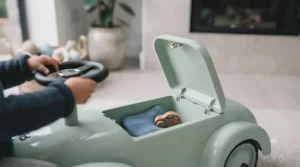
If your priority is simply getting a toddler outdoors on wheels without spending much, the Dolu Walk & Drive Foot-to-Floor Car is the most straightforwardly affordable option in this line-up. The racer-style shape strips things back to basics: a working horn, a lift-up seat revealing basic under-seat storage, and a rear handlebar for parent-assisted early walking. Based on the spec comparison with pricier rivals, what you’re sacrificing at this price is wheel size and ground clearance — smaller wheels cope less well with uneven paving slabs or garden gravel than the larger tyres on the Cozy Coupe.
The compact dimensions (roughly 37cm x 48cm x 21cm) make this one of the smallest cars on this list, which is genuinely useful for narrow hallways or small gardens but means taller toddlers will outgrow it faster than bulkier rivals. Reviewers consistently note it as good value and easy to assemble, with the working horn frequently mentioned as a hit with younger children, though a recurring theme in aggregated feedback is that the plastic feels noticeably lighter-duty than premium alternatives — a fair reflection of the price point rather than a design flaw.
Pros:
- ✅ The lowest genuine price point in this comparison
- ✅ Compact size suits small gardens and hallways
- ✅ Working horn and simple storage trunk included
Cons:
- ❌ Smaller wheels struggle on uneven outdoor surfaces
- ❌ Lighter plastic construction than premium rivals
At around £20–£32, the Dolu Walk & Drive is the sensible starter buy for parents unsure whether their toddler will take to foot-to-floor riding at all — low financial risk, reasonable functionality.

6. Aosom Ride Racer Sliding Car — best lightweight option for garden cruising
The Aosom Ride Racer Sliding Car sits in the middle of this list on both price and build, and its main selling point is genuine lightness — easy for a parent to carry one-handed while wrangling a toddler with the other. The anti-over-backward design is worth interpreting properly: it’s a small stabilising lip at the rear that stops the car tipping backward if a toddler drives it into an obstacle like a raised patio edge, which is a more common real-world garden hazard than most parents expect before they own one.
Under-seat storage, working horn, and optional light-up wheels (battery-powered separately from the foot-to-floor mechanism itself) round out the feature set. What most buyers overlook is that “foot-to-floor” toys like this one still list a nominal weight capacity around 55lbs (25kg), and going meaningfully over that changes the ride quality noticeably — the wheels sit lower and drag more on grass or gravel.
Aggregated reviews highlight the horn and lights as genuine hits with toddlers, alongside praise for how easy the car is for small children to physically climb into given its low seat height. A consistent theme across garden-toy reviews in this bracket is that anti-tip features specifically reduce parental anxiety about outdoor use on sloped or uneven ground.
Pros:
- ✅ Genuinely lightweight — easy for parents to carry
- ✅ Anti-tip design suited to uneven patio edges
- ✅ Low seat height for easy independent mounting
Cons:
- ❌ Ride quality drops noticeably near weight capacity
- ❌ Light-up wheel feature needs separate batteries
Priced around £35–£50, the Aosom sits as a solid mid-range choice for families whose garden includes slopes, raised edges or uneven ground where anti-tip design earns its keep.
7. HOMCOM Goodyear-Licensed Quad Walker — best branded design at a mid-range price
Rounding out the list, the HOMCOM Goodyear-Licensed Quad Walker brings officially licensed styling from tyre brand Goodyear to the foot-to-floor category, aimed at slightly older toddlers who respond well to recognisable, “grown-up” branding. Unlike the electric Goodyear-branded ride-ons HOMCOM also sells, this is a genuine no-battery, foot-powered model — worth double-checking at purchase, since HOMCOM’s Goodyear range spans both powered and unpowered toys under similar naming.
The quad-bike shape (four visible wheels rather than a car-style enclosed body) gives a slightly wider stance than the sliders on this list, which translates into noticeably better lateral stability — useful for toddlers who lean or reach while riding rather than sitting perfectly still. Reviewers consistently describe the build as sturdy for its price bracket, with the officially licensed detailing frequently mentioned as a genuine draw for parents buying for car-obsessed toddlers specifically.
Pros:
- ✅ Wide quad stance improves lateral stability
- ✅ Officially licensed Goodyear branding and detailing
- ✅ Suits slightly older, more active toddlers well
Cons:
- ❌ Naming overlaps with HOMCOM’s powered range — check carefully
- ❌ Wider stance needs more storage space than sliders
At roughly £38–£55, this sits comfortably in the mid-range band, and the value verdict depends heavily on whether branded detailing matters to your household — functionally, it performs similarly to the cheaper HOMCOM G350 slider above.
Practical Usage Guide: Getting the Most From Your Outdoor Foot-to-Floor Car
Buying the toy is the easy part. A few genuinely useful habits make the difference between a foot-to-floor car that lasts three seasons and one that’s cracked plastic in a skip by next spring.
First-use setup matters more than most parents expect. Most models arrive with some assembly required — wheels, handlebars or a floorboard clicking into a moulded base — and it’s worth doing this on a flat, hard surface rather than carpet, since misaligned wheel axles are a common early fault that only becomes obvious once weight is on the seat. Check every screw or clip against the instructions before your toddler ever sits in it; a loose rear axle is the single most reported early failure across foot-to-floor cars generally.
For the first 30 days, expect a steep and occasionally frustrating learning curve. Most toddlers under two years old need several sessions of guided practice — a hand on the back of the seat, gentle verbal encouragement about pushing with both feet together — before genuine independent movement clicks. Don’t be discouraged if week one looks more like sitting still than driving; foot-to-floor control is a genuinely new coordination skill, not an extension of walking.
Maintenance is minimal but not zero. Wipe down seats and steering wheels weekly if the car lives outdoors permanently — pollen, grass clippings and rainwater residue build up in seams and can make plastic surfaces slippery. Check wheel axles for grit build-up every few weeks; a stiff-turning wheel is very often just compacted garden debris rather than a mechanical fault, and a quick wipe with a damp cloth usually resolves it. Store the car under cover overnight where possible — UV exposure is the single biggest driver of plastic fading and brittleness over a British summer, even on the UV-stabilised models reviewed above.

Real-World Scenarios: Which Foot-to-Floor Car Suits Your Family
Specs only tell half the story — how a toy fits your actual daily life matters just as much. Here are three common household situations matched to sensible picks, with the reasoning behind each.
If you’re a parent in a first-floor flat with a small shared garden and limited storage, the compact footprint and fold-flat design of the Scramblebug or the small dimensions of the Dolu Walk & Drive make more practical sense than the bulkier Cozy Coupe — you need something that tucks into a hallway cupboard between uses, not a permanent garden fixture.
If you’re raising a very early walker — say, a confident 11-month-old who’s already cruising along furniture — the Little Smoby‘s low seat height and anti-tip bars are specifically designed for exactly this stage, where a taller or heavier toy risks tipping before the child has full trunk control.
If you have an active two-to-four-year-old who treats the garden like a race track and goes through toys fast, the Little Tikes Cozy Coupe‘s heavier-duty plastic and multi-year age range make it the toy least likely to need replacing mid-season — the higher upfront cost is offset by not repurchasing a flimsier model after six months of daily hammering.
Problem → Solution: Common Foot-to-Floor Car Headaches Solved
A few recurring issues come up again and again in aggregated review feedback across this category — here’s how to handle each one practically.
Problem: the car won’t move in a straight line. This is almost always either uneven ground (grass, gravel, sloped patios) or a genuinely different steering mechanism, as with the Scramblebug’s 360° castors. Try practice sessions on a flat hard surface like a garage floor or decking first, before expecting straight-line control on grass.
Problem: my toddler keeps tipping the car sideways. Look for anti-tip design specifically — both the Little Smoby and Aosom Ride Racer build this in. If you already own a model without it, restricting early use to flat, obstacle-free areas until balance improves is the safest fix.
Problem: the plastic has faded or gone brittle after one summer. UV exposure is the culprit almost every time. Covering the toy overnight, or storing it in a shed or under a garden furniture cover during heatwaves, meaningfully slows this down — even UV-stabilised plastics benefit from reduced constant exposure.
Problem: wheels have gone stiff or squeaky. Grit and grass debris in the axle housing is the near-universal cause. A damp cloth wipe, followed by a drop of silicone-based lubricant (never oil-based, which attracts more dirt) on the axle, usually resolves it within minutes.
How to Choose an Outdoor Foot-to-Floor Car
Working through these seven criteria in order will get most families to the right decision faster than scrolling star ratings alone.
- Match age to seat height, not just the box label. A confident 12-month-old walker may cope fine with a slightly taller seat than a cautious 20-month-old — physical readiness varies more than age alone suggests.
- Check the ground your toddler will actually ride on. Uneven paving or sloped gardens favour larger wheels and anti-tip design; flat decking or smooth patios are more forgiving.
- Weigh storage space honestly. A fold-flat design like the Scramblebug earns its keep in small gardens or flats; a permanent garden fixture like the Cozy Coupe needs somewhere dry to live.
- Prioritise wheel size for outdoor-heavy use. Smaller wheels (as on budget sliders) struggle more on gravel or grass than the larger tyres on premium models.
- Decide whether push-along function matters. If you’ll be walking your toddler on pavements or park paths, a rear handle for parent-assisted push is worth prioritising over a pure slider.
- Factor in siblings and resale. Heavier-duty plastic (Little Tikes, Little Smoby) tends to survive being handed down; budget sliders more often don’t make it to a second child intact.
- Set a realistic weight capacity buffer. Buying for current size alone often means an outgrow within a year — checking the upper weight limit against expected growth avoids an early repurchase.
Cheapest Foot-to-Floor Ride-On Cars: Smart Budget Picks
If cost is the main constraint, it’s worth being precise about what “cheapest” actually buys you, because the gap between the lowest and highest prices on this list is genuinely significant — roughly £20 versus £75.
| Budget Product | Price Range | What You Gain | What You Sacrifice |
|---|---|---|---|
| Dolu Walk & Drive | £20–£32 | Lowest entry cost, compact size | Smaller wheels, lighter plastic |
| Scramblebug 4-Wheel Balance Bike | £25–£40 | Portability, balance development | Mixed reviews on directional control |
| HOMCOM 3-in-1 G350 Slider | £30–£45 | Licensed styling, 3-in-1 function | Decorative-only steering wheel |
Here’s what to weigh honestly: the cheapest foot-to-floor ride-on car on this list, the Dolu Walk & Drive, is a genuinely sensible first purchase for parents unsure whether their toddler will take to the toy at all, precisely because the financial risk is low. Where cheap options tend to fall short isn’t safety — all the products here meet UK toy safety requirements — it’s longevity on rough outdoor terrain. Reviewers consistently note that budget sliders cope fine on smooth patios and decking but show wear faster on gravel driveways or uneven grass than the heavier-duty Cozy Coupe or Little Smoby. If your garden is mostly flat and smooth, a cheap slider is genuinely good value; if it’s gravel, slope or uneven paving, spending a little more upfront on wheel size and build quality tends to work out cheaper over two to three years than replacing a budget model twice.
✨ Don’t Miss These Exclusive Deals!
🔍 Take your outdoor toddler play to the next level with these carefully selected products. Click on any highlighted item to check current pricing and availability. These toys will help create authentic outdoor adventures your family will love!
Foot-to-Floor Car vs Push Along Ride-On
This is one of the most common points of confusion for first-time buyers, and it’s worth a proper written comparison rather than just a table, because the two categories solve genuinely different problems.
A foot-to-floor car is entirely child-powered — the toddler sits and pushes with their own legs, with no assistance mechanism beyond an optional parent handle for early support. A push-along ride-on, by contrast, is specifically designed around a detachable parent handle as its primary function: the adult steers and controls speed while the child sits, and the toy typically converts to standard ride-on mode only once the handle is removed. Several products in this list — the Cozy Coupe, the HOMCOM G350, and the Dolu — technically span both categories via a removable floorboard or handle, which is exactly why “3-in-1” labelling shows up so often in this market.
| Factor | Foot-to-Floor Car | Push Along Ride-On |
|---|---|---|
| Who controls movement | Child, entirely | Parent, via handle |
| Best age to start | 10–18 months+ | 6–12 months+ |
| Develops | Leg strength, independent balance | Confidence being wheeled, early steering exposure |
| Best For | Confident early walkers | Very early walkers, pavement walks |
The practical takeaway from this comparison: a pure push-along ride-on suits families who want to use the toy on actual walks — to the shops, round the block — where a parent needs full control near traffic or kerbs. A pure foot-to-floor car suits garden and patio use where independent, self-directed movement is the whole point. The hybrid “3-in-1” models on this list are the sensible middle ground for most UK households, since they let you start with parent control on pavements and switch to independent foot-power once your toddler’s confidence catches up — though it’s worth checking the UK’s Toys (Safety) Regulations 2011 guidance if you’re ever unsure whether a specific hybrid model meets current requirements, since manufacturers publish full compliance documentation as standard for anything sold legally on Amazon UK.
Garden Toys: Building an Outdoor Play Zone Around Your Foot-to-Floor Car
An outdoor foot-to-floor car rarely works best in isolation — it tends to get far more use as part of a small, deliberately arranged garden toys zone rather than left to roam a whole lawn unsupervised. A flat, hard-standing area — decking, a patio, or a dedicated rubber play mat — gives the most consistent ride quality across every product on this list, since grass and gravel both slow wheels and increase tipping risk regardless of anti-tip design.
Positioning matters more than most parents initially think. Keep the riding area away from steps, ponds, or anywhere with a drop, even a small one — toddlers steering a new toy for the first time have minimal spatial awareness of hazards behind or beside them. A low fence, hedge line or simply the boundary of a patio slab works well as a natural “track edge” that keeps early rides contained without needing constant redirection.
Combining a foot-to-floor car with complementary garden toys — a low balance beam, a soft-surface ball pit, or simple cone markers for a mini obstacle course — extends genuine play value considerably. Reviewers across this category consistently mention that toddlers lose interest in a ride-on toy faster when it’s the only outdoor option available, and regain enthusiasm quickly when it becomes one element of a rotating outdoor play routine rather than the sole attraction.
Outdoor Toddler Play: Why Foot-to-Floor Cars Matter for Development
There’s a genuine developmental case for outdoor toddler play beyond simply tiring a small child out before nap time, and foot-to-floor cars sit squarely within it. UK physical activity guidance recommends that toddlers aged one to two years should be physically active for at least 180 minutes — three hours — spread across the day, with outdoor play specifically highlighted as one of the most effective ways to reach that target, according to NHS guidance on physical activity for children under five.
A foot-to-floor car contributes to that total in a genuinely different way from walking or running: the repetitive leg-pushing motion specifically strengthens the same large muscle groups used in walking and eventually pedalling a tricycle, while the seated, self-directed steering builds coordination and spatial awareness that free-form running doesn’t develop as directly. What most parents overlook is that outdoor use specifically — rather than the same toy used indoors on carpet — adds meaningful resistance from grass, gravel or slightly uneven ground, which in practice means more genuine leg-strengthening effort per session than an equivalent indoor slide across a smooth floor.
There’s also a confidence dimension worth naming honestly. Toddlers who struggle with unassisted walking often show noticeably more willingness to attempt independent movement in a seated, stable foot-to-floor car than on their own two feet, precisely because a fall risk is lower. Several models on this list — particularly the anti-tip Little Smoby and Aosom — are specifically designed around that early-confidence use case rather than pure play value.
Durable Ride-On Materials: What Actually Survives Garden Play
Not all “outdoor-rated” plastic is equal, and understanding the difference genuinely changes which product makes sense for your garden specifically.
The premium end of this list — the Little Tikes Cozy Coupe and Little Smoby — both use rotationally moulded, thick-walled polyethylene, the same manufacturing process used for outdoor garden furniture and industrial containers. This process produces a single-piece shell with no seams to crack and genuinely UV-stabilised additives mixed into the plastic itself rather than sprayed on as a coating, which is why these two models consistently show the least fading and brittleness in long-term outdoor use according to aggregated reviewer feedback.
Budget sliders like the Dolu and HOMCOM G350 more commonly use injection-moulded ABS or polypropylene, which is lighter, cheaper to produce, and perfectly serviceable for occasional or covered outdoor use, but noticeably more prone to UV-related brittleness with permanent, uncovered outdoor storage over multiple seasons. This isn’t a safety issue — every product reviewed here meets current UK toy safety standards — it’s a longevity trade-off that’s worth knowing before you buy rather than discovering after a season outdoors.
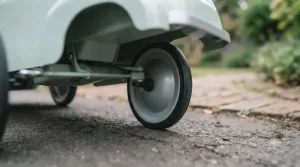
Wheel material matters just as much as body plastic. Solid rubber or dense polyurethane wheels, as used on the Cozy Coupe, resist cracking on gravel and rough paving far better than the harder, hollow plastic wheels found on several budget sliders, which can develop flat spots or hairline cracks after regular use on abrasive surfaces. If your garden includes gravel, exposed brick, or unfinished paving, wheel material is genuinely worth prioritising over body plastic thickness alone.
Common Mistakes When Buying an Outdoor Foot-to-Floor Car
A handful of avoidable errors come up repeatedly in aggregated buyer feedback across this category, and most are easy to sidestep once you know to look for them.
Buying purely on age label rather than actual physical readiness is the most common misstep — a toy labelled “12 months+” assumes a confident early walker, not every 12-month-old. Cross-check seat height and weight against your own child’s current size and coordination rather than the box alone. Choosing a permanent outdoor-only model without checking wheel material is another frequent regret, particularly for gravel or unfinished-paving gardens, where budget wheels wear noticeably faster than reviewers initially expect. Skipping the assembly instructions in favour of “it looks obvious” is a surprisingly consistent source of early wheel or axle faults — several reported “wobbly wheel” complaints across this category turn out to be assembly errors rather than manufacturing defects. Finally, underestimating storage needs catches many first-time buyers out: a bulky, non-folding car left permanently outdoors fades and weathers considerably faster than one stored under cover between uses, even when the plastic itself is genuinely UV-stabilised.
Safety, Regulations & Compliance Guide
Every product covered in this guide is required to meet the UK’s Toys (Safety) Regulations 2011, which set essential safety requirements covering mechanical strength, choking hazards from small parts, and material toxicity before any toy can legally be sold in Great Britain, whether it carries a UKCA or CE mark. The full legal detail is set out in the Toys (Safety) Regulations 2011 on legislation.gov.uk, which businesses selling toys are required to comply with regardless of where the toy is manufactured.
In practice, this means checking for a UKCA or CE mark on the packaging, along with the manufacturer’s name and address — both are legal requirements, not optional extras, and their absence is a genuine red flag on unfamiliar or unbranded listings. For ride-on toys specifically, safe use guidance consistently emphasises supervising young children closely during early use, checking the toy is genuinely the correct size for the child rather than “growing into it,” and keeping an eye on other children nearby who could trap fingers under moving wheels or rockers.
Outdoor-specific safety considerations worth applying to every product on this list: check the riding surface is free of steps, drops or standing water before independent play begins, and inspect wheel axles periodically for wear, since a toy that’s structurally sound when new can develop hazards over seasons of outdoor exposure that indoor-only toys never encounter. For broader guidance on managing safe outdoor play spaces generally, RoSPA’s Play Safety resources offer detailed practical advice beyond what fits in a single product-focused guide.
Long-Term Cost & Maintenance
Thinking about total cost of ownership rather than sticker price alone changes the value ranking on this list meaningfully.
A £25 budget slider that needs replacing after one summer due to UV brittleness costs more over three years than a £65 Little Smoby or £70 Little Tikes Cozy Coupe bought once and handed down to a younger sibling. Running the numbers roughly: two budget replacements over three years lands around £50–£65 total — comparable to, or more than, a single premium purchase that lasts the same period and potentially longer.
Maintenance costs are genuinely minimal across this entire category — there’s no battery replacement, no charging infrastructure, and no motor servicing, which is one of foot-to-floor cars’ clearest advantages over electric ride-ons. The only recurring cost is time: a few minutes of wheel-axle cleaning every few weeks, and occasional silicone lubricant, which costs pennies across a toy’s lifespan. Resale or hand-down value is where premium models pull further ahead — heavier-duty plastic and solid wheels genuinely survive a second child’s use in a way budget sliders more rarely manage, meaningfully improving the effective cost-per-child for larger families.
Frequently Asked Questions
❓ What age is best for an outdoor foot-to-floor car?
❓ Are foot-to-floor cars safe on grass and gravel?
❓ How long do outdoor ride-on cars typically last?
❓ Can a foot-to-floor car double as a push along ride-on?
❓ Do outdoor foot-to-floor cars need a UKCA or CE mark?
Conclusion
There’s no single “best” outdoor foot-to-floor car — there’s a best one for your child’s age and confidence, your garden’s surface, and how much storage space you’re realistically willing to give up. For sheer longevity and all-round durability, the Little Tikes Cozy Coupe remains the benchmark the rest of this category gets measured against. For the earliest walkers, the Little Smoby‘s low, stable design is genuinely purpose-built rather than a scaled-down version of a toy meant for older toddlers. And if you’re simply not sure your toddler will take to independent riding yet, the Dolu Walk & Drive offers a low-risk way to find out without a big financial commitment.
What matters most across every product reviewed here is matching the toy to where it’ll actually live and ride — a flat decked garden opens up almost every option on this list, while gravel or uneven paving genuinely narrows the field toward larger wheels and thicker plastic. Whichever you choose, the core value is the same: proper outdoor movement, at a toddler’s own pace, powered by nothing more complicated than their own determination to keep up with the family dog.
Recommended for You
- 7 Best First Ride-On Car for Toddlers Picks: 2026 UK Guide
- 7 Best Wooden Animal Ride-On Picks for Toddlers (2026 UK Guide)
- Rolling Plush Animal Ride-On: 7 Best Picks for 2026 (Tried; Tested Research)
Disclaimer: This article contains affiliate links. As an Amazon Associate, I earn from qualifying purchases. If you purchase products through these links, we may earn a small commission at no additional cost to you.
✨ Found this helpful? Share it with your friends! 💬🤗
