
In This Article
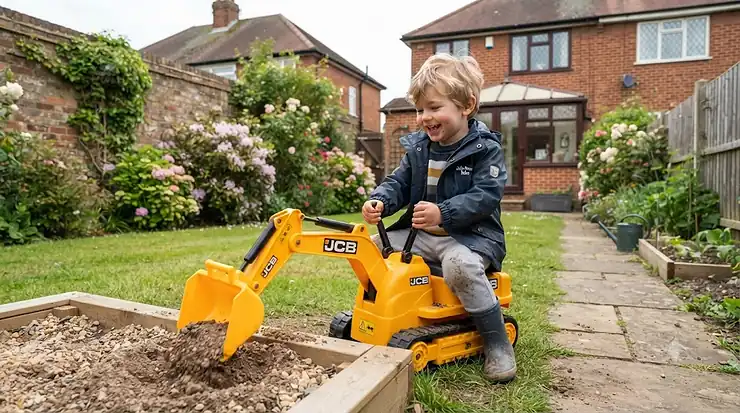
There’s a very specific sound every parent of a small, mud-obsessed human learns to recognise: the “vroom-scoop-vroom” of a plastic bucket dragging across the patio at 7:42am. If you’re here, you already know it. You’re either standing in the rubble of a decision (there are approximately four hundred options and they all look the same in thumbnail form), or you’re simply trying to work out whether a ride on digger toy is worth the space it’ll take up next to the trampoline nobody uses in January.
So, what is a ride on digger toy? It’s a construction-themed ride-on vehicle, styled after a real excavator or JCB, that lets a child sit or stand while operating a working bucket, arm, or scoop — usually through hand levers, pedals, or in electric models, a steering wheel and foot pedal. Some are foot-to-floor scooters with a digging attachment, others are full battery-powered machines with a working boom.
The market genuinely has changed since your own childhood tractor. Modern kids excavator ride on models now come in manual, pedal, and 12V electric formats, several are officially licensed by CAT or JCB, and UK safety standards have tightened considerably (more on that later — it matters more than the marketing photos let on). Below, we’ve dug through (sorry, not sorry) seven real, currently available products, weighed their genuine strengths against their genuine compromises, and built out a proper buying framework so you’re not gambling £150 on a guess.
Quick Comparison Table
Before the deep dive, here’s the fast version for anyone reading this one-handed while a toddler tugs at their sleeve.
| Product | Power Type | Best For | Price Range |
|---|---|---|---|
| HOMCOM Licensed CAT Kids Ride-On Digger Excavator | Manual (foot-to-floor) | Budget-conscious first-timers | Under £45 |
| Little Tikes Dirt Diggers 2-in-1 Excavator | Manual | Toddlers who want ride-on + real digging | £35-£50 range |
| Best Ride On Cars CAT Excavator Push Car | Manual, push/lights/sound | Sensory play and imaginative fans | £70-£90 range |
| Costway 12V Kids Ride-On Excavator Digger | 12V electric | Families wanting an electric ride on digger UK option | £150-£220 range |
| Rolly Toys JCB Backhoe Loader Ride-On | Pedal-powered | Older, active kids who want realism | £150-£200 range |
| Little Tikes Dirt Diggers Excavator Sandbox | Manual, static sandpit | Sandpit excavator toys / garden digging zones | £90-£130 range |
| HOMCOM 3-in-1 Ride-On Excavator Pull Cart | Manual, no-power | Younger toddlers just learning to walk | Under £45 |
A quick read of that table tells its own story: price roughly tracks with realism and power source, not with brand hype. The HOMCOM Licensed CAT Kids Ride-On Digger Excavator and the HOMCOM 3-in-1 Ride-On Excavator Pull Cart sit at the entry point because they’re simple, no-battery designs aimed at very young toddlers, while the Costway 12V Kids Ride-On Excavator Digger and Rolly Toys JCB Backhoe Loader Ride-On cost more because you’re paying for a drivetrain, not just a shell. If your child is under three, resist the urge to jump straight to the priciest option — as we’ll cover below, the manual models often suit that age bracket better anyway.
💬 Just one click — help others make better buying decisions too!😊
Top 7 Ride On Digger Toys: Expert Analysis
We picked these seven specifically to span budget, mid-range, and premium tiers, plus the different play styles (manual, pedal, electric, static sandpit) that actually matter when you’re choosing for a specific child rather than a generic “best digger.”
1. HOMCOM Licensed CAT Kids Ride-On Digger Excavator — best budget pick for toddlers
The standout here is the CAT licence on a genuinely low price point, which is rarer than you’d think in this category. Aimed at children roughly 1-3 years old, this foot-to-floor ride-on has a long arm with a shovel bucket, operated via hand levers, plus a horn and under-seat storage. Dimensions run around 85cm long by 47.5cm tall, with a seat height of roughly 24.5cm from the ground — low enough that a wobbly toddler isn’t climbing far to get on.
Based on the spec comparison against similar entry-level models, the appeal is simplicity: no batteries to charge, no assembly headache beyond bolting on wheels and a seat, and a genuinely low barrier to entry for parents who aren’t sure their toddler will stick with the “digger phase.” What most buyers overlook is that the manual lever action, not the ride-on part, is what actually holds toddler attention longest — repetitive scoop-and-dump is the addictive bit.
Reviewers consistently report that assembly is straightforward and that the horn is the single most-used feature (for better or worse, depending on your tolerance for beeping). A recurring theme in aggregated feedback is that the plastic wheels can feel slippery on smooth indoor flooring, so this one performs best outdoors or on carpet.
Pros:
- ✅ Officially CAT-licensed at a genuinely low price
- ✅ No batteries or charging required, ever
- ✅ Low seat height suits younger, less confident toddlers
Cons:
- ❌ Plastic wheels can slip on hard indoor floors
- ❌ Weight capacity limits it to roughly ages 1-3
Priced under £45 in most listings, this is squarely a value buy, and the value case is strong provided you’re shopping for a genuine toddler rather than a five-year-old who’ll outgrow it within a season.
2. Little Tikes Dirt Diggers 2-in-1 Excavator — best 2-in-1 ride-on and digging tool
This one’s standout feature is genuinely clever: it’s not just a toy that looks like a digger, it’s a functional shovel your child can detach and use as an actual sand tool, then reattach for ride-on play. That dual-purpose design is the reason it earns its spot on this list over some flashier-looking alternatives.
Built for children aged two and up, it’s designed for both indoor and outdoor use, with a durable build that Little Tikes is well known for across its wider ride-on range. The removable scoop transforms the whole toy from a foot-powered ride-on into a stand-alone digging tool, which extends its useful life well beyond a typical single-mode ride-on.
Here’s what to weigh: because it’s built as much for beach and sandbox digging as it is for riding, it’s arguably the most versatile toy on this list for families who split play time between the garden and actual sand. Reviewers frequently note that the build quality holds up to genuinely rough outdoor use over multiple seasons, which is a meaningful data point in a category where flimsy plastic is a common complaint.
Pros:
- ✅ Doubles as a real, detachable digging tool
- ✅ Durable build rated for years of outdoor use
- ✅ Works equally well in sand, dirt, or as a ride-on
Cons:
- ❌ Less “realistic” looking than licensed CAT or JCB models
- ❌ No steering wheel, so movement is purely foot-powered
Sitting in the £35-£50 range, this is arguably the smartest all-rounder purchase on this list if your household genuinely wants one toy to cover both digging and riding duties.
3. Best Ride On Cars CAT Excavator Push Car — best for imaginative sound-and-lights play
The standout feature is the interactive steering wheel with built-in music and horn sounds, which pushes this beyond a purely physical toy into sensory, imaginative territory. It’s officially licensed CAT construction gear, aimed at children roughly one to three years old, with a functional front bucket for scooping and dumping.
Key specs worth knowing: under-seat storage for stashing small toys mid-play, a sturdy backrest for extended sitting sessions, and a foot-to-floor design (no pedals or battery) so a toddler propels it with their own legs while steering with the wheel. On paper this means it behaves more like a ride-on toy with a digger bolted on, rather than a true excavator simulator — which is exactly the point for this age group.
What most buyers overlook about this model is that the sound features, while fun in the shop, are genuinely the thing that determines whether a toddler engages with it repeatedly at home. Aggregated review sentiment for this product line skews strongly positive on durability and the horn/music combo, with the most common complaint being that the sounds can grate on adult ears after the fortieth repetition of the day.
Pros:
- ✅ Interactive steering wheel with music and horn
- ✅ Officially licensed CAT branding and styling
- ✅ Under-seat storage for toys and treasures
Cons:
- ❌ Sound features may irritate parents over long play sessions
- ❌ Foot-to-floor only, no pedal-drive option
Typically priced in the £70-£90 range, it sits comfortably mid-table — a step up from the most basic push-diggers, but well short of pedal or electric territory.
4. Costway 12V Kids Ride-On Excavator Digger — best electric ride on digger UK pick
If you’ve been specifically hunting for an electric ride on digger UK buyers can actually get hold of, this is the standout in that category. The 12V battery-powered build gives genuine forward/reverse driving, a steering wheel, and a foot pedal accelerator, alongside a manually adjustable digging bucket operated via a control lever.
The battery, motor, and remote setup mean this isn’t just “sit and push” — it’s a proper ride-on vehicle in miniature. It’s UKCA certified, includes LED headlights, a horn, and a media player, and — usefully for anxious parents — a 2.4G parental remote control with a slow-start function so the vehicle can’t lurch forward unexpectedly. Reviewers consistently note the remote control as the single most valued safety feature, since it lets an adult intervene before a child drives into a flowerbed at speed.
Here’s what the spec sheet won’t tell you outright: the safe top speed is roughly 1.6-2.2mph, which sounds slow on paper but feels genuinely brisk to a three-year-old the first time they floor the pedal. Aggregated feedback also flags that charging takes several hours for a play session of around 1-1.5 hours, so it’s not an all-day toy without planning ahead.
Pros:
- ✅ Genuine 12V drive with forward/reverse control
- ✅ Parental 2.4G remote override for safety
- ✅ UKCA certified with slow-start function
Cons:
- ❌ Requires 8-12 hours of charging for ~1.5 hours of play
- ❌ Meaningfully heavier and bulkier than manual models
Expect to pay in the £150-£220 range depending on retailer and bundle, which reflects the added cost of the motor, battery, and remote hardware.
5. Rolly Toys JCB Backhoe Loader Ride-On — best premium pedal-powered digger
The standout advantage is authenticity: this is an officially licensed JCB backhoe loader with a fully functional front loader and rear excavator arm, both operated through separate hand levers, on a genuinely chain-driven pedal system rather than a simple push-along frame.
Aimed at children aged three and up, the covered integral chain drive is a real engineering touch — it protects little fingers from the moving chain while still delivering an authentic pedal-power experience closer to a go-kart than a toy. The chunky steering wheel and anti-slip pedals are built for active, physically engaged play rather than passive sitting.
Based on the spec comparison with other pedal-driven ride-ons, this is the most physically demanding option on the list, which is precisely why it suits an older, more energetic child better than a two-year-old. Reviewers frequently highlight the dual-function loader-and-backhoe setup as genuinely engaging for years, not weeks, because there’s enough mechanical complexity to keep growing children interested as their fine motor skills develop.
Pros:
- ✅ Officially licensed JCB design with dual loader/backhoe
- ✅ Genuine chain-driven pedal power, not push-along
- ✅ Chain guard protects fingers during pedalling
Cons:
- ❌ Requires real leg strength, unsuitable for under-3s
- ❌ Assembly is more involved than simpler ride-ons
Typically priced in the £150-£200 range, this sits at the premium end for a manual (non-electric) toy — the cost reflects genuine mechanical engineering rather than branding alone.
6. Little Tikes Dirt Diggers Excavator Sandbox — best sandpit excavator toy
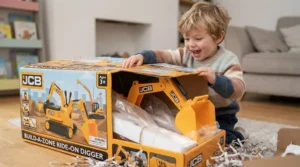
This is the one dedicated entry on the list for anyone specifically searching sandpit excavator toys rather than a ride-on. The standout feature is the working excavator arm built directly into the sandbox lid, which doubles as a truck ramp when closed — genuinely dual-purpose design rather than a gimmick.
Holding up to roughly 46kg of play sand (not included), it comes with six sand accessories plus an exclusive Dirt Digger vehicle, giving a child a proper contained construction site rather than sand scattered across the entire garden. Because it’s a static unit rather than a ride-on, the play pattern shifts from “driving around” to “building and excavating in place,” which suits children who prefer focused, repetitive fine-motor play over full-body movement.
What the spec sheet won’t tell you, but parent reviews consistently mention, is that the lid genuinely earns its keep — closing a sandbox properly is the single biggest factor in keeping local cats and rainwater out, and a lid that doubles as a ramp means it doesn’t get left open “just for five minutes” as often. Reviewers do note that filling 46kg of sand is a genuine one-off task worth planning for, ideally with a helper and a wheelbarrow rather than bag by bag.
Pros:
- ✅ Dual-purpose lid works as a truck ramp
- ✅ Includes six accessories plus a bonus digger toy
- ✅ Holds a substantial amount of play sand for group play
Cons:
- ❌ Sand not included, and 46kg is a serious top-up job
- ❌ Static design, so no ride-on or driving element
Priced in the £90-£130 range, it’s a genuinely different category of purchase to the ride-ons above — better thought of as a construction-themed sandpit than a vehicle.
7. HOMCOM 3-in-1 Ride-On Excavator Pull Cart — best value pull-along for younger toddlers
The standout feature is genuine flexibility for the very youngest users: this model doubles as a toddler walker and a construction excavator, so a child who isn’t yet confidently walking can use it to steady themselves while also operating the digging bucket.
Aimed broadly at 18-48 months, it includes a scooping bucket with real working dual-action levers, a horn requiring no battery, and — critically for early walkers — double anti-fall protection with a high backrest and an anti-rollover device at the base. There’s also under-seat storage that doubles, somewhat charmingly, as a sand or water container.
Based on the spec comparison against the CAT-licensed HOMCOM model above, this one leans further into the “walker” use case rather than pure ride-on play, which is exactly why it suits a slightly younger age bracket. Reviewers consistently report that the anti-rollover design genuinely reduces tip-over incidents compared with simpler ride-on shells, which matters most in this youngest user bracket where balance is still developing.
Pros:
- ✅ Doubles as a toddler walker and digger toy
- ✅ Anti-fall backrest and anti-rollover base design
- ✅ Under-seat storage box for sand, water, or toys
Cons:
- ❌ Best suited to a narrow, younger age window
- ❌ Less durable long-term than pedal or electric options
Sitting under £45 in most listings, it directly competes with the first HOMCOM model on this list, and the choice between them really comes down to whether your toddler is still finding their feet (this one) or already confidently walking (the CAT-licensed alternative).
Full Spec Comparison
| Product | Age Range | Key Mechanism | Best For |
|---|---|---|---|
| HOMCOM Licensed CAT Kids Ride-On Digger Excavator | ~1-3 years | Hand-lever bucket, foot-to-floor | Budget-first toddlers |
| Little Tikes Dirt Diggers 2-in-1 Excavator | 2+ years | Detachable digging scoop | All-rounder digging + riding |
| Best Ride On Cars CAT Excavator Push Car | ~1-3 years | Push, steering wheel with sound | Sensory/imaginative play |
| Costway 12V Kids Ride-On Excavator Digger | 3-8 years | 12V motor, remote override | Electric ride on digger UK shoppers |
| Rolly Toys JCB Backhoe Loader Ride-On | 3+ years | Pedal chain drive, dual levers | Active older toddlers |
| Little Tikes Dirt Diggers Excavator Sandbox | 2+ years | Static excavator arm | Sandpit excavator toys fans |
| HOMCOM 3-in-1 Ride-On Excavator Pull Cart | 18-48 months | Walker + digger hybrid | Youngest, early walkers |
Reading across this table, the age range column is genuinely the most decision-relevant data point — far more than price. Notice that the Costway 12V Kids Ride-On Excavator Digger and the Rolly Toys JCB Backhoe Loader Ride-On both target the 3+ bracket, meaning the electric-versus-pedal decision at that age comes down to how much you value convenience over physical activity, not which one is “better” outright.
✨ Don’t Miss These Exclusive Deals!
🔍 Take your ride on digger toy search to the next level with these carefully selected products. Click on any highlighted item to check current pricing and availability. These tools will help you create authentic construction-site adventures your family will love!
Ride On Digger Toys for Toddlers: What Really Matters at This Age
Buying for a toddler is a genuinely different exercise to buying for a five-year-old, even though the products often sit on the same shelf. Ride on digger for toddlers searches almost always come down to three practical questions: can they get on and off unaided, is there a real risk of tipping, and will the lever action actually be within their strength range.
Seat height is the first filter worth applying. A toddler under 30 months typically struggles with a seat higher than around 25cm off the ground — anything taller and you’re lifting them on and off constantly, which defeats the “independent play” point of a ride-on in the first place. Both HOMCOM models on this list, along with the Best Ride On Cars push car, sit in that lower bracket for exactly this reason.
Second, anti-rollover and anti-fall features aren’t marketing fluff at this age — a toddler’s centre of gravity is genuinely higher relative to their height than an older child’s, so a wide wheelbase and a backrest that actually locks in place make a measurable difference to how often they tip backwards mid-lever-pull. Reviewers consistently flag this as the difference between a toy that gets used daily and one that gets shoved to the back of the shed after week two.
Finally, lever resistance matters more than most parents expect before they buy. A bucket lever that’s too stiff simply won’t get operated by small hands, turning an “interactive” toy into a static ride-on within days. According to the NHS, physical activity guidelines for children under five recommend building movement into everyday play rather than structured exercise sessions, and a digger toy with genuinely operable levers does double duty here — it’s both gross motor (pushing, riding) and fine motor (lever control) in one purchase.
Sandpit Excavators & Construction Themed Toys: Building the Full Play Zone
Sandpit Excavator Toys
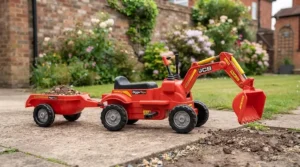
A ride-on digger and a sandpit excavator solve slightly different problems, and it’s worth being honest about that before you buy both (or either). A ride-on gives mobility and imaginative “driving” play; a static sandpit excavator, like the Little Tikes model reviewed above, gives sustained, repetitive scooping and building — genuinely different developmentally, and genuinely not interchangeable.
What most buyers overlook is that sandpit excavator toys tend to get significantly more daily use time per session than ride-on diggers, simply because a child doesn’t tire of the physical exertion of pedalling or steering — they can sit and scoop for twenty minutes at a stretch. If your garden already has (or could accommodate) a dedicated sand area, a static excavator unit is arguably the higher-value purchase for sheer hours of engagement per pound spent.
Construction Themed Toys
Beyond the ride-ons and sandpits, construction themed toys as a broader category — dump trucks, cranes, hard hats, high-vis vests — genuinely extend the play value of a digger purchase without much additional cost. Reviewers of the CAT and JCB-licensed products above frequently mention pairing them with a simple plastic hard hat or high-vis vest, which costs a few pounds and meaningfully deepens the role-play (kids are, it turns out, extremely committed to costume accuracy).
Here’s what to weigh if you’re building out a full construction set rather than a single toy: buying licensed pieces from the same brand family (all-CAT, or all-JCB) tends to create a more coherent play world for a child than mixing unlicensed generic diggers with branded trucks, purely because the colour schemes and proportions match. It’s a small thing, but it’s the sort of detail that shows up repeatedly in parent feedback as “why my kid plays with this set specifically.”
Electric Ride On Digger UK: Battery vs Manual Explained
This is the section for anyone specifically weighing up an electric ride on digger UK purchase against a manual one, because the decision genuinely isn’t as simple as “electric is better.”
On paper, electric models like the Costway 12V Kids Ride-On Excavator Digger offer real driving — forward, reverse, a genuine top speed, LED lights, and usually a parental remote override. That last point is arguably the single biggest safety advantage of electric over manual: you can physically stop the vehicle from a distance if your child heads towards a road, a pond, or your prize tomato plants.
What the spec sheet won’t tell you is the maintenance overhead. Electric ride-ons need charging (typically 8-12 hours for costs like this one), a dry storage spot away from damp sheds that can corrode battery terminals, and eventually a replacement battery, which isn’t always cheap or easy to source for off-brand models. Reviewers consistently note that battery life shortens noticeably after 12-18 months of regular outdoor use, particularly if the toy is left out in UK weather rather than brought indoors.
Manual and pedal models, by contrast, have essentially zero ongoing running cost and nothing to charge, but they demand more from the child physically and, in the case of push-along designs, from the adult supervising (you will be doing some pushing on tired days, let’s be honest). Based on the spec comparison across this list, the honest recommendation is: choose electric if your child is a confident three-plus-year-old who wants genuine independent driving and you’re happy with a charging routine; choose manual or pedal if your child is younger, if you want zero running costs, or if garden storage for a battery unit is genuinely tight.
Practical Usage Guide & Outdoor Digging Toys: First 30 Days
Getting a new ride on digger toy set up properly in the first month makes a genuine difference to how long it stays loved rather than abandoned. Here’s what that first month should actually look like.
Assembly and first use: Most manual models need only wheels and a seat attached — budget 15-20 minutes with a screwdriver. Electric models like the Costway take longer, often 30-45 minutes, and critically need a full initial charge (usually 8-12 hours) before first use, so don’t plan on Christmas morning driving without charging it the night before.
The first week — managing expectations: A brand-new lever mechanism on manual diggers can feel stiff initially. Working the bucket lever through its motion a dozen times before handing it over softens the action and prevents a frustrated toddler giving up on day one. For electric models, spend the first session together demonstrating the forward/reverse and remote override so the “rules” are established from the outset rather than after an incident.
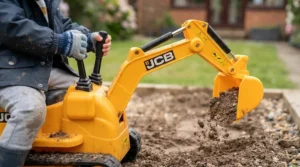
Outdoor digging toys — getting real value from garden play: If you’re specifically searching outdoor digging toys, the biggest optimisation trick isn’t the toy itself, it’s the surface. A digger performs dramatically better on loose soil, bark chippings, or sand than on grass, where the bucket simply can’t scoop anything meaningful. Designating even a small border or a bought sandpit as the “digging zone” transforms a toy that gets ten minutes of half-hearted use into one that gets genuine daily engagement.
Common early mistakes to avoid: Leaving manual or pedal models out overnight in UK rain accelerates plastic brittleness and rusts metal chain-drive components on models like the Rolly Toys backhoe. A £5 waterproof cover, or simply wheeling it into a porch, adds real years to the toy’s lifespan. For electric models, avoid leaving the battery on charge for days beyond the recommended cycle — most manufacturer guidance flags this as the leading cause of premature battery degradation.
Real-World Scenarios: Which Digger Suits Your Child?
Sometimes the fastest way to decide is to see yourself in someone else’s shoes. Here are three realistic profiles.
The city-flat toddler with a communal garden: If you’re managing space and shared outdoor areas, a compact, lightweight, manual model — the HOMCOM CAT-licensed digger or the 3-in-1 pull cart — makes more sense than a bulky electric unit. Both fold down or store reasonably easily, and neither needs a charging point in a shed you don’t have.
The suburban family with a proper garden and an energetic five-year-old: Here, the Rolly Toys JCB Backhoe Loader genuinely earns its higher price. The physical exertion of pedalling, combined with dual-function loader and backhoe controls, gives a child who’s outgrown toddler toys a genuinely engaging, years-long play pattern rather than a six-month fad.
The family building a dedicated sand-and-mud play corner: If your garden already has, or is getting, a designated digging area, pairing the Little Tikes Dirt Diggers Excavator Sandbox with a couple of construction-themed accessories (hard hat, dump truck) creates a self-contained play zone that doesn’t demand constant adult supervision the way a ride-on near a driveway does.
None of these are the “objectively best” choice — they’re the right choice for a specific set of circumstances, which is really the whole point of doing this kind of comparison properly rather than just buying whatever has the most stars.
Problem → Solution: Fixing Common Ride-On Digger Headaches
Problem: the bucket lever has gone stiff or stuck. This is almost always dried mud or sand in the pivot joint rather than a mechanical fault. A quick clean with a damp cloth and a drop of silicone-based lubricant (never oil-based, which attracts more grit) on manual models like the HOMCOM diggers usually resolves it in minutes.
Problem: the toy tips over during lever use. This is typically a weight-distribution issue rather than a design fault — check that your child is seated centrally rather than leaning fully forward while operating the bucket. On models without a wide wheelbase, playing on a slight incline dramatically increases tip risk, so flat ground matters more than it seems.
Problem: the electric model won’t hold charge. Before assuming a faulty battery, confirm the charging port is fully seated and dry — outdoor storage exposes ports to moisture that prevents a full connection. If the issue persists after a full clean charge cycle, most 12V ride-on batteries are the standard sealed lead-acid type and can often be replaced independently rather than requiring a whole new toy.
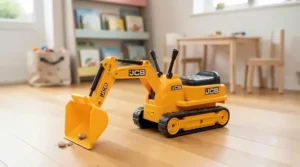
Problem: wheels slipping on hard flooring. This is a common complaint on foot-to-floor models used indoors. A cheap rubber play mat under the main play area solves this instantly and also protects laminate or wood flooring from scuff marks.
Problem: my child has lost interest after a few weeks. Before assuming the toy itself was the wrong choice, check the surface and setting first — as covered above, diggers used on grass simply can’t demonstrate their core function. Moving play to sand, soil, or bark chippings often revives interest immediately because the toy can finally do what it was designed to do.
How to Choose a Ride On Digger Toy: 7 Steps
- Start with age, not aspiration. It’s tempting to buy for the child you imagine in a year’s time, but a toy that’s genuinely too advanced (pedal-powered for a two-year-old, for instance) simply won’t get used.
- Decide manual, pedal, or electric first. This single choice filters out roughly two-thirds of the market immediately and should be based on your child’s current physical stage, not the flashiest option in the shop.
- Check the seat or standing height against your child’s current height. A seat too tall means constant lifting; too low and an older child will look, and feel, faintly ridiculous within months.
- Confirm UKCA or CE marking is present. This is non-negotiable — see the safety section below for why it matters more than it might seem from the packaging alone.
- Think about storage before you think about play. A pedal digger the size of the Rolly Toys model needs real shed or porch space; a compact HOMCOM model tucks into a hallway cupboard.
- Read aggregated reviews for durability specifically, not just star ratings. A 4.6-star average tells you little if the one-star reviews all mention the same snapped part after three months.
- Match the surface at home to the toy’s function. If you don’t have soil, sand, or bark chippings anywhere accessible, a digging-focused toy will underperform regardless of how good the spec sheet looks.
Common Mistakes When Buying a Ride On Digger Toy
The single most common mistake, based on the pattern across aggregated reviews of this entire category, is buying for the birthday rather than the age. Parents frequently size up “for growing room,” landing on a pedal or electric model that a two-year-old simply can’t operate confidently, then wrongly conclude the toy itself was a poor purchase.
A second recurring mistake is ignoring surface compatibility entirely. A digger toy bought for a paved patio or a lawn, with no soil or sand access anywhere, is functionally just an expensive ride-on with a decorative bucket — the core “digging” feature never gets to shine, and reviews from these buyers understandably skew more negative than the product deserves.
Third, and this one’s subtle: buyers often skip checking weight capacity, particularly for older siblings who “just want a go.” Most manual and foot-to-floor models cap out around 20-25kg, and exceeding that regularly stresses joints and axles well before the advertised age range would suggest.
Finally, a genuinely underrated mistake is overlooking storage and weather exposure at the point of purchase, rather than after. Electric models with exposed charging ports and pedal models with metal chain drives both degrade meaningfully faster when left outdoors year-round in the UK climate — a consideration that rarely makes it onto anyone’s pre-purchase checklist but shows up constantly in longer-term review feedback.
Ride On Digger Toys vs Traditional Ride-On Cars
| Factor | Ride On Digger Toy | Traditional Ride-On Car |
|---|---|---|
| Play style | Interactive (levers, scooping, building) | Passive (steering, driving) |
| Fine motor engagement | High — bucket/lever operation | Low — mostly gross motor only |
| Outdoor surface needs | Best on soil/sand/bark | Works on any flat surface |
| Typical price range | Under £45 to £220 | £30 to £250+ |
| Best For | Kids excavator ride on fans / active builders | Kids wanting speed and steering |
The core difference worth dwelling on is fine motor engagement. A traditional ride-on car is fundamentally a steering-and-pedalling exercise — valuable, but largely gross motor. A ride on digger toy adds a genuinely different skill layer: lever operation, hand-eye coordination while aiming a bucket, and the kind of repetitive, purposeful scooping that occupational therapists often point to as good hand-strength development. Neither is objectively superior, but if your household already owns a ride-on car, a digger genuinely adds something different rather than duplicating it.
Safety, Regulations & Compliance Guide
UK toy safety isn’t just a box-ticking exercise — the Toys (Safety) Regulations 2011 set the legal baseline for anything sold to children under 14 in Great Britain, covering everything from small parts and choking hazards to flammability and chemical content. Every product on this list should carry either a UKCA or CE marking, and both remain legally valid for the Great Britain market under current government guidance on using the UKCA marking.
In practice, this means checking the packaging or the toy itself for a visible, legible mark before buying, particularly from third-party marketplace sellers rather than established retailers. It’s genuinely worth being sceptical of ride-on diggers sold with no visible marking at all, or with markings that look printed on a sticker that could easily be removed or swapped.
Beyond the legal minimum, a few practical safety habits matter specifically for this toy category. Always supervise lever operation in the early weeks until you’re confident your child understands not to put fingers near moving joints. For electric models, never leave a child unsupervised near roads, driveways, or water features, even with a parental remote fitted — the remote is a backup, not a substitute for attention. And for pedal models with exposed chain drives, like the Rolly Toys JCB, periodically check that the chain guard remains fully seated, since a loose guard is the single most common safety complaint in aggregated reviews of chain-driven ride-ons.
Long-Term Cost & Maintenance
| Cost Factor | Manual / Pedal Models | Electric (12V) Models |
|---|---|---|
| Upfront price | Under £45 to £200 | £150 to £220+ |
| Ongoing running cost | None | Electricity for charging (minimal) |
| Likely replacement parts | Wheels, seat pads | Battery (every 1-2 years typical) |
| Weatherproofing needs | Low to moderate | High — ports must stay dry |
| Realistic lifespan | 2-4 years, age-dependent | 2-3 years, battery-dependent |
Looking at the table, the real long-term cost divergence isn’t the sticker price at all — it’s the battery replacement cycle on electric models, which typically needs addressing within 12-24 months of regular use and can add a meaningful chunk to the total cost of ownership. Manual and pedal models, by contrast, have close to zero ongoing cost but a shorter practical lifespan since children simply age out of the physical fit sooner.
Value-per-year, a mid-range manual digger like the Little Tikes Dirt Diggers 2-in-1 Excavator often works out cheaper across its full useful life than an electric model, purely because there’s no battery to eventually replace. That said, if genuine independent driving is the priority — for a child who’s outgrown push-alongs but isn’t ready for a full pedal bike — the Costway 12V Kids Ride-On Excavator Digger justifies its higher running cost through the play value it delivers in that specific window.
What to Expect: Real-World Performance
Specs on a box rarely translate directly into lived experience, so here’s the honest, everyday version. Manual diggers like the HOMCOM models feel genuinely light and easy for a toddler to shuffle around a patio, but the bucket action requires real concentration from small hands initially — expect a fair bit of “helping” from an adult in week one.
Electric models feel noticeably more substantial the moment you lift them out of the box; the Costway 12V Kids Ride-On Excavator Digger, for instance, has real heft from the battery and motor housing, which translates to a more stable, less tippy ride once moving, but also means it’s genuinely awkward for one adult to carry up steps alone.
Pedal-driven models sit somewhere in between — the Rolly Toys JCB Backhoe Loader demands real leg effort from a child, which some parents assume will be off-putting, but reviewers consistently report the opposite: children treat the physical effort as part of the “real work” fantasy, not a barrier to it. Reviewers consistently note that construction-themed ride-ons, across power types, get their heaviest use in the first three to four months before settling into more occasional, sustained play as novelty fades and genuine preference takes over.
FAQ
❓ How fast can an electric ride on digger toy go?
❓ What age is best for a ride on digger toy?
❓ Do ride on digger toys need to be UKCA marked?
❓ Can a ride on digger toy be used indoors?
❓ How long do ride on digger toys typically last?
Conclusion
If there’s one honest takeaway from all of this, it’s that “best” genuinely depends on the child in front of you, not the star rating on the box. A wobbly eighteen-month-old and a determined five-year-old who’s already decided he’s a “real digger driver” need almost entirely different toys, even though they’ll both end up filed under the same search term.
For most families with a toddler just starting this journey, the HOMCOM Licensed CAT Kids Ride-On Digger Excavator or the HOMCOM 3-in-1 Ride-On Excavator Pull Cart offer a low-risk, low-cost way to test the waters. For households ready to commit to a more capable, longer-lasting toy, the Little Tikes Dirt Diggers 2-in-1 Excavator earns its place as the genuine all-rounder, while the Rolly Toys JCB Backhoe Loader Ride-On and Costway 12V Kids Ride-On Excavator Digger serve older, more physically ready children who want the real deal — pedal power or genuine electric driving, respectively. And if sand, not steering, is what your child actually loves, the Little Tikes Dirt Diggers Excavator Sandbox is worth considering ahead of any ride-on at all.
Whichever direction you land on, check the UKCA or CE marking, match the toy to your child’s current stage rather than an imagined future one, and give it proper soil, sand, or bark to actually dig into. Do those three things and you’ll get considerably more than a season of play out of it.
✨ Ready to Find Your Family’s Perfect Digger?
🔍 Compare the full lineup above and check current pricing and availability on each model. A little research now means years of genuinely happy construction-site chaos in the garden!
Recommended for You
- JCB Ride On Tractor: 7 Best Picks for Kids in 2026 (UK)
- 7 Best JCB Ride On Dumper Toys UK 2026: Pedal & Electric
- JCB Ride On Digger: 7 Best Yellow Diggers UK Kids Love (2026)
Disclaimer: This article contains affiliate links. As an Amazon Associate, I earn from qualifying purchases. If you purchase products through these links, we may earn a small commission at no additional cost to you.
✨ Found this helpful? Share it with your friends! 💬🤗
