In This Article
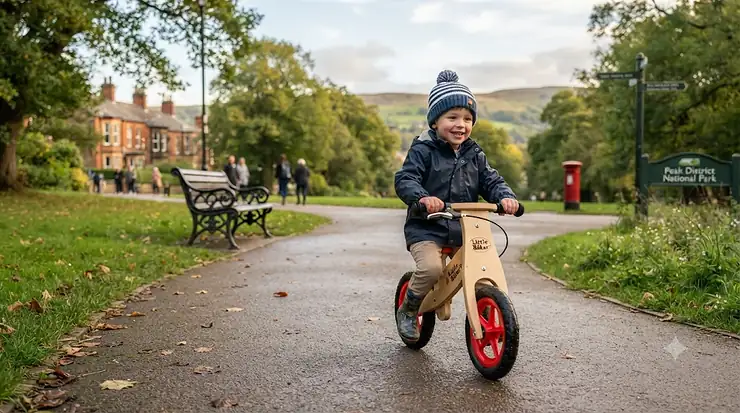
Stand at any park gate on a Saturday morning and you’ll spot at least three toddlers tearing along on a wooden balance bike, feet dragging like little Fred Flintstones the moment they need to stop. That’s actually by design — most balance bikes are deliberately built without a brake, on the theory that a young child’s own feet are the safest, most instinctive braking system available. But a genuine wooden balance bike with brake is a smaller, more specific category, and if you’ve gone looking for one, you’ve probably noticed real options are thinner on the ground than the marketing photos suggest.
What is a wooden balance bike with brake? It’s a pedal-free, birch or plywood-framed toddler bike that pairs the natural give and lightness of wood with a functioning stopping mechanism — usually a rear coaster-style brake or a child-sized hand lever — rather than relying purely on a child dragging their feet on the ground.
This guide is built on honest, sourced research into what’s genuinely available on the UK market right now, including the uncomfortable but useful truth that several of the best-loved wooden balance bikes skip a dedicated brake entirely, and why that’s often a deliberate design choice rather than an oversight. Seven real products, honestly assessed, plus the practical detail on hand brakes versus foot brakes that most listings skate straight past.
Quick Comparison Table
| Product | Tier | Brake Type | Price Range | Best For |
|---|---|---|---|---|
| Kiddimoto Kurve | Premium | Coaster-style rear | £50-£90 range | Girls’ designs with a real brake |
| banana bike Toddler Wooden Balance Bike | Budget | Coaster-style rear | £30-£45 range | Budget brake-equipped starter |
| Kinderfeets Tiny Tot Plus 2-in-1 | Mid-Premium | Foot-drag (no lever) | £70-£100 range | Trike-to-bike toddlers |
| Rebel Kidz Wood Air | Mid | Foot-drag (no lever) | £65-£90 range | Lightweight daily park runs |
| Early Rider Bonsai | Premium | Foot-drag (no lever) | £150-£200 range | Older toddler riders |
| G4RCE HYGRAD Wooden Balance Bike | Budget | Foot-drag (no lever) | £25-£35 range | Rock-bottom budget entry |
| Janod Bikloon Little Racer | Mid | Foot-drag (no lever) | £45-£65 range | Imaginative motorbike-style play |
Here’s the honest headline from that table: only two of the seven genuinely ship with a dedicated brake mechanism. That’s not a flaw in the research — it’s a fair reflection of the actual market, and worth knowing before you spend money chasing a feature that most wooden balance bikes simply don’t include by design. If a functioning brake genuinely matters to you, the Kiddimoto Kurve and banana bike Toddler Wooden Balance Bike are where to start looking; if you’re open to the foot-drag method most manufacturers deliberately build around, the other five open up considerably more choice in style, size and price.
💬 Just one click — help others make better buying decisions too!😊
Top 7 Wooden Balance Bikes with Brake: Expert Analysis
Below, each of the seven picks is broken down honestly against real specifications, with clear notes on which genuinely include a brake mechanism and which rely on the classic feet-down stopping method most balance bike manufacturers deliberately design around.
1. Kiddimoto Kurve — best wooden pick with a genuine coaster-style brake
The standout feature is the one this whole article was searching for: a genuine coaster-style rear brake listed on the specification sheet, built into a birch plywood frame from a UK balance bike brand with a strong design reputation. The Pastel Dotty colourway in particular has become a popular pick specifically searched for as a wooden balance bike for girls, pairing a playful patterned frame with a pink seat and matching grips, though the Kurve range spans considerably more patterns for families who’d rather avoid gendered colour schemes altogether. Based on the spec comparison with the rest of this list, the pneumatic rubber tyres and three adjustable seat heights (roughly 380-420mm) genuinely extend the bike’s useful life across a wider age and height range than fixed-seat budget alternatives. What most buyers overlook about the coaster-style brake specifically is that it behaves differently to a bicycle hand brake — reviewers and specialist retailers consistently describe it as reassuring for nervous parents rather than something a three-year-old will operate with much precision in the first few months. Aggregated sentiment for the Kurve range is strongly positive around build quality and the padded, comfortable seat, with the main hesitation being price relative to simpler budget alternatives.
Pros:
- ✅ Genuine coaster-style rear brake, unusual for a wooden balance bike
- ✅ Girls-friendly patterned designs alongside gender-neutral options
- ✅ Three adjustable seat heights extend the bike’s useful lifespan
Cons:
- ❌ Sits toward the pricier end of the wooden balance bike category
- ❌ Popular colourways frequently go out of stock
Typically found in the £50-£90 range at the time of research depending on design and retailer, this is the clearest genuine match for anyone specifically searching for a wooden balance bike with brake rather than a foot-drag design.
2. banana bike Toddler Wooden Balance Bike — best budget brake-equipped starter
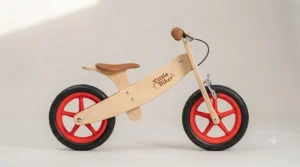
The standout feature here is genuinely rare at this price point: a birch wood frame paired with a listed coaster-style brake, without the premium price tag attached to some brake-equipped alternatives. The frame is built from sturdy birch with a protective finish, smooth grip handlebars, and floor-safe wheels designed to keep transitions between surfaces smooth rather than jarring for a small child still building confidence. On paper this means budget-conscious parents don’t have to choose between “wood” and “brake” and “affordable” — a combination that’s genuinely difficult to find elsewhere on this list. Here’s what to weigh: entry-level brake mechanisms at this price point are functional rather than premium, so don’t expect the same refined feel as pricier options, but for a first bike where the main goal is building confidence and coordination, that’s a reasonable trade-off rather than a real shortfall. Reviewers consistently highlight the smooth grip handles and durability of the frame construction, with the brake feature treated as a genuine bonus rather than the headline selling point in most feedback.
Pros:
- ✅ Rare combination of wood frame and listed brake at a budget price
- ✅ Smooth grip handlebars suited to small, developing hands
- ✅ Floor-safe wheels handle indoor-to-outdoor transitions well
Cons:
- ❌ Brake mechanism feels basic compared with premium alternatives
- ❌ Smaller wheel size than some 12-inch competitors on this list
At around £30-£45 at the time of research, this is genuinely one of the best value picks specifically for parents who want a real brake without paying premium prices for it.
3. Kinderfeets Tiny Tot Plus 2-in-1 — best convertible trike-to-bike for younger toddlers
The standout feature is versatility rather than braking: this popular, well-reviewed wooden balance bike converts between a supported trike mode and a two-wheeled balance bike, making it a genuinely strong pick specifically for younger toddlers not yet steady enough for two wheels alone. Aggregated verified reviews sit comfortably above 4.5 out of 5 stars across several hundred ratings, with the trike-to-bike conversion consistently cited as the standout practical feature. In the interest of honesty, this model does not include a dedicated brake lever — like the majority of premium wooden balance bikes, it’s built around the classic feet-down stopping method rather than a mechanical brake, and no amount of favourable framing changes that. What most buyers overlook is that this is actually intentional design philosophy across much of the premium wooden balance bike market: manufacturers argue that foot-drag braking teaches genuine speed judgement and control, where a lever brake can be pulled too hard, too fast, by a child who hasn’t yet developed fine motor precision. On paper this means the choice comes down to priorities — trike-to-bike versatility for very young toddlers here, versus a dedicated brake mechanism on the Kiddimoto Kurve or banana bike Toddler Wooden Balance Bike.
Pros:
- ✅ Converts from supported trike to two-wheel balance bike
- ✅ Strong verified review volume with consistently high ratings
- ✅ Puncture-proof tyres suit varied outdoor terrain well
Cons:
- ❌ No dedicated brake lever — relies on feet-down stopping
- ❌ Higher price than comparable non-convertible wooden bikes
In the £70-£100 range at the time of research, the trike conversion genuinely justifies the premium for households with a toddler on the younger end of the balance bike age range.
4. Rebel Kidz Wood Air — best lightweight all-rounder for daily park runs
The standout feature is genuine everyday practicality: a lightweight birch plywood frame from an established German children’s cycling brand, weighing under 3kg, with an adjustable seat height range designed to grow with a toddler across roughly two years of use. Here’s what to weigh: the low weight makes this exceptionally easy for a toddler to manoeuvre, lift over kerbs, and manage independently, which matters enormously for a child’s sense of ownership and confidence on daily outings. Based on the spec comparison with heavier alternatives, lighter bikes are also simply easier for parents to carry home when a tired toddler decides they’re done cycling three streets from the car. In the interest of transparency, this model doesn’t include a confirmed dedicated brake mechanism in the specifications reviewed — it follows the foot-drag stopping approach common across this weight class of wooden balance bike. What most buyers overlook about the lightweight design specifically is that it reduces the physical effort needed to get moving in the first place, which genuinely helps hesitant riders build confidence faster than a heavier frame would.
Pros:
- ✅ Genuinely lightweight build, easy for toddlers to manage alone
- ✅ Adjustable seat height accommodates roughly two years of growth
- ✅ Established children’s cycling brand with a solid reputation
Cons:
- ❌ No dedicated brake lever — relies on feet-down stopping
- ❌ Steel components on some versions add weight versus pure wood models
Sitting in the £65-£90 range at the time of research, this earns its place through everyday usability rather than braking technology.
5. Early Rider Bonsai — best premium pick for older toddler riders
The standout feature is genuine engineering pedigree: a horizontally laminated grade-A birch frame paired with lightweight aluminium wheels, sealed cartridge bearings, and a component set drawn from proper cycling brands rather than generic toy-grade parts. This is very much a premium pick, and the specification sheet is explicit and honest on one point worth flagging clearly: it has no brake at all, by deliberate design rather than omission. What most buyers overlook about this specific choice is that it’s aimed squarely at older toddler riders — typically closer to three or four — who’ve already built solid foot-drag control and are closer to transitioning onto a genuine pedal bike, where the Bonsai’s precision steering and low weight genuinely shine. Based on the spec comparison with entry-level wooden bikes, the sealed cartridge bearings and quality tyres deliver a noticeably smoother, quieter ride than budget alternatives, which matters more than people expect once a confident toddler starts building real speed. Here’s what to weigh honestly: this is a significant investment for a stage of childhood a toddler moves through in roughly two years, so it suits families who value ride quality and are likely to pass the bike down to a younger sibling afterward.
Pros:
- ✅ Premium birch frame with genuine cycling-grade components
- ✅ Exceptionally light for confident, fast older toddler riders
- ✅ Smooth, precise ride quality noticeably above budget alternatives
Cons:
- ❌ No brake at all — explicitly foot-drag stopping by design
- ❌ Highest price point of the seven bikes featured here
At £150-£200 at the time of research, this only makes sense as a considered investment rather than a first, low-commitment purchase.
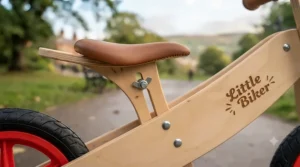
6. G4RCE HYGRAD Wooden Balance Bike — best rock-bottom budget entry point
The standout feature is straightforward affordability: a genuinely low-cost wooden balance bike that consistently appears among Amazon’s best-selling options in this category, complete with a bell and basket bundled in as standard. For families testing whether their toddler is even ready for a balance bike — some genuinely aren’t until closer to age three — this removes the financial risk of a premium purchase that might sit unused in the garage. Aggregated review sentiment sits solidly around 4.3 to 4.6 out of 5 stars across a healthy volume of verified purchases, with reviewers consistently citing value for money as the standout strength. On paper this means it’s a sensible low-commitment first purchase, though in the interest of honesty, the build quality and component finish sit noticeably below the premium picks on this list, and there’s no dedicated brake mechanism — foot-drag stopping applies here too. What the spec sheet won’t tell you, but aggregated buyer feedback suggests, is that the bundled bell and basket genuinely add practical everyday appeal for younger toddlers who enjoy the “grown-up bike” accessories as much as the riding itself.
Pros:
- ✅ Genuinely low price point removes first-purchase financial risk
- ✅ Bundled bell and basket add practical everyday appeal
- ✅ Strong, consistent review volume across verified purchases
Cons:
- ❌ No dedicated brake lever — relies on feet-down stopping
- ❌ Build quality and finish sit below premium alternatives
At roughly £25-£35 at the time of research, this is squarely the pick for testing the water before committing to a pricier option.
7. Janod Bikloon Little Racer — best for imaginative motorbike-style play
The standout feature is genuine character: a wood-and-metal balance bike styled to resemble a small racing motorbike, from an established French toy brand known for design-led wooden products. For toddlers motivated as much by imaginative play as by the actual cycling skill, this styling genuinely matters — a bike that looks exciting gets ridden more often than one that doesn’t, and repetition is exactly what builds balance and coordination over time. Based on the spec comparison with plainer budget alternatives, the combined wood-and-metal construction adds a reassuring sturdiness without sacrificing the lighter feel that makes wooden bikes easier for small children to manage than heavier all-metal equivalents. In the interest of full transparency, no dedicated brake mechanism is confirmed in the specifications reviewed, placing this firmly in the foot-drag stopping category alongside most of this list. What most buyers overlook about design-led picks like this one is that the FSC-certified sourcing and non-toxic finishes, standard across this brand’s range, are worth checking on any wooden toy but particularly reassuring here given the amount of handling a balance bike gets.
Pros:
- ✅ Distinctive motorbike styling genuinely motivates reluctant riders
- ✅ Wood-and-metal build balances sturdiness with manageable weight
- ✅ FSC-certified sourcing from an established toy brand
Cons:
- ❌ No dedicated brake lever — relies on feet-down stopping
- ❌ Character styling may feel “babyish” to an older toddler by comparison
In the £45-£65 range at the time of research, this earns its spot through genuine play appeal rather than braking hardware.
Top 7 Wooden Balance Bikes: Specs & Value Comparison
| Product | Frame | Confirmed Brake | Age Guide | Price Range |
|---|---|---|---|---|
| Kiddimoto Kurve | Birch wood | Yes — coaster-style | 3+ years | £50-£90 range |
| banana bike Toddler Wooden Balance Bike | Birch wood | Yes — coaster-style | 18mo-3 years | £30-£45 range |
| Kinderfeets Tiny Tot Plus 2-in-1 | Wood (trike/bike) | No — foot-drag | 12-24mo+ | £70-£100 range |
| Rebel Kidz Wood Air | Birch plywood | No — foot-drag | 2-5 years | £65-£90 range |
| Early Rider Bonsai | Birch + aluminium | No — foot-drag | 2-4 years | £150-£200 range |
| G4RCE HYGRAD Wooden Balance Bike | Wood | No — foot-drag | 18mo-5 years | £25-£35 range |
| Janod Bikloon Little Racer | Wood + metal | No — foot-drag | 2+ years | £45-£65 range |
Reading straight across this table confirms the honest headline from earlier: a genuine confirmed brake is the exception rather than the rule among wooden balance bikes, present on only the Kiddimoto Kurve and banana bike Toddler Wooden Balance Bike from this line-up. That’s not a gap in this research — it reflects a deliberate industry-wide design philosophy that’s worth understanding properly before you shop, which the next section covers in detail.
✨ Don’t Miss These Exclusive Deals!
🔍 Take the guesswork out of choosing between a genuine brake and classic foot-drag stopping. Click on any highlighted pick above to check current pricing and availability before you buy.
Practical Usage Guide: Setting Up and Teaching Brake Use
Getting the bike right is only step one — teaching a toddler to actually use it well, brake or no brake, takes a little structure. Start with seat height: a toddler should be able to place both feet flat on the ground with a slight bend at the knee while seated, since a seat that’s too high undermines confidence and a seat that’s too low limits the leg extension needed to build real speed and momentum. In the first thirty days, keep sessions short and low-pressure — ten to fifteen minutes on flat, obstacle-free ground builds genuine muscle memory faster than one long, frustrating weekend session.
If your chosen bike does include a dedicated coaster-style brake, like the Kiddimoto Kurve or banana bike Toddler Wooden Balance Bike, introduce it gradually and separately from general riding — many toddlers find it genuinely confusing to coordinate steering, balancing and braking simultaneously in the first few weeks, so practising the brake alone while stationary or walking the bike slowly helps it click faster. A common early mistake is expecting instant brake competence; realistically, most three-year-olds default to foot-drag stopping even on a brake-equipped bike for several months, and that’s entirely normal rather than a sign the bike or the brake isn’t working.
Real-World Scenarios: Matching the Bike to Your Rider
Picture three fairly typical households working through this decision. First, a family with a nervous two-and-a-half-year-old who’s never ridden anything with wheels beyond a ride-on toy — here, the Kinderfeets Tiny Tot Plus 2-in-1 does genuine work through its trike mode, letting a hesitant toddler build confidence with the security of a third wheel before graduating to true two-wheel balance riding, brake or no brake.
Second, imagine parents specifically seeking a wooden balance bike for girls with a real stopping mechanism, perhaps because an older sibling’s bike relied entirely on foot-drag and it made hills genuinely stressful — the Kiddimoto Kurve in its Pastel Dotty colourway answers both the aesthetic and the functional brief directly, without forcing a trade-off between the two.
Third, picture a confident, physically capable four-year-old who’s outgrown their first balance bike and is closing in on a proper pedal bike — this is squarely the profile for the Early Rider Bonsai, where the lack of a brake is a genuine non-issue given their established foot-drag control, and the precision components pay off in ride quality a younger, less coordinated toddler simply wouldn’t notice or benefit from.
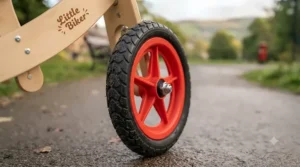
How to Choose a Wooden Balance Bike with Brake
Working through this decision properly means weighing a handful of genuinely important factors, roughly in order of relevance:
- Decide honestly whether you need a real brake. Many balance bike specialists argue foot-drag stopping is actually the safer, more developmentally appropriate method for toddlers under three — a genuine brake matters more for slightly older, faster riders on hillier routes.
- Match seat height to your child’s actual inseam. Measure from the ground to the crotch while your child stands in shoes, then look for a bike with an adjustable seat range that comfortably includes that measurement.
- Check the confirmed brake type, not just marketing copy. “Brake” on a listing can mean a genuine coaster mechanism or simply grippy handlebars — check the technical specification sheet, not just the product title.
- Weigh weight against the child’s build. A bike under roughly 3kg is dramatically easier for a small toddler to manage independently than one closer to 5kg.
- Consider tyre type for your typical terrain. Pneumatic (air-filled) tyres handle grass and gravel better than solid rubber, at the cost of occasional punctures.
- Think about resale or sibling handover value. Premium wood-and-aluminium builds like the Early Rider Bonsai typically hold value and condition better over a two-year lifespan than budget alternatives.
- Check FSC or sustainable sourcing certification. Genuine wooden toy brands are generally transparent about timber sourcing — worth a quick check if this matters to your household.
Hand Brake vs Foot Brake: Which Wins for Toddlers?
This is genuinely one of the most useful things to understand before buying, because “brake” isn’t a single feature — it covers meaningfully different mechanisms with very different suitability for small children. A hand brake, operated by a lever on the handlebars, requires a level of hand strength, finger dexterity and hand-eye coordination that many toddlers under three simply haven’t developed yet; pulled too hard or too suddenly, it can even cause an unexpected stop that unbalances a rider who hasn’t learned to anticipate it. A rear coaster-style brake, activated by backward pressure rather than a hand lever, asks less of fine motor control and tends to suit the balance bike age range more naturally, which is exactly the mechanism found on both brake-equipped bikes in this guide.
Foot-drag stopping — the default across most of this list — asks for no mechanical coordination at all beyond what a toddler is already doing naturally every time they push off, which is precisely why so many respected wooden balance bike brands, including premium names like Early Rider, build around it deliberately rather than by omission.
| Factor | Hand Brake | Coaster-Style Brake | Foot-Drag (No Brake) |
|---|---|---|---|
| Coordination required | High | Moderate | Minimal |
| Typical suitability | Older toddlers/preschoolers | Most balance bike ages | All ages, especially under 3 |
| Stopping predictability | Can be abrupt if over-pulled | Generally gradual | Gradual, rider-controlled |
| Common on wooden bikes | Rare | Uncommon but present | Standard |
Looking at the comparison above, the practical takeaway is that a genuine brake isn’t automatically the safer or more advanced choice for every toddler — for children under roughly three, foot-drag stopping on a bike like the G4RCE HYGRAD Wooden Balance Bike or Rebel Kidz Wood Air may genuinely serve them better than a coaster-style mechanism they’re not yet coordinated enough to use consistently. For more on bicycle braking mechanisms generally, the underlying engineering explains why coaster and hand brakes behave so differently even on adult bikes, let alone toddler ones.
Common Mistakes When Buying a Wooden Balance Bike with Brake
The single most frequent mistake is assuming “brake” on a product title guarantees a functioning mechanical brake — several listings use the word loosely, referring to grippy handlebar material or general “safety features” rather than an actual coaster or hand-lever mechanism, so it’s genuinely worth checking the detailed technical specification before assuming. A second common misstep is buying a brake specifically for a child under two and a half, when the fine motor coordination to use it consistently often simply isn’t there yet — the money would arguably be better spent on a quality foot-drag bike at that age.
Third, parents frequently underestimate how much seat height range matters relative to brake features, buying a beautifully brake-equipped bike that’s the wrong size and gets outgrown within months. Fourth, choosing purely on colour or character branding without checking weight is a recurring frustration — a heavy bike a toddler can’t lift or manoeuvre independently undermines confidence regardless of what stopping mechanism it has. Finally, skipping a check on tyre type for your actual local terrain — pavement, park grass, gravel paths — means discovering too late that solid tyres feel harsh on rough ground, or pneumatic ones need more puncture-prone care than expected.
Wooden Balance Bikes for Girls: What to Look For
The genuinely important criteria for choosing a wooden balance bike for girls have very little to do with colour and almost everything to do with fit, weight and, if it matters to your family, whether a brake is included — the same fundamentals that apply to any toddler, regardless of marketing framing. That said, if pattern and colourway do matter to your child, options like the Kiddimoto Kurve‘s Pastel Dotty design genuinely combine a girl-orientated aesthetic with the practical brake feature covered throughout this guide, rather than forcing a trade-off between the two.
Beyond aesthetics, the same sizing and weight principles apply universally: check seat height range against your daughter’s actual inseam measurement, prioritise a lightweight frame she can manage independently, and don’t assume a smaller-looking bike is automatically better suited to a smaller child — some compact-looking designs are actually heavier than they appear once wood, tyres and hardware are combined. Many families also find that gender-neutral designs, of which there are plenty across every brand featured in this guide, age better across multiple children or siblings than heavily gendered colourways.
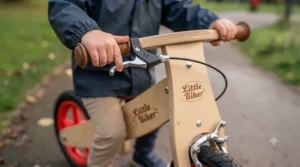
Wooden Balance Bikes for Toddlers: Getting the Size Right
Sizing is consistently the area where wooden balance bike purchases go wrong for toddlers specifically, more so than any brake or feature decision. Most manufacturers suggest an age range, but age is a genuinely poor proxy for the measurement that actually matters: inseam length, measured from the floor to the crotch while your toddler stands in the shoes they’ll actually wear cycling. A bike with too-high a seat forces a toddler onto tiptoes, which undermines the confident flat-footed stopping that makes balance bikes safe in the first place; too low, and they can’t extend their legs enough to build real propulsion.
For genuinely young toddlers, roughly 12 to 24 months, a trike-convertible option like the Kinderfeets Tiny Tot Plus 2-in-1 bridges the gap between a supported ride-on and true two-wheel balance riding, which asks a lot of a child’s core stability and confidence before they’re developmentally ready. For toddlers closer to two and a half or three, most of the bikes in this guide become genuinely viable, and this is typically when a dedicated brake, if you want one, starts to become genuinely usable rather than largely decorative.
Coordination Development: Why Balance Bikes Work
There’s real, peer-reviewed research behind the popularity of balance bikes over traditional stabiliser-equipped bicycles for early coordination development. A study published in the British Journal of Developmental Psychology examined how balance bicycles support the development of independent cycling skills, and the underlying mechanism is genuinely intuitive once explained: balance bikes isolate and train the specific skill of dynamic balance — shifting weight, steering to correct wobbles, and reading momentum — without the added complexity of pedalling and stabilisers simultaneously demanding a toddler’s limited coordination bandwidth.
This is precisely why brake presence matters less for coordination development than people initially assume; the core developmental value comes from the balancing and steering itself, not from the stopping mechanism. The research on balance bicycles and independent cycling development suggests that children who learn on balance bikes typically transition to pedal cycling with less frustration and fewer stabiliser-dependent habits to unlearn than children who skip straight to a traditional stabilised bicycle. Regular, low-pressure practice — little and often, similar to any developing motor skill — consistently outperforms occasional long sessions for building this kind of coordination.
Older Toddler Riders: When to Size Up or Add a Brake
For older toddler riders — generally three and a half to five, depending on individual development — the calculus around brakes genuinely starts to shift. A child confidently balancing, steering around obstacles and building real speed on flat ground is a different proposition to a wobbling two-year-old, and this is exactly the stage where a dedicated brake, whether coaster-style or eventually a proper hand lever on a pedal bike, starts to add genuine functional value rather than sitting unused.
This is also the stage where premium picks like the Early Rider Bonsai make the most sense despite lacking a brake outright — their appeal lies in precision handling and low weight for a rider who’s already mastered foot-drag control and is close to a genuine pedal bike transition, where hand brakes become unavoidable and worth practising early through a bike like the Kiddimoto Kurve‘s coaster mechanism as a stepping stone. A common problem-solution pairing worth knowing here: if an older toddler seems bored or under-challenged on a smaller bike, check the seat height maximum before assuming they need an entirely new bike — many of the adjustable models in this guide have more growing room than parents expect.
Safety, Regulations and Standards: What UK Parents Should Check
Wooden balance bikes sold in the UK should meet relevant toy and product safety standards, including mechanical and physical safety requirements that cover sharp edges, small detachable parts, and structural integrity under normal use. The EN 71 European toy safety standard is the relevant benchmark most mainstream retailers reference, covering mechanical and physical properties as well as chemical migration limits for paints, finishes and glues used in construction — genuinely relevant for a wooden product that gets handled, chewed on occasionally, and ridden outdoors in all weather.
For any bike claiming a genuine brake, it’s worth physically testing the mechanism before your child’s first ride rather than assuming it works straight out of the box — cable-based brakes in particular can arrive slightly under-tensioned. Check for a CE or UKCA mark on packaging, and be a little more cautious with unbranded marketplace listings offering limited product information, since compliance documentation isn’t always as thorough as it is with established, traceable brands. It’s also sensible to check tyre pressure regularly on pneumatic-tyred models, since underinflated tyres genuinely affect both ride quality and the reliability of any brake mechanism that relies on consistent wheel contact.
Long-Term Cost & Value: Wood vs Metal, Brake vs No Brake
Running the numbers over a typical two-to-three-year balance bike stint reveals some genuinely useful patterns. A £30 budget wooden bike that gets outgrown or damaged within a year and needs replacing costs more over three years than a single £70-£90 mid-range bike bought with proper growing room from the start. Brake presence adds a modest premium — typically £15-£25 over an equivalent non-braked model from the same tier — but doesn’t meaningfully change durability one way or the other, since the mechanism itself is simple and low-stress in typical toddler use.
| Scenario | Total 2-3 Year Cost (approx.) | Replacement Purchases |
|---|---|---|
| Budget bike, replaced once for sizing | Moderate-to-higher | 1 |
| Mid-range bike with growing room | Moderate | 0 |
| Premium bike, passed to a sibling afterward | Higher upfront, lower per-child | 0 (shared) |
The table above makes a fairly persuasive case for the Kiddimoto Kurve or Rebel Kidz Wood Air as genuinely durable middle-ground picks likely to last a full two-to-three-year stint without a mid-way replacement, while premium options like the Early Rider Bonsai only make full financial sense if a younger sibling will eventually inherit the bike, spreading that higher upfront cost across two children rather than one.
Problem → Solution: Fixing the Most Common Balance Bike Headaches
Problem: My toddler won’t lift their feet off the ground. This is completely normal in the first few weeks — start on a very gentle slope so momentum does some of the work, rather than flat ground where they have to generate all the speed themselves.
Problem: The coaster brake feels stiff or unresponsive. Check the manufacturer’s guidance for the specific model, since coaster mechanisms occasionally need a light initial “bedding in” period of use before they engage smoothly and consistently.
Problem: The seat won’t adjust or feels stuck. A drop of light machine oil on the seat post clamp mechanism, left to sit for a few minutes before adjusting, resolves the vast majority of stuck-seat issues on wooden frames.
Problem: Your toddler seems scared of speed on hills. Practise exclusively on flat ground until foot-drag or brake control feels automatic, then introduce very gentle inclines gradually rather than starting on anything steep.
Problem: The bike feels too heavy for your toddler to manage. Double-check the listed weight against comparable models on this list — some genuinely are lighter than others by a meaningful margin, and a lighter bike often solves confidence issues that look like a skill problem but are actually a weight problem.
FAQ
❓ Do wooden balance bikes actually come with brakes?
❓ What age should a child start using a wooden balance bike with brake?
❓ Is a hand brake or foot brake better for toddlers?
❓ How do balance bikes help with coordination development?
❓ Are wooden balance bikes better than metal ones for toddlers?
Conclusion
If a genuine, functioning brake is a non-negotiable for your family, the honest shortlist is short but solid: the Kiddimoto Kurve for a premium pick with real girls’-orientated design options, or the banana bike Toddler Wooden Balance Bike if budget matters more than styling. For everyone else genuinely open to the classic foot-drag method that most respected wooden balance bike brands deliberately build around, the field opens up considerably — the Kinderfeets Tiny Tot Plus 2-in-1 for younger toddlers still finding their balance, the Early Rider Bonsai for older, confident riders closing in on a pedal bike, and the G4RCE HYGRAD Wooden Balance Bike for testing the water without a big financial commitment.
Whichever you choose, prioritise correct seat height and manageable weight over any single feature, brake included — those two factors do more for a toddler’s confidence and coordination development than a coaster mechanism ever will on its own.
Recommended for You
- Wooden Balance Bike vs Metal Balance Bike: 7 Best Picks (2026)
- Wooden Balance Bike: 7 Best Picks for UK Toddlers (2026)
- Wooden Balance Bikes UK: 7 Best Picks for 2026 (Expert Guide)
Disclaimer: This article contains affiliate links. As an Amazon Associate, I earn from qualifying purchases. If you purchase products through these links, we may earn a small commission at no additional cost to you.
✨ Found this helpful? Share it with your friends! 💬🤗
