In This Article
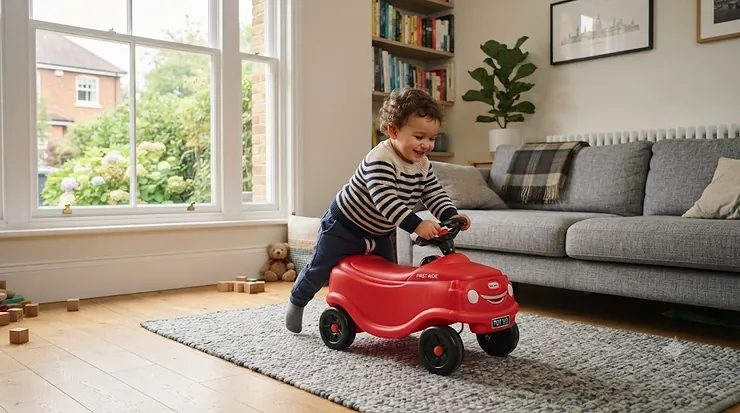
There’s a particular kind of chaos that arrives the moment a toddler discovers they can move a vehicle with their own two feet — half delighted shriek, half full-speed collision with the skirting board. A first ride-on car for toddlers is usually the toy responsible for that chaos, and it’s also one of the most genuinely useful purchases you’ll make in the first two years, not just the most fun.

So what actually is a first ride-on car for toddlers? In the simplest terms, it’s a low, stable, foot-powered vehicle — no batteries, no pedals a one-year-old could operate — designed to be pushed along the floor using the child’s own legs while seated, building leg strength, balance and confidence in the run-up to independent walking. It sits in that specific window between “not walking yet” and “walking confidently,” which is exactly why timing and design matter so much when you’re choosing one.
This guide compares seven genuinely available ride-on cars for UK parents, from the properly iconic Little Tikes Cozy Coupe to specialist foot-to-floor sliders built specifically for one-year-olds still finding their feet. Every product mention here is grounded in real specifications and honest aggregated review sentiment, not fabricated hands-on claims — because the last thing a knackered parent needs at 11pm, doom-scrolling for baby gifts, is another article dressed up as expertise it doesn’t actually have. We’ll also cover how ride-on play connects to toddler developmental milestones and walking development, so you can buy with a clearer sense of why this toy matters, not just which one looks nicest in the photos.
Quick Comparison Table
| Product | Best For | Age Range | Price Range |
|---|---|---|---|
| Little Tikes Cozy Coupe | Iconic all-rounder | 18 months+ | £45–£75 range |
| Smoby 2-in-1 Ride on Car | Earliest walkers | 10 months+ | Under £35 |
| HOMCOM Ride on Car Toddler Walker | Budget lights & sounds | 1.5–3 years | Under £35 |
| Hillington Kids Ride On Car | Parent-guided pushing | 19–36 months | Under £35 |
| AIYAPLAY Land Rover Discovery 2-in-1 | Licensed design fans | 18–36 months | £35–£55 range |
| Qaba Mercedes-Benz C-Class 2-in-1 | Premium licensed brand | 18–36 months | £35–£55 range |
| COSTWAY Foot to Floor Sliding Walker | No-frills simplicity | 18–36 months | Under £30 |
The age ranges here matter more than they might first appear. The Smoby 2-in-1 Ride on Car stands apart by starting from 10 months, making it the only genuine option here for a child who’s cruising furniture but not yet steady on their feet, while the rest of the field clusters around 18 months and up — the point at which most toddlers have the trunk control and balance to sit securely and push independently. Licensed models like the AIYAPLAY Land Rover Discovery and Qaba Mercedes-Benz C-Class sit at the top of the price range partly for branding and partly for the extra detailing — grille badges, under-seat storage, parent-control handles — that generic sliders skip.
💬 Just one click — help others make better buying decisions too!😊
Top 7 First Ride-On Cars for Toddlers: Expert Analysis
Here’s the detail behind the table — real specs, honest trade-offs, and who each one genuinely suits.
1. Little Tikes Cozy Coupe — best iconic first ride-on car for toddlers
Few toys earn the word “iconic” honestly, but the Little Tikes Cozy Coupe has been the preferred first car for toddlers since 1979, and it’s still doing the same job nearly five decades on: a low, wide-wheelbase foot-to-floor slider with a real clicking ignition switch, a working horn, and an opening fuel cap for pretend refuelling.
What makes the design genuinely clever rather than just nostalgic is the removable floorboard — babies just starting to push with their feet get the floor in place for protection, while confident toddlers take it out to use direct foot-to-floor power on carpet or hard flooring. Both front wheels spin a full 360 degrees, which sounds like a small detail until you watch a toddler attempt a three-point turn in a hallway and actually manage it.
This suits toddlers from roughly 18 months who’ve found their feet and want a durable, do-anything vehicle that works indoors and out, with a maximum weight limit of around 50 lbs giving it genuine longevity well past the first birthday. Aggregated reviewer sentiment across tens of thousands of Amazon UK ratings is consistently strong, with parents repeatedly praising the build quality and how many years of use — often across siblings — a single Cozy Coupe survives.
Pros:
- ✅ Removable floor adapts the toy as walking confidence grows
- ✅ 360-degree front wheels make tight turns genuinely manageable
- ✅ Decades-long reputation for surviving years of hard play
Cons:
- ❌ Requires assembly out of the box, which takes real time
- ❌ Bulkier storage footprint than slimline modern sliders
Sitting in the £45–£75 range depending on colourway and retailer stock, it’s a mid-range investment that consistently earns its keep across multiple years and, often, multiple children.
2. Smoby 2-in-1 Ride on Car — best foot-to-floor car for a 1 year old
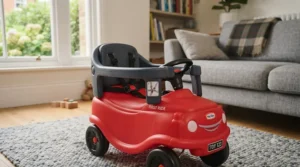
Where most of this list starts at 18 months, the Smoby 2-in-1 Ride on Car is built specifically for the earlier end of the journey — recommended from 10 months, it converts between a push-along walker and a seated ride-on, which matters enormously for a child whose walking development is still genuinely in progress.
The mechanism behind that flexibility is front and rear anti-topple devices that keep the car stable whether a baby is holding the back handle to cruise along behind it or sitting inside being pushed by an adult. A low seat height keeps getting on and off easy for uncertain little legs, and a hidden under-seat storage compartment gives toddlers somewhere to stash a favourite toy for the journey — a small feature that does a surprising amount of work in keeping a fussy 12-month-old content.
This is the clearest pick on this list for parents specifically searching for a foot-to-floor car for an 18 month old who isn’t walking confidently yet, or for a slightly younger sibling working through early cruising and first steps. Reviewer sentiment consistently highlights the sturdy, ergonomic build from Smoby, a French manufacturer with a century of toy-making history, and the genuine two-stage usefulness as babies transition from walker to rider.
Pros:
- ✅ Usable from 10 months, earlier than most ride-on competitors
- ✅ Converts between walker and seated ride-on as skills develop
- ✅ Anti-topple design front and back adds real stability
Cons:
- ❌ Smaller size means toddlers outgrow it faster than bigger cars
- ❌ Less exciting extras (no horn/lights) than pricier rivals
At under £35, it’s genuinely excellent value for the earliest stage of ride-on play, precisely when a toy needs to work hard for a relatively short but critical developmental window.
3. HOMCOM Ride on Car Toddler Walker — best budget pick with lights and sounds
The HOMCOM Ride on Car Toddler Walker takes the classic foot-to-floor slider format and adds the sensory extras — working horn, built-in music, and lights — that turn a simple push-along into something a toddler actively wants to sit in rather than just tolerates.
Beyond the sound and light features, the practical specification holds up too: an under-seat storage compartment for small toys, and a design rated for 1.5 to 3 years that covers the bulk of the ride-on-relevant age window in one purchase. HOMCOM has built a reputation in the UK budget toy and furniture space on delivering feature-heavy products at accessible prices, and this model follows that pattern closely.
This suits budget-conscious parents who want the “fun factor” extras without paying licensed-brand premiums, and particularly toddlers who respond well to sensory feedback — the horn-and-lights combination genuinely extends independent play time for children who might otherwise lose interest in a plain slider within minutes. Aggregated Amazon review sentiment is positive on value for money, with the most common praise centring on how much toddlers enjoy the interactive horn and music features specifically.
Pros:
- ✅ Working horn, lights and music add genuine play value
- ✅ Under-seat storage keeps small toys close at hand
- ✅ Covers a wide 1.5–3 year age range in one purchase
Cons:
- ❌ Battery-powered sound features need occasional replacement
- ❌ Build quality trails premium and licensed alternatives
Priced under £35, this is a strong budget pick specifically for toddlers who thrive on sensory feedback rather than just movement alone.
4. Hillington Kids Ride On Car — best for parent-guided pushing
The Hillington Kids Ride On Car covers similar ground to the HOMCOM model above — steering wheel, lights, music, horn, under-seat storage — but adds a genuinely useful safety feature aimed at the earlier, wobblier end of its 19-to-36-month age range: a safety backrest and anti-tip stopper designed specifically to prevent the car tipping backward when a toddler leans or climbs.
That anti-tip detail matters more than it might sound, particularly for toddlers still building core strength and balance; a car that tips easily under an enthusiastic lean can turn a fun toy into a source of bumps and bruises fast. The safety backrest adds support for toddlers who haven’t yet developed the seated trunk control that older, more established walkers take for granted.
This is best suited to parents whose toddler is still developing balance and trunk stability, or who want extra reassurance around tipping risk during the early weeks of ride-on play — a common concern for first-time parents navigating this stage for the first time. Reviewer sentiment on Amazon reflects general satisfaction with the value-for-money combination of features, though as with most budget imports, the review pool skews toward recent purchases rather than long-term durability reports.
Pros:
- ✅ Anti-tip stopper specifically addresses backward tipping risk
- ✅ Safety backrest supports toddlers with developing trunk control
- ✅ Steering wheel, lights, music and horn add engagement
Cons:
- ❌ Newer brand with a shorter long-term reputation than established names
- ❌ Plastic build feels lighter-duty than premium alternatives
At under £35, it’s a sensible budget choice specifically for parents prioritising tip-resistance during the earliest, least steady phase of ride-on play.
5. AIYAPLAY Land Rover Discovery 2-in-1 — best licensed design for outdoor explorers
The AIYAPLAY Land Rover Discovery Licensed Ride On Car brings officially licensed branding to the foot-to-floor category, styled after the real Land Rover Discovery, and adds a genuinely thoughtful 2-in-1 mechanism: a removable push handle that converts the car between independent foot-to-floor play and parent-controlled pushing.
That removable handle solves a real problem — a toddler confident enough to steer themselves around the living room may not be ready to manage kerbs, slopes, or a busy pavement outside, and parents need a way to retain control without swapping toys entirely. A protective guardrail adds a further layer of containment for toddlers at the more active, climb-happy end of the 18-to-36-month range, alongside the under-seat storage now standard across most of this list.
This suits families who want a slightly more premium, outdoor-ready ride-on with genuine parent-control functionality for walks beyond the garden, and toddlers who respond to recognisable, “grown-up” vehicle styling rather than generic cartoonish designs. Licensed ride-ons in this category tend to draw praise in aggregated reviews for realistic detailing, with the trade-off being a price step up from unbranded equivalents that offer similar mechanical function without the licensing costs.
Pros:
- ✅ Removable handle switches between independent and parent-led play
- ✅ Protective guardrail adds containment for active toddlers
- ✅ Officially licensed Land Rover styling for realistic detailing
Cons:
- ❌ Costs more than unbranded equivalents with similar mechanics
- ❌ Handle mechanism adds a moving part that needs occasional checking
In the £35–£55 range, it’s a considered mid-to-premium pick for parents who’ll actually use the outdoor push-handle function regularly rather than leaving it in the garage.
6. Qaba Mercedes-Benz C-Class 2-in-1 — best premium licensed brand pick
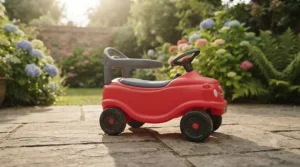
The Qaba Mercedes-Benz C-Class Licensed 2-in-1 Ride-On Push Car takes the same core formula as the AIYAPLAY model above — parent-control handle, safety guardrail, horn, under-seat storage — and pairs it with officially licensed Mercedes-Benz styling, aimed at toddlers aged 18 to 36 months.
The core engineering rationale mirrors its Land Rover-styled sibling: a removable handle for parent-guided walks, a guardrail for extra containment, and foot-to-floor sliding for independent play once a toddler is ready to go it alone. Where it differentiates is purely in badge and styling appeal — for households where a particular car brand carries genuine excitement (grandparents who drove a C-Class for decades, older siblings obsessed with car badges), that emotional pull is a real, if unmeasurable, part of the value proposition.
This suits toddlers around the mid-point of the 18-to-36-month range who are confidently seated but still benefit from a parent-controlled option for trips beyond the house, and parents who specifically want licensed automotive branding over generic styling. As with the Land Rover model, aggregated review sentiment for this newer licensed category tends to focus on styling satisfaction and build solidity rather than a long multi-year track record, since officially licensed toddler ride-ons are a relatively recent trend compared with unbranded classics.
Pros:
- ✅ Officially licensed Mercedes-Benz styling and badge detailing
- ✅ Parent-control handle converts for guided outdoor walks
- ✅ Safety guardrail suits more active, climb-prone toddlers
Cons:
- ❌ Licensing premium pushes price above generic 2-in-1 alternatives
- ❌ Styling appeal matters more to adults than to most toddlers
Also sitting in the £35–£55 range, this is essentially a styling-driven choice between two very similar mechanical packages — pick based on which badge genuinely excites your household.
7. COSTWAY Foot to Floor Sliding Walker — best no-frills simplicity
The COSTWAY Ride on Car strips the category back to essentials: a foot-to-floor sliding walker for 18-to-36-month-olds with under-seat storage and a steering wheel, without the lights, music or licensed branding that push other models up in price.
That simplicity is the entire point. For toddlers who get overstimulated by too many sounds and flashing lights — a genuine consideration for some children, particularly close to bedtime — a plain, quiet slider that does exactly one job well can be the better choice, not the compromise choice. The steering wheel still gives toddlers something to physically interact with and pretend-drive, satisfying the imaginative-play element without any of the sensory overload.
This suits budget-conscious parents buying a first ride-on purely for the physical and developmental benefit — leg strength, balance, confidence — rather than as an entertainment centre, and households where a quieter toy is genuinely preferred for reasons of sensory sensitivity or simply parental sanity. Aggregated review sentiment for budget no-frills sliders in this category tends to centre on solid value for straightforward foot-to-floor function, with the honest caveat that verified individual customer reviews for this specific listing remain thinner than for more established, higher-volume competitors.
Pros:
- ✅ Quiet, no-frills design avoids sensory overstimulation
- ✅ Steering wheel supports imaginative pretend-driving play
- ✅ Straightforward foot-to-floor function at accessible pricing
Cons:
- ❌ Lacks the lights and sounds that hold some toddlers’ attention
- ❌ Smaller, newer review pool than long-established rivals
At under £30, it’s the most accessible entry point on this list for parents who want the developmental benefit without paying for extras their toddler may not need.
Top 7 Products: Specs and Price at a Glance
| Product | Type | Standout Feature | Price Range | Best For |
|---|---|---|---|---|
| Little Tikes Cozy Coupe | Foot-to-floor slider | Removable floor, 360° wheels | £45–£75 | Long-term all-round durability |
| Smoby 2-in-1 Ride on Car | Walker/ride-on hybrid | Usable from 10 months | Under £35 | Earliest walkers, 1 year olds |
| HOMCOM Ride on Car Walker | Foot-to-floor slider | Horn, lights, music | Under £35 | Sensory engagement on a budget |
| Hillington Kids Ride On Car | Foot-to-floor slider | Anti-tip stopper, backrest | Under £35 | Balance-building safety focus |
| AIYAPLAY Land Rover Discovery | 2-in-1 push/ride | Removable parent handle | £35–£55 | Outdoor walks, licensed styling |
| Qaba Mercedes-Benz C-Class | 2-in-1 push/ride | Licensed Mercedes branding | £35–£55 | Premium badge appeal |
| COSTWAY Sliding Walker | Foot-to-floor slider | No lights/sound, low sensory | Under £30 | Budget, quiet simplicity |
Reading across this table, the clearest dividing line isn’t price but mechanism: the Smoby 2-in-1 Ride on Car stands alone as a true walker-to-rider hybrid for the earliest stage, while the AIYAPLAY Land Rover Discovery and Qaba Mercedes-Benz C-Class share an almost identical parent-handle mechanism and differ mainly on badge. Meanwhile the Little Tikes Cozy Coupe occupies its own category entirely — durable enough to be treated as a multi-year, potentially multi-child investment rather than a single-stage purchase.
Practical Usage Guide: Setting Up and Introducing a Ride-On Car Safely
Getting a ride-on car home is only the start — how you introduce and set it up shapes how quickly your toddler takes to it and how safely they use it.
Most foot-to-floor cars, the Little Tikes Cozy Coupe included, require assembly straight out of the box: wheels, seat, steering column and horn typically clip or bolt together in 20 to 40 minutes depending on the model. Do this on a flat, stable surface and check every wheel spins freely before your toddler ever climbs in — a wheel that catches will cause frustrating, jerky movement that can put a wobbly beginner off the toy entirely in the first few attempts.
Introduce the car indoors first, on carpet rather than hard flooring, so early wobbles and tips are cushioned rather than jarring. Let your toddler explore the car stationary before you encourage forward movement — climbing in and out, opening storage compartments, testing the horn — since familiarity reduces the startle response that sometimes makes new toys feel intimidating rather than exciting. For foot-to-floor cars fitted with a removable floor panel, like the Cozy Coupe, keep the panel in place for the first few weeks if your toddler is still building leg strength, then remove it once they’re confidently pushing rather than merely sitting.
Common first-30-days mistakes are worth flagging directly: letting a toddler use a ride-on car on stairs or slopes before they’ve mastered flat-ground control, leaving a car unsupervised near roads or driveways even briefly, and over-correcting a toddler’s steering rather than letting them work out cause and effect through their own trial and error. Clean plastic surfaces periodically with a damp cloth and check moving parts — wheels, handles, any battery compartments on sound-feature models — every few weeks, since toddlers are notoriously hard on toys and small issues caught early rarely become bigger ones.
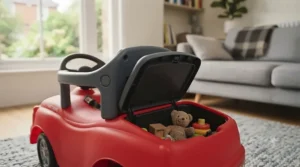
Real-World Scenarios: Matching the Car to Your Toddler’s Stage
Specs matter less than fit — here’s how three common situations map onto the products above.
The one-year-old still cruising furniture. Not yet walking independently but pulling to stand confidently and taking a few wobbly steps while holding on, this toddler benefits most from the Smoby 2-in-1 Ride on Car, since its walker mode supports the exact stage they’re at right now, with the ride-on mode ready to grow into over the following months. Budget here typically sits under £35, and the anti-topple design offers real reassurance for cautious parents.
The 18-to-24-month-old confidently walking indoors. Steady on their feet around the house but still building outdoor confidence on uneven pavements, this toddler is well served by either the AIYAPLAY Land Rover Discovery or Qaba Mercedes-Benz C-Class, since the removable parent handle lets caregivers retain control on trickier terrain while the child enjoys independent foot-to-floor play at home.
The nearly-three-year-old who’s outgrowing early toys. Physically capable, seeking more challenge and imaginative scope, this child gets the most lasting value from the Little Tikes Cozy Coupe, whose 50 lb weight limit and durable build mean it won’t be outgrown within a single season the way smaller, earlier-stage products often are.
Buyer’s Decision Framework
Work through these questions in order rather than starting from price alone.
If your toddler is under 15 months and still building walking confidence, choose the Smoby 2-in-1 Ride on Car because it’s the only product here genuinely designed for that earlier developmental stage. If you want one toy to last from first ride to nearly three years old, choose the Little Tikes Cozy Coupe because its size, weight limit and removable floor genuinely adapt as your toddler grows.
If sensory engagement — lights, horn, music — is the priority for keeping a toddler interested, choose the HOMCOM Ride on Car Toddler Walker or Hillington Kids Ride On Car, both of which build those features in at accessible prices. If your toddler is prone to overstimulation or you simply prefer a quieter toy, choose the COSTWAY Foot to Floor Sliding Walker for its deliberately stripped-back design. And if brand styling and outdoor parent-control functionality both matter, choose between the AIYAPLAY Land Rover Discovery and Qaba Mercedes-Benz C-Class based purely on which badge your household prefers — mechanically, the two are close to identical.
How to Choose a First Ride-On Car for Toddlers
Six practical questions to work through before adding one to your basket:
- What’s your toddler’s current stage — cruising, wobbly walking, or confident walking? This determines whether you need a walker-hybrid like the Smoby, or a straightforward foot-to-floor slider.
- Indoor use, outdoor use, or both? Outdoor use on pavements and paths benefits enormously from a removable parent-control handle, which not every model offers.
- Does your toddler respond well to sensory features, or get overstimulated? This single factor should steer you toward or away from lights-and-sound models.
- How much storage space do you realistically have? Larger, more durable cars like the Cozy Coupe take up meaningfully more room than compact walker-hybrids.
- Will this need to survive a sibling using it afterward? If so, prioritise build durability over sensory extras or licensed styling.
- What weight limit does your toddler need to grow into? Checking the stated maximum weight prevents an expensive early outgrow.
Foot-to-Floor Car for a 1 Year Old: What to Look For
Buying specifically for a one-year-old changes the calculus considerably compared with shopping for an older toddler, because physical readiness varies enormously within that single age band. According to NHS guidance on baby development, the age at which babies begin walking independently varies significantly from child to child, and it’s entirely normal for some to still be developing this skill well into their second year.
That variability matters directly for product choice. A car requiring confident, independent seated balance may frustrate a one-year-old who’s still cruising furniture, while a walker-hybrid designed around support and stability — like the Smoby 2-in-1 covered above — meets that child exactly where they are developmentally rather than pushing ahead of it. Look specifically for a low seat height that makes climbing in and out easy without adult lifting, a wide wheelbase for tip-resistance, and — critically — a manufacturer-stated minimum age genuinely below 12 months rather than a generic “toddler” label that assumes more developed balance than a one-year-old necessarily has.
Avoid anything requiring active steering coordination or pedal use at this stage; foot-to-floor propulsion alone is plenty of physical challenge for a one-year-old, and adding steering demands before the basic push-and-balance skill is established tends to produce frustration rather than engagement.

Foot-to-Floor Car for an 18 Month Old: What Changes
By 18 months, most toddlers have moved meaningfully past the wobbly early-walking stage covered above, and product requirements shift accordingly. Trunk control is typically stronger, meaning a seated foot-to-floor slider like the Little Tikes Cozy Coupe or HOMCOM model becomes appropriate even without the walker-support scaffolding a younger toddler needs.
This is also the point at which sensory and imaginative features start paying off more directly — an 18-month-old is far more likely to engage purposefully with a horn, steering wheel or storage compartment than a barely-walking one-year-old, whose attention is still largely absorbed by the physical challenge of movement itself. Look for anti-tip features specifically at this stage, since 18-month-olds are confident enough to lean, twist and occasionally attempt to stand up inside a seated ride-on, which is precisely the kind of enthusiastic-but-uncoordinated movement that tips a poorly stabilised car.
Outdoor use also becomes more realistic around 18 months, which is where 2-in-1 designs with a removable parent-control handle — the AIYAPLAY and Qaba models above — start to earn their higher price relative to indoor-only sliders.
Toddler Developmental Milestones and Ride-On Play
Ride-on cars aren’t just entertainment — they sit within a well-documented sequence of physical, or “gross motor,” developmental milestones that most toddlers move through in a broadly similar order, even though the exact timing varies widely between children.
| Approximate Age | Typical Milestone | Where Ride-On Play Fits |
|---|---|---|
| 9–12 months | Pulling to stand, cruising furniture | Walker-hybrid mode (e.g. Smoby) supports this stage |
| 12–15 months | First independent steps | Low seat height, wide wheelbase cars suit early confidence |
| 15–18 months | Walking with a wider, uneven gait | Anti-tip features matter most here |
| 18–24 months | Confident indoor walking, early running | Full foot-to-floor sliders become appropriate |
| 24–36 months | Coordinated steering, imaginative play | Steering wheels, storage and pretend-play features add value |
England’s statutory Early Years Foundation Stage framework specifically identifies physical development — including coordination, control and movement — as one of the core areas early years settings must support, reflecting just how central physical play, ride-on toys included, is considered to healthy early development rather than simply being “just” a toy. The table above is a general guide rather than a rigid schedule; plenty of perfectly healthy toddlers sit outside these windows in either direction, and a health visitor remains the right point of contact for genuine developmental concerns rather than a blog post.
First Ride-On Toys: Beyond the Car
Ride-on cars are the most recognisable category of first ride-on toys, but they’re not the only option, and understanding the alternatives helps you choose the right first purchase rather than simply the most obvious one.
Push-along walkers — distinct from the walker mode built into hybrids like the Smoby — are typically taller, handle-based frames designed purely for cruising support, without a seat at all. Balance bikes, usually aimed slightly older at 18 months to 2 years and up, ask toddlers to sit astride and push with alternating feet rather than sliding a whole car forward, building a different, more targeted balance skill that later transfers directly to pedal bikes. Ride-on animals and wiggle cars — hopping or rocking rather than rolling — suit toddlers who enjoy bouncing motion but don’t yet have the coordination for controlled forward propulsion.
| Toy Type | Core Skill Built | Typical Starting Age | Best Fit |
|---|---|---|---|
| Ride-on car (foot-to-floor) | Leg strength, seated balance | 10–18 months | Most first-time buyers |
| Push-along walker | Standing balance, cruising | 9–12 months | Pre-walking babies |
| Balance bike | Astride balance, steering | 18 months–2 years | Toddlers ready for bikes |
| Wiggle/rocking ride-on | Core stability, rhythm | 12–24 months | Bouncing, sensory-seeking toddlers |
The table above makes the trade-off reasonably clear: ride-on cars sit in a genuine sweet spot for most families, combining accessible starting ages with the seated support younger toddlers need and the imaginative-play appeal that keeps older toddlers engaged — which is exactly why they remain the default first purchase for so many parents rather than a push-along walker or balance bike alone.

Walking Development and How Ride-On Cars Help
It’s worth being precise about what ride-on cars actually contribute to walking development, since marketing copy has a habit of overstating toy benefits. Foot-to-floor propulsion — pushing a seated car forward using leg strength alone — directly exercises the same large leg muscles (quadriceps, calves, glutes) that independent walking relies on, while the seated, supported position removes the balance challenge that makes free-standing practice tiring and sometimes frustrating for a beginner.
This is genuine, if modest, developmental value rather than a marketing claim: repetitive leg-pushing motion builds strength and motor pattern familiarity in a lower-pressure context than unsupported walking practice. It’s not a substitute for tummy time, supported standing practice, or simply letting a toddler cruise furniture and attempt independent steps — those remain the primary drivers of walking development — but as a genuinely engaging, low-pressure supplement, a well-chosen ride-on car earns its place in a toddler’s toy rotation.
What ride-on play won’t do is accelerate walking beyond a toddler’s individual developmental timeline; readiness for independent walking is governed by neurological and muscular maturation that varies naturally between children, not by how many hours are logged in a foot-to-floor car. Treat it as supportive, enjoyable practice rather than a shortcut, and the toy earns its keep regardless of exactly when those first unaided steps arrive.
Common Mistakes When Buying a First Ride-On Car
A handful of buying mistakes come up repeatedly, and most are easy to sidestep once you know what to check.
The most common is buying based on the manufacturer’s headline age label alone, without cross-checking it against your own toddler’s actual physical stage — a “12 months+” label assumes an average developmental timeline that your specific child may sit either side of. The second is overlooking seat height and getting-in-out ease, which matters enormously for a toddler who can’t yet climb confidently; a car that requires adult lifting every single time defeats much of the independent-play purpose.
Parents also frequently underestimate storage space needs, particularly with larger, more durable models like the Cozy Coupe, only to find it awkwardly wedged in a hallway within days. Finally, many buyers skip checking the maximum weight limit entirely, leading to an unnecessarily early outgrow that a slightly higher-capacity model — often only a little more expensive — would have avoided.
Safety, Regulations and Compliance Guide
UK toy safety isn’t optional guidance — it’s a legal framework, and it’s worth understanding the basics before buying any ride-on toy. RoSPA’s toy safety advice recommends checking for the CE or UKCA mark on any toy before purchase, since this indicates the manufacturer has met the relevant UK and EU safety and environmental requirements, alongside checking that the toy’s stated age range genuinely matches the child who’ll use it.
Beyond the legal marking, a few practical checks matter specifically for ride-on cars: confirm wheels and any moving parts (steering columns, horns, removable handles) don’t present pinch-point risks for small fingers, check that any battery compartments for sound or light features are properly secured with screws rather than simple clips, and supervise early use closely regardless of how sturdy a model appears, since tipping risk is highest in the first few sessions before a toddler learns the car’s handling limits. Outdoor use near roads, driveways or steps warrants particularly close supervision — none of the seven products in this guide are designed with any braking mechanism, relying entirely on natural friction and adult oversight to control speed on slopes.

Frequently Asked Questions
❓ What age can a toddler start using a ride-on car?
❓ Is a ride-on car good for a baby who isn't walking yet?
❓ How do I know if a ride-on car is too advanced for my toddler?
❓ Are foot-to-floor ride-on cars safer than battery-powered ones?
❓ Do ride-on cars actually help with walking development?
Conclusion
Seven cars, one consistent message: match the toy to your toddler’s actual stage, not their age in months alone. Families with a still-cruising one-year-old will get the most genuine value from the Smoby 2-in-1 Ride on Car, while confidently walking 18-month-olds and up have a far wider field to choose from, spanning the budget sensory appeal of the HOMCOM Ride on Car Toddler Walker through to the long-haul durability of the Little Tikes Cozy Coupe.
What ties every recommendation together is honesty about what a first ride-on car for toddlers can and can’t do — it’s a genuinely useful, developmentally supportive toy, grounded in real leg-strengthening play, but it’s a supplement to walking development rather than a substitute for it, and the right product choice depends far more on your individual toddler’s stage than on any single “best overall” label. Choose based on where your toddler actually is right now, prioritise the safety checks covered above, and you’ll get months — often years — of genuine value out of what remains one of the most enduringly popular first toys for a reason.
Recommended for You
- 7 Best Wooden Animal Ride-On Picks for Toddlers (2026 UK Guide)
- Rolling Plush Animal Ride-On: 7 Best Picks for 2026 (Tried; Tested Research)
- Rocking Animal Ride-On for Toddlers: 7 Best Picks for 2026
Disclaimer: This article contains affiliate links. As an Amazon Associate, I earn from qualifying purchases. If you purchase products through these links, we may earn a small commission at no additional cost to you.
✨ Found this helpful? Share it with your friends! 💬🤗
