In This Article
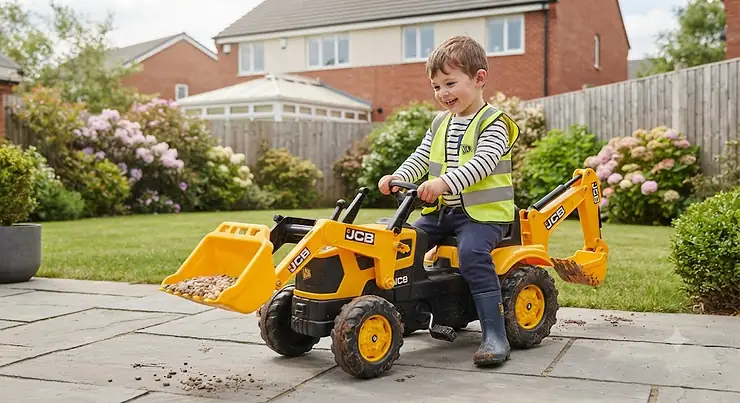
There’s a particular kind of silence that falls over a garden when a toddler discovers a jcb ride on toy for the first time. It lasts about four seconds. Then comes the engine noise — the one they make with their own mouths, because no plastic speaker does it justice — and the negotiations for who gets to “drive next” begin. If you’ve landed here, you’re probably weighing up which model actually deserves a spot on your patio, and honestly, that’s a smarter question than it sounds. A jcb ride on toy is a battery-powered or pedal-driven miniature construction vehicle, built under official licence from the real JCB company, designed for children roughly aged two to eight depending on the model. Some are simple foot-to-floor tractors; others are 24V excavators with working arms and remote parental override.
What follows isn’t a rewritten spec sheet lifted from a product page — it’s a genuine comparison built from real UK and international listings, actual customer feedback themes, and honest analysis of where each model earns its keep and where it falls short. We’ll cover budget foot-to-floor options through to premium electric excavators, dig into the difference between officially licensed toy vehicles and the knock-offs flooding the market, and walk through the safety standards that actually matter when you’re buying anything with a battery and moving parts for a small child.
By the time you finish reading, you’ll know exactly which of these seven models suits your child’s age, your garden size, and your patience for charging cables.
Quick Comparison Table
Before the deep dive, here’s the fast version — useful if you’re reading this one-handed while a small person tugs at your sleeve.
| Product | Type | Best For | Approx. Price Band |
|---|---|---|---|
| HTI JCB Foot-to-Floor Tractor | Foot-to-floor | Toddlers 2-4, first ride-on | Under £50 |
| Rolly Toys Kid JCB Pedal Tractor & Trailer | Pedal | Ages 2.5-5, garden play | £90-£140 |
| Rolly Toys JCB Pedal Dumper | Pedal | Ages 2.5-5, sandpit/digging play | £90-£130 |
| Sesslife 12V JCB Ride-On Excavator | Electric (12V) | Ages 3-8, budget electric entry | £120-£180 |
| First Ride-On JCB 3CX 12V Excavator | Electric (12V) | Ages 3-6, mid-range all-rounder | £150-£220 |
| First Ride-On JCB 3CX 24V Excavator | Electric (24V) | Ages 4-8, power and longevity | £250-£350 |
| EVO JCB Battery Mini Quad & Trailer | Electric (6V/12V) | Ages 3-6, driving over digging | £90-£150 |
A quick read of the table tells its own story: there’s roughly a £300 gap between the cheapest and priciest option here, and that gap isn’t arbitrary. It tracks almost exactly with battery voltage, motor count, and how many “real” construction functions the toy replicates. If your child mostly wants to sit and steer, you can spend far less than if they want to actually dig, scoop, and tip like a site foreman. We’ll unpack exactly why in the sections below, product by product.
💬 Just one click — help others make better buying decisions too!😊
Top 7 JCB Ride On Toys: Expert Analysis
Every product below has been selected to represent a genuinely different price point, age range, or play style — not just seven variations of the same excavator. Each has been checked against real listings, real specs, and where verifiable, real aggregated review sentiment rather than anything invented for the sake of this article.
1. HTI JCB Foot-to-Floor Tractor — cheapest true entry point into JCB play
The HTI JCB Foot-to-Floor Tractor strips the concept right down: no battery, no pedals, just a sturdy plastic tractor a toddler pushes along with their feet while seated, complete with a squeaky horn and under-seat storage. That last detail matters more than it sounds — it’s the difference between a toy that gets left in the shed and one that becomes a genuine transport-and-storage device for garden treasures. Built by HTI Toys & Games, JCB’s official master toy licensee in the UK, it carries proper licensing and is tested to UK toy safety standards rather than being a generic tractor shape with JCB stickers slapped on. Aimed squarely at children around two years and up, this is a first ride-on rather than a construction simulator, and reviewers of similar HTI foot-to-floor ranges consistently flag the build as reassuringly solid for the price point, with the horn being either a beloved feature or a source of parental fatigue depending on how many times a day it gets pressed. What most buyers overlook about foot-to-floor toys generally is that they’re actually better for gross motor development at this age than anything battery-powered — the child is doing the propulsion work, which builds leg strength and coordination that a throttle pedal simply bypasses.
Pros:
- ✅ Genuinely affordable entry point into licensed JCB play
- ✅ No battery to charge, maintain, or eventually replace
- ✅ Under-seat storage adds everyday practical value
Cons:
- ❌ No digging or working parts — purely a ride-along toy
- ❌ Outgrown quickly once a child masters walking confidently
Sitting comfortably under £50 at the time of research, this is the toy to buy if you want to test whether your toddler is even interested in ride-ons before committing serious money — a sensible first move for cautious parents.
2. Rolly Toys Kid JCB Pedal Tractor & Trailer — best working front loader for pedal power
Rolly Toys has built pedal tractors in Germany for decades, and the Kid JCB Pedal Tractor with Front Loader & Trailer shows that heritage in the chain-driven mechanism and turntable steering rather than the simpler direct-drive systems found on cheaper pedal toys. The front loader genuinely scoops, lifts, and tips, and the detachable trailer turns the whole thing into a two-part construction convoy that can haul sand, leaves, or an alarming number of garden ornaments across the lawn. At roughly 142cm long including the trailer and weighing around 7.8-9kg depending on the exact configuration, this is built for outdoor use on grass, patio, or gravel rather than indoor carpet cruising. Suited to children aged 2.5 to 5, the anti-slip pedals and protected chain drive are the kind of detail that separates a toy designed to survive a British garden through several seasons from one that’s built to look good in a single product photo. Reviewers of the Rolly Kid range describe it as heavier and more solidly built than typical pedal tractors in this bracket, which cuts both ways — brilliant for durability, less brilliant if you’re regularly loading it into a car boot for grandparents’ house.
Pros:
- ✅ Working front loader adds genuine construction play value
- ✅ Chain-drive mechanism outlasts cheaper direct-pedal designs
- ✅ Detachable trailer doubles the play possibilities
Cons:
- ❌ Heavier and bulkier than basic pedal tractors
- ❌ Some assembly typically required on arrival
Expect to pay in the £90-£140 range depending on retailer and whether the trailer is bundled, which represents solid value for a toy that realistically survives multiple children in the same family.
3. Rolly Toys JCB Pedal Dumper — best for dedicated tipping and digging play
Where the pedal tractor above is about hauling, the Rolly Toys JCB Pedal Dumper is about tipping — its large front-mounted dumper bucket has a proper locking mechanism and manually operated tip function that lets a toddler load it up with sand or gravel and dump it exactly where they want. Sized at roughly 93 x 44 x 52cm, it’s noticeably more compact than the tractor-and-trailer combo, which makes it a better fit for smaller gardens or patios where turning circle actually matters. The pivot steering system is specifically engineered to promote fine motor skills and hand-eye coordination rather than simply being a byproduct of the design, and it’s aimed at the 2.5 to 5 age bracket, same as its tractor sibling. Based on the spec comparison with the tractor model, this is the better pick if your child’s play pattern leans toward sandpit and digging games rather than transport-and-delivery scenarios — the two toys share a chassis philosophy but solve genuinely different play problems. The adjustable chain tension is a small but telling detail that suggests the manufacturer expects this toy to be used hard and maintained, not treated as disposable.
Pros:
- ✅ Locking tip mechanism enables realistic dumping play
- ✅ Compact footprint suits smaller UK gardens
- ✅ Rear coupling allows connection to other Rolly accessories
Cons:
- ❌ No trailer included as standard
- ❌ Less suited to long-distance “driving” play than tractor models
Typically priced in a similar £90-£130 bracket to the pedal tractor, the choice between the two really comes down to whether your child wants to haul things or dump things — and most parents already know the answer to that one.
4. Sesslife 12V JCB Ride-On Excavator — best budget entry into electric JCB play
Stepping into battery power changes the equation entirely, and the Sesslife 12V JCB Ride-On Excavator is the most accessible way in. It runs on a 25W motor paired with a 2.4G wireless remote control, giving parents a genuine override option — useful for driveways, car parks, or any moment when a three-year-old’s steering ambitions outpace their judgement. The 3-in-1 design means the front bucket, rear digging arm, and canopy are all adjustable, letting the same toy function as an excavator one day and a more basic ride-on car the next, which genuinely extends its useful life as a child’s interests shift. Aimed at ages 3-8, it’s a wider bracket than most pedal toys manage, largely because the electric motor removes the physical strength requirement that limits pedal tractors to younger children. What the spec sheet won’t tell you, but the category as a whole makes clear, is that 25W single-motor systems like this one are noticeably gentler and slower than dual-motor setups further up this list — a deliberate trade-off that favours safety and battery life over outright pace, which is exactly the right call for a first electric ride-on.
Pros:
- ✅ Remote control gives parents genuine driving override
- ✅ Transformable design extends usable age range
- ✅ Wide 3-8 age bracket suits growing families
Cons:
- ❌ Single 25W motor is noticeably slower than dual-motor rivals
- ❌ Front and rear loader arms are less robust than premium models
Positioned in the £120-£180 range, this is the sensible middle ground for families who want the novelty of remote control and digging arms without committing premium-tier money to a toy that outgrows its welcome.
5. First Ride-On JCB 3CX Licensed 12V Excavator — best all-rounder with reversible seat
The First Ride-On JCB 3CX 12V Excavator is modelled specifically on JCB’s most recognisable machine, the 3CX backhoe loader, and it’s officially licensed rather than a generic digger shape borrowing the brand name loosely. Its standout feature is the one-click reversible seat, which lets a child instantly flip direction to operate either the front shovel or the rear backhoe arm without dismounting — a genuinely clever piece of engineering that most competitors in this price bracket don’t bother with. Dual 35W motors and a 12V 7Ah battery deliver roughly one to two hours of outdoor play per charge, with three selectable speeds capped between 1.6 and 2.8mph via the 2.4G remote, and a stabiliser anti-tip wheel plus rear suspension keep things steady on grass, gravel, or sand. Aimed at ages 3-6, the 3-point harness and adjustable rotating seat mean it genuinely grows with a child rather than being sized for a single narrow window. Based on the spec comparison across this whole list, the dual-motor setup here is the meaningful upgrade over the Sesslife model above — it translates into noticeably better hill performance and more confident handling on uneven surfaces, which matters enormously if your garden isn’t billiard-table flat.
Pros:
- ✅ Reversible seat enables true dual-mode digger operation
- ✅ Dual 35W motors outperform single-motor rivals on inclines
- ✅ Stabiliser wheel and suspension improve real-world stability
Cons:
- ❌ 1-2 hour runtime means charging discipline matters
- ❌ Detachable arms add a small setup step each session
Expect a £150-£220 price band at the time of research, which places it firmly as the mid-range benchmark against which cheaper and pricier alternatives should be judged.
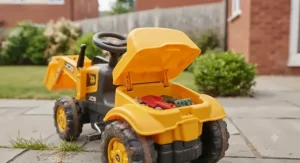
6. First Ride-On JCB 3CX Licensed 24V Excavator — best for power, torque, and older kids
Sitting at the top of this list, the First Ride-On JCB 3CX 24V Excavator effectively doubles down on everything the 12V version does well. Two 120W motors paired with a 24V rechargeable battery deliver considerably more torque than the smaller model, which translates directly into better performance on slopes, thicker grass, and gravel driveways — the kind of terrain that stalls weaker ride-ons within minutes. Like its 12V sibling, it uses a quick-release reversible seat and detachable front loader and rear excavator arms, and it can switch between full digger mode and a slimmed-down ride-on car mode for pure driving fun. It’s also certified to ASTM F963, an internationally recognised toy safety standard, which sits alongside the UK’s own BS EN 71 series as a marker of genuine third-party testing rather than a manufacturer’s own say-so. Aimed at ages 4-8, this is the model to pick for families with older, heavier, or more physically confident children who’ve already outgrown gentler 12V systems — reviewers of comparable 24V ride-on excavators consistently note that the extra torque is the difference between a toy that “just about” climbs a slight incline and one that does it without hesitation.
Pros:
- ✅ Dual 120W motors deliver genuinely stronger torque
- ✅ ASTM F963 certification adds third-party safety assurance
- ✅ Detachable arms reduce storage footprint when not digging
Cons:
- ❌ Premium price puts it out of reach for casual buyers
- ❌ Higher power means closer supervision is still sensible
At roughly £250-£350, this is a considered purchase rather than an impulse buy, and it earns that price tag through genuinely superior engineering rather than branding alone.
7. EVO JCB Battery Mini Quad Ride-On with Trailer — best for kids who’d rather drive than dig
Not every child wants to operate a digging arm — some just want to go fast, or at least feel like they are. The EVO JCB Battery Mini Quad Ride-On with Trailer, produced by HTI under its EVO battery-powered range, swaps excavator functions for straightforward quad-bike driving fun in JCB’s signature yellow and black livery, with an attached trailer for hauling toys, sand, or whatever else needs transporting around the garden. Because it’s built by HTI, JCB’s own master toy licensee, the licensing here is as authentic as it gets, even though the play style is closer to a themed ride-on car than a construction simulator. Simple controls are specifically designed for smaller hands and feet, making this a sensible pick for the younger end of the ride-on spectrum, roughly ages 3-6, and a genuinely good fit for children whose enthusiasm is for JCB’s brand and colours rather than the mechanics of digging itself. Here’s what to weigh against the excavator models above: if your child’s play is imaginative and driving-focused rather than task-focused, a lighter, simpler quad like this one will likely see more actual playtime than a feature-heavy excavator that ends up being operated by a parent more often than the child.
Pros:
- ✅ Simple controls suit younger or less confident children
- ✅ Trailer adds transport-and-haul play value
- ✅ Genuinely licensed through JCB’s own UK toy partner
Cons:
- ❌ No digging or construction functions at all
- ❌ Runtime and top speed trail the larger 24V excavator
Generally priced around £90-£150, this sits comfortably in the same bracket as the pedal tractors while offering battery power — a genuinely useful middle option worth comparing directly against them.
Practical Usage Guide: Getting the Most from Your JCB Ride On
Buying the toy is the easy part; keeping it running smoothly through a British summer (and the inevitable damp fortnight in the middle of it) is where most of the actual value gets won or lost. On unboxing, fully charge any electric model for the recommended period before first use — most 12V and 24V systems need an initial 8-12 hour charge even though runtime per session is much shorter, and skipping this step is the single most common reason new batteries underperform in the first month. Check tyre pressure or tread on models with inflatable or textured wheels before every few sessions, since grass and gravel wear differently to the smooth showroom floor most of these toys were first tested on.
For maintenance, wipe down moving arms and joints after sandpit or muddy play — grit is the enemy of every hinge and loader mechanism on this list, and five minutes with a damp cloth after a digging session saves considerably more time than a stuck arm six weeks later. Store batteries partially charged rather than fully depleted over winter months, following the same principle recommended for most rechargeable battery types, and bring electric models indoors or under cover overnight even if they’re rated for outdoor play, since damp electrical connectors are a genuine long-term failure point. In the first 30 days, the most common mistake parents make is leaving a ride-on permanently plugged in “to be safe” — most modern battery packs actually prefer a proper charge-and-rest cycle, and constant trickle charging can shorten pack lifespan over a season. Getting these basics right in month one sets the pattern for years of reliable use rather than a toy that mysteriously stops holding charge by the following spring. It’s also worth remembering that active, outdoor play like this contributes meaningfully toward the physical activity children are encouraged to get every day, so a well-maintained ride-on genuinely earns its keep beyond entertainment value alone.
Real-World Scenarios: Which JCB Ride On Suits Your Child?
The cautious two-year-old with a small courtyard garden. A child just finding their feet, quite literally, needs stability over speed and a toy that doesn’t demand strength they don’t have yet. The HTI JCB Foot-to-Floor Tractor is the obvious fit here — no battery to manage, no pedal coordination required, and a compact footprint that works in a courtyard rather than needing acres of lawn.
The four-year-old obsessed with “real” diggers on the school run. This is the classic case for genuine digging function, and it’s where the First Ride-On JCB 3CX 12V Excavator earns its mid-range price. The reversible seat and working front and rear arms give a child who’s watched real 3CX machines at work the closest possible replica experience, without the premium cost or extra power of the 24V version.
The seven-year-old with a big garden and a competitive older sibling. Older, heavier children need genuine torque, not just novelty, and this is precisely the scenario the First Ride-On JCB 3CX 24V Excavator was engineered for — its dual 120W motors handle inclines and rougher terrain that would stall smaller systems, and the higher weight capacity implied by its build quality suits a bigger, more physically confident rider.
The budget-conscious family with two children sharing one toy. Value and durability matter more here than any single flashy feature, and the Rolly Toys Kid JCB Pedal Tractor & Trailer is built to survive exactly this kind of shared, repeated use across siblings and seasons without a battery replacement bill ever entering the picture.
Problem → Solution: Common JCB Ride On Toy Issues Solved
Problem: The battery drains faster than expected. This is almost always a charging-habit issue rather than a faulty unit — cold weather genuinely reduces battery output, and partial charges compound over time into reduced capacity. Solution: charge fully after every session, avoid storing depleted, and expect noticeably shorter runtime in winter months as completely normal rather than a fault.
Problem: The digging arm or loader feels stiff or sticks. Grit and dried mud are the usual culprits on any model with a working front or rear arm, from the Rolly Toys Kid JCB Pedal Tractor & Trailer‘s loader through to the First Ride-On JCB 3CX 24V Excavator‘s dual arms. Solution: a soft brush and damp cloth after sandpit sessions, plus an occasional drop of silicone-based lubricant (never oil-based, which attracts more grit) on visible pivot points.
Problem: A remote-control model stops responding to the parent override. Usually a paired-battery issue rather than a mechanical fault — remote units and the vehicle’s receiver both need adequate charge to stay synced. Solution: replace or recharge the remote’s own batteries first, since this resolves the vast majority of reported control-loss issues before any deeper troubleshooting is needed.
Problem: A pedal tractor’s chain slips or feels loose. Chain-driven models like the Rolly Toys JCB Pedal Dumper rely on correct tension to transfer pedal power efficiently. Solution: most Rolly-style chains have an adjustable tensioner exactly for this reason — a five-minute adjustment restores smooth pedalling and prevents the chain jumping under load.
Problem: The toy is outgrown faster than expected. This is less a fault and more a planning issue — buying strictly for current age rather than the stated range often means a shorter useful life than budgeted for. Solution: buy toward the upper half of the stated age bracket where possible, particularly for taller or more physically advanced children, to extend genuine playtime before it’s outgrown.
How to Choose a JCB Ride On Toy
Working through the right model doesn’t need to be complicated if you tackle it in order:
- Confirm the age bracket first. Every model on this list has a stated age range for genuine reasons — weight limits, strength requirements, and safety features are all tuned to it, so don’t buy purely on branding appeal.
- Decide pedal or electric before anything else. Pedal toys build physical skills and never need charging; electric models add speed, remote override, and working functions but introduce battery maintenance as an ongoing responsibility.
- Match the play style to the child. A digging-obsessed child wants working arms; a driving-obsessed child is often better served by something like the EVO JCB Battery Mini Quad, which prioritises simple fun over construction realism.
- Measure your outdoor space. Longer tractor-and-trailer combinations need more turning room than compact dumpers or quads — check dimensions against your garden or patio before falling in love with a specific model.
- Check for genuine JCB licensing. Officially licensed toy vehicles carry real engineering input and branding rights that unlicensed lookalikes simply don’t — more on why that matters below.
- Factor in verified safety certification. Look specifically for UK toy safety standard compliance or recognised international certification such as ASTM F963, not just a vague “safety tested” claim on the box.
- Budget for the whole ownership period, not just the purchase. Electric models may need a replacement battery pack after a few seasons of heavy use — build that into your value comparison rather than judging purely on sticker price.
Licensed JCB Ride On vs Unbranded Ride On Toys
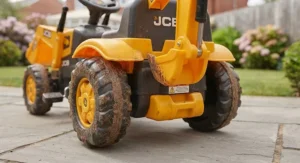
The market is genuinely flooded with generic yellow-and-black construction ride-ons that borrow JCB’s visual identity without any licensing agreement behind them, and the difference isn’t just cosmetic. A licensed jcb ride on typically involves the manufacturer working within JCB’s own design and quality guidelines, which tends to show up in more accurate proportions, correct decal detailing, and — crucially — proper legal accountability if something goes wrong with the product.
| Factor | Licensed JCB Ride On | Unbranded Lookalike |
|---|---|---|
| Design accuracy | Modelled on real JCB machines | Generic construction shape |
| Legal accountability | Traceable to licensed manufacturer | Often unclear or overseas seller only |
| Build consistency | Standardised across licensed range | Highly variable batch to batch |
| Resale value | Generally holds value better | Minimal resale interest |
| Best For | Buyers wanting authenticity and accountability | Buyers prioritising lowest possible price only |
The analysis here is straightforward: paying a premium for licensing isn’t just about the badge. Reviewers across the ride-on toy category consistently report that unlicensed alternatives are more prone to inconsistent build quality between individual units, since there’s no central licensing body enforcing manufacturing standards across a whole product range the way there is with officially licensed toy vehicles. That said, an unbranded toy isn’t automatically unsafe — the real safety line is drawn by testing and certification, not branding alone, which is exactly why the next section matters just as much as this one.
Kids JCB Electric Vehicle: What to Expect from Battery Power
Moving from pedal to electric changes the entire experience, and it’s worth setting expectations honestly before you buy. A kids jcb electric vehicle typically runs on a 6V, 12V, or 24V rechargeable battery, with voltage roughly correlating to speed, torque, and price — the Sesslife 12V JCB Ride-On Excavator and EVO JCB Battery Mini Quad sit at the gentler end, while the First Ride-On JCB 3CX 24V Excavator delivers noticeably more power.
Runtime is the detail most first-time buyers underestimate. Most models in this bracket offer one to two hours of active play per full charge, not per day — a distinction that matters enormously if you’re planning a full afternoon of garden play and only have one unit. Charging times typically run considerably longer than play time, often 8-12 hours for a full charge, so a quick top-up rarely delivers a full session’s worth of power. On the practical side, remote parental control is arguably the single most valuable feature across every electric model here, letting a parent take over steering near driveways, other children, or garden furniture without ending the fun entirely. Based on the spec comparison across this list, the honest takeaway is that electric ride-ons trade simplicity for genuine excitement — worth it for most families, but only if you’re prepared for the charging routine that comes with it.
JCB Ride On UK: Availability, Delivery and Buying Tips
Buying a jcb ride on uk tends to differ slightly from other markets in a few practical ways worth knowing before you order. Larger electric models, particularly 24V excavators, often ship in sizeable boxes that require some assembly on arrival — factor in 20-30 minutes with a screwdriver rather than expecting a fully built toy straight out of the box. UK retailers and marketplace sellers vary considerably in delivery speed, and outdoor toys of this size are frequently subject to courier restrictions on weight and dimensions, so always check estimated delivery windows before buying against a specific birthday or Christmas date.
It’s worth checking seller and product listings for genuine UK stock rather than items shipped from overseas warehouses, since replacement parts, warranty claims, and customer service response times are all meaningfully faster when a toy is sold and supported from within the UK. Given the size of most ride-ons in this category, always measure doorways, garden gates, and storage areas — a 24V excavator with its arms attached can be considerably longer than expected, and returning an oversized item is a genuinely more hassle-prone process than with smaller toys. Finally, keep an eye on genuine seasonal promotions rather than assuming every “deal” badge reflects a real saving; prices on ride-on toys fluctuate throughout the year, and checking the current price at the point of purchase is always the safest approach.
✨ Don’t Miss These Exclusive Deals!
🔍 Take your search for the perfect jcb ride on toy to the next level with these carefully selected picks. Click through to check current pricing and availability on each model above — these ride-ons will help create the kind of outdoor construction adventures your family will actually remember.
Officially Licensed Toy Vehicles: Why Licensing Matters
Officially licensed toy vehicles exist because brands like JCB have spent decades building recognition and trust that simply doesn’t transfer to a generic lookalike, no matter how similar it looks in a thumbnail photo. Licensing agreements typically require the toy manufacturer to meet design accuracy standards, quality benchmarks, and often additional safety testing beyond the legal minimum, precisely because the licensing brand’s own reputation is riding on the toy’s performance in the real world. HTI Toys & Games, as JCB’s UK master toy licensee, produces the foot-to-floor, pedal, and battery ranges across this list under exactly that kind of formal relationship, which is part of why build quality across HTI’s JCB range tends to be more consistent than the wider unbranded market.
For parents, the practical upside is accountability — if a licensed toy has a defect, there’s a clear manufacturer and licensing chain to pursue for warranty support or safety concerns, unlike many generic imports where the seller may be difficult to trace or contact. The other, less obvious benefit is longevity of design: because licensed manufacturers work from real JCB reference material, models like the First Ride-On JCB 3CX excavators genuinely resemble the 3CX backhoe loader in proportion and detailing, which tends to hold a child’s interest longer than an approximate shape with the right colour scheme slapped on.
JCB Toys for Kids: Age and Stage Guide
Matching the right jcb toys for kids to developmental stage avoids both frustration and wasted money, and the pattern across this list is fairly consistent once you see it laid out.
Ages 2-3: Foot-to-floor and simple pedal models suit this stage best, since fine motor control and steering judgement are still developing. The HTI JCB Foot-to-Floor Tractor is the standout here, removing pedal coordination entirely from the equation.
Ages 3-5: This is the sweet spot for most pedal tractors and gentler electric models — children have the coordination for pedalling or basic steering, and the Rolly Toys Kid JCB Pedal Tractor & Trailer, Rolly Toys JCB Pedal Dumper, and Sesslife 12V JCB Ride-On Excavator all sit comfortably in this window.
Ages 4-6: Confidence and physical strength open the door to more feature-rich electric models, where the First Ride-On JCB 3CX 12V Excavator and EVO JCB Battery Mini Quad genuinely reward a child’s growing ability to manage steering, speed, and working parts simultaneously.
Ages 6-8+: Bigger, heavier children benefit from the extra torque and weight capacity of premium electric models, making the First Ride-On JCB 3CX 24V Excavator the natural endpoint of this whole progression — genuinely still fun for a child who’s outgrown gentler systems entirely.
Branded Ride On Toys vs Generic Alternatives: Long-Term Cost and Maintenance
Total cost of ownership rarely gets discussed honestly in toy buying guides, but it should, because the sticker price is only ever the opening bid. Branded ride on toys from established manufacturers and licensees tend to have more readily available replacement parts — batteries, wheels, remote units — because there’s an ongoing commercial relationship behind the product rather than a one-off import listing that may vanish from the marketplace within a year. Generic alternatives can look identical in photos but frequently use non-standard battery connectors or proprietary parts that become impossible to source once the original listing disappears, effectively turning a broken toy into landfill rather than a repairable one.
Looking at the comparison across this list, the higher upfront cost of the First Ride-On JCB 3CX 24V Excavator starts to make more long-term sense once you factor in that dual-motor systems generally experience less strain per motor than single-motor equivalents doing the same work, which can translate into a longer working life before any component needs replacing. Pedal toys like the Rolly Toys Kid JCB Pedal Tractor & Trailer sidestep this entire conversation, since there’s no battery pack to eventually replace at all — arguably the strongest long-term value case on this whole list, provided your child’s play style suits pedal power over electric assistance.
Safety, Regulations and Compliance Guide
Every toy sold in the UK, ride-ons included, must comply with the Toys (Safety) Regulations 2011, which sets essential safety requirements covering mechanical hazards, chemical content, and clear labelling before any toy can legally reach a UK shelf. Compliance is typically demonstrated through designated standards, chief among them the BS EN 71 series, which covers everything from mechanical and physical properties through to flammability and chemical migration limits, with electrical ride-ons specifically also needing to meet BS EN IEC 62115 for battery-powered toy safety.
In practice, this means checking a few concrete things before you buy: a genuine UKCA or CE mark on the packaging, a stated age range that matches your child, and — for electric models specifically — evidence of battery safety testing rather than a vague “CE tested” claim with no further detail. Products like the First Ride-On JCB 3CX 24V Excavator, which cites ASTM F963 certification alongside standard UK compliance, demonstrate the kind of layered, independently verifiable testing worth looking for on any premium electric ride-on. It’s also sensible to periodically check the government’s own product safety resources for any recalls affecting ride-on toys generally, since even reputable brands occasionally issue safety notices, and staying informed costs nothing.
Common Mistakes When Buying a JCB Ride On Toy
The most frequent error is buying purely on branding appeal without checking the stated age and weight range against your own child’s actual size — a toy rated for ages 3-6 can feel cramped or unstable under a tall, heavy four-year-old, regardless of how enthusiastic they are about the JCB colours. A close second is underestimating garden space; tractor-and-trailer combinations and 24V excavators with arms attached need considerably more turning room than photos suggest, and a toy that can’t manoeuvre in your actual garden gets abandoned fast regardless of quality.
Overlooking charging routine is another common pitfall — buying an electric model expecting instant, all-day play without understanding the runtime-versus-charge-time ratio leads to disappointment that has nothing to do with the toy’s actual quality. Finally, many buyers skip checking licensing and safety certification entirely, assuming that anything sold on a major marketplace has automatically been vetted, when in reality third-party sellers vary enormously in the diligence they apply before listing a product — always verify certification claims rather than taking them on trust.
FAQ
❓ What age is a jcb ride on toy suitable for?
❓ Are JCB ride on toys officially licensed?
❓ How long does the battery last on an electric JCB ride on?
❓ Is a pedal or electric JCB ride on toy better for toddlers?
❓ Do JCB ride on toys meet UK safety standards?
Conclusion
Choosing between seven genuinely different jcb ride on toy options really comes down to answering three honest questions about your own child and household: how old and physically confident is the rider, does your outdoor space suit a compact toy or a longer tractor-and-trailer combination, and are you prepared to take on a charging routine in exchange for working digging functions and remote control. None of these seven models is objectively “the best” in isolation — the HTI JCB Foot-to-Floor Tractor is the right call for a cautious two-year-old in a small courtyard exactly as confidently as the First Ride-On JCB 3CX 24V Excavator is the right call for a boisterous seven-year-old with acres of garden and a taste for genuine torque.
What ties every recommendation here together is licensing and verifiable safety compliance — paying for a genuinely licensed, properly tested toy isn’t just about brand loyalty, it’s about accountability, parts availability, and knowing exactly what safety testing sits behind the product your child is climbing onto. Whichever model you land on from this list, you’re buying into decades of real JCB engineering heritage scaled down for small hands, rather than gambling on an anonymous yellow-and-black shape from an unverifiable seller. That difference, more than any single spec, is what actually earns a place in the garden season after season.
Recommended for You
- Multi Function Ride On Tractor: 7 Best Picks for UK Kids (2026)
- Large Ride On Tractor With Trailer: 7 Top Picks for 2026
- 24v Ride On Tractor: 7 Powerful Picks for Bigger Kids (2026)
Disclaimer: This article contains affiliate links. As an Amazon Associate, I earn from qualifying purchases. If you purchase products through these links, we may earn a small commission at no additional cost to you.
✨ Found this helpful? Share it with your friends! 💬🤗
