In This Article
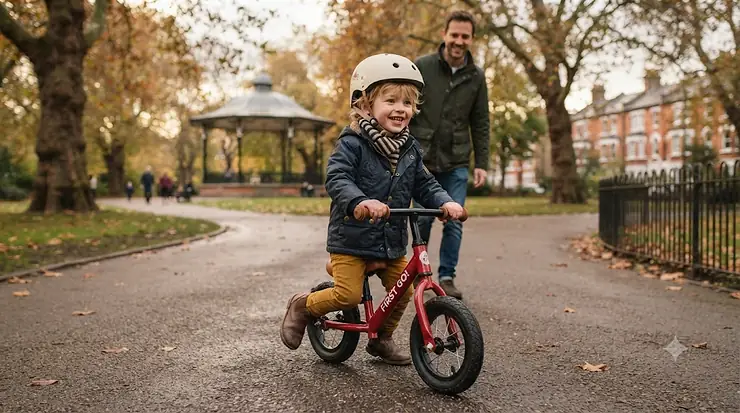
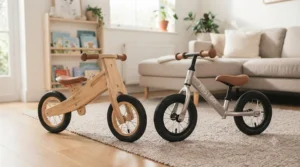
A first balance bike for toddlers is a pedal-free, two-wheeled bike with a very low, adjustable seat and a light frame. A child aged roughly 18 months to five years can push it along with their feet. It teaches balance and steering first, so pedals arrive later without the drama.
Your toddler gets to be a cyclist months before they can pedal, and you skip the wobbly-stabiliser phase entirely. The NHS physical activity guidelines for under-fives call for at least three hours of activity a day for toddlers and pre-schoolers. A bike that runs on little legs is one of the few gadgets that genuinely helps you get there. The catch is that the wrong bike turns that magic into a tearful stand-off on the driveway. Too tall, too heavy or too twitchy, and it goes back in the shed.
This guide compares seven real models available to UK buyers. They’re judged on the two things that decide whether a toddler sticks with a bike: seat height adjustability (can it start low enough, and keep up with a growth spurt?) and confidence-building features (footrests, steering limiters, brakes and tyres). Everything here is built from published manufacturer specifications, expert reviews and aggregated parent feedback. I haven’t ridden any of these bikes, so treat this as a research shortcut rather than a lab report. Prices are given as ranges because they shift constantly on Amazon, so always check the current price before you buy.
Quick Comparison: 7 Picks for a First Balance Bike for Toddlers
Short on time? Here’s the whole field at a glance. Weights and seat ranges come from manufacturer or retailer specifications, so treat them as close guides rather than lab measurements.
| Product | Weight | Seat range | Tyres | Price range | Best For |
|---|---|---|---|---|---|
| Strider 12 Sport | About 3.0kg | 28–48cm (with XL post) | Airless foam | £100–£125 | Tiny 18-month-olds, tool-free tweaks |
| Hornit AIRO | 2.95kg | 29–44cm | Air | £130–£150 | Weight-sensitive riders, park carrying |
| Puky LR M | About 3.5kg | From roughly 29cm | Soft, puncture-free | £90–£100 | Small, hesitant two-year-olds |
| Banana GT | Check listing | 32–44cm | Air | £55–£80 | Tight budgets |
| Chillafish BMXie | About 3.6–3.8kg | 32–41cm (three settings) | Airless | Under £100 | BMX-mad two-to-four-year-olds |
| Liferyder Vogue | About 3.5kg | 32–45cm | Air | £80–£100 | Long-term use, style-conscious families |
| woom GO 1 | About 3.0kg | About 26–37cm | Air | £230–£250 | Small toddlers, early braking |
Reading across the table, the Banana GT is the value outlier, while the woom GO 1 costs roughly three to four times as much for a lower seat and a rear brake. If your child is on the small side, the Strider 12 Sport, Hornit AIRO, Puky LR M and woom GO 1 start lowest. For everyone else, the 32cm-start group of the Banana GT, Chillafish BMXie and Liferyder Vogue offers more choice at friendlier prices.
💬 Just one click — help others make better buying decisions too!😊
Top 7 Picks for a First Balance Bike for Toddlers: Expert Analysis
Each pick below gets the same treatment: what the specs mean in practice, who it suits, what reviewers keep saying, and whether the money makes sense.
1. Strider 12 Sport — lowest starting seat, tool-free tweaks
The Strider 12 Sport earns its place by starting low and adjusting fast, which is exactly what a first balance bike for toddlers should do.
The steel frame weighs about 3.0kg. The seat runs from roughly 28cm up to 43cm, stretching to around 48cm with the extra-long seatpost included in newer bundles. The handlebar moves separately between 46cm and 56cm, and both clamps are quick-release. In practice, you can re-fit the bike in a car park with cold fingers and no Allen key. A growing child also keeps a natural upright posture instead of hunching over fixed bars. The airless foam tyres never puncture, and the 27kg rider limit outlasts most toddlers’ interest.
Based on the spec comparison, this is the safest bet for petite 18-month-olds. The trade-off is ride quality: foam doesn’t cushion like air, so gravel and cobbles will feel busier. There’s no brake either, so stopping is a feet-on-the-floor affair, which plenty of parents prefer at this age.
Reviewers consistently praise the low weight. One UK tester noted their three-year-old could pick it up and wheel it around indoors like a toy, which is half the battle in building early confidence.
Pros:
- ✅ Lowest starting seat of the lot
- ✅ Tool-free seat and handlebar adjustment
- ✅ Puncture-proof tyres, zero maintenance
Cons:
- ❌ Foam tyres feel harsh on rough ground
- ❌ No brake to practise with
Expect roughly the £100–£125 range at the time of research. With a growth range stretching towards age five, that’s solid value.
2. Hornit AIRO — featherweight frame with real air tyres
The Hornit AIRO is the lightest bike in this round-up at 2.95kg, and one of the few featherweights that still gets proper air-filled tyres.
The frame and fork are magnesium alloy, a material one UK review put at about a third lighter than aluminium. The 12.5-inch wheels wear fat 2.25-inch tyres, and the saddle spans 29cm to 44cm for inside legs of about 30cm to 46cm. The footrests are moulded into the frame. Translated: it’s light enough to hoist one-handed when your toddler abandons ship halfway round the park, and the air cushioning takes the sting out of pavement joins.
What the spec sheet won’t tell you, but reviewers do, is that the seatpost has no quick-release, so seat height adjustability needs a tool. At the lowest setting the base of the post sits barely 1.5 inches off the ground, so a US reviewer advised raising it slightly. Hornit sells a shorter seatpost separately, which is worth budgeting for if your child is very small. The 12-inch model also has no brake.
Reviewers, including Cycling UK’s buying guide, rate it highly for weight and looks. The recurring gripes are the tool-only seat clamp and narrow bars that feel twitchy for taller riders.
Pros:
- ✅ Just 2.95kg, easy to carry
- ✅ Air tyres smooth out paths and pavements
- ✅ Lifetime frame warranty reported by reviewers
Cons:
- ❌ Seat adjustment needs a tool
- ❌ No brake, tight seatpost clearance when lowest
Roughly £130–£150 is the going range. That’s pricey beside the budget bikes, but justified if weight is your priority.
3. Puky LR M — compact starter with a proper footboard
The Puky LR M is built for the smallest riders, with a low step-through steel frame and a broad footboard that invites early gliding.
It weighs about 3.5kg and rolls on small puncture-free wheels. It also comes with a handlebar pad and a banana-shaped saddle. Puky recommends it from around two years old (about 85cm tall), and the seat starts lower than most 12-inch rivals, at roughly 29cm to 31cm depending on the source. Seat and bars adjust continuously rather than in notches. Puky also leaves out a steering limiter on purpose, so the bars can drop flat in a tumble instead of jabbing the child.
The honest take is that the deck and low frame make it a confidence-builder for hesitant toddlers. However, a German test magazine reported twitchy steering from the small wheels and a fairly heavy build once the kickstand is counted. Taller three-year-olds will outgrow this wheel size sooner than they would a 12-inch bike.
Reviewers, including Cyclist magazine, like the styling, the portability and the maintenance-free wheels. Critics point to the handling compromises.
Pros:
- ✅ Low start suits small two-year-olds
- ✅ Footboard encourages early gliding
- ✅ Puncture-free wheels, minimal upkeep
Cons:
- ❌ Small wheels feel twitchy
- ❌ Riders outgrow it sooner than 12-inch bikes
Around £90–£100 is typical. That’s fine for a small rider, but similar money elsewhere buys bigger wheels and longer life.
4. Banana GT — budget pick with real air tyres
The Banana GT pairs an aluminium frame with pneumatic tyres at a price where rivals usually cut corners.
The step-through frame keeps the centre of gravity low. Other specifications include 12-inch air tyres and a twin-bearing headset for smoother steering. The seat adjusts from about 32cm to 44cm, and the bars adjust too. The listing doesn’t shout about weight, so check current specifications if carrying matters to you. The 32cm minimum suits two-year-olds better than petite 18-month-olds. The 44cm ceiling gives seat height adjustability that lasts well into the pre-school years.
Sentiment is encouraging. The GT listing on Amazon UK averaged around 4.6 out of 5 from well over a thousand ratings at the time of research. One parent on a UK mountain-bike forum paid a little extra for the GT over the cheaper LT, which has plastic wheels and solid tyres, and was happy with the choice.
Pros:
- ✅ Real air tyres at a budget price
- ✅ Lightweight aluminium frame
- ✅ Seat and handlebar both adjust
Cons:
- ❌ Minimum seat rules out tiny riders
- ❌ No brake to practise with
Roughly £55–£80 is the range. This is the strongest value verdict in the guide, provided your child’s inside leg clears the 32cm start.
5. Chillafish BMXie — tool-free seat with BMX swagger
The Chillafish BMXie trades metal for reinforced plastic. In exchange it delivers a tool-free seat and a look older siblings won’t mock.
The frame weighs roughly 3.6–3.8kg depending on the version, and the 12-inch RubberSkin tyres are airless. The integrated footrest doubles as a footbrake on some models. Seat height adjustability is the headline: turn, pull and lock across 32cm to 41cm, with no tools. The catch is that it happens in three fixed positions, which one US review put at only about three inches of total growth. Translated, it’s a bike for roughly two to four years old rather than two to five.
Reviewers consistently highlight easy assembly and tumble-proof durability. Equally common complaints include the wide rear axle interfering with stride and an unpadded saddle. Some parents also worry that a fully plastic build feels less robust over time. One reviewer suggested the footrest-cum-footbrake could confuse very young riders.
It suits average-to-tall two-year-olds who like the real-bike look.
Pros:
- ✅ Tool-free seat change in seconds
- ✅ Puncture-proof airless tyres
- ✅ BMX styling kids love
Cons:
- ❌ Only three fixed seat positions
- ❌ Wide rear end can hinder stride
It typically lands under £100. That’s good value if the fit is right, and weaker value for very small or long-legged children.
6. Liferyder Vogue — UK-designed grower with style
The Liferyder Vogue is the style pick, but the numbers behind it are just as persuasive.
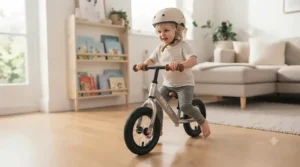
A polymer composite frame keeps it near 3.5kg, and it carries 12-inch air tyres on tri-spoke wheels for riders up to 30kg. The saddle runs 32cm to 45cm across three marked settings, roughly matching ages 1.5–2, 2–3.5 and 3.5–5. It needs the supplied tool to adjust. The confidence-building features include anti-jackknife steering, integrated footrests and a saddle shaped for little bottoms. That generous top-end range gives it real staying power.
A Mumsnet review found it sturdy and comfortable on countryside terrain, and the eldest child kept choosing it. The gripes were fiddly assembly and a younger, shorter sibling finding the straight frame awkward to climb onto. That step-over is worth noting, because a straight top tube isn’t as easy to mount as a step-through design like the Puky LR M.
Pros:
- ✅ Air tyres cope with most terrain
- ✅ 32–45cm seat range lasts for years
- ✅ Anti-jackknife steering for wobbly starts
Cons:
- ❌ Assembly is fiddly, tool needed to adjust
- ❌ Straight frame harder for short toddlers to mount
Expect the £80–£100 range at the time of research. Availability on Amazon can vary, so check current listings.
7. woom GO 1 — premium pick with a rear brake
If your budget stretches, the woom GO 1 is the most confidence-focused bike here. It’s the smallest-fitting option, and the only one with a proper rear brake and steering limiter as standard.
The aluminium frame weighs about 3kg, and the 12-inch wheels use light air tyres. The saddle spans roughly 26cm to 37cm (10.4in to 14.4in), suiting children about 82cm to 100cm tall, or around 18 months to 3.5 years. There’s a two-year warranty through the maker’s UK store. In practice, a low frame plus a lever-style brake introduces braking early, so the eventual pedal bike isn’t a shock.
The trade-off is size. One owner review on woom’s own site said a three-year-old outgrew it, noting non-adjustable bars, and another reviewer suggested it’s best on smooth paved surfaces. The brand’s site shows about 4.7 out of 5 from a few dozen reviews, though those are brand-hosted. Woom sells mainly through its own store, so check whether an Amazon UK listing is live.
Pros:
- ✅ Smallest fit and lowest seat here
- ✅ Rear brake and steering limiter included
- ✅ Around 3kg with quality air tyres
Cons:
- ❌ Highest price by a wide margin
- ❌ Older toddlers outgrow it fastest
The £230–£250 bracket is steep. It pays off for a small toddler and a bike you’ll hand down.
Side-by-Side: Seat Range and Confidence-Building Features
| Product | Seat range | Seat adjustment | Brake | Best For |
|---|---|---|---|---|
| Strider 12 Sport | 28–48cm (XL post) | Quick-release, no tools | None | Youngest starters |
| Hornit AIRO | 29–44cm | Tool required | None (12-inch) | Lightweight preference |
| Puky LR M | From about 29cm | Continuous adjustment | None | Small, cautious toddlers |
| Banana GT | 32–44cm | Adjustable | None stated | Budget buyers |
| Chillafish BMXie | 32–41cm | Tool-free, three positions | Footbrake on some models | Style-led two-year-olds |
| Liferyder Vogue | 32–45cm | Three settings, tool required | None | Long-term use |
| woom GO 1 | About 26–37cm | Hex key | Rear hand brake | Early braking practice |
The lowest starting seats belong to the woom GO 1, Strider 12 Sport, Hornit AIRO and Puky LR M. The Liferyder Vogue and Hornit AIRO stretch highest, which favours longevity. Only the woom GO 1 (and, on some models, the Chillafish BMXie) lets a child practise braking, so the rest ask you to rely on feet-first stopping.
Seat Height Adjustability: How to Fit and Re-Fit Your Toddler’s Bike
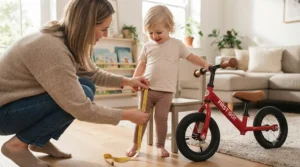
Seat height adjustability decides two things: whether the bike works on day one, and how many months it stays useful. Here’s the routine I’d follow, built on manufacturer numbers and standard fitting advice.
- Measure the inside leg. Stand your child against a wall in their usual shoes, put a book snugly between their legs, and measure from the floor to the top of the book.
- Compare against the minimum seat height. Manufacturer figures suggest the saddle top sits roughly 1–3cm below the inside leg. The Hornit AIRO lists a 30cm inside leg with a 29cm saddle, for example.
- Test the fit. Your child should sit with both feet flat on the floor and knees softly bent, so they can push off without tiptoeing.
- Check seatpost clearance. Look for the minimum-insertion mark, and remember the Hornit AIRO post sits close to the ground at its lowest setting.
- Re-check every couple of months. Toddlers grow in bursts, so a tool-free system such as the Strider 12 Sport or Chillafish BMXie removes friction, while the Liferyder Vogue needs its tool handy.
Handlebar height matters too. The Strider 12 Sport adjusts bars independently, whereas one owner review of the woom GO 1 reported non-adjustable bars becoming a limit for a taller three-year-old.
Confidence-Building Features: Problems and Solutions
Confidence is what keeps a toddler on the bike, so here are the common wobbles and which confidence-building features fix them.
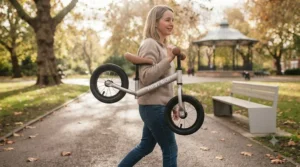
- Problem: They won’t sit down. The fix is a very low saddle and footrests. The Strider 12 Sport and woom GO 1 start lowest, and a frame handle helps on the Hornit AIRO and Liferyder Vogue when it’s time to carry them home.
- Problem: The front wheel flips round and dumps them. Steering limiters help, and the woom GO 1 has one while the Liferyder Vogue advertises anti-jackknife steering. The Puky LR M takes the opposite view, letting bars drop flat so they can’t jab a child in a fall. Both are defensible design philosophies.
- Problem: They go too fast downhill. A footboard lets feet park safely on the Puky LR M, while the woom GO 1 adds a rear brake and some Chillafish BMXie models have a footbrake.
- Problem: They tire and stall. Weight is your friend. Sub-3.5kg bikes such as the Hornit AIRO are easier to lift after a spill.
- Problem: You’re hovering. Cycling UK’s coaching advice notes that experienced instructors avoid holding the saddle. It also suggests a game of frog jumps, where the child scoots in short bursts, to build core balance.
Confidence-building features work best when matched to your child’s temperament, not stacked up on a checklist.
How to Choose the First Balance Bike for Toddlers
Follow these six steps and you’ll narrow the field in minutes. Which? advises checking that your child sits with both feet flat, that fixings are tight and that tyre pressure is right before the first ride.
- Measure the inside leg first. Age is a rough guide, but inside leg decides whether a bike fits.
- Match the minimum seat to that measurement. A 30cm inside leg needs a bike that starts near 28–29cm.
- Prioritise weight. A lighter bike is easier to steer, lift and abandon at the park gate.
- Choose tyres for your terrain. Air suits paths and gravel, foam suits smooth pavements and zero maintenance.
- Decide on brakes. For a first balance bike for toddlers, feet-first stopping is fine. A brake becomes useful nearer three.
- Set a budget with the future in mind. A bike that fits for 30 months costs less per month than a cheaper one outgrown in 12.
Real-World Scenarios: Which Bike Fits Which Family
Scenario one: petite 20-month-old, garden and pavement, budget around £100–£125. With a short inside leg, the Strider 12 Sport is the logical fit. It starts at about 28cm, adjusts without tools and needs no tyre pumps.
Scenario two: tall-for-age three-year-old, rough park paths, several rides a week. A bike with air tyres and a high seat ceiling makes sense, such as the Hornit AIRO or Liferyder Vogue. Both top out in the mid-40cm range.
Scenario three: second child, hand-me-down potential, tight budget. The Banana GT at roughly £55–£80 delivers air tyres and an aluminium frame. A parent on a UK mountain-bike forum noted the same bike being passed down without complaint.
Scenario four: cautious toddler who hates wobbling. The Puky LR M with its footboard, or the woom GO 1 with its rear brake, are the most reassuring picks.
Whichever profile is closest to yours, the deciding factors are the inside-leg measurement, the terrain and how many months you expect to use the bike.
What to Expect: The First Weeks on a Balance Bike
Set realistic expectations and you’ll avoid the disappointment that ends many bike careers early. Retailers and coaches describe a natural progression: sit, stand and walk, scoot, then glide. Most children pick up the basics within days or weeks, though timelines vary enormously.
Short, frequent sessions tend to work better than marathon outings. Let your toddler treat the bike as a walking toy at first, and don’t panic if they’d rather push it than sit on it. One parent on a UK mountain-bike forum reported that their child showed little interest for a year or so, then loved it once it clicked. Patience isn’t just a virtue here, it’s the strategy.
Seat height adjustability comes into play again during this phase. If your toddler is on tiptoes, lower the saddle. If they’re scrunched up, raise it a notch. A well-set bike makes the sit-and-scoot stage feel natural rather than a wrestling match.
Balance Bike vs Stabilisers vs Tricycle
| Balance bike | Stabiliser bike | Tricycle | |
|---|---|---|---|
| Teaches balance early | Yes, from day one | Not really; can mask leaning | No; three wheels do the work |
| Route to pedalling | Smooth once feet lift and glide | Already pedalling, but stabilisers must go | Big jump to two wheels |
| Bumpy or sloping ground | Feet act as stabilisers | Can be unstable | Stable but bulky |
| Portability | Light and easy to carry | Heavier with chain and pedals | Bulky |
| Best For | Toddlers around 18 months to 5 years | Older children ready to pedal | Very young toddlers who want to sit and steer |
Cycling UK notes that stabilisers can be unstable on bumpy or sloping ground and can make a child think they’re balancing when they aren’t. Which? similarly explains that a balance bike teaches balance straight away, while stabilisers focus on pedalling and steering. Tricycles are fun, but by design they don’t teach the lean-and-correct skill a two-wheeler needs, so the leap to two wheels is bigger.
Features That Actually Matter (And Those That Don’t)
Features that matter:
- Weight. Everything else being equal, lighter bikes are easier for tiny arms and legs to handle.
- Minimum seat height. If the child can’t plant both feet flat, nothing else matters.
- Tyres. Air tyres suit rougher terrain, foam or airless tyres suit maintenance-averse parents.
- Footrests. These give a place to park feet during downhill glides and encourage the transition to lifting feet.
- Steering approach. A limiter or a deliberately limiter-free design both work, but know which you’re buying.
Features that don’t matter as much:
- Fancy graphics and personalisation. Nice, but they won’t affect learning.
- Kickstands. One German test magazine noted that the kickstand on the Puky LR M adds weight to an already heavy bike.
- Brakes at 18 months. A rear brake on the woom GO 1 is useful practice later, but toddlers usually stop with their feet first.
✨ Ready to Pick Your Favourite?
🔍 Take your first balance bike for toddlers search to the next level with these carefully selected products. Click on any highlighted item to check current pricing and availability. These bikes will help you create confident first rides your family will love!
Common Mistakes When Buying a First Balance Bike for Toddlers
The classic error is buying for age rather than inside leg. A ‘for ages 2–5’ label doesn’t mean the seat starts low enough for your two-year-old, so always check the minimum saddle height.
A close second is buying a bike to grow into. If a child can’t reach the floor comfortably, they’ll perch on tiptoes, lose confidence and give up. Buying slightly small is easier to fix than buying too big.
Third, don’t assume bigger wheels are automatically better. Fourteen-inch bikes suit older children, while 12-inch models fit most toddlers.
Fourth, resist paying for extras. Bells, baskets and personalised plates are lovely, but the money is better spent on lower weight or a lower minimum seat.
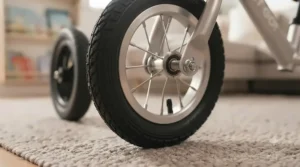
Fifth, don’t skip the tyre check. Air-filled tyres need occasional pressure checks. If that sounds like a chore, foam or airless tyres may suit your household better.
Finally, don’t forget head protection. Helmets aren’t a legal requirement for cycling in the UK, but starting the habit early makes the routine stick.
Long-Term Cost and Maintenance
Price per ride is a better yardstick than sticker price. An illustrative example: a bike in the £100 range that serves a child from around 20 months to four and a half years (about 34 months) works out at roughly £3 a month, before any hand-me-down value.
| Product | Price bracket | What the money buys | Best For |
|---|---|---|---|
| Strider 12 Sport | £100–£125 | Widest tool-free adjustability | Longevity from 18 months |
| Hornit AIRO | £130–£150 | Lowest weight plus air tyres | Weight-sensitive riders |
| Puky LR M | £90–£100 | Footboard and low start | Tiny or hesitant toddlers |
| Banana GT | £55–£80 | Air tyres and aluminium | Tight budgets |
| Chillafish BMXie | Under £100 | Tool-free seat, BMX looks | Style-conscious two-to-four-year-olds |
| Liferyder Vogue | £80–£100 | 32–45cm range plus air tyres | Long-term use |
| woom GO 1 | £230–£250 | Brake, limiter, smallest fit | Small toddlers, hand-me-downs |
The Banana GT delivers the lowest cost per month, while the Strider 12 Sport and Liferyder Vogue offer the best mix of longevity and price. The woom GO 1 makes sense only if your child is small enough to use its low end and you plan to hand it down.
Maintenance is minimal. Air tyres need occasional pressure checks, and the woom GO 1 and Liferyder Vogue use car-type Schrader valves, so a standard pump works. Foam and airless tyres need nothing. On any bike, check seat and handlebar bolts monthly and wipe it clean.
Safety, Helmets and UK Regulations
A helmet isn’t a legal requirement for cycling in the UK, but Cycling UK’s guidance is that if you choose one for your child, it should fit properly. It should cover the forehead, with tight straps. Introduce it alongside the bike so the two become inseparable.
On the regulatory side, most toddler balance bikes are sold as toys. That means the Toys (Safety) Regulations 2011 apply, so look for the labelling requirements for toys on the product or packaging. These include the manufacturer’s name and address, a type, batch or model number, a CE or UKCA mark, and the required warnings and instructions. Strider states that its bikes are tested to the standard for children from 18 months rather than 36 months. That’s a manufacturer claim rather than something verified here, but it’s a useful question to ask any brand.
For second-hand bikes, the general product safety rules apply and the instructions and warnings should still be present. Check for cracks, tyre condition and a firm seatpost clamp. Supervise near roads and slopes, and keep early rides to flat, traffic-free spaces.
Frequently Asked Questions
❓ Can an 18-month-old ride a first balance bike for toddlers?
❓ Is a second-hand first balance bike for toddlers a good idea?
❓ Should I choose 10-inch or 12-inch wheels for a first balance bike for toddlers?
❓ Where can I buy a first balance bike for toddlers in the UK?
❓ What's the cheapest first balance bike for toddlers that's still worth buying?
Conclusion
The best first balance bike for toddlers is the one that fits your child’s inside leg on day one and keeps fitting for as long as possible. Seat height adjustability and a few well-chosen confidence-building features matter far more than fancy graphics.
If your child is small, the Strider 12 Sport offers the lowest start and tool-free adjustment, while the woom GO 1 adds a rear brake and steering limiter at a premium. If you want the lightest bike with air tyres, the Hornit AIRO is the standout. Budget-conscious families should look at the Banana GT, and those wanting long-term range and style should consider the Liferyder Vogue. The Puky LR M suits hesitant two-year-olds, and the Chillafish BMXie suits average-to-tall toddlers who love a real-bike look.
Whatever you choose, measure first, buy on fit, and let your toddler set the pace.
Recommended for You
- First Balance Bike: 7 Top UK Picks For New Riders (2026)
- Strider Balance Bike Vs Standard Balance Bike: 7 Best Picks; Verdict (2026)
- Strider Balance Bike For Toddlers: 7 Best Picks Tested (2026)
Disclaimer: This article contains affiliate links. As an Amazon Associate, I earn from qualifying purchases. If you purchase products through these links, we may earn a small commission at no additional cost to you.
✨ Found this helpful? Share it with your friends! 💬🤗
