In This Article
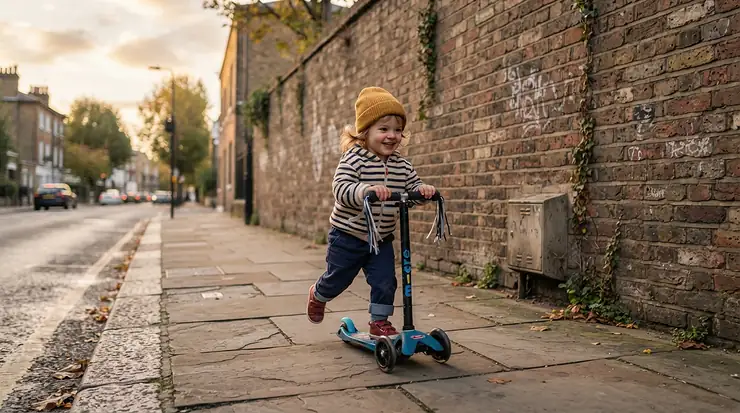
A micro scooter for 3 year old riders is a lightweight, low-slung, three-wheeled kick scooter that steers by leaning rather than by turning the handlebars. Built for roughly ages two to five, it pairs a wide non-slip deck with a rear foot brake, so preschoolers can learn balance, pushing off and stopping without a fall every ten metres.

Three is a funny age. Legs are suddenly long enough to push, opinions are suddenly loud enough to fill a car park, and the buggy has become, in your child’s eyes, deeply uncool.
The appeal goes beyond convenience. The NHS says pre-schoolers should get at least 180 minutes of physical activity a day, including active outdoor play. A scooter turns a grumbled ten-minute trudge into exercise your child actively wants to do.
The market is crowded, though. “Toddler scooter” covers everything from £25 budget buys to convertibles costing four times that. So I’ve narrowed the field to seven options using spec sheets, published UK parent-testing and aggregated review themes. Each is judged on what matters to a three-year-old: weight, brake design, the lean-to-steer mechanism and how long it will last.
Along the way you’ll find a plain-English micro scooter review of what parents consistently report. You’ll also see what Swiss-engineered design actually buys you, and how three-wheel stability works. One honest note: this is analysis, not hands-on testing. I haven’t ridden these scooters, and I’ll flag it wherever the evidence is thin.
Quick Comparison: 7 Best Micro Scooter for 3 Year Old Options at a Glance
| Product | Age range | Scooter weight | Price range | Best For |
|---|---|---|---|---|
| Mini Micro Deluxe | 2–5 years | ~2kg | £75–£90 | All-round first scooter |
| Mini Micro Deluxe LED | 2–5 years | ~2kg | £70–£95 | Dusk and winter school runs |
| Micro Mini2go Deluxe Plus | 18 months–5 years | 1.9kg (3.6kg with seat) | £130–£170 | One purchase from toddler to preschool |
| Globber Primo | 3+ years | ~3kg | £60–£75 | Nervous beginners |
| Globber Go Up Active Lights | 15 months+ | ~3.8kg | £80–£100 | Ride-on to scooter progression |
| EVO Mini Cruiser | 2+ years | ~2kg | £20–£30 | Tight budgets |
| Banwood Eco Scooter | 3+ years | ~2.5kg | £80–£90 | Eco-minded families |
Price ranges reflect UK listings at the time of research. Prices may vary, so check current price before buying.
Looking at the comparison above, the Mini Micro Deluxe hits the sweet spot of low weight and proven design. If your child is still a wobbler, though, the Globber Primo‘s steering lock justifies the extra kilo. Budget buyers should note that the EVO Mini Cruiser trades polish and long-term support for its tiny price. The Micro Mini2go Deluxe Plus only makes sense if you’ll genuinely use the seat stage.
💬 Just one click — help others make better buying decisions too!😊
Top 7 Micro Scooter for 3 Year Old Picks: Expert Analysis
1. Mini Micro Deluxe — the lightweight benchmark everything else is judged against
The Mini Micro Deluxe is the scooter other scooters get compared to. It has been a fixture on UK school runs for over 20 years, and the Deluxe version refines the original formula.
On paper it’s a 2–5 year scooter weighing around 2kg, with a 35kg rider limit and a handlebar that adjusts from roughly 49cm to 68cm. In practice, that 2kg figure is the headline. A three-year-old can lift it over a kerb, drag it upright after a spill and carry it indoors without recruiting you. The anodised stem resists corrosion, and the raised silicone grip suits small hands.
Based on the spec comparison, it suits almost any preschooler, particularly one who’ll be doing regular pavement miles. Mumsnet’s parent testers describe a joy to use day to day, with a smooth, well-engineered lean-to-steer mechanism. Separate forum parents report scooters ridden “into the ground” across several children. The recurring grumbles are price and the fact it doesn’t fold.
Pros:
- ✅ Light enough for toddlers to lift themselves
- ✅ Smooth, intuitive lean-to-steer mechanism
- ✅ Replaceable parts extend its working life
Cons:
- ❌ Doesn’t fold for travel or storage
- ❌ Pricey for a two-to-three-year window
Expect roughly £75–£90. Verdict: the best-value long-term pick if you’ll pass it to a younger sibling.
2. Mini Micro Deluxe LED — motion-powered wheels that make dusk rides sparkle
The Mini Micro Deluxe LED is the same chassis wearing a party frock. Its front wheels light up as they spin, with no batteries to buy, charge or lose behind the sofa.
Specs mirror the standard Deluxe: ages 2–5, a 35kg limit and around 2kg of scooter. The practical meaning is simple. Because the lights are motion-powered, there’s nothing to fail mid-ride. Wheel glow also makes a small rider easier to spot on gloomy winter afternoons.
Be realistic, though. RoSPA advises avoiding scooter use in the dark, since scooters lack proper lights and reflectors. Glowing wheels add visibility but aren’t a lamp, so treat them as a bonus.
Independent testing tends to cover the Deluxe family as a whole, so LED-specific feedback is thinner. One UK reviewer’s summary says the lights are a fun add-on that makes it a nighttime favourite. Mumsnet’s verdict likewise credits the bright wheels with brightening dull mornings.
Pros:
- ✅ Battery-free light-up wheels
- ✅ Same proven build as the standard Deluxe
- ✅ Extra visibility on gloomy school runs
Cons:
- ❌ Wheel glow isn’t a substitute for proper lights
- ❌ Still doesn’t fold
Expect around £70–£95 depending on colour and retailer. Verdict: worth it if your routes include dim mornings, otherwise the standard model is plenty.
3. Micro Mini2go Deluxe Plus — sit, ride, then scoot, all in one purchase
The Micro Mini2go Deluxe Plus is the “buy once” option within the Micro range. It starts as a parent-pushed ride-on with a retractable handle and drawer. Remove the seat and it becomes a stand-on scooter.
Listings put it at around 1.9kg as a scooter, and 3.6kg with the seat fitted. Handlebar height runs from roughly 49cm to 67cm, and the 120/80mm PU wheels roll smoothly over pavement. Weight limits vary between retailers (some say 35kg in scooter mode, others 50kg), so check the manufacturer’s figure before buying.
Here’s the honest analysis. If your child is already a confident three-year-old, you’re paying for a stage you’ve skipped. This model shines where there’s an 18-month-old sibling, or a three-year-old who still wants a seat for tired legs. Independent UK review data is thinner for this model than for the plain Deluxe, so treat this as spec-led analysis rather than crowd verdict.
Pros:
- ✅ Converts from ride-on to stand-on scooter
- ✅ Retractable parent handle for tired legs
- ✅ Under-seat drawer for snacks and treasures
Cons:
- ❌ Premium price if the seat goes unused
- ❌ Seat and drawer add bulk to carry
Expect roughly £130–£170 (check current price). Verdict: strong value across two children, hard to justify for one preschooler.
4. Globber Primo — steering lock and folding frame for nervous starters
The Globber Primo targets the child who’s keen but twitchy. A steering lock lets beginners practise pushing and braking in a straight line before tackling the lean-to-steer mechanism.
It’s listed for ages 3+ with a 50kg limit and weighs around 3kg. The handlebar has three height settings, rising to about 77.5cm. That means the same scooter keeps working long after a Mini-type model is outgrown. The extra-long rear brake is easier for small feet to find. The frame folds, which Micro’s Deluxe models don’t.
The price of all this is weight. At roughly a kilo heavier than the Mini Micro Deluxe, it’s more of a lift for tiny arms. Mumsnet’s tester found it quick to assemble and easy to raise as the child grows, and crowned it best budget pick. Reviewers also note it’s heavier than some rivals and more child-like in styling.
Pros:
- ✅ Steering lock helps cautious beginners
- ✅ Folds for boot and buggy storage
- ✅ Taller handlebar extends useful life
Cons:
- ❌ Around a kilo heavier than lightest rivals
- ❌ Chunkier to carry for small arms
Expect roughly £60–£75. Verdict: excellent value for hesitant riders and for families who fold scooters into the boot.
5. Globber Go Up Active Lights — three modes, no tools required
The Globber Go Up Active Lights changes shape as your child does. It moves from parent-pushed ride-on to child-powered ride-on, and finally to a scooter, with no tools or screws.
Listed from around 15 months, it carries up to 20kg in ride-on modes and 50kg as a scooter. It weighs about 3.8kg, nearly double the lightest options, with battery-free LED wheels, an extra-long rear brake and adjustable handlebars. That weight means a three-year-old may need help lifting it, though stability benefits from the heft.
This suits the child who’s wobbly at three and may only reach full scooter mode around four. Mumsnet’s tester praised the easy mode changes and durability over time, and called it pricey. Their verdict matches my read of the spec sheet: it earns its keep over years, not months.
Pros:
- ✅ Tool-free conversions between all three modes
- ✅ Works from toddlerhood into primary school
- ✅ Battery-free light-up wheels
Cons:
- ❌ Heavy for a three-year-old to lift
- ❌ Pricey compared with single-mode scooters
Expect roughly £80–£100. Verdict: fair value if you’ll use every stage, poor value if you’ll skip straight to scooting.
6. EVO Mini Cruiser — the pocket-friendly scooter with a basket
The EVO Mini Cruiser proves a first scooter doesn’t need to cost a weekend away. It’s a stable three-wheeler for ages 2+ with a 35kg limit, adjustable handlebars and an anti-slip deck.
At around 2kg it matches the Micro Deluxe on weight. The rear foot brake and lean-to-steer design mirror the pricier models. The wooden-look front basket is pure toddler catnip, and for transporting snacks and “treasure”, it adds real value. Handlebars also detach for easier storage in a crowded hallway.
The trade-offs are predictable. It doesn’t fold fully, and it isn’t built for older children. I also couldn’t find evidence of a spare-parts range comparable to Micro’s, so a damaged part may mean replacing the scooter. Mumsnet’s verdict is warm, and one forum parent reports using it from around 18 months, with the eldest now four. Independent long-term data remains limited.
Pros:
- ✅ Remarkably low price for a three-wheeler
- ✅ Front basket delights small passengers
- ✅ Removable handlebars simplify storage
Cons:
- ❌ Outgrown sooner than adjustable alternatives
- ❌ Doesn’t fold fully for travel
Expect roughly £20–£30. Verdict: a smart trial scooter before committing to something premium.
7. Banwood Eco Scooter — recycled materials without the flimsy feel
The Banwood Eco Scooter suits parents who read labels. It’s made from recycled materials including fishing nets and plastic bottles, yet it feels sturdy rather than disposable.
It’s listed for ages 3+ with a 50kg limit, weighing around 2.54kg. Three handlebar heights stretch its lifespan, and the stable three-wheel layout suits beginners. At roughly half a kilo above the lightest options, it remains manageable for most three-year-olds.
Mumsnet’s tester used it for over a year with two boys aged four and five, reporting impressive durability and very little wear. Cons are familiar: the price, the basket sold separately, no full fold, and weaker performance on gravel and rough terrain. Analytically, it’s an urban-pavement scooter that rewards families who stay on smooth routes.
Pros:
- ✅ Made from recycled fishing nets and bottles
- ✅ Durable after a year of sibling use
- ✅ Three handlebar heights grow with your child
Cons:
- ❌ Struggles on gravel and rough ground
- ❌ Basket costs extra
Expect roughly £80–£90. Verdict: good value for the eco-conscious, mid-pack for everyone else.
Your First 30 Days: A Practical Setup and Maintenance Guide
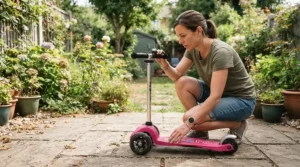
Most scooter frustration happens in the first fortnight, so a little structure pays off.
Set the height first. Handlebars should sit around chest height, so your child stands upright with slightly bent elbows. Resist buying a size-up for them to “grow into”. RoSPA’s toy safety guidance stresses trying scooters for fit and robustness, and an oversized model is harder to control.
Week one: glide, don’t push. Let your child scoot in short pushes on flat, smooth ground, then step onto the deck and coast. Practise stopping with the rear foot brake before anything else.
Week two: add gentle turns. Encourage leaning towards where they want to go. On a Globber Primo, keep the steering lock on until straight-line pushing feels automatic.
Weeks three and four: build routes. Short pavement trips beat long outings that end in carrying a scooter and a cross toddler.
Maintenance schedule:
- Wipe the deck and wheels weekly, especially after puddles.
- Check bolts and the T-bar clamp monthly.
- Keep the scooter dry and indoors where possible.
Common first-month mistakes: riding near roads, skipping the helmet, and attempting hills too early. A scooter picks up speed quickly on slopes, so start flat.
Real-World Scenarios: Matching a Scooter to Your Family
Specs only matter when they meet real life. Here are three typical profiles and the logic behind each match.
The nursery-run family. You walk half a mile to nursery, weather permitting, four days a week. Your three-year-old needs a light scooter to lift over kerbs and carry at the door. The Mini Micro Deluxe wins on weight and durability, and over a typical two-to-three-year window the daily use dilutes its cost.
The two-child household. An 18-month-old is tagging along behind a confident three-year-old. The Micro Mini2go Deluxe Plus or Globber Go Up Active Lights earns its price here, because the younger child uses the seat stage while the elder races ahead.
The budget-conscious grandparent. Birthday money is limited and you’re unsure the child will take to scooting. The EVO Mini Cruiser keeps the downside tiny. If scooting sticks, upgrade later, and the cheaper scooter still makes a fine garden toy.
Consider budget, environment and frequency together. A flat, smooth route favours light scooters. A rough or gravelly one favours extra-large wheels, which none of these three-wheelers are designed for. I’d argue that frequency matters most: daily use justifies premium spending, while twice-a-month use doesn’t.
Problem → Solution Guide: Common Toddler Scooter Struggles
Problem: the scooter veers and wobbles. Beginners often steer by twisting the handlebars instead of leaning. Choose a model with a steering lock, such as the Globber Primo, or practise leaning drills on a flat lawn.
Problem: scuffed toes and dragging feet. The scooter is likely too big, or the child is pushing with the wrong foot. Lower the handlebar, and choose a lighter model like the Mini Micro Deluxe.
Problem: they can’t find the brake. Rear foot brakes require a deliberate stamp. Practise “stamp to stop” in the garden as a game, and favour models with an extra-long brake like the Globber Go Up Active Lights.
Problem: your child is scared of speed. Start on grass, then the driveway, then a quiet pavement. Confidence is built in small wins, so let them set the pace.
Problem: you’re carrying the scooter half the time. A heavy scooter becomes the parent’s burden. The lightest options, around 2kg, mean the child can carry it, and a folding frame helps when they can’t.
How to Choose a Micro Scooter for 3 Year Old Riders
Follow these six steps in order, and the shortlist builds itself.
- Check the age range. Aim for 2–5 years. Most three-year-olds have the balance for a three-wheeler, while larger models like the Maxi Micro Deluxe are aimed at ages five and up and are heavier for small riders.
- Weigh the scooter. Under 2.5kg is easiest for a toddler to lift. Heavier models add stability but make you the porter.
- Confirm the lean-to-steer mechanism. It’s more intuitive for preschoolers than handlebar turning.
- Test the brake. A rear foot brake needs a firm stamp, so check your child can reach and press it.
- Look at adjustability. A handlebar range that grows with your child extends the useful window.
- Consider portability. If you travel or store in a small hall, a folding frame is worth paying for.
Micro Scooter Review: What Parents Consistently Report
This micro scooter review draws on published parent testing, not my own riding. The aggregate picture is consistent.
What gets praised. Reviewers repeatedly highlight lightweight frames, intuitive steering and durability. Mumsnet’s in-depth Mini Micro Deluxe review calls it well balanced and hard to tip, and notes the replaceable parts. Another UK reviewer highlights how easily a child learns to scoot and stop.
What gets criticised. The price, mainly. Reviewers also mention the lack of a folding mechanism on the Mini line, and some find heavier convertibles awkward for small children to manoeuvre. Mumsnet’s three-year-old tester found a heavier convertible trickier to handle than her regular lightweight scooter.
What reviews don’t tell you. Most consumer feedback comes from enthusiastic early adopters, so long-term wear data on budget models is sparse. If a product’s review pool is thin, as with the Micro Mini2go Deluxe Plus in the UK, I’ve said so rather than guess.
How the Lean-to-Steer Mechanism Works (and Why It Suits Preschoolers)
The lean-to-steer mechanism is the reason a micro scooter for 3 year old riders feels so intuitive. Instead of twisting handlebars, the child tilts their body and the deck pivots, steering the scooter in that direction.
Why does this suit preschoolers? Turning handlebars demands coordination that many three-year-olds haven’t developed. Leaning is instinctive, the same movement they use on a swing or when running around a corner. Mumsnet’s scooter guide notes that most three-wheelers use this approach, whereas two-wheelers tend to use turn-to-steer handling, better suited to confident riders.
There’s a catch. Leaning too hard on a tight turn can tip a scooter, and Mumsnet warns that front wheels catching on obstacles can pitch a scooter forward suddenly. That’s why beginner-friendly models add steering locks or wide, low decks.
The practical takeaway: pick a lean-to-steer mechanism with smooth, gentle tilt. The Mini Micro Deluxe‘s version is the benchmark parents cite, while the EVO Mini Cruiser offers a budget take on the same idea.

Swiss-Engineered Design: What You Actually Pay For
Micro Scooters markets its range as Swiss designed, and retailers like John Lewis repeat the description. But what does Swiss-engineered design mean for your wallet?
In practice, it covers three things. First is the low, light, tilting layout that defined the category. Second is build quality, with an anodised stem and strong polyurethane wheels. Third is the spare-parts ecosystem: Mumsnet notes that parts, maintenance guides and on-call engineers back the Mini Micro Deluxe, which supports a longer life.
A caution is worth adding. “Swiss design” describes where the scooter was engineered, not necessarily where it’s made. Check packaging if manufacturing origin matters to you.
So is it worth the premium? If you’ll ride regularly and might pass the scooter on, probably yes. If your child may lose interest in a month, a cheaper scooter makes a gentler experiment.
Three-Wheel Stability vs Alternatives
Three-wheel stability is the simple geometry behind a preschooler’s confidence. Two front wheels and one rear wheel create a wide base, so the scooter stays upright when your child steps on, steps off or simply pauses.
Mumsnet’s testing of the Mini Micro Deluxe found it well balanced when weight was placed on the deck, and hard to tip in any direction. That’s reassuring for a first-timer, but stability isn’t unlimited, so surface and speed still matter.
| Feature | Three-wheel lean-to-steer | Two-wheel turn-to-steer | Balance bike |
|---|---|---|---|
| Stability | High | Low | Medium |
| Learning curve | Gentle | Steep | Moderate |
| Typical age | 2–5 years | 7+ years | 2–5 years |
| Example | Mini Micro Deluxe | Typical older-child scooters | Pedal-free bikes |
| Best For | Preschoolers learning balance | Confident older riders | Children heading towards pedal bikes |
The comparison above shows why three-wheelers dominate this age group. Two-wheel scooters demand far more balance, and Mumsnet suggests they’re usually best from seven or eight, or for children who’ve mastered three-wheelers. A balance bike builds different skills, such as steering and gliding, so some families buy both. For a child who loves scooting, a three-wheeler like the Banwood Eco Scooter is the more stable first step.
Long-Term Cost and Value: Is Premium Worth It?
Price tags mislead when you ignore time. A scooter that lasts several years and passes to a sibling costs far less per ride than a cheap one that fails.
A hypothetical illustration: use a £75–£90 scooter four times a week for three years and that’s roughly 600 outings. That works out at somewhere around 12–15p per ride. A £25 scooter that lasts one season may cost similar or more per use.
| Product | Price range | Stated age window | Value verdict | Best For |
|---|---|---|---|---|
| Mini Micro Deluxe | £75–£90 | 2–5 years | Strong if passed on | Regular daily use |
| Micro Mini2go Deluxe Plus | £130–£170 | 18 months–5 years | Good across two children | Siblings or younger starters |
| Globber Go Up Active Lights | £80–£100 | 15 months+ | Good if all modes used | Gradual progression |
| EVO Mini Cruiser | £20–£30 | 2+ years | Great for testing interest | Budget buyers |
| Banwood Eco Scooter | £80–£90 | 3+ years | Fair, with eco bonus | Environmentally minded families |
Looking at the table above, the Mini Micro Deluxe offers the best balance of price and longevity, and its replaceable parts reduce lifetime cost. The Micro Mini2go Deluxe Plus only repays its premium if you use the seat stage. Remember that resale value on well-known brands can offset some upfront cost, and maintenance costs are minimal. Wipe-downs and the occasional bolt check are essentially free.
Safety, Regulations and Protective Gear
Safety deserves attention. Toys sold in Great Britain must comply with the Toys (Safety) Regulations 2011, and either a UKCA or CE mark is accepted. Mumsnet notes that EN 71 is the relevant standard for younger-age scooters, listed on packaging or the manufacturer’s website.
Ride safely:
- Wear a helmet. RoSPA recommends a cycle helmet, plus knee and elbow pads for beginners.
- Avoid roads. The Mini Micro Deluxe retailer listing states it’s not for use in traffic.
- Avoid the dark. Scooters lack proper lights, so keep rides to daylight.
- Go gently on hills. Speed builds quickly on slopes.
- Supervise. Adult supervision is a stated requirement on major listings.
A final tip: if you’re comparing budget scooters, check the standard listed on the packaging. A missing mark is a reason to walk away.

FAQ
❓ Is a micro scooter for 3 year old riders worth the money?
❓ Should I buy a Maxi Micro for my three-year-old?
❓ Does my 3 year old need a helmet for a scooter?
❓ Can a toddler scooter handle grass or gravel?
❓ Is a three-wheel scooter safer than a two-wheel one for a toddler?
Conclusion
Choosing a micro scooter for 3 year old riders comes down to a handful of decisions. How light does it need to be? Does your child need a steering lock? Will you use a seat stage? And how long should it last?
For most families, the Mini Micro Deluxe is the safest all-round pick: light, stable, parent-approved and backed by replaceable parts. Add the Mini Micro Deluxe LED if your routes include gloomy mornings. Choose the Globber Primo for nervous beginners, the Micro Mini2go Deluxe Plus or Globber Go Up Active Lights for younger siblings and transitional stages, the EVO Mini Cruiser for tight budgets and the Banwood Eco Scooter for eco-minded households.
Whichever you choose, pair it with a helmet, flat routes and short, happy outings. Three-year-olds don’t need speed. They need success, and that’s what the lean-to-steer mechanism, three-wheel stability and a good brake deliver.
✨ Ready to get rolling?
🛴 Click any highlighted product name above to check current pricing and availability, then pick the scooter that fits your child’s confidence, your routes and your budget. Happy scooting!
Recommended for You
- First Balance Bike With Adjustable Handlebars: 7 Best Picks (2026)
- Balance Bikes For 1 Year Olds: 7 Safe Picks For UK (2026)
- First Balance Bike For Toddlers: 7 Best Picks
Disclaimer: This article contains affiliate links. As an Amazon Associate, I earn from qualifying purchases. If you purchase products through these links, we may earn a small commission at no additional cost to you.
✨ Found this helpful? Share it with your friends! 💬🤗
